

Master Korean CRM: Turn One-Time Buyers into ‘Dan-gol’
Phase 1: Empathy & Hook
Hello, global marketers and advanced Korean learners! This is the Lead Editor of Daily Hangul.
Picture this: Your phone buzzes. It’s a KakaoTalk message from your favorite K-Beauty brand. The message reads, “VIP 회원님, 몰래 드리는 시크릿 쿠폰입니다” (To our VIP member, here is a secret coupon just for you). It feels personal, almost like they know you, right?
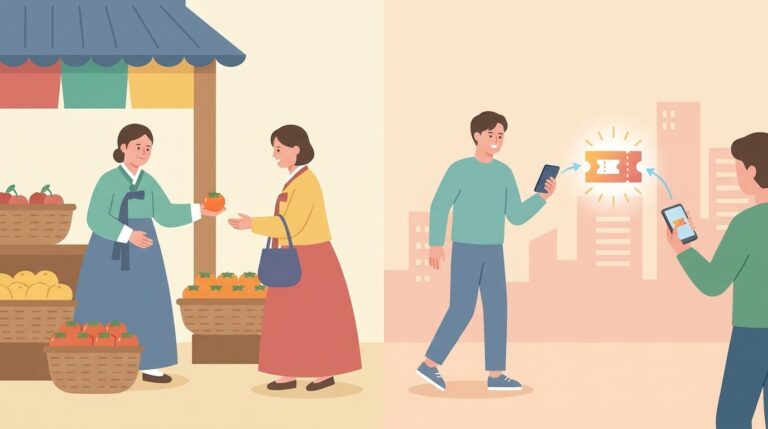
If you want to understand marketing in Korea—or do business in Seoul—you need to understand this exact feeling. In Western marketing, we talk about “Customer Retention” and “CRM (Customer Relationship Management).” But in Korea, this goes much deeper. It taps into the ancient cultural concept of making someone a 단골 (Dan-gol)—a loyal regular. Knowing the textbook translation for “repurchase” won’t impress a Korean marketing team. But knowing how to pitch a “Lock-in strategy to build Dan-gol loyalty”? That will get you a seat at the executive table.
This guide is curated for C2-level learners who need to navigate high-stakes business meetings, understand digital CRM campaigns, and grasp the cultural psychology behind Korean customer loyalty.
Phase 2: Core Expressions Deep Dive
1. 이탈을 방어하고 재구매를 유도하다
- Pronunciation: itareul bangeohago jaegumaereul yudohada
- Meaning: Literal: “To defend against defection and induce repurchase” / Real nuance: “To prevent customer churn and drive repeat purchases.”
- K-Culture Moment: You are in a strategy meeting at a K-Fashion startup. The Q3 data looks grim. A senior marketer points at the presentation and says, “We need to stop the bleeding. 이탈을 방어하고 재구매를 유도할 (to prevent churn and drive repeat purchases) aggressive CRM campaigns are required immediately.”
- Editor’s Insight: The word ‘이탈’ (ital – breakaway/desertion) is highly militaristic, reflecting the aggressive nature of the Korean e-commerce war. You aren’t just ‘retaining’ users; you are ‘defending’ (방어하다) against them leaving for a competitor like Coupang or Naver Shopping.
- Situation Spectrum:
- Casual with friends: 🚫 (Too formal/business-like)
- Professional peer-to-peer: ✅
- Formal presentation to executives: ✅
- 🤔 Think About It: Why does Korean business jargon often use defense/military terminology (e.g., 방어하다 – to defend, 타격 – hit/impact) when discussing customer behavior?
2. 락인(Lock-in) 효과를 극대화하다
- Pronunciation: rakin hyogwareul geukdaehwahada
- Meaning: Literal: “To maximize the lock-in effect” / Real nuance: “To trap customers in our ecosystem so they can’t leave.”
- K-Culture Moment: Think of Coupang’s ‘Rocket WOW’ membership or the Kakao ecosystem. Once you are in, it’s virtually impossible to leave. In a tech meeting, suggesting ways to 락인 효과를 극대화하다 is the holy grail of modern Korean CRM.
- Editor’s Insight: Notice the Konglish “락인” (Lock-in). In C2 business Korean, using precise Konglish terms often sounds more professional and native than trying to translate it into pure Korean (like 고객 고착화).
- Situation Spectrum:
- Casual with friends: 🚫
- Professional peer-to-peer: ✅
- Formal presentation to executives: ✅
- 🤔 Think About It: Does your native language rely heavily on English loanwords for digital marketing concepts, or do you invent native equivalents?
3. 단골 고객으로 전환시키다
- Pronunciation: dangol gogegeuro jeonhwansikida
- Meaning: Literal: “To convert into a regular customer” / Real nuance: “To turn a one-time buyer into a loyal, lifelong fan.”
- K-Culture Moment: From a grandmother running a Tteokbokki stand to the CEO of a multi-million dollar cosmetics brand, the goal is the same: making Dan-gols. It’s a blend of B2B CRM metrics and traditional Korean hospitality.
- Editor’s Insight: ‘전환시키다’ (to convert) adds a modern data-driven edge to the traditional, emotional word ‘단골’. It’s the perfect marriage of heart and metrics.
- Situation Spectrum:
- Casual with friends: ⚠️ (A bit stiff, friends would just say “단골 만들다”)
- Professional peer-to-peer: ✅
- Formal presentation to executives: ✅
Phase 3: Textbook vs. Real Korean
[Discussing Customer Retention Strategies]
* 📖 Textbook Korean: 고객들이 우리 제품을 다시 사게 만들어야 합니다. (We need to make customers buy our products again.)
* 🗣️ Real Korean: 기존 고객 이탈을 방어하고, 재구매 사이클을 단축시켜야 합니다. (We must defend against existing customer churn and shorten the repurchase cycle.)
* 💡 Why the difference?: C2 business Korean heavily utilizes Sino-Korean words (한자어) like 이탈 (churn), 방어 (defense), and 단축 (shorten) to sound objective, analytical, and authoritative.
[Proposing a VIP Benefit]
* 📖 Textbook Korean: VIP 회원들에게 선물을 줍시다. (Let’s give gifts to VIP members.)
* 🗣️ Real Korean: VIP 등급 혜택을 강화해서 충성도를 제고하죠. (Let’s enhance the VIP tier benefits to boost loyalty.)
* 💡 Why the difference?: In marketing, a ‘gift’ is an emotional concept. ‘혜택’ (perk/benefit) and ‘제고하다’ (to uplift/boost) turn an emotional action into a measurable corporate strategy.
Phase 4: Cultural Context — K-Culture Deep Dive
4-1. Non-verbal Communication in Korean CRM
When presenting CRM strategies in Korea, numbers matter, but 눈치 (Nunchi) matters more. If you propose cutting a popular customer benefit to save money, you must read the room. Koreans deeply value the “Service” (freebies) culture. Removing a perk can cause public backlash (known as 역풍을 맞다). Present changes with a slightly apologetic yet firm, data-backed posture.
4-2. The Evolution of “Service” (서비스) to CRM Algorithms
Walk into any old-school Korean BBQ restaurant as a regular, and the owner will yell, “이모, 여기 계란찜 서비스!” (Auntie, a free steamed egg over here!). This analog concept of giving extra to regulars is called “덤” (Deom) or “서비스” (Service).
Modern K-Beauty and K-Commerce giants have essentially digitized this BBQ restaurant experience. When you get a push notification saying “Only for you, a 10% discount on your cart items,” it’s the algorithmic version of the free steamed egg. True Korean CRM isn’t just about points; it’s about making the customer feel that special Jeong (정 – warm connection), even through an app.
Phase 5: Practical Roleplay Scenario
Scenario A: The Strategy Meeting
Setting: Tuesday, 10:00 AM. A sleek glass meeting room in a Gangnam e-commerce startup. You and your team are looking at a dashboard showing a drop in Q2 repeat purchases.
Characters:
– YOU: The newly hired Global Marketing Director.
– Team Leader Kim (38, M): Data-driven, slightly stressed, respects strong arguments.
Dialogue:
Kim: 이번 분기 신규 가입자는 늘었는데, 리텐션이 엉망입니다. 📉
(ibeon bungi singyu gaipjaneun neureonneunde, ritensyeoni eongmangimnida.)
[New sign-ups increased this quarter, but retention is a mess.]
(🎭 Stage Direction: Kim taps his pen aggressively against the table.)
YOU: 특히 첫 구매 이후 2차 구매로 이어지는 비율이 많이 떨어졌네요.
(teuki cheot gumae ihu icha gumaero ieojineun biyuri mani tteoreojyeonneyo.)
[Specifically, the conversion rate from the first purchase to the second purchase has dropped significantly.]
Kim: 맞습니다. 이대로 가면 마케팅 비용만 날리는 꼴이에요. 대책이 필요합니다.
(matseumnida. idaero gamyeon maketing biyongman nallineun kkorieyo. daechaegi piryohamnida.)
[Exactly. At this rate, we’re just blowing our marketing budget. We need a countermeasure.]
🔀 Your Turn! How do you propose a solution?
– A) “고객들한테 이메일로 쿠폰을 보내는 건 어떨까요?” (Shall we send coupons to customers via email?)
– B) “첫 구매 고객 전용 알림톡 캠페인을 기획해서, 재구매를 유도하는 것이 좋겠습니다.”
– C) “저희 제품이 별로라서 그런 거 아닐까요?”✅ Best Choice: B — “I suggest we plan a KakaoTalk notification (알림톡) campaign exclusively for first-time buyers to induce repurchases.” It uses specific platforms (알림톡 instead of email, which Koreans rarely open for marketing) and professional C2 vocabulary.
⚠️ Choice A Analysis: Way too basic for a director. Also, Koreans rely on KakaoTalk (알림톡) over email for B2C CRM.
⚠️ Choice C Analysis: A career-ending move. Never blame the product without hard data in a Korean meeting.
Kim: (Nods approvingly) 알림톡 좋네요. 오픈율도 높으니까요. 바로 기획안 잡아주시죠.
(allimtok jonneyo. opeunyuldo nopeunilkkayo. baro gihoegan jabajusijo.)
[KakaoTalk notifications sound good. The open rate is high. Please draft a proposal right away.]
Scenario B: The Offline “Dan-gol” Experience
Setting: Your favorite local cafe. You go there every morning.
Barista: 어서 오세요! 늘 드시던 아이스 아메리카노 맞으시죠?
(eoseo oseyo! neul deusideon aiseu amerikano majeutsijo?)
[Welcome! The usual iced Americano, right?]
YOU: 네, 맞아요. 오늘은 포인트로 결제할 수 있을까요?
(ne, majayo. oneureun pointeuro gyeoljehal su isseulkkayo?)
[Yes, that’s right. Can I pay with my points today?]
Barista: 그럼요! 단골이신데, 오늘은 제가 샷 추가 서비스로 해드릴게요!
(geureomyo! dangorisinde, oneureun jega syat chuga seobiseuro haedeurilgeyo!)
[Of course! Since you’re a regular, I’ll add an extra shot on the house today!]
Phase 6: 10-Second Shadowing Drill
Practice this sentence to sound like a seasoned Korean marketing executive:
😤 신규 고객 / 유치도 / 중요하지만, / 핵심은 / 기존 고객의 이탈을 방어하고 / 재구매를 / 유도하는 겁니다.
(singyu gogek / yuchido / jungyohajiman, / haeksimeun / gijon gogege itareul bangeohago / jaegumaereul / yudohaneun geomnida.)
[Attracting new customers is important, but the core is defending against the churn of existing customers and inducing repurchases.]
Phase 7: K-Culture Mini Dictionary
1. 단골 (dangol)
* English: Regular customer / Loyal patron
* Context: Originally stemming from traditional shamanistic rituals where families had a ‘regular’ shaman. Today, it represents a deep, loyalty-based relationship between a business and a customer.
2. 알림톡 (allimtok)
* English: KakaoTalk informational messages
* Context: The backbone of Korean CRM. Instead of emails, brands send beautifully formatted push messages directly to your KakaoTalk. It boasts an insanely high open rate.
3. 혜택 (hyetaek)
* English: Perks / Benefits
* Context: Used everywhere from credit cards to membership tiers. Koreans are incredibly savvy about maximizing their ‘혜택’.
4. 객단가 (gaekdanga)
* English: Average Transaction Value (ATV) / Average Ticket Size
* Context: A crucial C2 business term. CRM strategies in Korea are often split into two: increasing the repurchase rate (재구매율) or increasing the ‘객단가’ per visit.
Phase 8: Traveler Survival Kit
Even as a traveler, you will be sucked into Korean CRM marketing. From Olive Young to local cafes, loyalty programs are everywhere.
🆘 Survival Expressions for Travelers
– 🇰🇷 “포인트 적립하시겠어요?” (pointeu jeongnipasigesseoyo?)
– 🗣️ Meaning: “Would you like to accumulate points?”
– 📍 Where: Every convenience store, cafe, and cosmetics shop.
– 💡 Pro Tip: If you are just traveling and don’t have a Korean phone number, simply say, “아니요, 괜찮습니다” (No, it’s okay).📌 Editor’s Travel Note
– KakaoTalk Plus Friends: If a store offers a 10% discount for adding them on KakaoTalk, do it! You can always block the CRM messages later.
– The “2+1” Trap: Convenience stores heavily use 1+1 or 2+1 promotions. This is basic CRM to clear inventory and lock you into buying more. If you see “교차증정 가능” (Cross-promotional mixing allowed), you can mix flavors!
Phase 9: Critical Thinking Corner — “One Step Deeper”
🧠 Think Deeper: Algorithmic Jeong (알고리즘화된 정)
The transition from the traditional market’s ‘Dan-gol’ to the tech industry’s ‘CRM Lock-in’ represents a fascinating shift in Korean society. Historically, loyalty was built on Jeong (정)—an unspoken, emotional bond developed over time. Today, massive corporations use AI and big data to simulate this Jeong. When an app sends you a “We missed you!” push notification with a 15% discount exactly 30 days after your last purchase (your predicted churn date), is it still Jeong, or just algorithmic manipulation? In a society rapidly shifting toward hyper-personalization, the line between genuine hospitality and calculated retention strategies is blurring.
💬 Your Turn: Does your culture have a concept similar to ‘Dan-gol’ or ‘Jeong’ in business? How has digital marketing changed it? Share in the comments!
Phase 10: FAQ & Avoiding Mistakes
Q: Can I use Konglish terms like ‘CRM’, ‘Lock-in’, and ‘Retention’ in Korean meetings?
Yes, absolutely! In fact, translating them purely into Korean might make you sound like you are reading a 1990s textbook. C-level executives fluidly mix Korean grammar with English marketing terms.
Q: Is ‘단골’ only used for restaurants?
Mostly yes for everyday life, but in business, you can playfully use it for B2B clients. e.g., “A회사는 우리 단골 고객사입니다” (Company A is our regular client).
❌ Common Mistake #1: Translating “Target Audience” literally as “타겟 청중” (Target listeners).
✅ Do this instead: Use 타겟 고객 (Target customers) or simply 타겟 (Target).❌ Common Mistake #2: Confusing 고객 (Customer) and 거래처 (Client/Vendor).
✅ Do this instead: Use 고객 for B2C end-users, and 거래처 for B2B partners.
Phase 11: Summary & Action Items
- One-Liner Summary: True Korean marketing isn’t just about “retention”—it’s about maximizing the lock-in effect to transform one-time buyers into lifelong Dan-gols.
-
Action Mission 3 Steps:
- 🥉 Bronze (Solo): Read the Shadowing Drill sentence aloud 3 times, focusing on an authoritative, professional tone.
- 🥈 Silver (Online): Look at your own company’s marketing. Try writing one sentence in Korean explaining how you “induce repurchase” (재구매를 유도하다).
- 🥇 Gold (Real-world): Go to a Korean cafe or use a Korean app. Listen for/look for the phrase “포인트 적립” (Point accumulation) or “혜택” (Benefits).
- K-Culture Mission: Open a Korean e-commerce app (like Olive Young Global, Coupang, or YesStyle) and locate their VIP Membership page. Find the words ‘혜택’ (Benefits) and ‘재구매’ (Repurchase).
Phase 12: Quiz — Interactive Challenge
1. Situational Judgment: Your boss asks how to stop users from deleting your shopping app. What is the most C2-appropriate response?
A) 사람들이 앱을 지우지 않게 합시다.
B) 기존 고객의 이탈을 방어할 락인(Lock-in) 전략이 필요합니다.
C) 고객들에게 서비스 줍시다.
2. Fill in the blank:
“이번 캠페인의 핵심은 1회성 고객을 ( _________ ) 고객으로 전환시키는 것입니다.”
(Hint: The cultural term for a loyal, regular customer.)
3. True or False — K-Culture Edition:
“In Korean digital CRM, companies prefer to send marketing newsletters via Email rather than KakaoTalk.”
(Answers: 1. B, 2. 단골(dangol), 3. False – KakaoTalk ‘알림톡’ is the absolute king of Korean CRM.)
Frequently Asked Questions (FAQ)
Q: What does "이탈을 방어하고 재구매를 유도하다" mean in Korean and how do you pronounce it?
A: In Korean, "이탈을 방어하고 재구매를 유도하다" is pronounced [itareul bangeohago jaegumaereul yudohada] and means: Literal: "To defend against defection and induce repurchase" / Real nuance: "To prevent customer churn and drive repeat purchases."
Q: What does "락인(Lock-in) 효과를 극대화하다" mean in Korean and how do you pronounce it?
A: In Korean, "락인(Lock-in) 효과를 극대화하다" is pronounced [rakin hyogwareul geukdaehwahada] and means: Literal: "To maximize the lock-in effect" / Real nuance: "To trap customers in our ecosystem so they can't leave."
Q: What does "단골 고객으로 전환시키다" mean in Korean and how do you pronounce it?
A: In Korean, "단골 고객으로 전환시키다" is pronounced [dangol gogegeuro jeonhwansikida] and means: Literal: "To convert into a regular customer" / Real nuance: "To turn a one-time buyer into a loyal, lifelong fan."







