

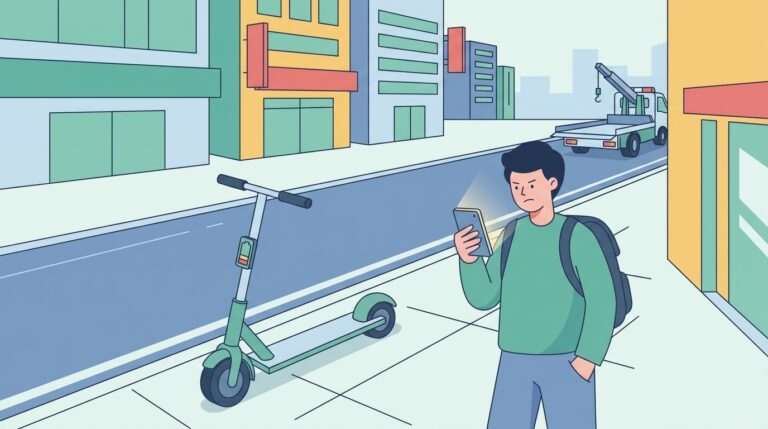
Phase 1: Empathy (Immersion Open)
Hello there! This is your Lead Editor at Daily Hangul.
Imagine this: You’re walking down the vibrant, bustling streets of Hongdae on a Friday night. The smell of spicy tteokbokki fills the air, and neon signs are lighting up the alleys. You’re weaving through the crowd when, suddenly—screech!—you almost trip over an electric kickboard left right in the middle of the sidewalk.
As you regain your balance, you hear an older Korean gentleman muttering under his breath, shaking his head. You might know basic words like ‘짜증나’ (annoying), but in the world of Korea’s hyper-fast sharing economy, the vocabulary has evolved rapidly. Today, shared e-scooters (공유 킥보드) are a massive part of urban life in Korea, but they’ve also sparked intense debates about public space, safety, and civic duty.
If you want to read the local news, engage in deep discussions with Korean friends, or even file a complaint using a city app, “I’m sorry” or “It’s bad” just won’t cut it. You need the C2-level vocabulary to discuss parking issues (주차 문제) and towing measures (견인 조치).
This guide is crafted from real frustrations and situations experienced by expats living in Seoul. Let’s dive in!
Phase 2: Deep Dive into Core Expressions
Let’s look at the three most crucial expressions you need to discuss this modern urban clash like a highly educated local.
1. 무단 방치 (Illegal Abandonment / Unauthorized Parking)
- Pronunciation: mudan bangchi [Moo-dan bang-chee]
- Meaning:
- Literal: Unauthorized abandonment.
- Real Nuance: Leaving an e-scooter or shared bike anywhere you please without considering public inconvenience.
- K-Culture Moment: You’ll hear this on the news almost daily or read it on the ‘안전신문고’ (Safety Report) app. When neighbors complain about a scooter blocking their apartment entrance, they say, “누가 또 킥보드를 무단 방치했어.”
- Editor’s Insight: ‘무단’ implies doing something without permission, and ‘방치’ means neglecting or leaving something alone. It has a highly critical, slightly bureaucratic tone. If you use this in daily conversation, you instantly sound like someone who reads the local newspaper.
- Situation Spectrum:
- Casual with friends: ✅ (Used to complain about the situation)
- Co-workers (Semi-formal): ✅
- Formal / Bureaucratic: ✅
- 🤔 Think About It: Why does Korean use such heavy, legal-sounding Sino-Korean vocabulary (Hanja) for a simple parking issue? How does the use of Hanja elevate the seriousness of a social problem in Korea?
2. 견인 조치되다 (To be towed away / subjected to towing measures)
- Pronunciation: gyeonin jochidoeda [Gyo-nin jo-chee-dwe-da]
- Meaning:
- Literal: Towing measures are taken.
- Real Nuance: The city government or a private company has forcibly removed the illegally parked scooter (and will charge a hefty fine).
- K-Culture Moment: In K-Dramas, you often see a wealthy protagonist’s sports car getting towed to show their sudden downfall. Nowadays, Seoul city officials literally drive around in trucks to ‘견인 조치’ hundreds of e-scooters daily to clear the sidewalks.
- Editor’s Insight: The word ‘조치’ (measure/action) is deeply embedded in Korean administrative culture. Koreans love taking ‘measures’ to fix things quickly.
- Situation Spectrum:
- Casual with friends: ⚠️ (A bit formal, friends might just say “견인됐어”)
- Co-workers (Semi-formal): ✅
- Formal / Official: ✅
- 🤔 Think About It: In your home country, how does the local government deal with micro-mobility issues? Does the government act as swiftly as the ‘빨리빨리’ (Pali-pali) towing trucks of Seoul?
3. 통행에 방해가 되다 (To obstruct traffic / to get in the way)
- Pronunciation: tonghaenge banghaega doeda [Tong-hang-eh bang-hae-ga dwe-da]
- Meaning:
- Literal: To become an obstacle to passage.
- Real Nuance: To block pedestrians or cars, creating a massive nuisance.
- K-Culture Moment: If you park a shared scooter right in front of a small ‘맛집’ (famous restaurant) where people are lining up, the owner might rush out and scold you using a variation of this phrase.
- Editor’s Insight: ‘통행’ refers to the flow of traffic (pedestrian or vehicular). It’s a polite but firm way to say, “You are in the way of society.”
- Situation Spectrum:
- Casual with friends: ⚠️ (Friends usually use slang, see Phase 3)
- Co-workers (Semi-formal): ✅
- Formal / Public announcements: ✅
- 🤔 Think About It: Korean culture places a high value on ‘not inconveniencing the collective’ (민폐를 끼치지 않기). How does a scooter blocking the way violate this core cultural rule?
Phase 3: Textbook vs. Real Korean
Let’s see how the sterile textbook phrases transform on the bustling streets of Seoul.
[Describing a scooter blocking the sidewalk]
* 📖 Textbook Korean: 보행자의 안전을 위협합니다. (It threatens the safety of pedestrians.)
* 🗣️ Real Korean: 아, 길막 진짜 오지네. 킥라니들 극혐이야. (Ugh, they’re totally blocking the way. Kick-ranis are the worst.)
* 💡 Why the difference?: ‘길막’ (길을 막다 – blocking the path) and ‘킥라니’ (Kickboard + Gorani/Water Deer, meaning reckless riders who jump out of nowhere) are internet slang born from sheer public frustration. Younger generations use hyperbole (‘오지네’, ‘극혐’) to express their annoyance.
[Telling someone not to park there]
* 📖 Textbook Korean: 이곳에 공유 킥보드를 주차하면 안 됩니다. (You must not park the shared kickboard here.)
* 🗣️ Real Korean: 여기 대면 바로 견인돼요. (If you park here, it gets towed right away.)
* 💡 Why the difference?: In real life, Koreans emphasize the consequence (getting towed/fined) rather than just stating the rule. It’s more effective!
Bottom Note: At a C2 level, you should understand slang like ‘킥라니’ but use it carefully. In a professional setting, stick to ‘무단 방치’ to sound educated and observant.
Phase 4: Cultural Context — K-Culture Deep Dive
4-1. Non-Verbal Elements & ‘Nunchi’ on the Streets
In Korea, Nunchi (눈치)—the subtle art of gauging the mood and situation—doesn’t just apply to conversations; it applies to physical space. When you finish using a shared kickboard, parking it in a spot where it doesn’t obstruct the visually impaired blocks (the yellow tactile paving) or crosswalks is an ultimate test of civic Nunchi. If you park it poorly, expect loud, aggressive sighs from passersby or the distinct click of a smartphone camera. Why the camera? Because Seoulites actively use reporting apps to upload photos of illegally parked scooters!
4-2. K-Culture Connection: The ‘Pali-Pali’ Bureaucracy vs. Sharing Economy
Korea adopted the sharing economy at lightning speed. Global and local scooter apps flooded the streets almost overnight. However, the infrastructure (designated parking zones) couldn’t keep up with the ‘Pali-pali’ (hurry up) adaptation.
This mirrors a common K-Drama trope: the clash between reckless modern innovation and the traditional neighborhood harmony. Just as K-Drama protagonists often fight against giant corporations ruining their small neighborhoods, regular citizens in Korea are now waging a daily war against tech companies’ scooters cluttering their precious alleys.
Critical View: The media often portrays Korea as a flawless, futuristic tech utopia. But the scooter towing war reveals the growing pains of rapid digitalization—where tech outpaces civic infrastructure.
Phase 5: Real-Life Roleplay Scenario
Setting: It’s 6:30 PM on a Tuesday. You are standing in front of a narrow, aesthetic cafe in Seongsu-dong, waiting for your iced latte. A young guy zooms up on a shared e-scooter, abruptly stops right at the narrow entrance of the cafe, ends his ride on the app, and turns to walk away.
Characters:
– YOU: An expat working in Seoul, fluent in Korean, who knows that the cafe owner will get in trouble if the entrance is blocked.
– Minsu (30): Your Korean coworker, who is waiting for coffee with you. He is observant but avoids confrontation.
– Scooter Rider (20s): In a rush, completely lacking spatial ‘Nunchi’.
Dialogue:
Minsu: 헐, 저 사람 저기에 킥보드 버리고 가는 거 봤어요? 🤦♂️
(Heol, jeo saram jeogie kikbodeu beorigo ganeun geo bwasseoyo?)
[Whoa, did you see that guy just abandoning his kickboard there?]
(🎭 Stage Direction: Minsu points subtly with his chin, a classic Korean gesture to avoid pointing fingers)
YOU: 네, 완전 입구 한가운데네요. 저러면 손님들 어떻게 들어가라고…
(Ne, wanjeon ipgu hangaundeneyo. Jeoreomyeon sonnimdeul eotteoke deureogarago…)
[Yeah, it’s right in the middle of the entrance. How are customers supposed to get in…]
Minsu: 저거 무단 방치로 구청에 민원 넣어야 하는 거 아니에요? 요즘 견인 조치 엄청 빨리 하던데.
(Jeogeo mudan bangchiro gucheonge minwon neoeoya haneun geo anieyo? Yojeum gyeonin jochi eomcheong ppalli hadeonde.)
[Shouldn’t we file a civil complaint to the district office for illegal abandonment? They tow them away super fast these days.]
YOU: 맞아요. 통행에 너무 방해가 되잖아요. 제가 저 사람한테 말해볼까요?
(Majayo. Tonghaenge neomu banghaega doejanayo. Jaega jeo saramhante malhaebolkkayo?)
[Right. It’s completely obstructing traffic. Should I say something to him?]
Minsu: 에이, 그냥 두세요. 괜히 시비 붙으면 피곤해져요.
(Ei, geunyang duseyo. Gwaenhi sibi buteumyeon pigonhaejyeoyo.)
[Ah, just let it be. It’s exhausting if you get into an argument for no reason.]
🔀 Your Turn! How do you respond to the rider who is about to leave?
– A) “저기요, 여기에 주차하시면 안 됩니다. 법에 어긋납니다.” (Too rigid, sounds like a police officer.)
– B) “저기요, 여기 대시면 카페 통행에 방해가 돼서요. 조금만 옆으로 옮겨주시겠어요?”
– C) “야! 킥라니! 길막 오지네 진짜!” (You will absolutely start a street fight.)✅ Best Choice: B — Reason: It provides a logical reason (blocking the cafe) and uses polite but firm request forms (‘옮겨주시겠어요?’). It avoids direct aggression while solving the issue.
⚠️ Choice A Analysis: While grammatically perfect, using “법에 어긋납니다” (It’s against the law) to a stranger in a daily situation sounds unnatural and overly confrontational.
Phase 6: 10-Second Shadowing Drill
Let’s practice a phrase you can use when you are frustrated by a blocked path. Pay attention to the rhythm and the dramatic pause!
😤 아니, / 길 한가운데에 / 이렇게 킥보드를 무단 방치하면 / 어떡해?
(a-ni, / gil han-ga-un-de-e / i-reo-ke kik-bo-deu-reul mu-dan bang-chi-ha-myeon / eo-tteok-hae?)
Pro-Tip: The ‘아니’ at the beginning is not literally “no.” It’s the ultimate Korean expression of exasperation. Put a heavy, annoyed emphasis on it!
Phase 7: K-Culture Mini Dictionary
To master C2, you need the socio-cultural keywords behind the sharing economy conflicts.
1. 민원 (Minwon)
* Romanization: minwon
* English: Civil complaint / Public grievance
* Context: A cornerstone of Korean civic life. Koreans actively file ‘minwon’ via apps or calls to fix neighborhood issues instantly.
2. 킥라니 (Kick-rani)
* Romanization: kingnani
* English: Kickboard + Gorani (Water Deer)
* Context: A derogatory slang for electric scooter riders who pop out of nowhere into traffic or sidewalks, terrifying drivers and pedestrians alike.
3. 구청 (Gucheong)
* Romanization: gucheong
* English: District Office
* Context: The local government body responsible for towing illegally parked scooters. Seoul is divided into 25 ‘Gu’s (districts), and each has its own towing policy.
4. 딱지 (Ttakji)
* Romanization: ttakji
* English: Fine ticket / Violation sticker
* Context: When a car or scooter is illegally parked, an official slaps a ‘딱지’ on it. If you say “딱지 끊겼어”, it means “I got a parking ticket.”
Phase 8: Traveler Survival Kit
Even if you’re just visiting Korea, you’ll likely want to use a shared scooter. Here is how you survive the complex parking rules.
🆘 Survival Expressions
– 🇰🇷 “여기에 킥보드 세워두면 견인되나요?”
– 🗣️ Pronunciation: [yeo-gi-e kik-bo-deu se-wo-du-myeon gyeo-nin-doe-na-yo?]
– 📍 Where to use: Asking a convenience store owner or building guard if it’s safe to park your scooter there.
– 💡 Pro Tip: Look out for yellow tow zones or subway exits. Parking right in front of a subway exit is a guaranteed way to get the scooter towed and your account fined!📌 Editor’s Travel Note
– The Apps: Gcooter, Swing, and Beam are popular. You will need a registered driver’s license (international works for some apps) to ride legally.
– The Fines: If your parked scooter gets towed because it blocked a crosswalk or bus stop, the sharing company will pass the towing fee (usually around 40,000 KRW) directly to your registered credit card.
Phase 9: Critical Thinking — “One Step Deeper”
Global Era & Civic Duty (글로벌 시대와 시민 의식)
Korea’s infrastructure is world-class, yet the sharing economy exposed a fascinating cultural friction. Historically, Korean modernization happened top-down: the government built the roads, and the citizens followed the rules. However, shared e-scooters are a bottom-up innovation driven by private startups.
The result? A clash between the sheer convenience of dropping a scooter anywhere and the traditional Korean emphasis on ‘Nunchi’ and not causing ‘Minpye’ (public nuisance). The government’s solution—creating an app for citizens to report scooters and deploying tow trucks—is a uniquely Korean blend of hyper-digitalization and swift administrative punishment. It begs the question: Does ultimate convenience always come at the cost of public space?
💬 Your Turn: How does your city handle the micro-mobility (e-scooter) trend? Do people leave them everywhere, or is there a strict docking system? Share your culture’s approach in the comments!
Phase 10: FAQ & Avoiding Misunderstandings
Q: Can I use the word ‘무단 방치’ when complaining to my landlord about a neighbor’s trash?
Yes! While highly associated with vehicles, ‘무단 방치’ works perfectly for any items (like old furniture or trash) illegally left in common areas.
Q: If I get into an argument over a scooter, is it okay to drop honorifics?
Absolutely not. Even if a ‘킥라니’ almost hits you, dropping honorifics (using 반말) to a stranger instantly shifts the argument from “who is legally wrong” to “why are you disrespecting me?” Always maintain formal language (존댓말) during disputes to keep the moral high ground.
❌ Common Mistake #1: Physically moving someone else’s parked scooter to clear your path.
✅ Do this instead: It’s better to report it. Shared scooters have alarms that will aggressively beep if moved without unlocking, drawing unwanted attention to you!
Phase 11: Summary & Action Items
- One-Liner Summary: To navigate Seoul’s scooter wars, remember that ‘무단 방치’ (illegal abandonment) leads to ‘견인 조치’ (towing measures) because it causes ‘통행 방해’ (obstruction of traffic).
-
Action Mission 3 Steps:
- 🥉 Bronze (Solo): Read the three core expressions aloud, mimicking the frustrated tone of a local.
- 🥈 Silver (Online): Look up “공유 킥보드 견인” on YouTube and read the angry Korean comments to see real C2-level slang in action.
- 🥇 Gold (Real Life): Next time you see a poorly parked scooter in Korea, point it out to a Korean friend and say, “저거 무단 방치네요. 견인 조치돼야 할 텐데.”
- K-Culture Mission: Open Google Street View in Gangnam or Hongdae. Scan the sidewalks. I guarantee you will find an e-scooter within 5 minutes. Judge its parking spot using today’s vocabulary!
Phase 12: Quiz — Interactive Challenge
1. Situational Judgment:
You are managing a small cafe. You find three e-scooters blocking your door. You call the district office. What is the most appropriate C2-level phrase to use?
* A) 킥보드들이 길막 오지게 하고 있어요.
* B) 입구에 킥보드가 무단 방치되어 통행에 방해가 됩니다. 조치 부탁드립니다.
* C) 킥보드 싫어요. 빨리 치워주세요.
(Hint: You want to sound professional to get the fastest bureaucratic response. Answer: B)
2. Fill in the Blank:
When a reckless e-scooter rider suddenly cuts in front of your car, locals angrily refer to them as a ________.
(Answer: 킥라니 / Kick-rani)
3. True or False — K-Culture Edition:
If you park a shared scooter right in front of a subway exit in Seoul, it will be fine as long as you lock it in the app.
(Answer: False. Subway exits are strictly designated tow zones!)
Great job today! Keep practicing, and soon you’ll be navigating the complex socio-linguistics of Korea like a native. See you in the next Daily Hangul module!
Frequently Asked Questions (FAQ)
Q: What does "무단 방치 (Illegal Abandonment / Unauthorized Parking)" mean in Korean and how do you pronounce it?
A: In Korean, "무단 방치 (Illegal Abandonment / Unauthorized Parking)" is pronounced [mudan bangchi [Moo-dan bang-chee] and means: Literal: Unauthorized abandonment.
Q: What does "견인 조치되다 (To be towed away / subjected to towing measures)" mean in Korean and how do you pronounce it?
A: In Korean, "견인 조치되다 (To be towed away / subjected to towing measures)" is pronounced [gyeonin jochidoeda [Gyo-nin jo-chee-dwe-da] and means: Literal: Towing measures are taken.
Q: What does "통행에 방해가 되다 (To obstruct traffic / to get in the way)" mean in Korean and how do you pronounce it?
A: In Korean, "통행에 방해가 되다 (To obstruct traffic / to get in the way)" is pronounced [tonghaenge banghaega doeda [Tong-hang-eh bang-hae-ga dwe-da] and means: Literal: To become an obstacle to passage.







