

Phase 1: Empathy & The K-Culture Cold Open
Hello! I am the lead editor of Daily Hangul.
Imagine this: You’re walking through the bustling underground shopping mall at Gangnam Station. It’s Friday evening. Suddenly, a man a few meters ahead of you collapses. The crowd freezes. It looks exactly like a high-tension scene from a K-Drama like Dr. Romantic (낭만닥터 김사부) or Hospital Playlist (슬기로운 의사생활). In the drama, the heroic doctor slides in, yells “V-Fib!” and saves the day.
But this is reality. You learned basic Korean like “Hello” and “How much is this?”, but what happens when you need to act fast, direct people, and ask for an Automated External Defibrillator (AED)?
At the C1 level, your goal isn’t just to order coffee perfectly; it’s to function seamlessly in Korean society. Knowing emergency Korean isn’t just about language—it’s about understanding Korea’s Palli-palli (hurry up) culture intersecting with the bystander effect. This guide is crafted from real-life scenarios to ensure that if the Golden Time (골든타임) ever ticks down around you, you won’t just stand there—you’ll know exactly how to take charge.
Phase 2: Core Expressions Deep Dive
1. 거기 안경 쓰신 분, 119에 신고해 주시고 AED 좀 가져다주세요!
- Pronunciation: Geogi angyeong sseusin bun, il-il-gue singohae jusigo AED jom gajyeodajuseyo! [Sounds like: guh-gee ahn-gyung sseu-shin boon, eel-eel-goo-eh shin-go-hae joo-she-go A-E-D johm gah-jyuh-dah-joo-seh-yo!]
- Meaning: You there with the glasses, please call 119 and bring an AED!
- K-Culture Moment: In Korea, if you just yell “Somebody call an ambulance!”, the Nunchi (눈치) culture might cause people to hesitate, waiting for someone else to step up. You must pinpoint a specific person using their physical description (like “the person wearing glasses” or “the person in the red shirt”).
- Editor’s Insight: Notice the use of the honorific “쓰신 분” (person who is wearing). Even in a life-or-death emergency, Koreans instinctively maintain a baseline level of politeness when addressing strangers.
- Situation Spectrum:
- Strangers on the street: ✅
- Close Friends (Casual): ⚠️ (You would drop the honorifics: 야, 너 119 불러!)
- Workplace (Formal): ✅
- 🤔 Think About It: Why do you think Korean society requires you to point out specific physical traits to break the bystander effect, rather than just pointing a finger?
2. 환자 상의를 벗기고 패드를 쇄골 아래에 붙이세요.
- Pronunciation: Hwanja sang-uireul beotgigo paedeureul swaegol araee buchuseyo. [Sounds like: hwan-jah sahng-ee-reul but-gee-go pae-deu-reul swae-gol ah-rae-eh boo-chee-seh-yo.]
- Meaning: Remove the patient’s top and attach the pad under the collarbone.
- K-Culture Moment: This is the exact robotic voice you will hear when you turn on a Korean AED. Medical vocabulary like Swaegol (쇄골 – collarbone) and Sang-ui (상의 – upper garment) are essential C1 terms.
- Editor’s Insight: The verb “붙이다” (to attach/stick) is highly versatile. You use it for AED pads, Band-Aids (밴드를 붙이다), and even metaphorical things like “gaining interest” (흥미를 붙이다).
- Situation Spectrum:
- Emergency giving instructions: ✅
- Casual conversation: 🚫 (Too medical/instructional)
- 🤔 Think About It: The AED machine uses the -(으)세요 ending. It is a command, but a polite one. How does your native language handle automated emergency instructions? Are they polite or blunt?
3. 다들 환자에게서 떨어지세요! 물러서세요!
- Pronunciation: Dadeul hwanja-egeseo tteoreojiseyo! Mulleoseoseyo! [Sounds like: dah-deul hwan-jah-eh-geh-suh ttuh-ruh-jee-seh-yo! mool-luh-suh-seh-yo!]
- Meaning: Everyone, step away from the patient! Stand back!
- K-Culture Moment: Watch any Korean medical drama, and right before the electric shock, the doctor yells this. “떨어지다” literally means “to fall” or “to drop,” but physically it means “to separate/step away from.”
- Editor’s Insight: If you just say “비키세요!” (Move out of the way!), it sounds a bit aggressive and is usually used when someone is blocking your path. “물러서세요” (Stand back) is the socially appropriate and professional way to clear an area.
- Situation Spectrum:
- Crowd control in emergencies: ✅
- Daily life (someone standing too close): ⚠️ (A bit dramatic for everyday use)
- 🤔 Think About It: Even when saving a life, tone matters. Does the concept of “saving face” exist in emergency situations in your culture?
Phase 3: Textbook vs. Real Korean
[Situation 1: Asking someone to bring the AED]
* 📖 Textbook Korean: 자동 제세동기를 가져오십시오. (Jadong jesedonggireul gajyeo-osipsio.)
* 🗣️ Real Korean: 저기 파란 옷 입으신 분! 제발 AED 좀 갖다주세요! (Jeogi paran ot ibeusin bun! Jebal AED jom gatdajuseyo!)
* 💡 Why the difference?: While “자동 제세동기” is the official term, Koreans almost universally say the English alphabet letters “A-E-D” or “자동 심장 충격기” in a panic. “가져오십시오” is too formal; “갖다주세요” is urgent but polite.
[Situation 2: Telling people to clear the area]
* 📖 Textbook Korean: 안전을 위해 환자로부터 거리를 두십시오. (Anjeoneul wihae hwanjarobuteo georireul dusipsio.)
* 🗣️ Real Korean: 떨어지세요! 다들 뒤로 가주세요! (Tteoreojiseyo! Dadeul dwiro gajuseyo!)
* 💡 Why the difference?: Efficiency is key. Long, formal sentences are discarded for punchy, action-oriented verbs like “떨어지다” (detach/step away) and “뒤로 가다” (go back).
Phase 4: Cultural Context — K-Culture Deep Dive
4-1. Non-verbal Elements: The Art of Breaking the Nunchi
In Korea, pointing a single index finger at someone is generally considered rude. You usually use an open hand facing upward. However, during CPR, you must throw this rule out the window. If you just yell into the void, Korea’s Nunchi (눈치) culture kicks in—everyone looks at each other to see who will act first. You must make intense, direct eye contact, point (even with a finger if needed), and describe their clothing to break the bystander effect.
4-2. K-Drama Connection: The Medical Thriller Trope
If you’ve watched K-Dramas like Descendants of the Sun or Dr. Romantic, you know the CPR scene. The protagonist sweats, pumps the chest, and yells “Charge to 200 Joules!”. But notice the language they use with the nurses vs. the crowd. Medical professionals in K-Dramas often use highly formal Hapsyo-che (합쇼체, -ㅂ/습니다) during procedures to maintain strict hierarchy and clear communication. But when turning to the crowd of bystanders, they switch to the slightly softer but authoritative Haeyo-che (해요체, -요) to manage the public without insulting them.
Phase 5: Real-Life Roleplay Scenario
Setting: Gangnam Station Exit 11, underground. 6:30 PM. The station is packed with commuters. Suddenly, a man in a suit collapses near a pillar. You are the closest person to him.
Characters:
– YOU: An expat who has lived in Seoul for 2 years (C1 level Korean). You’ve taken a CPR course.
– Min-su (30s): A bystander wearing a blue jacket, looking panicked.
– Subway Staff: Rushing to the scene.
Dialogue:
YOU: (Checking the man’s breathing) 숨을 안 쉬어요! 심정지예요!
(Sumeul an swieoyo! Simjeongjiyeyo!)
[He’s not breathing! It’s a cardiac arrest!]
(🎭 Stage Direction: You look up and lock eyes with a specific person in the crowd)
YOU: 저기 파란 재킷 입으신 분! 119에 전화해 주세요!
(Jeogi paran jaekit ibeusin bun! il-il-gue jeonhwahae juseyo!)
[You there in the blue jacket! Please call 119!]
Min-su: 아, 네! 지금 걸게요! 119죠?
(Ah, ne! Jigeum geolgeyo! il-il-gujyo?)
[Ah, yes! I’ll call now! 119, right?]
YOU: 네! 그리고 그 옆에 모자 쓰신 분, 역무실 가서 AED 좀 빨리 가져다주세요!
(Ne! Geurigo geu yeope moja sseusin bun, yeongmusil gaseo AED jom ppalli gajyeodajuseyo!)
[Yes! And the person next to him wearing a hat, please go to the station office and quickly bring an AED!]
(🎭 Stage Direction: 2 minutes later, the staff arrives with the red AED box)
Subway Staff: 여기 자동 심장 충격기 가져왔습니다!
(Yeogi jadong simjang chunggyeokgi gajyeowatseumnida!)
[I brought the AED here!]
YOU: 감사합니다. 패드 좀 꺼내주세요. 상의를 벗겨야 해요.
(Gamsahamnida. Paedeu jom kkeonaejuseyo. Sang-uireul beotgyeoya haeyo.)
[Thank you. Please take out the pads. We need to remove his top.]
(🎭 Stage Direction: The AED machine speaks: “환자에게서 떨어지세요.”)
🔀 Your Turn! How do you address the crowding bystanders?
– A) “다들 꺼지세요!” (Hey everyone, get lost!)
– B) “위험하니까 뒤로 물러서주세요!” (It’s dangerous, so please step back!)
– C) “가까이 오지 마십시오.” (Do not come closer.)✅ Best Choice: B — Reason: It provides the reason (“위험하니까” – because it’s dangerous) and uses a polite but firm request (“물러서주세요”).
⚠️ Choice A & C Analysis: Choice A is highly offensive slang (“꺼지다” = f*** off). Never use this. Choice C is grammatically perfect but sounds like a security guard making a public announcement, lacking the urgent, human connection needed here.
Phase 6: 10-Second Shadowing Drill
Listen to the rhythm of the Korean language. Pay attention to the pauses (/) and the emotional tags.
😤 (Firmly) 거기 파란 옷 입으신 분! / 119에 / 신고해 주세요!
(Geogi paran ot ibeusin bun! / il-il-gue / singohae juseyo!)
⚠️ (Urgent) 다들 / 뒤로 / 물러서세요! / 전기 충격 / 들어갑니다!
(Dadeul / dwiro / mulleoseoseyo! / jeongi chunggyeok / deureogamnida!)
Phase 7: K-Culture Mini Dictionary
1. 눈치
* Romanization: nunchi
* English: Situational awareness / Reading the room
* Context: In Korean society, observing others before acting is common. In an emergency, you must override people’s Nunchi by giving direct commands.
2. 골든타임
* Romanization: goldeun-taim
* English: Golden Time (The critical window for saving a life)
* Context: A highly used term in Korean news and medical dramas referring to the first 4 minutes of a cardiac arrest. Korea is obsessed with speed, and missing the Golden Time is a frequent media talking point.
3. 선한 사마리아인 법
* Romanization: seonhan samariain beop
* English: Good Samaritan Law
* Context: Korea has laws protecting individuals who perform CPR in good faith from civil and criminal liability if things go wrong. Knowing this can give you the confidence to act.
4. 119
* Romanization: il-il-gu
* English: Korean Emergency Number (Fire & Ambulance)
* Context: Unlike 911 in North America, Korea splits its numbers. 119 is for medical and fire emergencies. 112 is strictly for the police.
Phase 8: Traveler Survival Kit
If you are traveling in Korea, knowing where to find medical equipment is crucial.
🆘 Survival Expressions #1
– 🇰🇷 “여기 제일 가까운 AED(자동 심장 충격기)가 어디 있어요?” (Yeogi jeil gakkaun AED-ga eodi isseoyo?)
– 🗣️ English Pronunciation: [Yuh-gee jeh-il gah-kkah-oon A-E-D-gah uh-dee iss-uh-yo?]
– 📍 Where to use: Subway stations, apartment security guards, large malls.
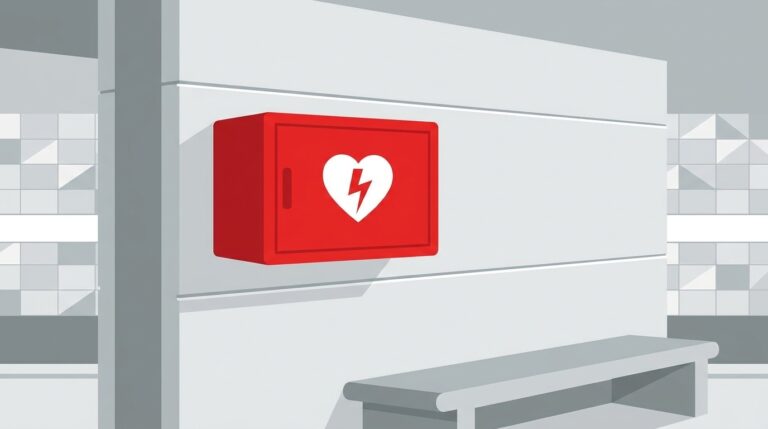
– 💡 Pro Tip: In Korea, AEDs are legally required in all subway stations, public buildings, and large apartment complexes. Look for the bright orange or red boxes with a heart and lightning bolt symbol.📌 Editor’s Travel Note
– Useful App: Download the “Emergency Ready App” (안전디딤돌). It’s provided by the Korean government, available in English, and shows the exact location of every AED near you.
– Subway trick: If you are on a train, run to the carriage doors and use the emergency intercom (비상통화장치) to tell the conductor: “의식 잃은 사람이 있어요!” (Someone is unconscious!)
Phase 9: Critical Thinking Corner — “One Step Deeper”
🧠 Think Deeper: Language & Power in Chaos
When a medical emergency occurs, panic ensues. Yet, even in the midst of performing chest compressions, Koreans rarely drop their honorifics (존댓말) when addressing adult strangers. You will hear “가져다주세요!” (Please bring it) rather than “가져와!” (Bring it). This reveals a profound aspect of Korean society: the social contract of respect does not evaporate in chaos. Language is the ultimate glue holding the societal structure together. Dropping honorifics might make you sound faster, but it also makes you sound like you are violating the social order, which could ironically make bystanders less willing to help you.💬 Your Turn: If an emergency happened in your home country, do people still use polite words like “please” and “sir/ma’am”, or does all politeness disappear for the sake of speed? Share your thoughts below!
Phase 10: FAQ & Preventing Misunderstandings
Q: “Can I just use Banmal (casual speech) to be faster in an emergency?”
A: No, unless absolutely necessary. While yelling “도와줘!” (Help me!) is acceptable if you are the victim, directing others using Banmal (e.g., “너 119 불러!”) will come off as incredibly rude and might shock the bystanders into inaction. Stick to the -(으)세요 ending. It’s short, commanding, but respectful.
Q: “What if I don’t know the Korean word for AED?”
A: Just say “A-E-D”. While the native term is 자동 심장 충격기 (Jadong simjang chunggyeokgi), the English acronym “AED” is universally understood in Korea and is printed on all the boxes.
❌ Common Mistake #1: Saying “119 불러주세요” to the general crowd.
✅ Do This Instead: Point and describe: “거기 모자 쓰신 분, 119 불러주세요!” (You in the hat, call 119!). Break the bystander effect.
Phase 11: Summary & Action Items
One-Liner Summary: In a Korean medical emergency, use descriptive commands to break the Nunchi, maintain polite urgency with -(으)세요, and remember that 119 is your lifeline.
Action Mission 3 Steps:
– 🥉 Bronze (Solo): Stand in front of your mirror and practice the phrase: “거기 안경 쓰신 분, 119에 신고해 주세요!” 3 times with urgency.
– 🥈 Silver (Online): Go to a Korean language forum or your study group and write down what you would say if someone collapsed near you.
– 🥇 Gold (Real World): Next time you are in a Korean subway station or building, actively hunt for the AED box. Read the Korean instructions printed on it!
K-Culture Mission:
Watch a clip from the Korean drama Romantic Doctor, Teacher Kim. Find a CPR scene and listen closely to the verbs the doctors use. Can you catch them saying “떨어지세요” (Stand back) before using the defibrillator?
Engagement: Have you ever noticed where the AED is in your apartment building or workplace in Korea? Let me know in the comments!
Phase 12: Quiz — Interactive Challenge
1. Situational Judgment:
You need someone to grab the AED from the wall. What is the most culturally effective way to ask?
– A) “누구 아무나 AED 좀 주세요!”
– B) “저기 빨간 가방 메신 분, AED 가져다주세요!”
– C) “야! 너 AED 가져와!”
(Answer: B. You must specify a person to break the bystander effect, and use polite but firm language.)
2. True or False – K-Culture Edition:
“If you need an ambulance in Korea, you should dial 112.”
(Answer: False. 112 is for the police. For medical emergencies and fire, dial 119!)
3. Fill in the Blank:
Before the AED delivers a shock, you must ensure no one is touching the patient. You shout: “다들 환자에게서 ( _________ )!”
(Answer: 떨어지세요 / tteoreojiseyo – Step away!)
Frequently Asked Questions (FAQ)
Q: What does "거기 안경 쓰신 분, 119에 신고해 주시고 AED 좀 가져다주세요!" mean in Korean and how do you pronounce it?
A: In Korean, "거기 안경 쓰신 분, 119에 신고해 주시고 AED 좀 가져다주세요!" is pronounced [Geogi angyeong sseusin bun, il-il-gue singohae jusigo AED jom gajyeodajuseyo! [Sounds like: guh-gee ahn-gyung sseu-shin boon, eel-eel-goo-eh shin-go-hae joo-she-go A-E-D johm gah-jyuh-dah-joo-seh-yo!] and means: You there with the glasses, please call 119 and bring an AED!
Q: What does "환자 상의를 벗기고 패드를 쇄골 아래에 붙이세요." mean in Korean and how do you pronounce it?
A: In Korean, "환자 상의를 벗기고 패드를 쇄골 아래에 붙이세요." is pronounced [Hwanja sang-uireul beotgigo paedeureul swaegol araee buchuseyo. [Sounds like: hwan-jah sahng-ee-reul but-gee-go pae-deu-reul swae-gol ah-rae-eh boo-chee-seh-yo.] and means: Remove the patient's top and attach the pad under the collarbone.
Q: What does "다들 환자에게서 떨어지세요! 물러서세요!" mean in Korean and how do you pronounce it?
A: In Korean, "다들 환자에게서 떨어지세요! 물러서세요!" is pronounced [Dadeul hwanja-egeseo tteoreojiseyo! Mulleoseoseyo! [Sounds like: dah-deul hwan-jah-eh-geh-suh ttuh-ruh-jee-seh-yo! mool-luh-suh-seh-yo!] and means: Everyone, step away from the patient! Stand back!







