

Phase 1: Empathy & K-Culture Cold Open
Hello! I’m your Daily Hangul Editor, your friendly neighborhood Korean tutor, and cultural navigator.
Imagine this: You’re watching your favorite K-Drama. The main character receives a mysterious, perfectly taped box. They open it with breathless excitement. Now, bring that to your real life in Korea. You’ve just ordered a gorgeous jacket you saw a K-Pop idol wearing. Thanks to Korea’s famous ‘rocket delivery’ culture, it arrives the very next morning. You tear it open, put it on, and… oh no. The sleeves are way too long.
Panic sets in. “How do I return this? Do I have to explain myself in fluent Korean? Will I be stuck with a jacket that doesn’t fit?”
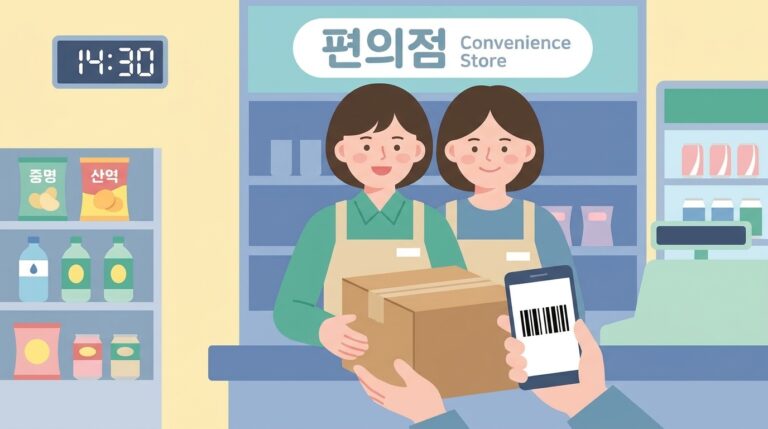
Take a deep breath! Returning a package (반품) in Korea is actually a magical, stress-free experience once you know how the system works. In many cases, you just leave the box outside your door or drop it off at a local convenience store.
This guide is crafted from real moments of panic my beginner students have faced. Today, we’re going to learn the absolute basic, survival phrases to confidently request a return. Let’s turn that shopping fail into a total cultural win!
Phase 2: Deep Dive into Core Expressions
Let’s master the three essential phrases you need for any return scenario.
1. 반품하고 싶어요 (I want to return this)
- Pronunciation: ban-pum-ha-go si-peo-yo [bahn-poom-ha-go shee-puh-yo]
- Sound Guide: ‘ban’ sounds like ‘bun’ with an ‘a’, and ‘pum’ sounds like ‘boom’ but with a ‘p’.
- Meaning: Literal: “I want to do a return.” / Real nuance: “I’d like to return this item, please.”
- K-Culture Moment: You walk into a GS25 or CU convenience store holding a taped-up box. The clerk looks at you. You smile slightly, lift the box, and say this phrase. Instantly, they know exactly what to do.
- Editor’s Insight: This is your golden ticket. It’s polite, clear, and perfectly natural. You don’t need to explain why you are returning it right away. Just state your intention.
- Situation Spectrum:
- Friends (Casual): ⚠️ (You’d drop the ‘yo’ and say 반품하고 싶어)
- Store Clerks/Customer Service (Semi-formal): ✅ (Perfect!)
- Formal/Elders: ✅ (Very polite and safe)
- 🤔 Think About It: Notice how we don’t say “Take this back!” We say “I want to return” (고 싶어요). Korean culture values indirectness and politeness to maintain harmony. Do you use indirect phrasing when asking for favors in your native language?
2. 환불해 주세요 (Please give me a refund)
- Pronunciation: hwan-bul-hae ju-se-yo [hwan-bool-heh joo-seh-yo]
- Sound Guide: ‘hwan’ rhymes with ‘swan’, and ‘bul’ sounds like ‘bull’.
- Meaning: Literal: “Please do refund.” / Real nuance: “I would like a refund, please.”
- K-Culture Moment: You’re at an underground shopping mall in Gangnam. You bought a shirt, but noticed a stain right after stepping out. You politely walk back, show the receipt, and gently use this phrase.
- Editor’s Insight: Use this when you specifically want your money back, not an exchange. It pairs perfectly with handing over your receipt.
- Situation Spectrum:
- Friends (Casual): 🚫 (Friends don’t usually refund you!)
- Store Clerks/Customer Service (Semi-formal): ✅
- Formal/Elders: ✅
- 🤔 Think About It: “주세요” (ju-se-yo) means “please give.” It is the absolute most important ending for an A1 learner. Whenever you need something, just add 주세요 at the end!
3. 사이즈가 안 맞아요 (The size doesn’t fit)
- Pronunciation: sa-i-jeu-ga an ma-ja-yo [sah-ee-zuh-gah ahn mah-jah-yo]
- Sound Guide: ‘sa-i-jeu’ is just the English word “size” said with a Korean accent. ‘an’ means not, ‘ma-ja-yo’ sounds like ‘mah-jah-yo’.
- Meaning: Literal: “Size not fits.” / Real nuance: “It’s the wrong size for me.”
- K-Culture Moment: Sometimes, a cashier will kindly ask why you are returning it by simply saying “Why?” (왜요?). Saying this short phrase saves you from a complicated grammar trap.
- Editor’s Insight: Koreans use a lot of ‘Konglish’ (Korean + English). Since ‘size’ is used in Korean, this sentence is super easy for English speakers to memorize!
- Situation Spectrum:
- Friends (Casual): ⚠️ (Say 안 맞아 without ‘yo’)
- Store Clerks/Customer Service (Semi-formal): ✅
- Formal/Elders: ✅
- 🤔 Think About It: Why does Korean adopt English words like “size” instead of inventing a new Korean word?
Phase 3: Textbook vs. Real Korean
Let’s see how native speakers actually talk compared to textbooks.
[Situation 1: Declaring your return at the counter]
* 📖 Textbook Korean: 이것을 반품하려고 합니다. (I am planning to return this item.)
* 🗣️ Real Korean: 반품이요. (ban-pum-i-yo) / 반품할게요. (ban-pum-hal-ge-yo)
* 💡 Why the difference?: Efficiency! Korea’s Palli-palli (hurry up) culture applies to language too. Dropping the subject (“this item”) and just saying “Return, please” is faster and perfectly polite.
[Situation 2: Explaining the reason]
* 📖 Textbook Korean: 제게 너무 커서 환불을 원합니다. (Because it is too big for me, I want a refund.)
* 🗣️ Real Korean: 사이즈가 안 맞아서요. (sa-i-jeu-ga an ma-ja-seo-yo)
* 💡 Why the difference?: Adding “~서요” (~seo-yo) at the end of a sentence implies “Because…” in a soft, polite way without over-explaining.
Bottom Note: For A1 beginners, don’t worry about complex grammar. Just smile, point to the item, and say “반품이요” (ban-pum-i-yo). It works like a charm!
Phase 4: Cultural Context — K-Culture Deep Dive
4-1. Non-Verbal Communication: Nunchi at the Counter
When making a return, body language is everything. Hand over the box and your receipt (or phone with the barcode) using both hands. Also, Korean Nunchi (reading the room) dictates that you should have your barcode ready before you step up to the cashier. Don’t make the people behind you wait while you dig through your phone apps!
4-2. The Magic of the Korean Convenience Store (K-Travel & Life)
In Korea, convenience stores (CU, GS25, 7-Eleven) are not just for buying snacks. They are community hubs! You can charge your T-money card, eat hot ramen, ship packages, and—yes—return your online shopping.
If you buy clothes from popular online platforms, the app will give you a return barcode. You simply pack the box, walk to the nearest convenience store, show the clerk the barcode on your phone, and leave the box. It takes less than 30 seconds. No post office required!
Critical Point: Unlike Western countries where customer service is highly chatty, Korean convenience store clerks are polite but transactional. Don’t be offended if they just scan your item in silence!
Phase 5: Real-Life Roleplay Scenario
Let’s put you in the driver’s seat.
- Setting: A bright, air-conditioned GS25 convenience store in Hongdae. It’s 2 PM. You have a small cardboard box sealed with tape.
- Characters:
- YOU: An absolute beginner in Korean, but brave enough to try!
- Ji-hoon: A 22-year-old part-time clerk. He’s listening to a K-Pop song and tapping his foot behind the counter.
Ji-hoon: 어서 오세요!
(eo-seo o-se-yo!)
[Welcome!]
(🎭 Stage Direction: Ji-hoon bows slightly as the door chimes ring.)
YOU: 안녕하세요. 이거… 반품하고 싶어요.
(an-nyeong-ha-se-yo. i-geo… ban-pum-ha-go si-peo-yo.)
[Hello. I… want to return this.]
Ji-hoon: 네, 바코드 보여주세요.
(ne, ba-ko-deu bo-yeo-ju-se-yo.)
[Yes, please show me the barcode.]
(🎭 Stage Direction: He grabs the scanner gun.)
YOU: 아, 네! 여기 있어요.
(a, ne! yeo-gi i-sseo-yo.)
[Ah, yes! Here it is.]
Ji-hoon: 포장 다 하셨어요?
(po-jang da ha-syeo-sseo-yo?)
[Did you finish packing it?]
(🎭 Stage Direction: He touches the tape on your box to make sure it’s secure.)
🔀 Your Turn! How do you answer?
– A) “포장… 뭐예요?” (po-jang… mwo-ye-yo? / Packing… what is it?)
– B) “네, 다 했어요!” (ne, da hae-sseo-yo! / Yes, I did it all!)
– C) “대박!” (dae-bak! / Awesome!)✅ Best Choice: B. Since you already taped the box, confirming with a simple “Yes, I did” is perfect.
⚠️ Choice C Analysis: “Dae-bak” is for expressing amazement. If you say this here, Ji-hoon will be very confused!
YOU: 네, 다 했어요!
(ne, da hae-sseo-yo!)
[Yes, I did it all!]
Ji-hoon: 네, 영수증 드릴까요?
(ne, yeong-su-jeung deu-ril-kka-yo?)
[Yes, shall I give you the receipt?]
YOU: 괜찮아요. 감사합니다!
(gwaen-cha-na-yo. gam-sa-ham-ni-da!)
[It’s okay (No thanks). Thank you!]
Ji-hoon: 안녕히 가세요~
(an-nyeong-hi ga-se-yo~)
[Goodbye~]
Phase 6: 10-Second Shadowing Drill
Practice this sentence out loud. Pay attention to the pauses (/) and the emotion tags!
🥺 (Politely and softly)
이거 / 반품하고 / 싶어요.
(i-geo / ban-pum-ha-go / si-peo-yo.)
This / to return / I want to.
Phase 7: K-Culture Mini Dictionary
Here are 4 must-know words related to delivery and returns in Korea:
1. 택배
* Romanization: taek-bae
* English: Parcel delivery service
* Context: The backbone of Korean convenience! You will see small trucks everywhere.
2. 반품
* Romanization: ban-pum
* English: Return (of goods)
* Context: Sending an item back to get your money back.
3. 교환
* Romanization: gyo-hwan
* English: Exchange
* Context: Use this if you don’t want your money back, but just need a different size or color.
4. 영수증
* Romanization: yeong-su-jeung
* English: Receipt
* Context: Clerks will always ask if you want this. If you don’t need it, just say “괜찮아요” (It’s okay/No thanks).
Phase 8: Traveler’s Survival Kit
Even if you aren’t living in Korea, you might buy souvenirs or clothes during your trip. Here is your quick survival kit for store returns.
🆘 Survival Phrases for Shopping & Returns
– 🇰🇷 “환불해 주세요.” (hwan-bul-hae ju-se-yo) – Please give me a refund.
– 🇰🇷 “교환해 주세요.” (gyo-hwan-hae ju-se-yo) – Please exchange this.
– 🇰🇷 “영수증 여기 있어요.” (yeong-su-jeung yeo-gi i-sseo-yo) – Here is the receipt.📌 Editor’s Travel Note
– Time Limit: In Korea, you usually have 7 days to return clothing or items bought in a physical store, provided the tags are still attached and you have the receipt.
– Card is King: If you paid by credit card, you must bring the exact same physical card used for the purchase to get a refund. They cannot refund cash for a card purchase!
Phase 9: Critical Thinking Corner — “One Step Deeper”
Korean in the Global Era (Language & Evolution)
Have you noticed how many English words we used in this unit? “Size” (사이즈), “Barcode” (바코드), “Tape” (테이프). Modern Korean, especially in retail and technology, heavily borrows from English.
🧠 Think Deeper:
This phenomenon, sometimes called ‘Konglish’, makes basic survival incredibly easy for English speakers traveling in Korea. However, some older generations find it difficult to understand the rapidly increasing English vocabulary in daily life. Does your native language borrow heavily from English for modern conveniences, or do you invent new words to preserve linguistic purity?💬 Your Turn: Does your country have a fast-paced delivery culture like Korea? How easy is it to return a package where you live? Let me know in the comments!
Phase 10: FAQ & Avoiding Common Mistakes
Q: Can I use “반품하고 싶어요” to an older store owner?
Yes! The “~요” ending is standard polite Korean. It is completely safe to use with strangers, clerks, and elders.
Q: What if I can’t read the Korean app to get my return barcode?
Many foreigners use translation apps like Papago to navigate Korean shopping apps. Take a screenshot of the app screen, put it in Papago’s image translator, and look for the word “반품” (Return).
❌ Common Mistake #1: Mixing up 반품 (Return) and 교환 (Exchange).
If you say 교환 (gyo-hwan), the clerk will expect you to pick out another item to replace it. If you want your money back, always use 반품 (ban-pum) or 환불 (hwan-bul).❌ Common Mistake #2: Opening the item carelessly.
In Korea, to get a full refund, the packaging should be as pristine as possible. Don’t rip the plastic bags forcefully!
Phase 11: Summary & Action Items
One-Liner Summary: To return an item effortlessly, politely hand it over and say “반품하고 싶어요” (I want to return this).
Your Action Missions for Today:
– 🥉 Bronze (Solo): Look in the mirror with an imaginary box and say “반품하고 싶어요” 3 times out loud.
– 🥈 Silver (Online): Write “반품하고 싶어요” in your notes app or post it in a language learning forum as your new phrase of the day.
– 🥇 Gold (Real Life): Next time you watch a K-Drama or vlog, listen carefully when they enter a store or receive a package. Can you hear the word “택배” (delivery)?
Phase 12: Interactive Challenge (Quiz)
Test your new skills!
1. Situational Judgment:
You bought a shirt, but you want a different color. You don’t want a refund, you just want to swap it. What should you say?
* A) 반품하고 싶어요 (ban-pum-ha-go si-peo-yo)
* B) 교환해 주세요 (gyo-hwan-hae ju-se-yo)
* C) 택배 왔어요 (taek-bae wa-sseo-yo)
2. True or False — K-Culture Edition:
You can drop off a return package at almost any major Korean convenience store using a barcode.
* True or False?
3. Fill in the Blank:
The clerk asks if you need the piece of paper showing your transaction. They are asking if you need the _________ (yeong-su-jeung).
(Answers: 1: B – you want an exchange, not a return. 2: True – GS25, CU, etc., handle returns brilliantly! 3: 영수증 / Receipt)
Frequently Asked Questions (FAQ)
Q: What does "반품하고 싶어요 (I want to return this)" mean in Korean and how do you pronounce it?
A: In Korean, "반품하고 싶어요 (I want to return this)" is pronounced [ban-pum-ha-go si-peo-yo [bahn-poom-ha-go shee-puh-yo] and means: a key conversational Korean expression covered in this lesson.
Q: What does "환불해 주세요 (Please give me a refund)" mean in Korean and how do you pronounce it?
A: In Korean, "환불해 주세요 (Please give me a refund)" is pronounced [hwan-bul-hae ju-se-yo [hwan-bool-heh joo-seh-yo] and means: a key conversational Korean expression covered in this lesson.
Q: What does "사이즈가 안 맞아요 (The size doesn't fit)" mean in Korean and how do you pronounce it?
A: In Korean, "사이즈가 안 맞아요 (The size doesn't fit)" is pronounced [sa-i-jeu-ga an ma-ja-yo [sah-ee-zuh-gah ahn mah-jah-yo] and means: a key conversational Korean expression covered in this lesson.







