

Phase 1: Empathy (The K-Culture Cold Open)
Hello! I’m the Chief Editor of Daily Hangul, your local culture navigator and veteran tutor.
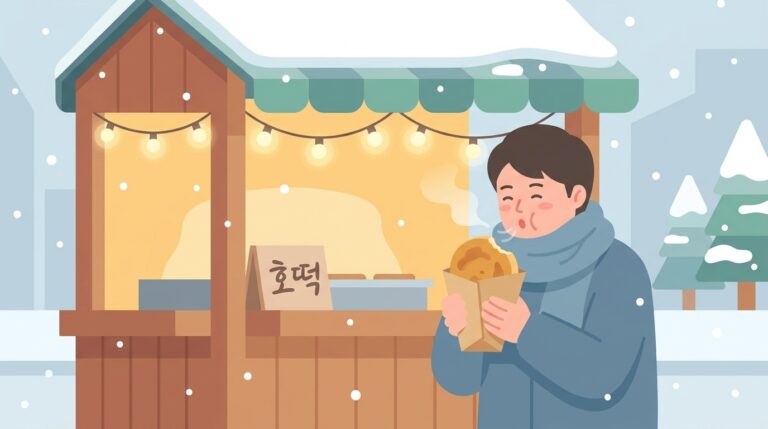
Picture this: It’s a freezing December evening in Seoul. You’re walking through the bustling streets of Myeongdong, and suddenly, a sweet, cinnamon-laced aroma stops you in your tracks. In K-Dramas, this is exactly the moment the main characters stop at a little street cart, rubbing their hands together, and share a piping hot, golden-brown pancake.
That pancake is 호떡 (Hotteok).
But when the friendly Imo (auntie) hands you that freshly fried Hotteok in a little folded paper cup, she’ll likely say something rapidly to you. If you don’t know what she’s saying, you might take a huge bite immediately and—ouch!—burn your tongue on the molten brown sugar inside.
In this unit, we’re not just learning how to order food. We are learning the essential ‘survival’ phrases for Korean winter street food, specifically how to blow on it—“호호” (ho-ho)—and eat it safely like a true local. This guide is built from the exact moments my students realized that street food in Korea isn’t just a snack; it’s an extreme sport if you aren’t prepared! Let’s dive in.
Phase 2: Core Expressions Deep Dive
Here are the top three expressions you absolutely need when facing a deliciously dangerous Hotteok.
1. 너무 뜨거워요! (It’s too hot!)
- Pronunciation: neomu tteugeowoyo! [Neo-mu Tteu-geo-wo-yo]
- Sound-alike guide: ‘뜨’ (tteu) sounds like the tight, tense sound you make when you’re shivering from the cold. ‘으’ (eu) sounds like the disgusted sound you make when stepping in gum.
- Meaning: “It is too hot!” (Literal) / “Watch out, it’s burning hot!” (Real nuance)
- K-Culture Moment: You’ll hear this constantly at winter street stalls. The vendor will warn you as they hand over the food, or your Korean friend will yell this as you go in for a bite.
- Editor’s Insight: This isn’t just a statement; it’s an expression of care. When Koreans tell you something is hot, it means they are looking out for you.
- Situation Spectrum:
- To friends (Casual – 너무 뜨거워!): ✅
- To the vendor (Semi-formal): ✅
- In a formal meeting: 🚫 (You wouldn’t be eating Hotteok here anyway!)
- 🤔 Think About It: Why do Koreans often warn others about the temperature of food? Does your culture have a specific phrase to warn people before they eat?
2. 이거 하나 주세요. (Please give me one of this.)
- Pronunciation: igeo hana juseyo. [Ee-guh ha-na joo-se-yo]
- Meaning: “Please give me one of this.”
- K-Culture Moment: When you are at a crowded stall in Namdaemun Market and don’t know the exact name of the food, pointing and saying “Igeo” (this) is your magic wand.
- Editor’s Insight: It’s polite, effective, and works universally. You don’t need complex grammar here. Just point, smile, and say this phrase.
- Situation Spectrum:
- To street vendors / Cafe staff: ✅
- To close friends: 🚫 (Use “이거 줘” instead)
- 🤔 Think About It: “주세요” means “please give me.” In English, we often say “Can I get…?” Why do you think Korean uses a direct “give me” command softened by polite verb endings rather than a question?
3. 호호 불어 드세요. (Blow on it before you eat.)
- Pronunciation: hoho bureo deuseyo. [Ho-ho boo-ruh deu-se-yo]
- Meaning: “Blow on it and eat.” (Literal) / “Careful, blow on it so you don’t get burned.” (Real nuance)
- K-Culture Moment: You’ll see K-Drama moms saying this to their kids, or a romantic lead saying it to their partner while sharing a winter snack.
- Editor’s Insight: “호호” (ho-ho) is a mimetic word (onomatopoeia) imitating the sound of blowing air gently. It adds a warm, affectionate feeling to the sentence.
- Situation Spectrum:
- Vendor to customer: ✅
- Older friend to younger friend (호호 불어 먹어): ✅
- 🤔 Think About It: Korean has hundreds of words that mimic sounds and feelings (like ho-ho). How does adding these ‘sound words’ change the mood of a conversation?
Phase 3: Textbook vs. Real Korean
Let’s look at how textbook phrases transform on the lively streets of Seoul.
[Situation 1: Ordering your Hotteok]
* 📖 Textbook Korean: 저는 호떡 한 개를 사고 싶습니다. (I would like to buy one Hotteok.)
* 🗣️ Real Korean: 사장님, 이거 하나요! (Boss, one of this!)
* 💡 Why so different?: Speed is key at street stalls. Koreans value efficiency (빨리빨리 – ppalli-ppalli), so omitting the subject (“I”) and the verb, leaving just “this one, please,” is perfectly natural.
[Situation 2: Reacting to the heat]
* 📖 Textbook Korean: 이것은 매우 뜨겁습니다. (This is very hot.)
* 🗣️ Real Korean: 앗, 뜨거! (Ouch, hot!)
* 💡 Why so different?: Spontaneous reactions don’t use formal endings. “앗” (at) is the Korean equivalent of “Oops” or “Ouch!”
Bottom Note: For A2 learners, you don’t need to master complex slang. Just shortening your sentences and using words like “앗” (At!) will instantly make you sound like a local.
Phase 4: Cultural Context — K-Culture Deep Dive
4-1. Non-verbal Elements: The Paper Cup Technique
When eating Hotteok, the vendor will hand it to you inside a small paper cup folded in half. Do not take the Hotteok out of the cup! The cup is there to protect your hands from the grease and the scalding heat. Also, when receiving the food or paying, use two hands (or support your right arm with your left hand) as a sign of respect to the older vendor.
4-2. K-Food & K-Drama Connection
The ‘Winter Street Food’ Trope
Have you ever noticed in K-Dramas that when the characters are broke, going through a breakup, or having a heart-to-heart, they always end up at a street food tent (Pojangmacha) or eating a Hotteok/Bungeoppang? Winter food in Korea isn’t just about calories; it’s about sharing warmth. Taking a bite of a piping hot Hotteok, doing the “ho-ho” breath, and making eye contact with your friend is the ultimate bonding experience.
Critical View: In dramas, characters always seem to take massive, perfect bites of Hotteok without making a mess. In reality? The syrup will drip, and it will burn. Lean forward so it doesn’t get on your coat!
Phase 5: Real-life Roleplay Scenario
Setting: A chilly Friday evening, 6 PM. You and your Korean friend Minsu are walking near Gangnam Station. Your breath forms little clouds in the air. Suddenly, you spot a food cart with a long line. The smell of frying oil and sweet cinnamon fills the air.
Characters:
– YOU: A foreign exchange student, starving after a long day of classes.
– Minsu (25): Your Korean buddy who loves street food and taking you to local spots.
– Imo (Vendor): The warm but fast-paced auntie running the stall.
Dialogue:
Minsu: 와, 진짜 춥다. 우리 호떡 먹을래? 🥶
(Wa, jinjja chupda. Uri hotteok meogeullae?)
[Wow, it’s really cold. Wanna eat Hotteok?]
YOU: 좋아요! 저 호떡 한 번도 안 먹어봤어요.
(Joayo! Jeo hotteok han beondo an meogeobwasseoyo.)
[Sounds good! I’ve never tried Hotteok before.]
Minsu: 진짜? 대박. 이모님! 여기 호떡 두 개 주세요.
(Jinjja? Daebak. Imonim! Yeogi hotteok du gae juseyo.)
[Really? Awesome. Auntie! Two Hotteoks here, please.]
Imo (Vendor): 네~ 금방 나와요.
(Ne~ geumbang nawayo.)
[Okay~ It’ll be out shortly.]
(🎭 Stage Direction: Imo flips the golden dough in the shimmering oil, then tucks them into folded paper cups.)
Imo (Vendor): 자, 여기요. 안에 꿀 엄청 뜨거우니까 조심해요!
(Ja, yeogiyo. Ane kkul eomcheong tteugeounikka josimhaeyo!)
[Here you go. The honey inside is super hot, so be careful!]
🔀 Your Turn! How do you respond to the vendor?
– A) “앗, 네! 감사합니다!” (Ah, yes! Thank you!)
– B) “얼마나 뜨거워요?” (How hot is it?)
– C) (Take a huge bite immediately without saying anything)✅ Best Choice: A — Acknowledge her warning brightly and say thank you.
⚠️ Choice C Analysis: You will definitely burn your tongue, and the vendor might gasp in horror!
(Let’s assume you chose A and took the Hotteok. You take a tiny nibble…)
YOU: 앗, 뜨거! 진짜 뜨거워요! 😲
(At, tteugeo! Jinjja tteugeowoyo!)
[Ouch, hot! It’s really hot!]
Minsu: ㅋㅋㅋ 내가 조심하라고 했잖아!
(Kkkkk naega josimharago haetjana!)
[Hahaha, I told you to be careful!]
YOU: 안에 국물(?)이 있어요!
(Ane gungmuri isseoyo!)
[There’s soup(?) inside!]
Minsu: 국물 아니고 꿀이야. 호호 불어서 먹어.
(Gungmul anigo kkuriya. Hoho bureoseo meogeo.)
[It’s not soup, it’s honey. Blow ‘ho-ho’ and eat it.]
(🎭 Stage Direction: Minsu demonstrates blowing “ho-ho” onto his Hotteok before taking a careful bite.)
Phase 6: 10-Second Shadowing Drill
Let’s practice the most crucial warning phrase. Pay attention to the pauses (/) and intonation!
😲 앗, 뜨거! / 이거 / 진~짜 뜨거워요!
(at, tteugeo! / igeo / jin~jja tteugeowoyo!)
[Ouch, hot! / This / is re~ally hot!]
Delivery Tip: Say “앗, 뜨거!” quickly like you just touched a hot stove. Stretch out the “진~짜” (really) to emphasize how hot it is.
Phase 7: K-Culture Mini Dictionary
1. 길거리 음식 (Gilgeori Eumsik)
* Romanization: gilgeori eumsik
* English: Street food
* Context: A huge part of Korean food culture. Usually sold in tents or small carts on the sidewalk.
2. 붕어빵 (Bungeoppang)
* Romanization: bungeoppang
* English: Fish-shaped pastry
* Context: The rival to Hotteok! A fish-shaped pastry usually filled with sweet red bean paste. Another winter staple.
3. 이모 / 이모님 (Imo / Imonim)
* Romanization: imo / imonim
* English: Auntie (Vendor)
* Context: Literally means “mother’s sister,” but affectionately used to address middle-aged women running restaurants or food stalls.
4. 계좌이체 (Gyejwa-iche)
* Romanization: gyejwa-iche
* English: Bank transfer
* Context: Many street stalls don’t take credit cards. If you don’t have cash, you’ll see a bank account number written on a piece of cardboard. Koreans use their banking apps to transfer money in seconds.
Phase 8: Traveler’s Survival Kit
Don’t let the lack of Korean stop you from getting that sweet, sweet Hotteok!
🆘 Survival Expression #1: Asking the Price
– 🇰🇷 “이거 얼마예요?” (igeo eolmayeyo?)
– 🗣️ English Guide: [Ee-guh uhl-ma-ye-yo?]
– 📍 Where to use: Street stalls, markets, underground shopping malls.
– 💡 Pro Tip: If you can’t understand the numbers they reply with, just point to your phone’s calculator app. The vendor will happily type the price for you!🆘 Survival Expression #2: Ordering safely
– 🇰🇷 “하나 주세요.” (hana juseyo)
– 🗣️ English Guide: [Ha-na joo-se-yo]
– 📍 Where to use: Everywhere. Change “hana” (one) to “du-gae” (two) or “se-gae” (three) as needed.📌 Editor’s Travel Note: Cash vs. Card
Korea is famously a “cashless society.” You can buy a 1,000 KRW pack of gum with a credit card at a convenience store. However, winter street food stalls are the exception! Always carry a few 1,000 KRW bills in your pocket during winter—Koreans call this “carrying Hotteok money in your chest.”
Phase 9: Critical Thinking — “One Step Deeper”
🧠 Think Deeper: Food & Identity (음식과 정체성)
Why do Koreans love to stand outside in the freezing wind, huddled around a small cart, eating hot street food? In Korea, food is rarely just about sustenance; it’s heavily tied to the concept of ‘Jeong’ (정 – unspoken affection/warmth). Eating Hotteok with a friend, warning each other about the hot syrup, and sharing the physical warmth of the stall creates a sense of shared community. The winter cold actually amplifies the warmth of the connection.
💬 Your Turn: Does your culture have a specific food that brings people together specifically during the cold winter? Share it in the comments below!
Phase 10: FAQ & Avoiding Common Mistakes
Q: The vendor called me “Student” (학생 – Haksaeng), but I’m 30 years old! Should I be offended?
No! Vendors often use “Haksaeng” or “Samchon” (Uncle) or “Eonni” (Older sister) regardless of your actual age. It’s a friendly, affectionate term. Take it as a compliment that you look young!
Q: Can I ask them to make it less hot?
No, Hotteok is deep-fried on the spot. Asking for a cold one defeats the purpose! You must embrace the heat and “ho-ho” blow on it.
❌ Common Mistake #1: Handing money with one hand while looking away.
✅ Do this instead: Hand your cash using two hands, or lightly touch your left hand to your right elbow. Look at the vendor and give a quick head nod (small bow) and say “감사합니다” (Thank you).
Phase 11: Summary & Action Items
One-Liner Summary: To survive Korean winter street food, remember to say “하나 주세요” (One please) and blow “호호” so you don’t burn your tongue!
Action Mission:
– 🥉 Bronze (Solo): Stand in front of a mirror and dramatically say “앗, 뜨거!” (Ouch, hot!) three times.
– 🥈 Silver (Online): Go to your favorite Korean learning forum or social media and comment: “I really want to try Hotteok this winter! 🤤”
– 🥇 Gold (Real-life): Next time you eat soup, coffee, or pizza, blow on it and whisper “호호 불어 먹어요” to yourself.
K-Culture Mission: The Street Food Hunt
Go to YouTube and search for “Korean Street Food Hotteok.” Watch how the vendor flips them and how the customers hold the paper cups. Imagine yourself ordering “이거 하나 주세요!”
Did you enjoy today’s lesson? Have you ever burned your tongue on a delicious food because you couldn’t wait? Tell me your story in the comments! 👇
Phase 12: Quiz — Interactive Challenge
1. Situational Judgment:
You are at a Hotteok stall. You want to buy one for yourself and one for your friend. What is the most natural thing to say?
* A) 사장님, 두 개 주세요. (Sajangnim, du gae juseyo.)
* B) 나는 호떡 두 개를 원합니다. (Naneun hotteok du gaereul wonhamnida.)
* C) 너무 뜨거워요! (Neomu tteugeowoyo!)
2. True or False — K-Culture Edition:
* T/F: You should tip the Hotteok vendor if the food is really good.
3. Fill in the Blank:
The Korean sound word for gently blowing on hot food is “____ 불어 먹어요.”
(Scroll down for answers!)
.
.
.
Answers:
1. A is correct. It is polite and natural. B sounds like a robot. C means “It’s too hot!”
2. False. There is NO tipping culture in Korea. The vendor will be confused and try to chase you down to return your change!
3. 호호 (Ho-ho)
Frequently Asked Questions (FAQ)
Q: What does "너무 뜨거워요! (It's too hot!)" mean in Korean and how do you pronounce it?
A: In Korean, "너무 뜨거워요! (It's too hot!)" is pronounced [neomu tteugeowoyo! [Neo-mu Tteu-geo-wo-yo] and means: a key conversational Korean expression covered in this lesson.
Q: What does "이거 하나 주세요. (Please give me one of this.)" mean in Korean and how do you pronounce it?
A: In Korean, "이거 하나 주세요. (Please give me one of this.)" is pronounced [igeo hana juseyo. [Ee-guh ha-na joo-se-yo] and means: "Please give me one of this."
Q: What does "호호 불어 드세요. (Blow on it before you eat.)" mean in Korean and how do you pronounce it?
A: In Korean, "호호 불어 드세요. (Blow on it before you eat.)" is pronounced [hoho bureo deuseyo. [Ho-ho boo-ruh deu-se-yo] and means: "Blow on it and eat." (Literal) / "Careful, blow on it so you don't get burned." (Real nuance)







