

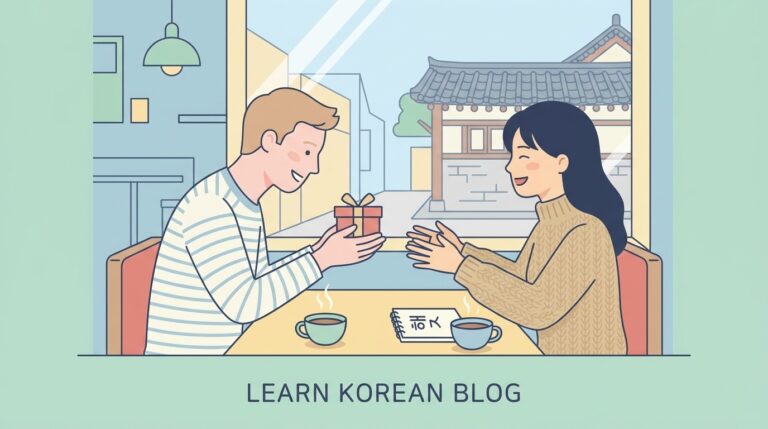
Hello! It’s your Daily Hangul Editor.
Phase 1: Empathy (Immersive K-Culture Cold Open)
Imagine this classic K-Drama scene: It’s the first snowfall of the year. The male lead awkwardly pulls out a beautifully wrapped box from his coat pocket, hands it to the female lead without making eye contact, rubs the back of his neck, and mutters a few words. The English subtitles simply read, “I got this for you.”
But if you listen closely, he didn’t just say “I got this for you.” He used a phrase that translates to “I wish this enters your heart.”
Giving a gift in Korea isn’t just about the physical item; it’s a delicate dance of showing affection (정 – Jeong) while trying not to burden the receiver. If you’ve ever wanted to give a souvenir to your Korean friend, a fan letter to your favorite K-Pop idol, or a small thank-you snack to a helpful Airbnb host, handing it over in silence can feel a bit awkward.
Knowing exactly what to say will instantly upgrade you from “polite foreigner” to “someone who truly understands Korean culture.” This guide is based on real questions from our A1 (beginner) students who wanted to express their gratitude perfectly. Let’s dive in!
Phase 2: Core Expression Deep Dive
1. 마음에 들면 좋겠어요 (I hope you like it)
- Pronunciation: [ma-eu-me deul-myeon jo-ket-seo-yo]
Sound-alike guide: ma-eu-meh (the ‘eu’ sounds like the disgusted sound you make when stepping in gum) deul-myun jo-ket-so-yo.- Meaning:
- Literal: I wish it enters your mind/heart.
- Real nuance: I hope you like it / I hope this pleases you.
- K-Culture Moment: This is the ultimate “heart-fluttering” phrase. You’ll hear this at K-Pop fan meetings when a fan gives a handmade gift to an idol, or when someone brings a housewarming gift to a new apartment.
- Editor’s Insight: The word 마음 (ma-eum) means mind, heart, or feelings. In Korean, when you like something, you don’t just “like” it; it “enters your heart.” It sounds so poetic, right?
- Situation Spectrum:
- Friends (Casual – drop the ‘yo’): ✅
- Co-workers (Semi-formal): ✅
- Boss/Elders (Formal): ✅
- 🤔 Think About It: Why does Korean language focus on the receiver’s “heart/feelings” rather than the giver’s action of buying the gift? What does this say about Korean empathy?
2. 작은 선물이에요 (It’s a small gift)
- Pronunciation: [ja-geun seon-mu-ri-e-yo]
Sound-alike guide: ja-geun sun-moo-ree-eh-yo.- Meaning:
- Literal: It is a small gift.
- Real nuance: It’s just a little something for you (used to show modesty).
- K-Culture Moment: A colleague goes on a trip to Jeju Island and brings back two massive boxes of premium oranges. They will still hand it to the boss and say, “It’s a small gift.”
- Editor’s Insight: This is the golden shield against making the receiver feel burdened. Even if you bought a luxury handbag, calling it a “small gift” is considered good manners!
- Situation Spectrum:
- Friends (Casual): ✅
- Co-workers (Semi-formal): ✅
- Boss/Elders (Formal): ✅
- 🤔 Think About It: In your culture, do people downplay the value of their gifts, or do they hype them up (“I searched everywhere for this!”)?
3. 별거 아니에요 (It’s nothing special)
- Pronunciation: [byeol-geo a-ni-e-yo]
Sound-alike guide: byul-go ah-nee-eh-yo.- Meaning:
- Literal: It is not a special thing.
- Real nuance: It’s no big deal / Don’t worry about it.
- K-Culture Moment: You give your language exchange partner a snack from your home country. They gasp and say, “Oh my gosh, you didn’t have to!” You wave your hands and say, “Ah, 별거 아니에요.”
- Editor’s Insight: This phrase is the perfect humble response when someone is overly thankful. It shows you’re generous and easygoing.
- Situation Spectrum:
- Friends (Casual): ✅
- Co-workers (Semi-formal): ✅
- Boss/Elders (Formal): ⚠️ (Better to say “약소합니다” – but that’s too advanced for now! Stick to younger or peer groups for this one).
Phase 3: Textbook vs Real Korean
[Giving a Souvenir to a Friend]
* 📖 Textbook Korean: 당신을 위해 선물을 준비했습니다. (I prepared a gift for you.)
* 🗣️ Real Korean: 이거 별거 아닌데… 마음에 들면 좋겠어요. (This is nothing much, but… I hope you like it.)
* 💡 Why the difference?: Using “당신” (you) sounds like a translated English book or a police interrogation. Real Koreans use modesty and the “it’s nothing much” opener to reduce pressure.
[When They Thank You Profusely]
* 📖 Textbook Korean: 천만에요. (You’re welcome.)
* 🗣️ Real Korean: 에이~ 아니에요! (Ey~ No, it’s nothing!)
* 💡 Why the difference?: “천만에요” is almost entirely dead in spoken Korean. Brushing off the thanks playfully with “아니에요” (No) is the ultimate native-like reaction.
Phase 4: Cultural Context — K-Culture Deep Dive
4-1. The Non-Verbal Language of Gifting
Language is only half the battle. In Korea, the way you hand over the gift is just as important as what you say.
– Two Hands Rule: Always give and receive gifts with both hands. If one hand is occupied, place your left hand lightly under your right elbow or wrist while handing it over. It’s a sign of deep respect.
– The “Nunchi” of Opening: In many Western cultures, you rip the gift open immediately to show excitement. In Korea, traditionally, people open gifts later in private to avoid showing disappointment if they don’t like it, or to avoid appearing greedy. However, among young people today, it’s okay to ask, “지금 열어봐도 돼요?” (Can I open it now?).
4-2. The K-Drama Connection: The “Tsundere” Trope
Have you noticed a K-Drama trope where a character acts cold but is secretly warm-hearted? This is called a Tsundere.
A classic line they use when throwing a gift at someone is: “오다 주웠어” (I picked it up on the way).
It means, “I didn’t go out of my way to buy this for you; I literally just found it on the street, so take it.” It’s the ultimate exaggerated form of Korean modesty!
Warning: Only use this jokingly with very close friends, otherwise they might actually think you gave them trash from the street! 🤣
Phase 5: Real-Life Roleplay Scenario
Setting: Saturday afternoon, 2 PM. A minimalist, aesthetic cafe in Yeonnam-dong (Hongdae area). You are meeting your Korean language exchange partner, Ji-min, right before you fly back to your home country. You bought her a small hand cream as a thank-you gift.
Characters:
– YOU: A beginner Korean learner, excited but slightly nervous.
– Ji-min (25): Your Korean friend. Warm, supportive, and loves giving reactions.
Dialogue:
Ji-min: 벌써 가다니 너무 아쉬워요! 😭
(beol-sseo ga-da-ni neo-mu a-swi-wo-yo!)
[I’m so sad that you’re leaving already!]
YOU: 저도요. 지민 씨, 이거… 작은 선물이에요. 🎁
(jeo-do-yo. ji-min ssi, i-geo… ja-geun seon-mu-ri-e-yo.)
[Me too. Ji-min, this… is a small gift.]
(🎭 Stage Direction: You hand a beautifully wrapped little bag to her with both hands.)
Ji-min: 헐! 대박! 진짜요? 안 주셔도 되는데!
(heol! dae-bak! jin-jja-yo? an ju-syeo-do doe-neun-de!)
[Gasp! Awesome! Really? You didn’t have to give me anything!]
🔀 Your Turn! How should you respond?
– A) 네, 엄청 비싼 거예요. (Yes, it’s very expensive.)
– B) 별거 아니에요. 마음에 들면 좋겠어요. (It’s nothing special. I hope you like it.)
– C) 천만에요. (You’re welcome.)✅ Best Choice: B — Reason: It perfectly balances modesty (“It’s nothing special”) with care (“I hope you like it”).
⚠️ Choice A Analysis: Bragging about the price is considered a huge faux pas!
⚠️ Choice C Analysis: Sounds too robotic and textbook-like.
(Continuing with Choice B)
YOU: 별거 아니에요. 마음에 들면 좋겠어요. 😊
(byeol-geo a-ni-e-yo. ma-eu-me deul-myeon jo-ket-seo-yo.)
[It’s nothing special. I hope you like it.]
Ji-min: 지금 열어봐도 돼요?
(ji-geum yeo-reo-bwa-do dwae-yo?)
[Can I open it now?]
YOU: 네! 당연하죠.
(ne! dang-yeon-ha-jyo.)
[Yes! Of course.]
Ji-min: 와! 제가 진짜 좋아하는 브랜드예요! 고마워요!
(wa! je-ga jin-jja jo-a-ha-neun beu-raen-deu-ye-yo! go-ma-wo-yo!)
[Wow! It’s a brand I really like! Thank you!]
Phase 6: 10-Second Shadowing Drill
Let’s practice your pronunciation! Follow the slashes for pauses, and try to mimic the emotion.
- 😊 Bright & Modest: 이거 / 별거 / 아니에요.
(i-geo / byeol-geo / a-ni-e-yo) - 🥺 Sincere & Caring: 마음에 / 들면 / 좋겠어요~
(ma-eu-me / deul-myeon / jo-ket-seo-yo) - 🤲 Polite & Formal: 작은 / 선물이에요.
(ja-geun / seon-mu-ri-e-yo)
Phase 7: K-Culture Mini Dictionary
1. 정 (Jeong)
* Romanization: jeong
* English: Deep emotional connection / affection
* Context: The core of Korean relationships. Giving a small gift or even sharing your food is a way of “giving Jeong.”
2. 부담 (Budam)
* Romanization: bu-dam
* English: Burden / Pressure
* Context: Koreans hate causing budam to others. That’s why we say “It’s a small gift” to remove the pressure of receiving something grand.
3. 눈치 (Nunchi)
* Romanization: nun-chi
* English: Social situational awareness
* Context: Having “quick Nunchi” means knowing when to open a gift right away to please the giver, or when to save it for later so you don’t look greedy.
4. 기념품 (Ginyeompum)
* Romanization: gi-nyeom-pum
* English: Souvenir
* Context: A highly popular item to give friends and colleagues when returning from a trip.
Phase 8: Traveler Survival Kit
If you’re traveling in Korea, you’ll likely be buying gifts to bring back home. Here are the top phrases you need when shopping in Myeongdong, Insadong, or a local Kakao Friends store!
🆘 Survival Phrases for Gift Shopping
– 🇰🇷 “선물용이에요. 포장해 주세요.”
(seon-mul-yong-i-e-yo. po-jang-hae ju-se-yo.)
Meaning: It’s for a gift. Please wrap it.
– 🇰🇷 “제일 잘 나가는 게 뭐예요?”
(je-il jal na-ga-neun ge mwo-ye-yo?)
Meaning: What is the best seller?
– 🇰🇷 “이거 새 걸로 주세요.”
(i-geo sae geol-lo ju-se-yo.)
Meaning: Please give me a new one (not the display item).📌 Editor’s Travel Note
– Duty-Free Packaging: If you buy cosmetics in bulk in tourist areas, they often throw in free samples (서비스 – “Service”). You can use these tiny samples as cute mini-gifts for your coworkers back home!
– No Tipping! Remember, if you love a store’s service, do not try to give the cashier a tip as a “gift.” Tipping does not exist in Korea and will only cause confusion.
Phase 9: Critical Thinking Corner — “One Step Deeper”
🧠 Think Deeper: Language & Power (The Culture of Modesty)
Have you ever wondered why Koreans almost never admit that their gift is amazing? If you say, “I bought you the best necklace in the world,” it places an immediate emotional debt on the receiver. By using phrases like “별거 아니에요 (It’s nothing special)” and “마음에 들면 좋겠어요 (I just hope it enters your heart),” the giver lowers their own status and elevates the receiver. It’s a linguistic way of saying, “Our relationship is more important than the money I spent on this.”💬 Your Turn: In your culture, when you give a gift, do you highlight how hard you worked to find it, or do you play it down like Koreans do? Share in the comments below!
Phase 10: FAQ & Common Mistakes
Q: Can I use this phrase with a K-Pop idol at a fan signing event?
Yes! Idols will love it. Hand them your fan letter or small gift and warmly say: “마음에 들면 좋겠어요!” It shows immense respect and affection.
Q: Should I wrap the gift in a specific color?
Avoid wrapping gifts with solid black or white paper, as these colors are traditionally associated with funerals in Korea. Bright colors or aesthetic pastel wrapping are always safe bets!
❌ Common Mistake #1: Handing over a gift with one hand (especially your left hand) while looking away.
✅ How to fix it: Always use two hands! If you are giving it to someone older or a boss, bow slightly as you offer it.❌ Common Mistake #2: Saying “당신을 위해 샀어요” (I bought this for you).
✅ How to fix it: The word 당신 (you) sounds very confrontational in spoken Korean. Simply drop the “you” entirely! Just say “작은 선물이에요” (It’s a small gift).
Phase 11: Summary & Action Items
- One-Liner Summary: When giving a gift in Korea, stay humble and focus on their feelings by saying, “마음에 들면 좋겠어요 (I hope you like it).”
-
Action Mission 3 Steps:
- 🥉 Bronze (Solo): Stand in front of your mirror, hold out a random object with both hands, and say “마음에 들면 좋겠어요” three times out loud.
- 🥈 Silver (Online): Go to your favorite Korean celebrity’s Instagram or Weverse, and leave a comment with: “우리 팬들의 마음이에요. 마음에 들면 좋겠어요!” (This is our fans’ hearts. I hope you like it!).
- 🥇 Gold (Real-Life): The next time you meet your Korean friend or tutor, give them a small candy or snack and use this exact phrase!
- K-Culture Mission: Watch any K-Drama episode this week. I guarantee you will spot a scene where someone gives a gift. Watch their body language—did they use two hands? Did they look shy?
Phase 12: Quiz — Interactive Challenge
1. Situational Judgment: You bought a nice box of cookies for your Korean manager. You walk up to their desk, hand it over with both hands, and say:
* A) 제 돈 많이 썼어요. (I spent a lot of my money.)
* B) 작은 선물이에요. 마음에 들면 좋겠어요. (It’s a small gift. I hope you like it.)
* C) 오다 주웠어요. (I picked it up on the street.)
2. True or False – K-Culture Edition:
In Korea, it is considered rude to call your gift “small” or “nothing special” because it means you didn’t care about the person.
* [True / False]
3. Fill in the Blank:
If your friend thanks you for a gift, instead of textbook “천만에요” (You’re welcome), a natural Korean would say “에이, [ ] 아니에요!” (Ey, it’s nothing special!).
(Answers: 1. B – A is rude, C is too casual/joking for a manager. 2. False – It’s a sign of modesty! 3. 별거 (byeol-geo))
Frequently Asked Questions (FAQ)
Q: What does "마음에 들면 좋겠어요 (I hope you like it)" mean in Korean and how do you pronounce it?
A: In Korean, "마음에 들면 좋겠어요 (I hope you like it)" is pronounced [ma-eu-me deul-myeon jo-ket-seo-yo] and means: Literal: I wish it enters your mind/heart.
Q: What does "작은 선물이에요 (It's a small gift)" mean in Korean and how do you pronounce it?
A: In Korean, "작은 선물이에요 (It's a small gift)" is pronounced [ja-geun seon-mu-ri-e-yo] and means: Literal: It is a small gift.
Q: What does "별거 아니에요 (It's nothing special)" mean in Korean and how do you pronounce it?
A: In Korean, "별거 아니에요 (It's nothing special)" is pronounced [byeol-geo a-ni-e-yo] and means: Literal: It is not a special thing.







