

Phase 1: Empathy (Immersive Opening)
Greeting: Hello! This is the Lead Editor of Daily Hangul.
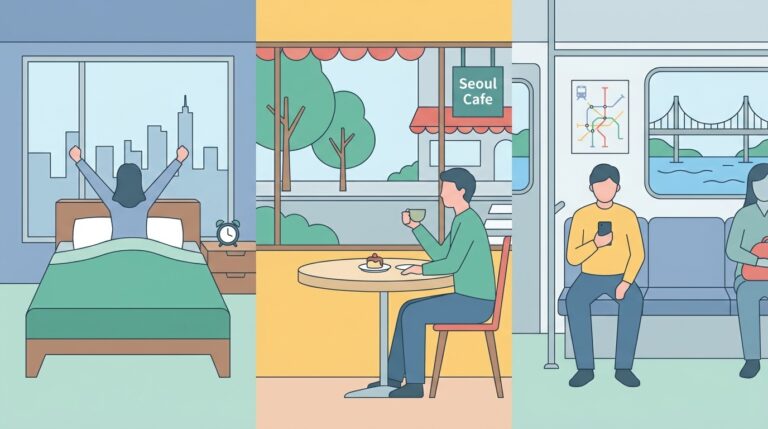
Have you ever watched your favorite K-Pop idol’s “Day in the Life” vlog on YouTube? You watch them wake up with perfectly messy hair, head to the dance studio, eat a salad, and then practice until 2 AM. In the subtitles, it says, “First I practice, and then I eat, and after that…”
But when you try to talk about your own day in Korean, do you feel like a broken robot? “I wake up. I eat. I sleep.” It sounds a bit choppy, right?
Connecting your daily routines smoothly is the secret to sounding like a natural Korean speaker instead of a textbook. Whether you are explaining your travel itinerary to a taxi driver or sharing your busy day with a new Korean friend over an Americano, mastering the sequence of time is your golden key. Don’t worry! I’ve seen countless students struggle with this, and today, I’ll show you exactly how to make your sentences flow perfectly.
Phase 2: Core Expressions Deep Dive
Let’s look at the top 3 expressions you need to sequence your day perfectly.
1. 먼저 (First) / 마지막으로 (Lastly)
- Pronunciation: [meon-jeo] / [ma-ji-mak-eu-ro]
- meon sounds like ‘run’ with an ‘m’, and jeo is a soft ‘joe’.
- Meaning: First (to start the sequence) / Lastly (to end it).
- K-Culture Moment: Think of a K-Beauty YouTube tutorial. The creator always starts with: “먼저, 스킨을 바릅니다 (First, I apply toner),” and ends with “마지막으로, 선크림을 바릅니다 (Lastly, I apply sunscreen).”
- Editor’s Insight: This sets the structure of your story.
먼저acts as the grand opening, letting the listener know you are starting a list of events.- Situation Spectrum:
- Casual with friends: ✅ (Perfect)
- Co-workers (Semi-formal): ✅ (Very clear)
- Boss/Elders (Formal): ✅ (Professional)
- 🤔 Think About It: Why do Koreans love making ordered lists when talking? Could it be related to Korea’s “Ppalli-Ppalli” (hurry-hurry) culture, where efficiency in communication is highly valued?
2. 그 다음에 (Next / After that)
- Pronunciation: [geu da-eum-e]
- geu sounds like the ‘goo’ in ‘good’, da like ‘ah’, eum sounds like humming ‘mmm’.
- Meaning: Literally “at that next (time),” used to say “Next” or “After that.”
- K-Culture Moment: In K-Dramas, when detectives are interrogating a suspect about their alibi: “So you left the cafe… 그 다음에 어디 갔어?! (Where did you go after that?!)”
- Editor’s Insight: If you use this instead of repeating “그리고 (and)” a hundred times, your Korean immediately levels up from A1 to A2.
- Situation Spectrum:
- Casual with friends: ✅ (Often shortened to just ‘다음에’)
- Co-workers (Semi-formal): ✅
- Boss/Elders (Formal): ✅
- 🤔 Think About It: “다음” means ‘next’. Do you have a similar phrase in your language that links events using the concept of “next”?
3. -고 나서 (After doing ~)
- Pronunciation: [-go na-seo]
- go like ‘go’, na like ‘nah’, seo like ‘saw’ (but cut short).
- Meaning: Attached to a verb stem to emphasize that one action has completely finished before the next one starts.
- K-Culture Moment: Your Korean mom or friend nagging you: “밥 먹고 나서 숙제해! (Do your homework after you finish eating!)”
- Editor’s Insight: While
-고just means “and,” adding나서makes the sequence strictly chronological. It feels like checking off a box on your to-do list.- Situation Spectrum:
- Casual with friends: ✅
- Co-workers (Semi-formal): ✅
- Boss/Elders (Formal): ✅ (Just make sure the final verb matches the polite level)
- 🤔 Think About It: Why do we need a specific grammar point to show an action is completely finished? It shows how much weight Korean culture places on doing things properly, step by step.
Phase 3: Textbook vs. Real Korean
Let’s see how the textbook differs from the streets of Seoul!
[Linking Actions Together]
* 📖 Textbook Korean: 저는 아침을 먹습니다. 그리고 학교에 갑니다. (jeoneun achimeul meokseumnida. geurigo hakgyoe gamnida.) – I eat breakfast. And I go to school.
* 🗣️ Real Korean: 아침 먹고(나서) 학교 가요. (achim meokgo(naseo) hakgyo gayo.) – I eat breakfast and then go to school.
* 💡 Why the difference?: Koreans love efficiency. We drop the object particles (을/를) in speech and combine sentences to get to the point faster!
[Saying “First”]
* 📖 Textbook Korean: 첫 번째로 (cheot beon-jjae-ro) – Firstly
* 🗣️ Real Korean: 일단 (il-dan) or 먼저 (meon-jeo) – For now / First of all
* 💡 Why the difference?: “첫 번째로” sounds like you are giving a formal PowerPoint presentation. In daily life, “일단” is the ultimate “let’s just do this first” vibe.
Bottom Note: At the A2 level, focus on using
-고and그 다음에to connect your sentences. Avoid the trap of saying “그리고… 그리고… 그리고…” all the time!
Phase 4: Cultural Context — K-Culture Deep Dive
4-1. Non-Verbal Elements
When Koreans list their daily schedule, watch their hands! Unlike in many Western cultures where people start counting on their index finger, Koreans start counting by folding their thumb inward, then the index finger, then the middle finger. Try doing this while saying “먼저, 그 다음에, 마지막으로!”
4-2. K-Culture Connection: The “God-saeng” Vlog
If you search “브이로그 (Vlog)” on Korean YouTube, you’ll see a massive trend called 갓생 (God-saeng). It’s a combination of the English word “God” and the Korean word “생 (saeng – life)”. It means living an incredibly productive, disciplined daily life.
In these vlogs, creators sequence their routines meticulously:
“먼저 새벽 5시에 일어나요.” (First, I wake up at 5 AM.)
“그 다음에 운동을 해요.” (After that, I exercise.)
“마지막으로 영어 공부를 해요.” (Lastly, I study English.)
Critical View: While “God-saeng” is motivating, it also highlights the immense pressure in Korean society to be constantly productive. Sometimes, a “Day in the Life” should just be: “먼저 자요. 계속 자요.” (First I sleep. I keep sleeping.) And that’s perfectly okay!
Phase 5: Real-world Roleplay Scenario
Setting: Saturday afternoon, 3 PM. You are at a trendy, aesthetic cafe in Yeonnam-dong. The smell of roasted coffee beans fills the air. You are catching up with your Korean language exchange partner, Minji.
Characters:
– YOU: An A2 Korean learner, eager to share your travel plans.
– Minji (26): Your Korean friend, bright, encouraging, always drinking an Iced Americano.
Dialogue:
Minji: 내일 주말인데, 뭐 할 거예요? 😊
(naeil jumarinde, mwo hal geoyeyo?)
[Tomorrow is the weekend, what are you going to do?]
YOU: 내일 엄청 바빠요. 먼저 명동에 갈 거예요.
(naeil eomcheong bappayo. meonjeo myeongdonge gal geoyeyo.)
[I’m super busy tomorrow. First, I’m going to Myeongdong.]
Minji: 오, 명동이요! 쇼핑하려고요?
(o, myeongdong-iyo! syopingharyeogoyo?)
[Oh, Myeongdong! To go shopping?]
YOU: 네! 옷을 사고 나서 홍대에 갈 거예요.
(ne! oseul sago naseo hongdaee gal geoyeyo.)
[Yes! After buying clothes, I’m going to Hongdae.]
Minji: 홍대 좋죠! 가서 맛있는 거 먹을 거예요?
(hongdae jochyo! gaseo masinneun geo meogeul geoyeyo?)
[Hongdae is great! Are you going to eat something delicious there?]
🔀 Your Turn! How should you respond to sequence your final plan?
– A) “네. 그리고 마지막으로 한강에 갈 거예요.” (Yes. And lastly, I’ll go to the Han River.)
– B) “네. 밥 먹고 나서 한강에 갈 거예요!” (Yes. After eating, I’ll go to the Han River!)
– C) “아니요. 밥.” (No. Rice.)✅ Best Choice: B — Linking the action she just mentioned (eating) with your next plan using
-고 나서flows incredibly naturally!
⚠️ Choice A Analysis: Perfectly correct and good for A2! But B sounds slightly more conversational.
🚫 Choice C Analysis: Too abrupt! Don’t just shout “Rice!” at Minji!
(Continuing with Choice B)
YOU: 네. 밥 먹고 나서 한강에 갈 거예요!
(ne. bap meokgo naseo hangang-e gal geoyeyo!)
[Yes. After eating, I will go to the Han River!]
Minji: 와, 완벽한 하루네요! 저도 같이 가고 싶어요! 😆
(wa, wanbyeokan haruneyo! jeodo gachi gago sipeoyo!)
[Wow, what a perfect day! I want to go with you!]
Phase 6: 10-Second Shadowing Drill
Time to practice your mouth muscles! Pay attention to the pauses (/).
😊 밝게 (Brightly):
저는 / 먼저 밥을 먹고, / 그 다음에 / 커피를 마셔요!
(jeoneun / meonjeo babeul meokgo, / geu da-eum-e / keopireul masyeoyo!)
I first eat food, and after that, I drink coffee!
Phase 7: K-Culture Mini Dictionary
1. 일상 (Daily Life)
* Romanization: ilsang
* English: Daily life / Everyday routine
* Context: You’ll see this as a hashtag (#일상) on millions of Korean Instagram posts.
2. 갓생 (God-saeng)
* Romanization: gat-saeng
* English: Living a productive, exemplary life
* Context: A modern slang representing the hyper-productive daily routines of younger Koreans.
3. 브이로그 (Vlog)
* Romanization: beu-i-ro-geu
* English: Video blog
* Context: The format where Koreans document their daily routines in order.
4. 야근 (Night Work)
* Romanization: ya-geun
* English: Overtime work (at night)
* Context: The sad reality often placed at the end of a Korean office worker’s daily sequence. “그 다음에… 야근해요.” (After that… I work overtime.)
Phase 8: Traveler’s Survival Kit
When traveling in Korea, you’ll need to explain your daily itinerary to taxi drivers or hotel staff. Knowing sequence words is a lifesaver!
🆘 Survival Phrases for Travel Itineraries
– 🇰🇷 “먼저 서울역으로 가 주세요.” (meonjeo seoullyeogeuro ga juseyo.)
– 🗣️ Meaning: Please go to Seoul Station first.
– 📍 Where to use: In a taxi with multiple stops.
- 🇰🇷 “그 다음에 어디 가요?” (geu da-eum-e eodi gayo?)
- 🗣️ Meaning: Where are we going next?
- 📍 Where to use: Asking your tour guide or Korean friend.
💡 Pro Tip: If a taxi driver asks about your plans, listing them with “먼저…” and “그 다음에…” shows you know exactly where you are going, reducing the chance of miscommunication!
📌 Editor’s Travel Note
– Useful Apps: Use Naver Map or KakaoMap. Google Maps doesn’t show walking/driving routes well in Korea!
– Time Culture: Koreans are extremely punctual. If your itinerary says 2:00 PM, be there at 1:55 PM!
Phase 9: Critical Thinking — “One Step Deeper”
Media vs Reality: The “Vlog” Illusion
🧠 Think Deeper:
If you watch K-Dramas or YouTube vlogs, it seems like young Koreans wake up at 6 AM, run along the Han River, study for 4 hours, and then go to a beautiful cafe. This media portrayal of the perfect “sequence” of a day fuels the “God-saeng” culture. However, the reality for many students and workers is much more exhausting. The heavy reliance on words showing chronological sequence (first this, then that) in daily language might reflect a society that feels pressured to maximize every single minute.💬 Your Turn: Do people in your culture also feel the need to plan every part of their day in a strict sequence? Or is your culture more relaxed about time? Share in the comments!
Phase 10: FAQ & Avoiding Mistakes
Q: Can I just use “그리고 (and)” for everything?
A: Grammatically, yes. But if you say “I woke up. 그리고 I ate. 그리고 I went to work. 그리고…”, it sounds like a children’s book. Mix it up with “그 다음에” or “-고 나서” to sound fluent!
Q: Can I use “먼저 (first)” when talking to my boss?
A: Yes! It’s perfectly polite. In fact, saying “먼저 하겠습니다” (I will do it first / I will go first) is a very common and polite phrase in the office.
❌ Common Mistake #1: Translating “Then” literally as “그러면” (geureomyeon).
✅ Do this instead: “그러면” means “If so” or “In that case.” When talking about time sequences (What you did next), you MUST use 그 다음에.
Phase 11: Summary & Action Items
One-Liner Summary: Use 먼저 (First) to start your day’s story, connect actions with -고 나서 (After doing), and wrap it up with 마지막으로 (Lastly)!
Action Mission:
– 🥉 Bronze (Solo): Write down your morning routine in 3 sentences using 먼저 and 그 다음에.
– 🥈 Silver (Online): Post your Korean daily routine in the comments or on a language exchange app!
– 🥇 Gold (Real-world): Next time you meet a Korean speaker, explain your weekend plans in order!
🎬 K-Culture Mission:
Search “아이돌 브이로그” (Idol Vlog) on YouTube. Turn on the Korean subtitles and see how many times you can spot 먼저 or 그 다음에!
Phase 12: Quiz — Interactive Challenge
1. Situational Judgment:
You are telling your friend about your morning. You woke up, and after that, you drank water. What is the most natural way to say this?
– A) 일어났어요. 그러면 물을 마셨어요.
– B) 일어나고 나서 물을 마셨어요.
– C) 먼저 일어났어요. 마지막으로 물을 마셨어요.
2. Fill in the Blank:
“____ 숙제를 해요. 그 다음에 게임을 해요.”
(_____ I do my homework. After that, I play games.)
3. True or False – K-Culture Edition:
In Korea, the slang “God-saeng” (갓생) refers to someone who is very lazy and sleeps all day. (T / F)
👀 Click here for Answers!
1. B (일어나고 나서). A is wrong because 그러면 means ‘if so’. C is too dramatic for just drinking water.
2. 먼저 (First)
3. False. “God-saeng” is a highly productive, disciplined lifestyle!
Frequently Asked Questions (FAQ)
Q: What does "먼저 (First) / 마지막으로 (Lastly)" mean in Korean and how do you pronounce it?
A: In Korean, "먼저 (First) / 마지막으로 (Lastly)" is pronounced [meon-jeo] and means: a key conversational Korean expression covered in this lesson.
Q: What does "그 다음에 (Next / After that)" mean in Korean and how do you pronounce it?
A: In Korean, "그 다음에 (Next / After that)" is pronounced [geu da-eum-e] and means: a key conversational Korean expression covered in this lesson.
Q: What does "-고 나서 (After doing ~)" mean in Korean and how do you pronounce it?
A: In Korean, "-고 나서 (After doing ~)" is pronounced [-go na-seo] and means: a key conversational Korean expression covered in this lesson.







