

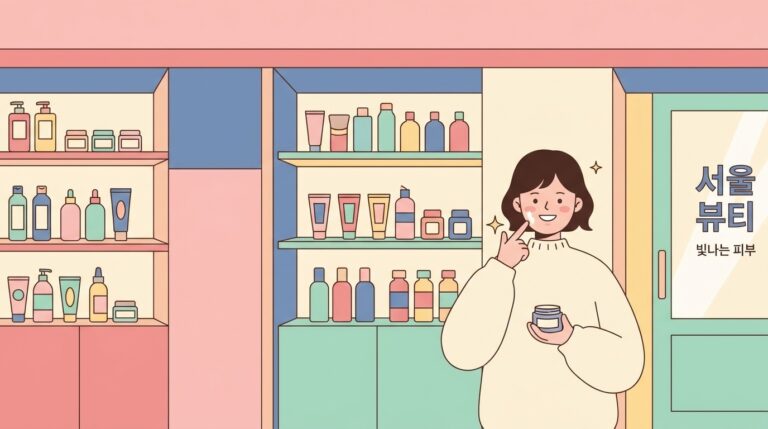
Phase 1: Empathy (Welcome to K-Beauty!)
Hello there! It’s your Daily Hangul Editor. 👋
Picture this: You’re standing in the middle of a brightly lit cosmetics store in Myeongdong, Seoul—maybe a bustling Olive Young. Rows upon rows of serums, toners, and sheet masks surround you. Suddenly, a friendly staff member approaches and asks you a question. You know you want that glowing, dewy “glass skin” you saw in your favorite K-Drama, but you freeze.
“How do I say my face gets super oily by 2 PM?”
I’ve seen so many of my students rely on translation apps or just blindly buy whatever has the prettiest packaging, only to break out the next day. But don’t worry! Knowing just a couple of simple words to express your skin type will not only save your wallet, but it will also get you the VIP “Insider” treatment from the store staff.
This guide is built from the real-life shopping survival stories of my students. Let’s dive in!
Phase 2: Core Expressions Deep Dive
Let’s look at the absolute must-know phrases for expressing your skin type.
1. 저는 건성 피부예요.
- Pronunciation: jeo-neun geon-seong pi-bu-ye-yo. [Sound-alike: juh-neun gun-sung pee-boo-yeh-yo]
- Meaning: I have dry skin. (Literal: I am dry-property skin.)
- K-Culture Moment: Korean winters are notoriously dry! Have you noticed K-Drama characters aggressively spraying facial mists while working at their desks? They are fighting the ultimate enemy: geon-seong (dryness).
- Editor’s Insight: Geon-seong literally means “dry property.” If your skin feels tight after washing, this is your magic word. The staff will immediately guide you to the rich, hydrating creams.
- Situation Spectrum:
- Casual with friends: ✅ (나는 건성 피부야)
- Talking to shop staff (Semi-formal): ✅
- Formal: ✅
- 🤔 Think About It: Koreans love categorizing things to find the perfect match—whether it’s MBTI for personalities, Personal Color for makeup, or Skin Types! Do people in your country categorize skin types this strictly?
2. 저는 지성 피부예요.
- Pronunciation: jeo-neun ji-seong pi-bu-ye-yo. [Sound-alike: juh-neun jee-sung pee-boo-yeh-yo]
- Meaning: I have oily skin.
- K-Culture Moment: You know that perfect matte makeup K-Pop idols have even after dancing under hot stage lights? They use special powders because they know how to handle ji-seong skin!
- Editor’s Insight: Ji-seong is for oily skin. Warning: Never use the word gireum (기름), which is the word for cooking oil or gasoline! If you say “My skin is gireum,” people might think you’re going to fry an egg on your face! 🍳
- Situation Spectrum:
- Casual with friends: ✅
- Talking to shop staff (Semi-formal): ✅
- Formal: ✅
- 🤔 Think About It: Why is having a specific vocabulary for “body oil” vs. “cooking oil” important? It shows how sensitive Korean culture is to personal care and beauty.
3. 촉촉한 거 찾아요.
- Pronunciation: chok-chok-han geo cha-ja-yo. [Sound-alike: choke-choke-hahn guh cha-jah-yo]
- Meaning: I’m looking for something moisturizing/dewy.
- K-Culture Moment: This is the holy grail word of K-Beauty! If you want that “glass skin” (유리알 피부), you need chok-chok.
- Editor’s Insight: Chok-chok is a “mimetic word” (a word that mimics a feeling). Say it with a little bounce in your voice! It feels exactly like patting a wet, bouncy sponge.
- Situation Spectrum:
- Casual with friends: ✅
- Talking to shop staff (Semi-formal): ✅
- Formal: ⚠️ (Better to say: 촉촉한 제품 찾고 있습니다)
- 🤔 Think About It: Korean has hundreds of words that describe feelings, textures, and sounds. How does describing the feeling of a product (chok-chok) work better than just reading its ingredients?
Phase 3: Textbook vs. Real Korean
Let’s compare what you learn in a grammar book versus what you actually hear in the beauty aisles of Hongdae.
[Situation 1: Explaining your skin type]
* 📖 Textbook Korean: 제 피부 타입은 건성입니다. (My skin type is dry.)
* 🗣️ Real Korean: 저 건성인데… (I’m dry, so… [leaves sentence trailing off])
* 💡 Why is it different?: Koreans often use “~인데 (~inde)” to soften their sentences and invite the listener to help them, making it sound much less robotic and much more polite!
[Situation 2: Asking for a recommendation]
* 📖 Textbook Korean: 저에게 맞는 화장품을 추천해 주시겠습니까? (Would you please recommend cosmetics that suit me?)
* 🗣️ Real Korean: (Pointing at face) 지성 피부에 좋은 거 추천해 주세요. (Please recommend something good for oily skin.)
* 💡 Why is it different?: In busy K-Beauty shops, efficiency is key. Dropping unnecessary words like “to me” gets straight to the point while still keeping the polite “ju-se-yo” (please give) at the end.
Bottom Note: At the A2 level, you don’t need perfect grammar to survive. Just pairing the noun (건성/지성) with “추천해 주세요” (Please recommend) makes you sound incredibly natural!
Phase 4: Cultural Context — K-Culture Deep Dive
4-1. Non-Verbal Tips in a Korean Cosmetics Shop
When you talk to the staff, body language is just as important as words.
– The “Hand Back” Test: In Korea, you never test products directly on your face without asking. You usually pump it onto the back of your hand (손등).
– The “Pat, Don’t Rub” Rule (톡톡): When Koreans apply skincare, they don’t rub it in aggressively. They gently pat it with their fingertips. Do this while saying “chok-chok” and the staff will immediately think you’re a K-Beauty pro!
– Nunchi (눈치): If the store is packed and a 1+1 sale is happening, staff members are running around. Use your nunchi (situational awareness)—have your words ready, be quick, and step aside to let others pass.
4-2. The “Olive Young” K-Travel Connection
If you travel to Korea, you will end up in a cosmetics shop. It’s inevitable! Often, tourist shops in Myeongdong have staff who speak English, Japanese, or Chinese. However, using Korean completely changes the dynamic. Instead of seeing you as just another “tourist buyer,” they see you as someone who respects the culture. You might even walk away with extra “saem-peul” (samples)!
Phase 5: Interactive Roleplay Scenario
Setting: Olive Young in Gangnam. 7 PM on a Friday. The store is playing trendy K-Pop. You’ve been staring at a wall of 50 different moisturizers for ten minutes.
Characters:
– YOU: A tourist on day 3 of their Korea trip, desperate for a good face cream but your skin is super oily.
– Sujin: A friendly 20-something store employee wearing a cute green apron.
Dialogue:
Sujin: 찾으시는 제품 있으세요? 😊
(cha-jeu-si-neun je-pum i-sseu-se-yo?)
[English] Are you looking for any specific product?
(🎭 Stage Direction: Sujin approaches you with a little shopping basket.)
YOU: 아, 수분 크림 찾아요.
(a, su-bun keu-rim cha-ja-yo.)
[English] Ah, I’m looking for a moisturizing cream.
Sujin: 고객님 피부 타입이 어떻게 되세요?
(go-gaeng-nim pi-bu ta-i-bi eo-tteo-ke doe-se-yo?)
[English] What is your skin type, customer?
🔀 Your Turn! How do you reply?
– A) “저는 기름이에요!” (jeo-neun gi-reum-i-e-yo!)
– B) “저는 지성 피부예요.” (jeo-neun ji-seong pi-bu-ye-yo.)
– C) “오 마이 갓, 너무 샤이니해요.” (o ma-i gat, neo-mu sya-i-ni-hae-yo.)✅ Best Choice: B — “I have oily skin.” You nailed the proper K-Beauty term!
⚠️ Choice A Analysis: NEVER say this! “Gireum” means cooking oil. Sujin will try very hard not to laugh.
⚠️ Choice C Analysis: Funny Konglish, but she might just offer you a blotting paper instead of a cream.
(Assuming you chose B)
Sujin: 아, 지성 피부시구나! 그럼 끈적거리는 건 싫어하시죠?
(a, ji-seong pi-bu-si-gu-na! geu-reom kkeun-jeok-geo-ri-neun geon si-reo-ha-si-jyo?)
[English] Ah, you have oily skin! Then you probably don’t like sticky things, right?
YOU: 네, 뽀송한 거 추천해 주세요!
(ne, ppo-song-han geo chu-cheon-hae ju-se-yo!)
[English] Yes, please recommend something with a matte/soft finish!
Phase 6: 10-Second Shadowing Drill
Read these out loud! Pay attention to the pauses (/) and the emotions. Let’s practice!
- 🥺 (Asking for help)
저기요, / 저는 건성 피부인데 / 이거 괜찮아요?
(jeo-gi-yo, / jeo-neun geon-seong pi-bu-in-de / i-geo gwaen-cha-na-yo?)
“Excuse me, / I have dry skin so / is this one okay?” -
😤 (When you hate sticky lotions)
저는 / 지성이라서 / 끈적거리는 거 / 싫어요.
(jeo-neun / ji-seong-i-ra-seo / kkeun-jeok-geo-ri-neun geo / si-reo-yo.)
“Because I am / oily skin / sticky stuff / I hate it.” -
😊 (Sounding like a K-Beauty Pro)
수분 가득하고 / 촉~~~촉한 제품 / 추천해 주세요!
(su-bun ga-deu-ka-go / chok~~~cho-kan je-pum / chu-cheon-hae ju-se-yo!)
“Full of moisture and / deeeeewy products / please recommend!”
Phase 7: K-Culture Mini Dictionary
Master these keywords, and you are officially a K-Beauty Insider!
1. 올영
* Romanization: Ol-yeong
* English: Short for “Olive Young”
* Context: The dominant health & beauty store in Korea. Saying “Let’s go to Ol-yeong” makes you sound like a true Seoul local.
2. 뽀송뽀송
* Romanization: Ppo-song-ppo-song
* English: Soft, matte, dry (in a good way)
* Context: The opposite of chok-chok (dewy). If you have oily skin (ji-seong), you want products that leave your face feeling ppo-song-ppo-song like a baby’s cheek.
3. 원플원
* Romanization: Won-peul-won
* English: 1+1 (Buy One Get One Free)
* Context: Korean shops love BOGO sales. Look for the red tags that say “1+1”!
4. 쌩얼
* Romanization: Ssaeng-eol
* English: Bare face (no makeup)
* Context: Good skincare is so you can be confident with your ssaeng-eol. It’s a common slang you’ll hear in K-Dramas when someone is hiding from their crush because they have no makeup on.
Phase 8: Travel Survival Kit
Are you planning to buy cosmetics in Seoul? Keep these flashcards handy!
🆘 Survival Phrase #1: Finding Testers
– 🇰🇷 “이거 테스터 있어요?” (i-geo te-seu-teo i-sseo-yo?)
– 🗣️ Sound-alike: ee-guh teh-seu-tuh ee-sseo-yo?
– 📍 Where to use: Anytime you want to try a color or texture.
– 💡 Pro Tip: Never open a sealed box! Always look for the bottle with “TESTER” written on it.🆘 Survival Phrase #2: Freebies!
– 🇰🇷 “샘플 좀 더 주실 수 있어요?” (saem-peul jom deo ju-sil su i-sseo-yo?)
– 🗣️ Sound-alike: sam-ple johm duh joo-shil soo ee-sseo-yo?
– 📍 Where to use: At the checkout counter (especially in standalone brand shops).
– 💡 Pro Tip: Say this with a big smile! Koreans love giving “service” (free extras) to friendly customers.📌 Editor’s Travel Note
– Tax Refund: Always bring your physical passport! Most big cosmetics stores like Olive Young offer “Immediate Tax Refund” right at the register. Just say “Tax-free ju-se-yo.”
– Bags: Plastic/paper bags are not free in Korea. They cost around 100 won. The cashier will ask “Bong-tu pi-ryo-ha-se-yo?” (Do you need a bag?). Just nod and say “Ne!”
Phase 9: Critical Thinking Corner — “One Step Deeper”
Media vs Reality (K-Beauty’s “Glass Skin” Illusion)
🧠 Think Deeper:
If you watch K-Dramas, you might think Koreans just wake up with flawless, poreless “glass skin.” However, the reality is that K-Beauty is built on an intense culture of self-discipline and care. It’s not just one magic cream; it’s a 7-step nightly routine, eating healthy foods, wearing sunscreen strictly, and frequent visits to the dermatologist. When a Korean asks about your skin type, they aren’t just selling a product; they are treating skincare like a science to solve a specific problem.💬 Your Turn: Does your culture value “quick fix” makeup to cover flaws, or “long-term” skincare like Korea? Share your thoughts in the comments!
Phase 10: FAQ & Mistake Prevention
Q: Can I just say “Dry” or “Oily” in English?
Yes! Most staff in tourist areas know basic English. However, saying geon-seong (dry) or ji-seong (oily) immediately signals that you know K-beauty, and they will usually recommend higher-quality, specialized products rather than generic tourist best-sellers.
Q: Is it rude to test a product and walk out without buying?
Not at all! “Window shopping” is completely fine. Just say “gam-sa-ham-ni-da” (Thank you) and walk out.
❌ Common Mistake #1: Saying “제 얼굴은 드라이해요.” (My face is dry.)
✅ Do this instead: “드라이 (Deu-ra-i)” usually refers to a hair dryer or dry cleaning in Korea! Always use 건성 (geon-seong) for skin.❌ Common Mistake #2: Applying a tester directly to your lips or eyes.
✅ Do this instead: For hygiene, always test lipsticks or eyeshadows on the back of your hand.
Phase 11: Summary & Action Items
One-Liner Summary: To get the best skincare in Korea, remember your team: Team Dry (Geon-seong) or Team Oily (Ji-seong), and ask for it to be Dewy (Chok-chok).
Your Action Missions for Today:
– 🥉 Bronze (Solo): Look at your face in the mirror right now and declare your skin type in Korean out loud 3 times!
– 🥈 Silver (Online): Find your favorite K-Beauty YouTuber and leave a comment using “저는 건성이에요” or “저는 지성이에요.”
– 🥇 Gold (Real World): Visit a Korean cosmetics store (or a K-Beauty website) and navigate straight to the section that fits your Korean skin type!
K-Culture Special Mission:
Go open your makeup bag right now. Find one Korean product, look at the back label, and try to find the word 건성 or 지성!
What is your skin type in Korean? Let me know in the comments below so we can share product recommendations! 👇
Phase 12: Quiz — Interactive Challenge
Let’s see if you’re ready for your shopping spree!
1. Situational Judgment:
It’s mid-July in Seoul. It’s hot and humid. Your face feels like an oil slick. What should you say to the staff?
– A) 저는 건성 피부예요. (jeo-neun geon-seong pi-bu-ye-yo.)
– B) 저는 지성 피부예요. (jeo-neun ji-seong pi-bu-ye-yo.)
– C) 저는 쌩얼이에요. (jeo-neun ssaeng-eol-i-e-yo.)
2. Fill in the Blank:
I want that K-Drama glass skin look! I should ask for a product that is ________.
– A) 촉촉한 거 (chok-chok-han geo)
– B) 뽀송한 거 (ppo-song-han geo)
– C) 매운 거 (mae-un geo)
3. True or False – K-Culture Edition:
You should always use the word 기름 (gireum) to describe your oily skin. (True / False)
Click here for the Answers!
1. B – Your skin is oily (ji-seong). A is dry, and C means bare face!
2. A – You want chok-chok (dewy). B is matte, and C means spicy (please don’t put spicy stuff on your face!).
3. False – “Gireum” is for frying chicken! Use “ji-seong” for your skin.
Frequently Asked Questions (FAQ)
Q: What does "저는 건성 피부예요." mean in Korean and how do you pronounce it?
A: In Korean, "저는 건성 피부예요." is pronounced [jeo-neun geon-seong pi-bu-ye-yo. [Sound-alike: juh-neun gun-sung pee-boo-yeh-yo] and means: I have dry skin. (Literal: I am dry-property skin.)
Q: What does "저는 지성 피부예요." mean in Korean and how do you pronounce it?
A: In Korean, "저는 지성 피부예요." is pronounced [jeo-neun ji-seong pi-bu-ye-yo. [Sound-alike: juh-neun jee-sung pee-boo-yeh-yo] and means: I have oily skin.
Q: What does "촉촉한 거 찾아요." mean in Korean and how do you pronounce it?
A: In Korean, "촉촉한 거 찾아요." is pronounced [chok-chok-han geo cha-ja-yo. [Sound-alike: choke-choke-hahn guh cha-jah-yo] and means: I'm looking for something moisturizing/dewy.







