

Phase 1: Empathy (The K-Culture Cold Open)
Hello! I’m the lead editor of Daily Hangul, your Korean tutor and local culture navigator.
Imagine this: You’re watching a tense family drama on TV. The mother-in-law is consulting a mudang (traditional shaman) to pick an auspicious wedding date, while the future daughter-in-law, clutching her cross necklace, insists on a modern church wedding. Or perhaps you’ve been walking near Gangnam Station, and someone approaches you with a polite smile, asking, “도를 아십니까?” (Do you know the Way?).
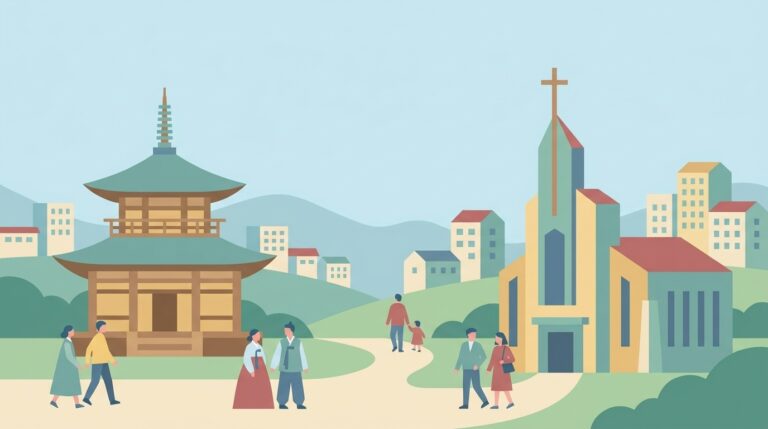
Korea is a fascinating, multi-religious society where Buddha’s Birthday and Christmas are both national holidays, and where skyscrapers share the skyline with neon red crosses and serene temple roofs. But beneath this peaceful coexistence, there are complex layers of cultural compromise and subtle conflicts—especially during traditional holidays like Chuseok, where Confucian ancestral rites (Jesa) clash with modern religious beliefs.
At the C2 level, you’re not just saying “I am Buddhist” or “I don’t go to church.” You need to navigate deep socio-cultural discussions, understand family dynamics, and express your thoughts on inclusivity and boundaries. This guide is crafted from real questions asked by advanced learners who want to discuss faith, philosophy, and society like a true intellectual in Korea. Let’s dive in!
Phase 2: Deep Dive into Core Expressions
Here are the top advanced expressions to discuss religious harmony and boundaries in Korea.
1. 제사 대신 추도 예배를 드려요
- Pronunciation: jesa daesin chudo yebae-reul deuryeoyo [jeh-sah dae-shin choo-doh yeh-bae-reul deu-ryuh-yo]
- Meaning: We hold a memorial service instead of traditional ancestral rites.
- K-Culture Moment: The ultimate Korean holiday compromise! In K-Dramas, you’ll often see families arguing over bowing to an ancestral table. Many Christian families in Korea adapt this by gathering around the table, but singing hymns and praying (추도 예배) instead of bowing and offering rice wine.
- Editor’s Insight: This phrase beautifully captures ‘Koreanized’ religion. It shows respect for the Confucian tradition of honoring ancestors while maintaining Christian theological boundaries.
- Situation Spectrum:
- Close Friends (Casual): ✅ (Perfect for explaining your holiday plans)
- Coworkers (Semi-formal): ✅
- Elders/Superiors (Formal): ✅ (Highly polite and respectful)
- 🤔 Think About It: How does religion bend to fit local culture? Why do you think Korean Christians kept the ‘gathering to honor ancestors’ aspect but changed the format?
2. 배타적인 태도는 지양해야 합니다
- Pronunciation: baetajeogin taedo-neun jiyanghaeya hamnida [bae-tah-juh-gin tae-doh-neun jee-yang-hae-yah ham-nee-dah]
- Meaning: We must avoid/reject exclusive attitudes.
- K-Culture Moment: Imagine a university debate club or a sophisticated podcast discussing social harmony. When discussing inter-religious conflicts, criticizing someone for being ‘closed-minded’ sounds basic. Using ‘배타적’ (exclusive/cliquish) elevates your intellect.
- Editor’s Insight: Pay attention to ‘지양하다’ (to avoid/reject). It sounds incredibly similar to ‘지향하다’ (to pursue/aim for), but means the exact opposite! At the C2 level, mastering these Hanja-based nuances is crucial.
- Situation Spectrum:
- Close Friends (Casual): ⚠️ (A bit too academic for a pub chat)
- Coworkers (Semi-formal): ✅ (Great for serious discussions)
- Elders/Superiors (Formal): ✅ (Excellent in formal debates or essays)
- 🤔 Think About It: In a society that heavily values Jeong (정 – deep collective bonding), how does an ‘exclusive’ religious group disrupt the social fabric?
3. 종교를 강요하는 건 부담스러워요
- Pronunciation: jonggyo-reul gangyohaneun geon budamseureowoyo [jong-gyoh-reul gahng-yoh-hah-neun geon boo-dahm-seu-ruh-wo-yo]
- Meaning: It’s burdensome/uncomfortable when religion is forced upon me.
- K-Culture Moment: You’re on a blind date (소개팅), and the person keeps insisting you come to their church next week. This phrase is the polite but firm “stop right there.”
- Editor’s Insight: ‘부담스럽다’ is the magical Korean word for “This is crossing my boundaries and causing me emotional pressure.” It softens the blow of a direct rejection while making your discomfort very clear.
- Situation Spectrum:
- Close Friends (Casual): ✅
- Coworkers (Semi-formal): ✅
- Elders/Superiors (Formal): ⚠️ (Use with caution; better to just change the subject with elders)
- 🤔 Think About It: Why do Koreans prefer saying “it’s burdensome” rather than “I hate it” or “Stop doing that”?
Phase 3: Textbook vs. Real Korean
How do Koreans actually handle religious situations in real life? Let’s compare.
[Situation 1: Declining an aggressive street evangelist]
* 📖 Textbook Korean: 저는 다른 종교를 믿고 있습니다. (I believe in another religion.)
* 🗣️ Real Korean: 아, 저 교회 다녀요. (Ah, I already go to church.) / 괜찮습니다~ 바빠서요. (It’s okay~ I’m busy.)
* 💡 Why the difference?: Telling an evangelist “I have another religion” invites a debate. Saying “I already go to your type of religion” or just “I’m busy” shuts the conversation down efficiently.
[Situation 2: Explaining family drama during the holidays]
* 📖 Textbook Korean: 우리 가족은 종교적인 차이로 갈등을 겪습니다. (My family experiences conflict due to religious differences.)
* 🗣️ Real Korean: 이번 명절에도 집안에 제사 문제로 난리 났어요. (This holiday, the family was in an uproar again over the Jesa issue.)
* 💡 Why the difference?: ‘난리 났다’ (in an uproar/chaos) is the perfect colloquial way to express family drama without sounding like a news anchor.
(Bottom Note: As a C2 learner, blending high-level vocabulary with natural conversational idioms like ‘난리 났다’ makes you sound like a true native.)
Phase 4: Cultural Context — K-Culture Deep Dive
4-1. Non-Verbal Cues & Nunchi
When discussing religion in Korea, Nunchi (the art of reading the room) is paramount. Religion is rarely brought up in the workplace. If an older person invites you to their religious event, directly saying “No, I don’t believe in that” can be seen as attacking their Kibun (mood/pride). The non-verbal trick? A polite, apologetic smile, a slight bow, and an excuse about a “prior family commitment.”
4-2. The K-Drama Connection: The ‘Shaman’ Trope
Even in a highly modernized, multi-religious society, traditional shamanism (무속신앙) thrives in the shadows. Have you noticed in K-Dramas how politicians, wealthy CEOs, and desperate mothers quietly visit a Jeomjip (fortune-telling house)? They might be devout Christians or Buddhists by day, but when their child’s university entrance exam approaches, they secretly buy a talisman (부적). This highlights a unique Korean mindset: religion is often approached pragmatically, seeking blessings for the present life (기복신앙 – prosperity faith) rather than just spiritual salvation.
Phase 5: Real-Life Roleplay Scenario
Setting: A Friday night at a cozy Makgeolli bar in Jongno. The rain is drizzling outside. You are having drinks with your Korean colleagues, Min-su (34, pragmatic, exhausted from family duties) and Ji-eun (29, a devout Christian). The topic drifts to the upcoming Seollal (Lunar New Year) holidays.
Min-su: 아, 다음 주가 벌써 설날이네요. 벌써부터 머리 아파요. 🍶
(ah, da-eum ju-ga beolsseo seollari-neyo. beolsseo-buteo meori apayo.)
[Ah, next week is already Seollal. My head hurts already.]
(🎭 Stage Direction: Min-su pours a glass of Makgeolli and sighs deeply)
YOU: 왜요? 가족들 오랜만에 만나면 좋잖아요.
(waeyo? gajokdeul oraenman-e mannamen jochahnayo.)
[Why? Isn’t it nice to see your family after a long time?]
Min-su: 저희 어머니는 불교신데, 제수씨가 기독교라서 제사 지낼 때마다 집안 분위기가 싸~해요.
(jeohui eomeoni-neun bulgyo-sinde, jesu-ssi-ga gidokgyo-raseo jesa jinael ttaemada jiban bunwigi-ga ssa~haeyo.)
[My mother is Buddhist, but my sister-in-law is Christian, so every time we hold the ancestral rites, the atmosphere in the house gets icy.]
Ji-eun: 어머, 진짜요? 우리 집은 그냥 합의해서 다 같이 추도 예배 드려요. 어머님이 포용적이셔서 다행이죠.
(eomeo, jinjja-yo? uri jib-eun geunyang habui-haeseo da gat-i chudo yebae deuryeoyo. eomeonim-i poyongjeogisyeoseo dahaeng-ijyo.)
[Oh, really? My family just reached an agreement and we all hold a memorial service together. We’re lucky my mother-in-law is inclusive.]
Min-su: 와, 부럽네요. 우리 집은 어머니가 전통을 너무 중시하셔서… OOO씨 나라에서는 종교 달라도 명절에 별문제 없어요?
(wa, bureomneyo. uri jib-eun eomeoni-ga jeontong-eul neomu jungsi-hasyeoseo… OOO-ssi nara-eseo-neun jonggyo dalla-do myeongjeol-e byeol-munje eop-seoyo?)
[Wow, I’m jealous. In my house, my mother values tradition too much… OOO, in your country, are there no issues during holidays even if religions differ?]
🔀 Your Turn! How will you respond to Min-su?
– A) “우리나라는 종교의 자유가 있어서 절대 안 싸워요.” (In our country, we have freedom of religion, so we never fight.)
– B) “문화마다 다르지만, 종교보다 가족의 화합이 먼저 아닐까요?” (It differs by culture, but shouldn’t family harmony come before religion?)
– C) “어머니가 너무 배타적이시네요. 고치셔야 해요.” (Your mother is too exclusive. She needs to fix that.)✅ Best Choice: B — This shows profound cultural understanding (C2 level). It empathizes with the situation while diplomatically presenting a philosophical viewpoint without judging his family.
⚠️ Choice C Analysis: Calling his mother ‘배타적’ (exclusive) to his face is a huge cultural taboo. Even if he complains about his parents, you should never insult them directly!
Phase 6: 10-Second Shadowing Drill
Practice this advanced sentence to perfect your intonation and pacing.
😌 종교적 신념은 / 다르지만, // 우리는 / 서로의 가치관을 / 존중해야 합니다.
(jonggyojeok sinnyeom-eun / dareujiman, // uri-neun / seoro-ui gachigwan-eul / jonjunghaeya hamnida.)
[Even though our religious beliefs differ, we must respect each other’s values.]
Tip: Pause slightly at the / marks. At //, take a small breath. Keep your voice calm and respectful, dropping the pitch at the end of ‘합니다’ for an authoritative yet polite tone.
Phase 7: K-Culture Mini Dictionary
1. 눈치 (Nunchi)
* Romanization: nunchi
* English: Social situational awareness / Emotional intelligence
* Context: The core social sense in Korea. Reading the room when the topic of religion comes up to avoid making anyone uncomfortable.
2. 제사 (Jesa)
* Romanization: jesa
* English: Ancestral rites
* Context: A Confucian tradition of preparing a feast and bowing to ancestors’ spirits. Often the biggest source of inter-faith friction in Korean families.
3. 기복신앙 (Gibok-sinang)
* Romanization: gibok-sinang
* English: Prosperity faith / Praying for worldly blessings
* Context: The underlying Korean spiritual mindset, regardless of official religion, where people pray for health, wealth, and exam success.
4. 이단 (Idan) & 사이비 (Saibi)
* Romanization: idan & saibi
* English: Heresy and Cult/Pseudo-religion
* Context: ‘사이비’ is frequently used in the news and daily life to warn others about aggressive, manipulative cult groups on the streets.
Phase 8: Traveler’s Survival Kit
Even if you’re just visiting Korea, religion and culture intersect constantly, from beautiful Temple Stays in the mountains to navigating busy streets.
🆘 Survival Phrases for the Street & Temple
– 🇰🇷 “마음만 받을게요. 바빠서 이만 가보겠습니다.” (ma-eum-man badeulgeyo. bappa-seo i-man gabo-get-seumnida.)
– 🗣️ Meaning: “I will only accept your good intentions. I’m busy, so I must go now.”
– 📍 Where to use: When street evangelists or cult members approach you.
– 💡 Pro Tip: Koreans rarely say “Leave me alone!” The ultimate, polite escape route is “I’m busy” while walking away without making eye contact.📌 Editor’s Travel Note: Temple Stays
– Etiquette: If you participate in a Temple Stay, you aren’t forced to become Buddhist. It’s viewed as a cultural experience. However, showing ‘포용적’ (inclusive) respect—like keeping quiet and participating in the 108 bows (if physically able)—is highly appreciated.
– Food: Temple food (사찰음식) is vegan and strictly avoids 5 pungent roots (garlic, green onion, etc.). It’s a Michelin-level culinary experience of peace!
Phase 9: Think Deeper — Critical Thinking Corner
🧠 Media vs. Reality: The Pragmatic Korean Spirituality
In Western media, religious conflicts often center around fundamental dogmas or holy texts. However, in Korea, inter-religious conflict is rarely about “Whose God is the true God?” Instead, as seen in K-Dramas, it’s almost entirely about family duty and social rituals (like Jesa). Bloodlines, filial piety, and community harmony (Jeong) structurally overpower theological dogma. This is why a Korean grandmother might go to a Buddhist temple to pray for her Christian grandson’s success. It shows that beneath the labels of world religions, the core operating system of Korean society remains a pragmatic blend of Confucianism and Shamanism.
💬 Your Turn: Does religion in your culture adapt to traditional family rituals, or does religion dictate the culture? Share your thoughts in the comments!
Phase 10: FAQ & Avoiding Common Mistakes
Q: Can I ask my coworkers about their religion?
A: No. In modern Korean corporate culture, asking about religion, politics, or marital status is increasingly considered taboo and a breach of professional boundaries.
Q: A taxi driver started playing loud sermons and preaching to me. What do I do?
A: Just nod and say, “아, 네~” (Ah, yes~). Don’t debate them. If it’s too much, politely say, “기사님, 제가 지금 머리가 좀 아파서요. 조용히 가고 싶습니다.” (Driver, I have a headache right now. I’d like to go quietly.)
❌ Common Mistake #1: Asking “종교가 뭐예요?” (What is your religion?) right after meeting someone.
✅ Do This Instead: Wait until you are very close friends. If you must ask due to dietary restrictions (e.g., Halal), frame it around food: “혹시 못 드시는 음식 있으세요?” (Are there any foods you cannot eat?)
Phase 11: Summary & Action Items
- One-Liner Summary: Navigating religious topics in Korea requires a deep understanding of Confucian family values, the concept of boundaries, and the art of Nunchi.
-
Action Mission:
- 🥉 Bronze (Solo): Stand in front of a mirror and practice saying “배타적인 태도는 지양해야 합니다” with a serious, intellectual expression.
- 🥈 Silver (Online): Go to a Korean language forum and write a short paragraph explaining the difference between ‘제사’ and ‘추도 예배’.
- 🥇 Gold (Real World): The next time you watch a K-Drama or movie, spot a scene where traditional beliefs (like a shaman or fortune teller) clash or coexist with modern life, and explain it to a friend using today’s vocabulary!
- Engagement: Have you ever experienced a culture clash regarding religion or traditions? How did you resolve it? Let’s discuss below!
Phase 12: Quiz — Interactive Challenge
1. Situational Judgment: You are walking in Hongdae, and two people approach you with a clipboard, complimenting your aura and asking for 5 minutes to talk about “ancestral karma.” What is the most culturally appropriate way to escape?
– A) “저는 무신론자입니다!” (I am an atheist!)
– B) “죄송합니다, 제가 지금 약속이 있어서 바빠서요.” (Sorry, I have an appointment now and am busy.)
– C) “사이비 종교 안 믿어요!” (I don’t believe in cults!)
Answer: B. It’s polite, non-confrontational, and effective. A will lead to them trying to “save” you. C might cause a dangerous confrontation.
2. Fill in the Blank:
우리 가족은 다 같이 모여서 제사 대신 ( _________ )를 드립니다.
(Our family gathers together and holds a ________ instead of an ancestral rite.)
Answer: 추도 예배 (Memorial service)
3. True or False – K-Culture Edition:
In Korea, it is completely normal to discuss religion during a first-round business dinner (회식) to bond with your boss.
Answer: False! Religion and politics are huge red flags in Korean business settings. Stick to talking about food, hobbies, or recent popular K-Dramas!
Frequently Asked Questions (FAQ)
Q: What does "제사 대신 추도 예배를 드려요" mean in Korean and how do you pronounce it?
A: In Korean, "제사 대신 추도 예배를 드려요" is pronounced [jesa daesin chudo yebae-reul deuryeoyo [jeh-sah dae-shin choo-doh yeh-bae-reul deu-ryuh-yo] and means: We hold a memorial service instead of traditional ancestral rites.
Q: What does "배타적인 태도는 지양해야 합니다" mean in Korean and how do you pronounce it?
A: In Korean, "배타적인 태도는 지양해야 합니다" is pronounced [baetajeogin taedo-neun jiyanghaeya hamnida [bae-tah-juh-gin tae-doh-neun jee-yang-hae-yah ham-nee-dah] and means: We must avoid/reject exclusive attitudes.
Q: What does "종교를 강요하는 건 부담스러워요" mean in Korean and how do you pronounce it?
A: In Korean, "종교를 강요하는 건 부담스러워요" is pronounced [jonggyo-reul gangyohaneun geon budamseureowoyo [jong-gyoh-reul gahng-yoh-hah-neun geon boo-dahm-seu-ruh-wo-yo] and means: It's burdensome/uncomfortable when religion is forced upon me.







