Phase 1: Empathy & The “Chimaek” Vibe
Hello, learners! I’m the Lead Editor of Daily Hangul.
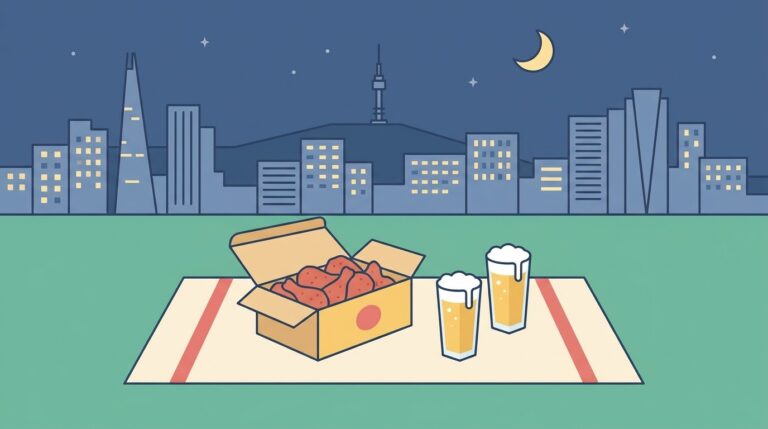
Picture this: It’s a humid Friday evening in Seoul. You’re sitting on a picnic mat at Hangang (Han River) Park, the city lights reflecting on the water. A delivery motorcycle pulls up, handing you a piping hot box. You pop open a cold beer, take a bite of perfectly crispy fried chicken, and suddenly, the stress of the entire week evaporates.
You’ve probably seen this exact scene in dozens of K-Dramas. Characters confess their love, complain about their terrible bosses, or cry over heartbreaks—all over a box of chicken and beer. This is 치맥 (Chimaek), a portmanteau of 치킨 (Chicken) and 맥주 (Maekju – Beer).
But Chimaek is more than just a late-night snack (야식 – Yasik); it’s a cultural ritual of bonding and emotional release. For an advanced (C1) Korean learner, knowing how to order chicken isn’t enough. You need to know how to navigate the subtle etiquette, the slang, and the unspoken rules of sharing. Let’s dive into the real, unfiltered Chimaek culture!
Phase 2: Core Expressions for the Perfect Chimaek Night
Here are the top advanced expressions that will make your Korean friends think you’ve lived in Seoul for a decade.
1. 치맥 땡긴다. 한잔 콜?
- Pronunciation: chimaek ttaengginda. hanjan kol? (ttaengginda sounds like a sharp, slightly nasal “ttang-ghin-dah”)
- Meaning: I’m craving Chimaek. Down for a drink?
- K-Culture Moment: You’ll hear this exactly at 5:50 PM in a Korean office on a Friday. It’s the universal signal that it’s time to let off some steam.
- Editor’s Insight: “땡기다” (ttaenggida) literally means “to pull,” but colloquially, it means your body is craving something. “콜” (kol) comes from the English word “Call” (like in poker), meaning “I agree” or “I’m in.”
- Situation Spectrum:
- Close Friends (Casual): ✅
- Coworkers (Semi-formal): ⚠️ (Only with close peers)
- Boss/Elders (Formal): 🚫
- 🤔 Think About It: Why do Koreans love adopting English words like “Call” and turning them into quick, punchy slang? How does this reflect Korea’s “Palli-Palli” (hurry up) culture?
2. 반반 무 많이요!
- Pronunciation: banban mu maniyo! (bahn-bahn moo mah-nee-yo!)
- Meaning: Half-and-half, and lots of radishes please!
- K-Culture Moment: Calling the local chicken joint. This is the holy grail of chicken orders.
- Editor’s Insight: “반반” means half original fried and half Yangnyeom (sweet and spicy). “무” refers to the cubed pickled radish that always accompanies Korean chicken. It cuts through the grease perfectly.
- Situation Spectrum:
- Close Friends (Casual): ✅
- Coworkers (Semi-formal): ✅
- Boss/Elders (Formal): ✅ (It’s just an order to the restaurant!)
- 🤔 Think About It: Korean cuisine relies heavily on side dishes (Banchan) to balance the main course. What is the equivalent “palate cleanser” in your food culture?
3. 오늘 닭다리는 양보할게.
- Pronunciation: oneul dakdarineun yangbohalge. (o-neul dahk-dah-ri-neun yahng-bo-hal-ge)
- Meaning: I’ll yield the drumstick to you today.
- K-Culture Moment: A romantic K-Drama scene where the male lead gives the female lead the last piece of the best meat.
- Editor’s Insight: In Korea, a whole chicken only has two drumsticks (닭다리). Giving one up is the ultimate sign of affection and sacrifice. If a Korean friend gives you the drumstick, you are officially VIP in their heart.
- Situation Spectrum:
- Close Friends (Casual): ✅
- Coworkers (Semi-formal): ⚠️ (Might seem a bit too affectionate!)
- Boss/Elders (Formal): 🚫
- 🤔 Think About It: How does the act of sacrificing a preferred piece of food demonstrate the Korean concept of Jeong (affection/attachment)?
Phase 3: Textbook vs. Real Korean
[Suggesting a Late-Night Snack]
* 📖 Textbook Korean: 오늘 밤에 야식으로 치킨과 맥주를 먹을까요? (Shall we eat chicken and beer as a late-night snack tonight?)
* 🗣️ Real Korean: 오늘 치맥 어때? 콜? (How about Chimaek today? In?)
* 💡 Why is it different?: Efficiency and intimacy. The textbook version sounds like an alien studying human behavior. Using abbreviations like “Chimaek” creates an instant sense of camaraderie.
[Describing the Taste]
* 📖 Textbook Korean: 겉은 바삭하고 속은 부드럽습니다. (The outside is crispy and the inside is soft.)
* 🗣️ Real Korean: 와, 이거 완전 겉바속촉 대박. (Wow, this is totally geot-ba-sok-chok amazing.)
* 💡 Why is it different?: Gen Z and Millennials love acronyms. 겉바속촉 (Geot-ba-sok-chok) is the gold standard of describing anything fried or baked in Korea.
Bottom Note: At the C1 level, your goal is to bridge the gap between being grammatically correct and culturally fluent. Using words like 겉바속촉 instantly elevates your conversational Korean.
Phase 4: Cultural Context — K-Culture Deep Dive
4-1. Non-Verbal Etiquette: The Art of Pouring Beer
If you’re having Chimaek with someone older or senior in rank, remember your Nunchi (눈치 – situational awareness).
– When pouring beer for a senior, hold the bottle with your right hand and lightly support your right wrist or forearm with your left hand.
– When clinking glasses (건배 – Geonbae), ensure the rim of your glass is slightly lower than your senior’s glass. It’s a subtle sign of respect!
4-2. K-Drama Trope: The Rooftop or Han River Confession
In K-Dramas, Chimaek is rarely just about eating. It is a narrative device. When characters are frustrated with life, they grab a beer. When they are celebrating a small victory, they order fried chicken. If you find yourself having Chimaek in Korea, take a moment to appreciate that you are participating in a modern Korean ritual of emotional release.
Critical Viewpoint: K-Dramas often show characters drinking multiple beers and perfectly waking up for work the next day with flawless skin. Reality check: Late-night sodium and alcohol will give you a wonderfully puffy face (붓기 – butgi) the next morning. Koreans often drink milk or green tea to combat this!
Phase 5: Real-Life Roleplay Scenario
Setting: Friday night, 8:00 PM at Yeouido Hangang Park. You and two Korean colleagues, Minji (30, friendly, loves food) and Team Leader Kim, are sitting on a rented mat. The delivery driver just dropped off two boxes of chicken.
YOU: 와, 한강에서 치맥이라니! 진짜 로망이었어요. (Wow, Chimaek at the Han River! This was truly my dream.)
Minji: 그쵸? 팀장님, 맥주부터 따르겠습니다. (Right? Team Leader, I’ll pour the beer first.)
Team Leader Kim: 어어, 내가 받을게. 다들 이번 주 고생 많았어. 짠하자! (Okay, I’ll take it. Everyone worked hard this week. Let’s cheers!)
(🎭 Stage Direction: Everyone clinks glasses. You take a bite of the chicken.)
YOU: 겉바속촉 장난 아니네요. 너무 맛있어요! (The geot-ba-sok-chok is no joke. It’s so delicious!)
Minji: (Picks up a chicken piece and extends her chopsticks toward your paper plate) 여기, 닭다리 하나 드세요. 한국에선 제일 친한 사람한테만 주는 거예요~ (Here, have a drumstick. In Korea, we only give this to our closest people~)
🔀 Your Turn! How do you respond?
– A) “아, 감사합니다! 잘 먹겠습니다!” (Ah, thank you! I will eat it well!)
– B) “에이~ 팀장님이랑 민지 씨가 드셔야죠! 저는 퍽퍽살 좋아해요.” (Hey~ Team Leader and you should eat it! I like the chicken breast.)
– C) “오예! 개이득!” (Oh yeah! Huge win!)✅ Best Choice: B — Why? In Korean culture, politely declining once or yielding the best piece to seniors/hosts shows excellent manners (Nunchi). By claiming you like the breast meat (퍽퍽살 – peok-peok-sal), you save them from feeling guilty. If they insist a second time, then you accept!
⚠️ Choice C Analysis: “개이득” (Gae-i-deuk – big profit/win) is internet slang. It’s funny with close friends, but a massive red flag in front of your Team Leader!
Phase 6: 10-Second Shadowing Drill
Let’s practice expressing that deep, soulful craving for late-night food. Read this out loud, focusing on the pauses and the emotional tone!
😩 아~ 오늘 진짜 / 치맥 / 땡기지 않아요?
(Ah~ oneul jinjja / chimaek / ttaenggiji anayo?)
Emotion Tag: Say it like you’ve been working at your desk for 10 hours and you desperately need a break. Extend the ‘Ah~’ for extra authenticity!
Phase 7: K-Culture Mini Dictionary
Here are 4 advanced keywords to level up your Chimaek vocabulary:
1. 야식 (Yasik)
* Romanization: ya-sik
* English: Late-night snack
* Context: A huge part of Korean culture. Because of the safe streets and 24/7 delivery infrastructure, ordering food at midnight is extremely common.
2. 겉바속촉 (Geot-ba-sok-chok)
* Romanization: geot-ba-sok-chok
* English: Crispy on the outside, moist on the inside.
* Context: The ultimate culinary compliment in Korea, usually applied to fried chicken, pastries, or pork belly.
3. 1인 1닭 (Irin Il-dak)
* Romanization: irin il-dak
* English: One chicken per person.
* Context: Usually, a box of chicken is shared by two people. “1인 1닭” is a humorous flex indicating that you are hungry enough (or rich enough) to eat a whole chicken by yourself.
4. 치콜 (Chicol)
* Romanization: chi-col
* English: Chicken and Cola.
* Context: For those who don’t drink alcohol, pairing chicken with Coca-Cola is the universally accepted alternative.
Phase 8: Traveler Survival Kit (Han River Edition)
Ordering delivery to a park is a uniquely Korean experience. Here are the survival phrases you need!
🆘 Survival Phrase #1: Finding Your Delivery
– 🇰🇷 “기사님, 여기 여의도 배달존 2번 앞이에요.” (gisanim, yeogi yeouido baedaljon ibeon apieyo.)
– 🗣️ Meaning: Driver, we are in front of Yeouido Delivery Zone 2.
– 📍 Where to use: Phone calls with delivery drivers.
– 💡 Pro Tip: Han River parks are massive. You cannot use a GPS pin. You must find a designated “배달존” (Delivery Zone) and tell the driver the zone number.🆘 Survival Phrase #2: Ordering Draft Beer
– 🇰🇷 “생맥주 오백 두 잔이요!” (saengmaekju obaek du janiyo!)
– 🗣️ Meaning: Two 500cc draft beers, please!
– 📍 Where to use: Inside a Hof (Korean pub) or chicken restaurant.
– 💡 Pro Tip: Koreans usually measure draft beer in CCs. “오백” (500) means a 500cc pint.🆘 Survival Phrase #3: Avoiding Bones
– 🇰🇷 “순살로 변경해 주세요.” (sunsallo byeonggyeonghae juseyo.)
– 🗣️ Meaning: Please change it to boneless.
– 📍 Where to use: Delivery apps or ordering at the counter.📌 Editor’s Travel Note
– Useful Apps: Baedal Minjok (배달의민족) or Yogiyo (요기요) are essential for delivery. However, they often require a Korean phone number. If you don’t have one, ask your hotel concierge or a friendly local to help you order!
– Trash Etiquette: At the Han River, you MUST separate your trash. There are designated recycling bins for leftover food (음식물 쓰레기), plastics, and paper. Leaving a mess on the grass is a huge faux pas.
Phase 9: Critical Thinking Corner — “One Step Deeper”
Food & Identity: The Power of Sharing
🧠 Think Deeper:
In many Western cultures, ordering a meal is an individualistic act—you order your plate, and you eat your food. However, Korean Chimaek culture is deeply communal. A whole chicken is placed in the center of the group, and everyone picks from the same box. Pouring drinks for oneself (자첨 – Jacheom) is traditionally seen as slightly lonely or unlucky; you pour for others, and they pour for you. This physical act of sharing from one central source builds Jeong (정 – deep emotional connection and collective identity). The boundaries between “mine” and “yours” blur into “ours.”💬 Your Turn: How does your culture view sharing food from the same plate? Is it seen as intimate, or an invasion of personal space? Share in the comments!
Phase 10: FAQ & Avoiding Common Mistakes
Q: Can I eat Korean fried chicken with my hands?
Yes! While many places provide small tongs (집게 – jibge) and a fork, eating with your hands is totally fine, especially at a picnic. They often provide wet wipes (물티슈 – mul-tisyu) for a reason.
Q: What if I don’t drink alcohol? Will Koreans be offended?
Absolutely not! Just say, “저는 술을 잘 못 마셔서 치콜 할게요!” (I can’t drink well, so I’ll do Chicol [Chicken + Cola]!). The drinking culture in Korea has become much more respectful of personal boundaries in recent years.
❌ Common Mistake #1: Saying “콜?” (Call?) to an elder or boss.
✅ Do This Instead: “콜” is strictly slang for friends or close colleagues. To a senior, use: “치맥 어떠세요?” (How about Chimaek?)
Phase 11: Summary & Action Items
- One-Liner Summary: Chimaek is Korea’s ultimate comfort food culture, fueled by crispy chicken, cold beer, and communal bonding (Jeong).
-
Action Mission 3 Steps:
- 🥉 Bronze (Solo): Look in the mirror and practice saying “아~ 오늘 치맥 땡긴다!” with pure exhaustion.
- 🥈 Silver (Online): Post on a language exchange app: “What is the best Chimaek brand in Korea? 반반 무 많이요!”
- 🥇 Gold (Real Life): Order fried chicken from a local Korean restaurant and specifically ask for “순살” (boneless) or extra “무” (radish) in Korean.
- K-Culture Mission: Watch an episode of a popular K-Drama (like Crash Landing on You or My Love from the Star) and spot the Chimaek scene. Observe who pours the beer and who gets the chicken legs!
Engagement: What is your ultimate late-night comfort food in your home country? Let me know below!
Phase 12: Interactive Quiz
1. Situational Judgment:
Your Korean boss says, “오늘 퇴근하고 치맥 한잔 어때?” (How about Chimaek after work today?) Which is the most culturally appropriate and natural C1 response if you want to go?
A) 콜! 당장 가요! (Call! Let’s go right now!)
B) 네, 팀장님. 좋습니다! (Yes, Team Leader. Sounds good!)
C) 오늘 닭다리는 양보할게요. (I’ll yield the drumstick to you today.)
Answer: B. “A” uses slang inappropriate for a boss. “C” is jumping too far ahead and sounds awkwardly intimate. B is respectful, enthusiastic, and safe.
2. Fill in the Blank:
The chicken just arrived. It looks incredibly crispy. You want to sound like a local foodie.
“와, 이거 완전 ____________ 대박이네요!”
Answer: 겉바속촉 (Geot-ba-sok-chok)
3. True or False – K-Culture Edition:
When sitting by the Han River, you can drop a pin on Google Maps to have the chicken delivered exactly to your picnic mat.
Answer: False. You must order to a designated “배달존” (Delivery Zone) and meet the driver there. Delivery apps also primarily use local maps like Naver or Kakao, not Google Maps.
Frequently Asked Questions (FAQ)
Q: What does "치맥 땡긴다. 한잔 콜?" mean in Korean and how do you pronounce it?
A: In Korean, "치맥 땡긴다. 한잔 콜?" is pronounced [chimaek ttaengginda. hanjan kol? (ttaengginda sounds like a sharp, slightly nasal "ttang-ghin-dah"] and means: I'm craving Chimaek. Down for a drink?
Q: What does "반반 무 많이요!" mean in Korean and how do you pronounce it?
A: In Korean, "반반 무 많이요!" is pronounced [banban mu maniyo! (bahn-bahn moo mah-nee-yo!] and means: Half-and-half, and lots of radishes please!
Q: What does "오늘 닭다리는 양보할게." mean in Korean and how do you pronounce it?
A: In Korean, "오늘 닭다리는 양보할게." is pronounced [oneul dakdarineun yangbohalge. (o-neul dahk-dah-ri-neun yahng-bo-hal-ge] and means: I'll yield the drumstick to you today.