

Hello there! I’m your Daily Hangul Editor.
Imagine this: You are sitting in a bustling Korean BBQ restaurant in Seoul. The savory smell of pork belly fills the air. Suddenly, the server approaches and starts covering your table with endless small plates. Red leafy things, cubed white things, marinated bean sprouts… Your eyes widen. Did I order all this? Is it going to cost a fortune?
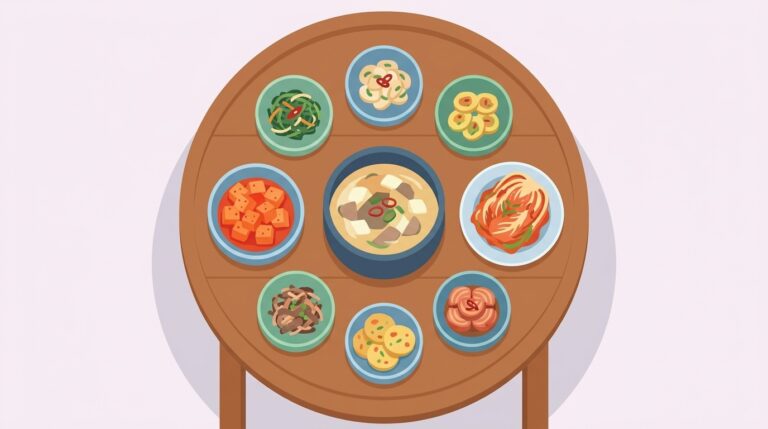
Welcome to the magic of Banchan (반찬)—the Korean side dish culture!
In K-Dramas, you often see characters fighting over the last piece of kimchi, or mothers passionately mixing massive tubs of spicy cabbage. To truly experience Korea, you need to understand Banchan, and more importantly, its undeniable superstar: Kimchi (김치).
But here is the catch—Kimchi isn’t just one thing. If you only know ‘Kimchi’, you are missing out on an entire universe of flavors. Let’s dive into the delicious world of Banchan and learn the exact expressions you need to sound like a local foodie!
Phase 2: Core Expressions Deep Dive
1. 배추김치 vs. 겉절이 (The Cabbage Kings)
- Pronunciation: [baechu-gimchi] vs. [geot-jeo-ri]
- Meaning:
- 배추김치: Fermented Napa cabbage kimchi (The standard!).
- 겉절이: Fresh, unfermented cabbage kimchi mixed right before eating.
- K-Culture Moment: Picture a rainy day in a K-Drama where the main characters are slurping Kalguksu (knife-cut noodles). What are they eating it with? That crisp, garlicky, unfermented Geotjeori. It’s a completely different vibe from the sour Baechu-kimchi you use for Kimchi Stew!
- Editor’s Insight: Baechu-kimchi is your everyday essential. But if you see Geotjeori at a restaurant, it means the place cares about freshness. The taste is sharper, sweeter, and crunchier.
- Situation Spectrum:
- With friends (Casual): ✅
- With coworkers (Semi-formal): ✅
- With bosses/elders (Formal): ✅ (Food terms are neutral!)
- 🤔 Think About It: Why do Koreans have so many different stages of fermented food? What does this say about the traditional agrarian lifestyle and the distinct four seasons in Korea?
2. 깍두기 (The Crunch Factor)
- Pronunciation: [Kkak-du-gi] (The ‘Kkak’ sounds sharp, like the crunching sound you make when eating it!)
- Meaning: Cubed radish kimchi.
- K-Culture Moment: You are watching a Mukbang. The YouTuber is eating a steaming bowl of Seolleongtang (ox bone soup). They scoop some rice, dunk it in the broth, and top it with a bright red, perfectly cubed radish. That satisfying CRUNCH? That’s Kkakdugi.
- Editor’s Insight: You cannot eat Korean soups (like Gomtang, Gukbap) without Kkakdugi. The sweet, juicy crunch cuts right through the rich, heavy broth.
- Situation Spectrum:
- Casual: ✅
- Semi-formal: ✅
- Formal: ✅
- 🤔 Think About It: Koreans love the concept of ‘ 궁합 (Gunghap – synergy/pairing)’. Soup and Kkakdugi are considered a perfect ‘Food Gunghap’. Does your culture have inseparable food pairings?
3. 반찬 좀 더 주시겠어요? (The Magic Refill Spell)
- Pronunciation: [ban-chan jom deo ju-si-ge-sseo-yo?]
- Meaning:
- Literal: Could you give me a little more side dishes?
- Real nuance: ‘Refill please!’
- K-Culture Moment: You are at a local diner. The potato salad banchan is absolutely divine. You’ve emptied the plate. You catch the server’s eye and use this phrase. They smile and bring you a mountain of it. And yes, it’s 100% free.
- Editor’s Insight: Korean generosity is built into the Banchan culture. Don’t be shy about asking for more! But adding ‘좀 (jom – a little)’ makes the request polite and soft.
- Situation Spectrum:
- To a server (Polite): ✅
- To a server (Casual slang): 🚫 (Always be polite to service staff!)
Phase 3: Textbook vs. Real Korean
[Asking for a Kimchi Refill]
* 📖 Textbook Korean: 저기요, 김치를 조금 더 주시겠습니까? (Excuse me, could you give me a little more kimchi?)
* 🗣️ Real Korean: 사장님~ 여기 깍두기 리필해 주세요! (Sajangnim~ kkakdugi refill-hae juseyo!)
* 💡 Why the difference?: Koreans love the Konglish word ‘리필 (Refill)’. Also, calling the staff ‘사장님 (Boss/Owner)’ or ‘이모님 (Auntie)’ is the ultimate local way to get friendly service, rather than the cold ‘저기요 (Excuse me)’.
[Commenting on the Kimchi’s Taste]
* 📖 Textbook Korean: 이 김치는 발효가 잘 되었습니다. (This kimchi is well-fermented.)
* 🗣️ Real Korean: 와, 김치 제대로 익었네요! (Wow, the kimchi is properly ripened!)
* 💡 Why the difference?: The verb 익다 (ik-da) literally means ‘to be cooked’ or ‘to ripen’. Koreans use this to describe perfectly fermented kimchi instead of the scientific term 발효 (fermentation).
Bottom Note: At a B2 level, start using descriptive verbs like ‘익다 (to ripen/ferment)’ and ‘시원하다 (to be refreshing/cool)’. Yes, Koreans describe spicy, hot kimchi soup as ‘cool/refreshing’ (시원하다) when it hits the stomach!
Phase 4: Cultural Context — K-Culture Deep Dive
4-1. Non-Verbal Cues: The Art of the Scissors
When your Kimchi arrives, it might be in long, uncut leaves. In Korea, scissors (가위) are an essential kitchen tool! When eating with older Koreans, it’s often the youngest person’s job to cut the kimchi.
Pro Tip: Cut the cabbage horizontally into bite-sized pieces, but leave the hard stem part at the top! Some older folks love eating that part by tearing it vertically with their hands (often seen in K-Dramas as a sign of affection when a mom places a torn piece on your rice).
4-2. K-Food Connection: The ‘National Banchan’ Code
If you ever order delivery (배달) in Korea, the app will sometimes have a checkbox: “반찬 빼주세요” (Please exclude side dishes). Why? Because Banchan is given by default!
However, not all Kimchi is created equal. The type of restaurant dictates the Kimchi:
* Kalguksu (Noodle) Shop: Extremely garlicky, spicy, fresh Geotjeori.
* Gukbap (Soup) Shop: Sweet, crunchy Kkakdugi.
* Samgyeopsal (BBQ) Shop: Sour, aged Muk-eun-ji (묵은지) meant to be grilled in pork fat!
Phase 5: Real-life Roleplay Scenario
Setting: A famous Seolleongtang (ox bone soup) restaurant in Myeongdong. It’s bustling, steaming hot, and smells like rich broth. You are having lunch with your Korean colleague, Min-su.
Characters:
* YOU: A foreign professional working in Seoul, always eager to try local ways.
* Min-su (32): Your friendly coworker who takes his food very seriously.
Dialogue:
Min-su: 여기 설렁탕 진짜 맛있어요. 간이 안 되어 있으니까 소금 넣으세요.
(Yeogi seolleongtang jinjja masisseoyo. Gani an doeeo isseunikka sogeum neoeuseyo.)
[The soup here is really good. It’s not seasoned, so add some salt.]
(🎭 Stage Direction: Min-su hands you the salt shaker.)
YOU: 아, 네! 향이 너무 좋네요. 어, 근데 김치가 통째로 있네요?
(A, ne! Hyangi neomu jonneyo. Eo, geunde gimchiga tongjjaero inneyo?)
[Ah, yes! The smell is so good. Oh, but the kimchi is whole?]
Min-su: 네, 여기 가위로 직접 잘라 먹어야 돼요. 제가 자를게요!
(Ne, yeogi gawiro jikjeop jalla meogeoya dwaeyo. Jaega jareulgeyo!)
[Yes, we have to cut it ourselves with scissors here. I’ll cut it!]
YOU: 오, 깍두기도 있네요. 국밥에는 역시 깍두기죠!
(O, kkakdugido inneyo. Gukbabeneun yeoksi kkakdugijo!)
[Oh, there is Kkakdugi too. For Gukbap, Kkakdugi is a must!]
Min-su: 오~ 한국 사람 다 됐는데요? 자, 드세요!
(O~ hanguk saram da dwaenneundeyo? Ja, deuseyo!)
[Oh~ You’ve become totally Korean! Here, eat up!]
(🎭 Stage Direction: You take a bite. The Kkakdugi is so good that you finish the plate in 5 minutes.)
🔀 Your Turn! The Kkakdugi plate is empty. How do you ask for more?
* A) “저기요! 깍두기 더 주세요!” (Excuse me! Give more Kkakdugi!)
* B) “이모님~ 여기 깍두기 좀 더 주시겠어요?” (Auntie~ Could we get a little more Kkakdugi here?)
* C) “사장님, 깍두기 리필 공짜예요?” (Boss, is the Kkakdugi refill free?)✅ Best Choice: B — Calling the friendly server ‘이모님 (Imonim)’ and using ‘좀 더 주시겠어요’ is the perfect blend of warmth and politeness.
⚠️ Choice A & C Analysis: A is a bit too direct and demanding. C is unnecessary because banchan refills are almost always universally free in Korea!
Bonus Scenario: The Convenience Store
You are at a CU or GS25 grabbing cup ramyun. You want Kimchi to go with it.
* YOU: 사장님, 혹시 볶음김치 어디 있어요?
(Sajangnim, hoksi bokkeum-gimchi eodi isseoyo? / Boss, by any chance, where is the stir-fried kimchi?)
* Clerk: 아, 삼각김밥 옆에 있어요.
(A, samgak-gimbap yeope isseoyo. / Ah, it’s next to the triangle kimbap.)
(Pro Tip: 볶음김치 [Bokkeum-kimchi] is stir-fried kimchi packaged in small pouches. It’s sweeter, less sour, and the ultimate companion for convenience store ramyun!)
Phase 6: 10-Second Shadowing Drill
Practice this sentence so you can confidently ask for a refill at a busy restaurant!
😊 이모님~ / 여기 / 깍두기 / 조금만 더 / 주세요!
(i-mo-nim~ / yeo-gi / kkak-du-gi / jo-geum-man deo / ju-se-yo!)
[Auntie~ / here / Kkakdugi / just a little more / please!]
Pitch guide: Start high and friendly on ‘이모님’, pause briefly to get their attention, then naturally flow through the rest with a polite smile.
Phase 7: K-Culture Mini Dictionary
1. 이모님 (I-mo-nim)
* Romanization: I-mo-nim
* English: Auntie (Respectful)
* Context: Literally means ‘Mother’s sister’, but used affectionately in casual restaurants to call middle-aged female servers. It creates an instant familial bond.
2. 묵은지 (Muk-eun-ji)
* Romanization: Muk-eun-ji
* English: Aged Kimchi
* Context: Kimchi that has been fermented for over a year. It’s incredibly sour and soft. Grilling this with pork belly (Samgyeopsal) is a religious experience in Korea.
3. 김장 (Gimjang)
* Romanization: Gimjang
* English: Kimchi-making season
* Context: The traditional late-autumn practice where families gather to make hundreds of heads of Kimchi for the winter. It’s recognized as UNESCO Intangible Cultural Heritage!
4. 눈치 (Nunchi)
* Romanization: Nunchi
* English: Emotional intelligence / reading the room
* Context: When asking for a Banchan refill, use your Nunchi. If the restaurant is overwhelmingly busy during peak lunch hour, ask gently or bring the plate to the counter yourself!
Phase 8: Traveler Survival Kit
Navigating Korean restaurants like a pro!
🆘 Survival Expression #1: Spiciness Check
* 🇰🇷 “이거 많이 매워요?” (igeo mani maewoyo?)
* 🗣️ Pronunciation: [ee-geo ma-ni mae-wo-yo?]
* 📍 Where to use: Any restaurant when trying red Banchan.
* 💡 Pro Tip: If you cannot eat spicy food, ask for 백김치 (Baek-kimchi – White Kimchi). It’s non-spicy, fermented in a fruity, refreshing brine!📌 Editor’s Travel Note
* Self-Bar (셀프바): Look out for signs that say ‘추가 반찬은 셀프입니다’ (Additional side dishes are self-serve). This means you take your plate and refill it yourself at the salad bar. Don’t call the server if you see this sign!
* Vegan Warning: Traditional Kimchi is NOT vegan. It contains 새우젓 (salted shrimp) or 멸치액젓 (anchovy fish sauce) for fermentation. If you are strictly vegan, look for designated Temple Food (사찰음식) restaurants!
Phase 9: Critical Thinking — “One Step Deeper”
🧠 Think Deeper: Food & Identity (정 – Jeong)
Why does Korea have this unique Banchan culture where countless small dishes are shared among everyone at the table? It all comes back to the concept of 정 (Jeong) – a deep emotional bond, affection, and community spirit. In the past, Korean villages survived harsh winters by sharing their Gimjang kimchi with neighbors. Sharing side dishes from the center of the table reinforces the idea that “we are eating as one family (식구 – meaning ‘mouths that eat together’)”. While individual plating is becoming more common nowadays for hygiene, the warm, communal spirit of sharing Banchan remains a core pillar of Korean identity.
💬 Your Turn: In your culture, do you share dishes from the center of the table, or does everyone get their own plate? How does sharing food affect your relationship with the people you eat with? Let me know in the comments!
Phase 10: FAQ & Mistake Prevention
Q: Are Banchan really free? Can I ask for 5 refills?
Yes, they are free! However, asking for 5 refills of an expensive side dish (like marinated crabs – Gejang) might get you some side-eyes. Some premium side dishes have a small refill fee, but Kimchi and basic veggies are always unlimited.
Q: Can I just eat Banchan as an appetizer before my meal?
Technically yes, but Banchan are heavily seasoned and salty because they are designed to be eaten with a spoonful of plain white rice (밥). Eating them alone might be too overwhelming!
❌ Common Mistake #1: Sticking your personal chopsticks into the shared Banchan after putting them in your mouth.
✅ How to fix it: While close friends might not care, it’s polite to use clean chopsticks or ask for separate serving utensils (집게 – tongs) in a formal setting or with new colleagues.
Phase 11: Summary & Action Items
- One-Liner Summary: Kimchi is not just one dish—it’s a diverse universe from crunchy Kkakdugi to fresh Geotjeori, and asking for a refill is the key to enjoying Korea’s generous Banchan culture.
Action Mission 3 Steps:
* 🥉 Bronze (Solo): Say “이모님, 깍두기 좀 더 주시겠어요?” out loud 3 times with a friendly smile.
* 🥈 Silver (Online): Look up a recipe for Geotjeori on YouTube and write down three Korean ingredients you see.
* 🥇 Gold (Real World): Visit a local Korean restaurant, order a soup, and successfully ask for a Kimchi refill using today’s expression!
K-Culture Mission:
Next time you watch a K-Drama, look closely at the dining scenes. Can you spot the red, cubed Kkakdugi vs. the leafy Baechu-kimchi? Bonus points if you spot someone cutting it with scissors!
Engagement: What is your absolute favorite Korean side dish? Is it Kimchi, or maybe the sweet soy-glazed potatoes? Drop a comment below!
Phase 12: Quiz — Interactive Challenge
1. Situational Judgment: You are eating Gukbap (soup with rice). The crunchy cubed radish kimchi is empty. How do you politely ask the female server for more?
* A) 저기요. 이거 주세요. (Excuse me. Give this.)
* B) 이모님~ 깍두기 좀 더 주시겠어요? (Auntie~ could we get a little more Kkakdugi?)
* C) 사장님, 김치 발효가 잘 됐네요. (Boss, the kimchi is well fermented.)
2. True or False – K-Culture Edition:
* “If you finish your Banchan in a Korean restaurant, you have to pay extra to get more Kimchi.” (T/F)
3. Fill in the Blank:
You want to describe that the Kimchi is perfectly fermented and tastes amazing.
“와, 김치 제대로 [ ______ ]네요!”
(Hint: A verb that means ‘to ripen’ or ‘to be cooked’)
🚨 Click here for Answers!
1. B – It uses the affectionate ‘이모님’ and the specific word ‘깍두기’ with a polite request form.
2. False – Banchan refills (especially Kimchi) are a staple of Korean generosity and are completely free!
3. 익었(네요) – from 익다 (to ripen/ferment).
Frequently Asked Questions (FAQ)
Q: What does "배추김치 vs. 겉절이 (The Cabbage Kings)" mean in Korean and how do you pronounce it?
A: In Korean, "배추김치 vs. 겉절이 (The Cabbage Kings)" is pronounced [baechu-gimchi] and means: 배추김치: Fermented Napa cabbage kimchi (The standard!).
Q: What does "깍두기 (The Crunch Factor)" mean in Korean and how do you pronounce it?
A: In Korean, "깍두기 (The Crunch Factor)" is pronounced [Kkak-du-gi] and means: Cubed radish kimchi.
Q: What does "반찬 좀 더 주시겠어요? (The Magic Refill Spell)" mean in Korean and how do you pronounce it?
A: In Korean, "반찬 좀 더 주시겠어요? (The Magic Refill Spell)" is pronounced [ban-chan jom deo ju-si-ge-sseo-yo?] and means: Literal: Could you give me a little more side dishes?







