

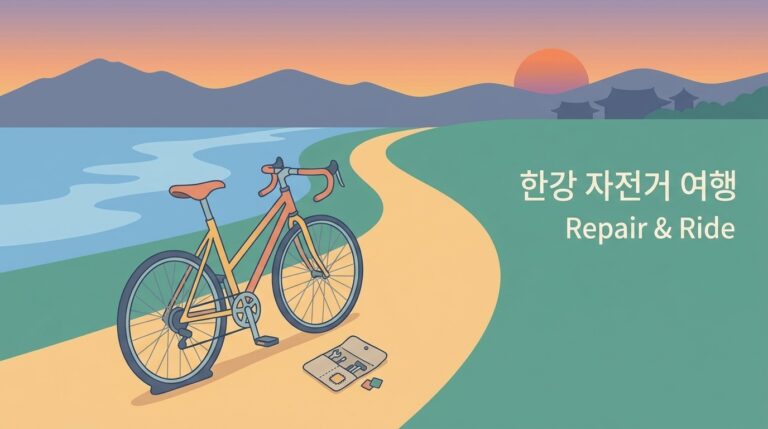
Phase 1: 공감 (The Immersive Open)
Hello there! It’s your Daily Hangul Editor.
Imagine this: You are riding a bike along the beautiful Han River (한강). The sun is setting, casting a golden hue over Seoul, and maybe your favorite K-Drama OST is playing in your earbuds. It’s the perfect K-Culture moment. You feel like the main character. But then… psssst. Your bike wobbles. You look down. A flat tire.
Suddenly, the romantic K-Drama turns into a survival variety show. You are miles away from the nearest subway station, your hands are covered in chain grease, and you need to ask a passing local cyclist for help.
As an advanced (C1) Korean learner, you might know the textbook word for ‘tire’ or ‘broken’. But do you know what real Koreans say when they are stranded on a bike path? Do you know the slang they use, or how to politely interrupt a fully-geared Korean ‘Ahjussi’ to borrow a tire puncture repair kit?
This guide is crafted from real-life panic moments my students have experienced. Let’s learn the authentic, street-smart Korean you need to turn this minor disaster into a chance to experience true Korean Jeong (정, warm-heartedness)!
Phase 2: 핵심 표현 심층 분석 (Deep Dive into Core Expressions)
1. 빵꾸 났어요 (I got a flat tire)
- Pronunciation: ppangku naseoyo [Sounds like: ppahng-koo nah-suh-yo. Make the ‘pp’ strong and tense!]
- Meaning: 직역(Literal): A puncture occurred. vs 의역(Real nuance): I got a flat tire / It’s busted.
- K-Culture Moment: You’ll hear this a lot on Korean variety shows when something goes wrong. ‘빵꾸’ (ppangku) comes from the Japanese pronunciation of the English word ‘puncture’. While the standard word is ‘펑크’ (peongkeu), everyone says ‘빵꾸’ in real life. If you say this to a passing cyclist, they’ll instantly relate to your pain.
- Editor’s Insight: This phrase carries a feeling of mild frustration but acceptance. It sounds incredibly natural and native-like. Using the standard ‘펑크가 났습니다’ sounds like a news anchor reporting a traffic accident.
- Situation Spectrum:
- 친구 사이(Casual): ✅ (야, 내 자전거 빵꾸 났어! – ya, nae jajeongeo ppangku naseo!)
- 직장 동료(Semi-formal): ✅ (타이어에 빵꾸가 났네요. – taieoe ppangkuga nanneyo.)
- 직장 상사·어른(Formal): ⚠️ (Use 펑크 if speaking to someone very formal, but 빵꾸 is generally accepted in emergencies.)
- 🤔 Think About It: Why does Korean have so many vocabulary words derived from English but altered through Japanese pronunciation (Konglish/Japanglish)? How does the history of modernization in Korea reflect in everyday hobby terms?
2. 혹시 펑크 패치 있으세요? (Do you happen to have a puncture patch?)
- Pronunciation: hoksi peongkeu paechi isseuseyo? [hok-shee / pung-keu / patch-ee / ee-sseu-seh-yo?]
- Meaning: 직역(Literal): By any chance, do you have a puncture patch? vs 의역(Real nuance): I’m so sorry to bother you, but do you have a repair kit I could use?
- K-Culture Moment: The magic word here is ‘혹시’ (hoksi – by any chance). In K-Dramas, whenever a character approaches a stranger or a crush to ask a favor, they almost always start with ‘저기요, 혹시…’ (Excuse me, by any chance…). It softens the request immensely.
- Editor’s Insight: If you just say “펑크 패치 있어요?” (Do you have a patch?), it sounds like an interrogation. Adding ‘혹시’ shows Nunchi (눈치)—you acknowledge you are interrupting their ride.
- Situation Spectrum:
- 친구 사이(Casual): 🚫 (Too polite for friends. Just say “너 패치 있냐?” – neo paechi innya?)
- 낯선 사람(Strangers): ✅✅ (Essential!)
- 직장 상사·어른(Formal): ✅
- 🤔 Think About It: Korean culture highly values not burdening others (민폐 끼치지 않기). How does the word ‘혹시’ serve as a linguistic cushion to protect both the speaker’s pride and the listener’s comfort?
3. 바람이 다 빠졌어요 (The air is completely gone)
- Pronunciation: barami da ppajyeosseoyo [bah-rah-mee / dah / ppah-jyuh-suh-yo]
- Meaning: 직역(Literal): The wind has all fallen out. vs 의역(Real nuance): The tire is completely flat / deflated.
- K-Culture Moment: This is the universal phrase for anything losing air—a tire, a balloon, or even a person’s energy. In a K-Pop fandom context, if a concert gets cancelled, fans might say “완전 바람 빠졌어” (I’m completely deflated/lost all my energy).
- Editor’s Insight: Notice how Koreans use ‘바람’ (wind) instead of ‘공기’ (air) for tires. If you say “공기가 빠졌어요” (The air leaked), it sounds overly scientific, like you are in a physics lab.
- Situation Spectrum:
- 친구 사이(Casual): ✅
- 직장 동료(Semi-formal): ✅
- 직장 상사·어른(Formal): ✅
- 🤔 Think About It: The verb ‘빠지다’ (to fall out / to deflate) is used for hair, weight, and air. Can you think of a verb in your native language that has such a versatile, physical meaning?
Phase 3: 교과서 vs 진짜 한국어 (Textbook vs. Real Korean)
[Describing the Flat Tire]
* 📖 교과서 한국어: 자전거 타이어가 파손되었습니다. (jajeongeo taieoga pason-doeeotseumnida.) – My bicycle tire has been damaged.
* 🗣️ 진짜 한국어: 아, 바퀴 빵꾸 났어요. (a, bakwi ppangku naseoyo.) – Ah, the wheel got a flat.
* 💡 왜 다를까?: Native speakers rarely use the formal word ‘파손’ (damage/destruction) for everyday objects. ‘바퀴’ (wheel) is often used interchangeably with ‘타이어’ (tire) in casual speech.
[Having to Walk the Bike]
* 📖 교과서 한국어: 자전거를 고칠 수 없어서 끌고 가야 합니다. (jajeongeoreul gochil su eopseoseo kkeulgo gaya hamnida.) – I cannot fix the bike, so I must drag it along.
* 🗣️ 진짜 한국어: 수리 키트 없어서 그냥 끌바해야 돼요. (suri kiteu eopseoseo geunyang kkeulbahaeya dwaeyo.) – I don’t have a repair kit, so I just have to walk it.
* 💡 왜 다를까?: ‘끌바’ (kkeulba) is a beloved cycling slang term. It is an abbreviation of ‘끌고 가는 자전거/바이크’ (dragging bike). Advanced learners using slang like ‘끌바’ will instantly earn the respect of local cyclists!
[Asking for a Bike Pump]
* 📖 교과서 한국어: 공기 주입기를 빌려주실 수 있습니까? (gonggi juipgireul billyeojusil su itseumnikka?)
* 🗣️ 진짜 한국어: 혹시 펌프 좀 빌릴 수 있을까요? 바람이 다 빠져서요. (hoksi peompeu jom billil su isseulkkayo? barami da ppajyeoseoyo.)
* 💡 왜 다를까?: ‘공기 주입기’ is strictly a catalog or manual term. In real life, everyone uses the English loanword ‘펌프’ (pump).
Bottom Note: At the C1 level, your goal is to bridge the gap between formal writing and natural colloquial speech. Using terms like ‘끌바’ and ‘빵꾸’ shows you understand the living language.
Phase 4: 문화적 맥락 — K-Culture 딥다이브 (Cultural Context & Deep Dive)
4-1. 비언어적 요소 (Non-verbal Cues)
When you flag down a stranger on a bike path in Korea, body language is crucial. Do not stand in the middle of the path waving your arms wildly. Step off the path safely. When a cyclist stops, do a slight bow (about 15-30 degrees) while saying “저기요, 혹시…” (Excuse me, by any chance…). This non-verbal display of respect and humility will almost guarantee they will stop and help you out. It is the ultimate display of Nunchi.
4-2. K-Culture 연결 고리 (K-Food Connection: The Reward!)
In Korea, Han River cycling culture is inextricably linked to K-Food. If an ‘Ahjussi’ (middle-aged man) or another cyclist helps you patch your tire with their kit, you can’t just say “Thank you” and ride away. It’s an unwritten cultural rule to offer a token of appreciation.
The best way to do this? The convenience store.
After the tire is fixed, point to the nearest convenience store (편의점) and say, “제가 시원한 음료수라도 하나 사드릴게요!” (Let me buy you a cold drink at least!).
Even better, if you end up bonding over the repair, this is the perfect excuse to experience 한강 라면 (Han River Ramen). Cycling in Korea isn’t just about exercise; it’s about the reward of eating instant ramen cooked in the foil machines by the river, often paired with Chimaek (치맥 – Chicken and Beer, though maybe skip the beer if you’re still riding!).
Critical Perspective: Why do Koreans try to share food, even with strangers who just helped them? It goes back to the concept of Jeong (정). In Korea, food is not just fuel; it’s the primary currency of gratitude, relationship-building, and showing care.
Phase 5: 실전 롤플레이 시나리오 (Interactive Roleplay)
Setting: Saturday afternoon, Banpo Han River Park. The bike path is bustling. You were riding confidently when—pop! Your front tire is completely flat. You check your bag: no repair kit. An older Korean man (Ahjussi) in full, professional spandex cycling gear pulls over.
Characters:
– YOU: An expat who loves cycling but forgot your gear today.
– Ahjussi (아저씨): A veteran cyclist. Looks intimidating in his mirrored sunglasses, but has a heart of gold.
Dialogue:
Ahjussi: 왜요? 빵꾸 났어요?
(waeyo? ppangku naseoyo?)
[Why? Did you get a flat?]
(🎭 Stage Direction: He unclips his cleats and stops next to you, looking at your front wheel.)
YOU: 네, 갑자기 바람이 다 빠졌네요.
(ne, gapjagi barami da ppajyeonneyo.)
[Yes, the air suddenly all went out.]
Ahjussi: 에이구, 끌바해야겠네. 패치 없어요?
(eigu, kkeulbahaeyagenne. paechi eopseoyo?)
[Oh my, you’ll have to walk it. No patch?]
🔀 당신의 차례! 어떻게 대답할까요? (Your Turn! How will you respond?)
– A) 패치 내놔요. (paechi naenwayo.) – Give me a patch.
– B) 제가 패치를 안 가져왔는데… 혹시 수리 키트 좀 빌릴 수 있을까요? (jega paechireul an gajyeowanneunde… hoksi suri kiteu jom billil su isseulkkayo?) – I didn’t bring a patch… by any chance, could I borrow a repair kit?
– C) 공기 주입기를 주시겠습니까? (gonggi juipgireul jusigetseumnikka?) – Would you give me an air injector?✅ Best Choice: B — Reason: It explains your situation humbly and uses ‘혹시’ and polite forms.
⚠️ Choice A & C Analysis: ‘A’ is extremely rude and aggressive (sounds like a mugger!). ‘C’ sounds like a robot reading a textbook.
(Assuming you chose B)
Ahjussi: 아, 있죠! 잠깐만요. 내가 때워 줄게요.
(a, itjyo! jamkkanmanyo. naega ttaewo julgeyo.)
[Ah, I have one! Hold on. I’ll patch it for you.]
(🎭 Stage Direction: He enthusiastically pulls out a pro-level tool kit.)
YOU: 헐, 정말 감사합니다!
(heol, jeongmal gamsahamnida!)
[Whoa, thank you so much!]
Ahjussi: 다 됐어요. 조심해서 타요!
(da dwaesseoyo. josimhaeseo tayo!)
[All done. Ride safely!]
YOU: 아저씨, 정말 감사합니다! 제가 저기 편의점에서 시원한 커피 하나 사드릴게요!
(ajeossi, jeongmal gamsahamnida! jega jeogi pyeonijeomeseo siwonhan keopi hana sadeurilgeyo!)
[Sir, thank you so much! Let me buy you a cold coffee at that convenience store over there!]
Phase 6: 10초 섀도잉 드릴 (10-Second Shadowing Drill)
Practice this out loud to get the natural rhythm and intonation. Follow the slashes for pausing!
🥺 간절하게 (Desperately):
저기요, / 혹시 / 펑크 패치 / 있으세요?
(jeogiyo, / hoksi / peongkeu paechi / isseuseyo?)
😢 난감하게 (Feeling troubled):
바람이 / 다 빠져서 / 끌바해야 할 것 같아요.
(barami / da ppajyeoseo / kkeulbahaeya hal geot gatayo.)
😊 감사하며 (Gratefully):
도와주셔서 감사합니다! / 제가 / 커피 한 잔 / 살게요!
(dowajusyeoseo gamsahamnida! / jega / keopi han jan / salgeyo!)
Phase 7: K-Culture 미니 사전 (Mini-Dictionary)
1. 빵꾸
* Romanization: ppangku
* English: Flat tire / Puncture
* Context: A widely used Konglish slang for a flat tire. Also used metaphorically when a plan falls through or someone creates a ‘hole’ in a schedule (e.g., “스케줄에 빵꾸 났다”).
2. 끌바
* Romanization: kkeulba
* English: Walking one’s bike (Dragging bike)
* Context: A portmanteau of ‘끌다’ (to drag/pull) and ‘바이크’ (bike). Cyclists use this when going up extremely steep hills or when dealing with an unfixable flat.
3. 따릉이
* Romanization: Ttareungi
* English: Seoul’s public bicycle rental system
* Context: The green and white bikes you see everywhere in Seoul. The name mimics the sound of a bicycle bell (“ring ring”). If a Ttareungi gets a flat, you just report it on the app and leave it at a station!
4. 한강 라면
* Romanization: Hangang ramyeon
* English: Han River Instant Ramen
* Context: Cooking ramen in a foil bowl using the special induction machines at Han River convenience stores. It is considered the ultimate post-ride meal.
Phase 8: 여행자 서바이벌 키트 (Traveler’s Survival Kit)
Even if you aren’t an expert mechanic, you need to know how to find a repair shop while traveling in Korea!
🆘 서바이벌 표현 (Survival Phrases)
– 🇰🇷 “이 근처에 자전거포(가게) 있나요?” (i geuncheoe jajeongeopo(gage) innayo?)
– 🗣️ English: Is there a bike shop near here?
– 📍 Where to use: Asking locals on the trail or a convenience store worker.
– 💡 Pro Tip: Older generations use the word ‘자전거포’ (jajeongeopo – bike shop), while younger people say ‘자전거 가게’ or ‘자전거 샵’. Knowing ‘자전거포’ will make Ahjussis respect your Korean skills!📌 Editor’s Travel Note
– Useful Apps: Do not use Google Maps in Korea for walking or biking! Use KakaoMap or Naver Map. They have dedicated “Bicycle Path” (자전거도로) layers that show gradients, repair shops, and public air pumps.
– Public Air Pumps: Many subway stations and local district offices (동주민센터) in Seoul have free electric bicycle pumps outside.
– Ttareungi Tip: If you are riding a rented ‘Ttareungi’ and get a flat, do not try to fix it yourself. Just find the nearest docking station, return it, and hit the “고장 신고” (Report breakdown) button on the app.
Phase 9: 비판적 사고 코너 — “한 발 더 깊이” (Think Deeper)
글로벌 시대의 한국어 (Korean in the Global Era): The Evolution of Konglish in Hobbies
When you engage in specialized hobbies like cycling, photography, or gaming in Korea, you will inevitably encounter a massive amount of ‘Konglish’ and Japanglish (Japanese-altered English). Words like ‘빵꾸’ (Puncture -> Panku -> Ppangku), ‘핸들’ (Handle instead of steering wheel/handlebars), and ‘펑크 패치’ show how Western technology was historically introduced to Korea via Japan, and then localized.
Some language purists argue we should use pure Korean words like ‘바람 빠짐’ or standard terms like ‘파손’. However, the cycling community fiercely holds onto their slang because it creates a sense of ingroup solidarity and efficiency.
🧠 Think Deeper:
Does the use of English loanwords in hobbies destroy a language’s purity, or does it make the language more dynamic and practical?💬 Your Turn: Does your native language borrow terms from other languages for specific hobbies? Share it in the comments!
Phase 10: FAQ & 오해 방지 (FAQ & Common Mistakes)
Q: Can I use the word ‘빵꾸’ when talking to a professional bike mechanic?
Yes! In fact, the mechanic will probably use it first. Saying “사장님, 앞바퀴 빵꾸 났어요” (Boss, the front wheel got a flat) sounds perfectly natural to a shop owner.
Q: The Ahjussi who helped me was so nice! Can I call him ‘Ahjussi-ssi’ (아저씨 씨)?
NO!
❌ 흔한 실수 #1: Attaching “~씨” (-ssi) to a title or using it with older strangers.
✅ 이렇게 하세요: Never use “~씨” with older strangers or titles. Just call him “아저씨” (Ahjussi) or if he seems like an expert, flatter him with “사장님” (Sajangnim – Boss, even if he doesn’t own a shop) or “선생님” (Seonsaengnim – Teacher).
Q: If I offer to buy them a coffee to say thanks, and they say “아니에요, 괜찮아요” (No, it’s okay), should I just leave?
Welcome to the Korean game of Nunchi. They will almost always decline the first time to be polite. You must insist at least once more: “에이, 제가 감사해서 그래요. 진짜 금방 사올게요!” (Oh come on, it’s because I’m so thankful. I’ll buy it really quickly!). If they decline three times, then you can just bow and say a sincere thank you.
Phase 11: 요약 및 액션 아이템 (Summary & Action Items)
One-Liner Summary: When your tire goes flat in Korea, don’t panic—use “바퀴 빵꾸 났어요” and a polite “혹시…” to unlock the hidden Jeong of local cyclists!
Action Mission 3단계:
– 🥉 Bronze (Solo): Stand in front of your mirror and practice the 10-second shadowing drill. Make sure you nail the polite ‘혹시’ tone.
– 🥈 Silver (Online): Go to YouTube, search “자전거 펑크 수리” (Bicycle flat repair), and leave a comment saying: “이 영상을 보니 나중에 자전거 빵꾸 나도 혼자 고칠 수 있을 것 같아요!” (Watching this video, I feel like I could fix it myself if I get a flat later!).
– 🥇 Gold (Real Life): Next time you are in Korea or at a Korean market, try buying something while initiating the conversation with “저기요, 혹시…” to test its magic power.
🚲 K-Culture Mission:
Open KakaoMap or Naver Map, find ‘여의도 한강공원’ (Yeouido Han River Park), and switch to the Bicycle Path view. Find the nearest convenience store on the map where you would eat your reward ramen after a long ride!
Phase 12: 퀴즈 — 인터랙티브 챌린지 (Interactive Quiz)
1. 빈칸 채우기 (Fill in the Blank)
You are asking a stranger for a pump.
“저기요, ________ 공기 펌프 좀 빌릴 수 있을까요?”
A) 야 (ya)
B) 빨리 (ppalli)
C) 혹시 (hoksi)
D) 당연히 (dangyeonhi)
2. 상황 판단 문제 (Situational Judgment)
You got a flat tire but have no repair kit. You decide to walk your bike to the nearest shop. What slang term perfectly describes this action?
A) 빵꾸 (ppangku)
B) 끌바 (kkeulba)
C) 따릉이 (ttareungi)
D) 눈치 (nunchi)
3. True or False — K-Culture Edition
“If a Korean stranger helps you fix your bike and you offer to buy them a drink, but they say ‘No, it’s fine’ the first time, you should immediately say ‘Okay, bye!’ and ride away.”
(Answers: 1: C, 2: B, 3: False – Always offer at least one more time to show genuine gratitude!)
Enjoyed this survival guide? Let us know in the comments if you’ve ever experienced a flat tire abroad and how you handled it!
Frequently Asked Questions (FAQ)
Q: What does "빵꾸 났어요 (I got a flat tire)" mean in Korean and how do you pronounce it?
A: In Korean, "빵꾸 났어요 (I got a flat tire)" is pronounced [ppangku naseoyo [Sounds like: ppahng-koo nah-suh-yo. Make the 'pp' strong and tense!] and means: 직역(Literal): A puncture occurred. vs 의역(Real nuance): I got a flat tire / It's busted.
Q: What does "혹시 펑크 패치 있으세요? (Do you happen to have a puncture patch?)" mean in Korean and how do you pronounce it?
A: In Korean, "혹시 펑크 패치 있으세요? (Do you happen to have a puncture patch?)" is pronounced [hoksi peongkeu paechi isseuseyo? [hok-shee / pung-keu / patch-ee / ee-sseu-seh-yo?] and means: 직역(Literal): By any chance, do you have a puncture patch? vs 의역(Real nuance): I'm so sorry to bother you, but do you have a repair kit I could use?
Q: What does "바람이 다 빠졌어요 (The air is completely gone)" mean in Korean and how do you pronounce it?
A: In Korean, "바람이 다 빠졌어요 (The air is completely gone)" is pronounced [barami da ppajyeosseoyo [bah-rah-mee / dah / ppah-jyuh-suh-yo] and means: 직역(Literal): The wind has all fallen out. vs 의역(Real nuance): The tire is completely flat / deflated.







