

Phase 1: Empathy & K-Culture Cold Open
Hello! Daily Hangul Editor here.
Imagine this: You’ve just attended a beautiful K-Drama style wedding in Seoul. The couple said their vows, the photos are done, and now it’s time for the real main event—the legendary Korean Wedding Buffet (결혼식 뷔페)!
You walk into a massive banquet hall (연회장) filled with hundreds of guests. There are endless rows of sushi, Korean BBQ, and colorful desserts. You fill your plate, sit down at a large round table with your Korean colleagues, and… silence. Everyone is waiting to start. What do you say? Do you just start chewing?
At a Korean dining table, knowing just one or two simple phrases changes everything. It elevates you from “the quiet foreign guest” to “the incredibly polite friend who respects K-Culture.” Don’t worry, my A1 beginners! This guide is based on real panic moments my students have faced at Korean weddings. Let’s make you a buffet insider!
Phase 2: Core Expressions Deep Dive
Here are the absolute lifesavers you need before you take your first bite.
1. 잘 먹겠습니다 (Jal meokgetseumnida)
- Pronunciation: [Jal meok-get-seum-ni-da] (Sound-alike: ‘Jal’ sounds like ‘Jal’ in Jalapeño. ‘meok’ rhymes with ‘buck’. The ‘da’ is soft like ‘tah’.)
- Meaning: I will eat well (Literal) / Thank you for the meal (Real nuance)
- K-Culture Moment: This is the magic phrase to say right before you pick up your chopsticks. In K-Dramas, you’ll often see characters clap their hands together softly, look at the food joyfully, and say this. At a wedding, saying this to your tablemates shows excellent manners.
- Editor’s Insight: Think of it as the Korean version of “Bon appétit” or saying grace. Even though you served yourself at the buffet, you are expressing gratitude for the food and the moment.
- Situation Spectrum:
- Friends (Casual): ✅ (Say: 잘 먹을게! – Jal meogeulge!)
- Coworkers (Semi-formal): ✅
- Elders/Bosses (Formal): ✅ (Perfect for weddings!)
- 🤔 Think About It: Why do Koreans announce they are going to eat? In a culture deeply rooted in community, acknowledging the shared meal brings everyone together. Does your language have a phrase you say right before eating?
2. 맛있게 드세요 (Masitge deuseyo)
- Pronunciation: [Ma-sit-ge deu-se-yo] (‘Ma’ like ‘ma’ma, ‘sit’ like the word sit, ‘eu’ sounds like the disgusted sound you make stepping in gum: ‘ugh’.)
- Meaning: Eat deliciously (Literal) / Enjoy your meal (Real nuance)
- K-Culture Moment: When you sit down with your plate, an older Korean guest might say this to you. You should reply with “잘 먹겠습니다” or repeat “맛있게 드세요” back to them!
- Editor’s Insight: It’s a warm wish for others to enjoy their food. It’s polite, friendly, and essential for group dining.
- Situation Spectrum:
- Friends (Casual): ⚠️ (Too formal. Use “맛있게 먹어” – Masitge meogeo)
- Coworkers (Semi-formal): ✅
- Elders/Bosses (Formal): ✅
- 🤔 Think About It: Wishing others a “delicious” experience shows the Korean emphasis on food as a source of joy and care.
3. 조금만 주세요 (Jogeumman juseyo)
- Pronunciation: [Jo-geum-man ju-se-yo] (‘Jo’ like ‘Joe’, ‘geum’ like ‘gum’, ‘ju’ like ‘jew’.)
- Meaning: Give me just a little (Literal / Real nuance)
- K-Culture Moment: Korean buffets have “live stations” where chefs cut steak or serve noodles. If you don’t want a massive portion, use this!
- Editor’s Insight: Koreans are generous with food. If you say nothing, you might get a mountain of steak. This gentle phrase saves your stomach space so you can try other dishes!
- Situation Spectrum: Universal ✅
Phase 3: Textbook vs. Real Korean
Let’s look at how people actually talk at a wedding buffet.
[Starting the Meal]
* 📖 Textbook: 식사합시다. (Let’s dine.)
* 🗣️ Real Korean: 잘 먹겠습니다! (Jal meokgetseumnida!)
* 💡 Why the difference?: “식사합시다” sounds like a military commander ordering troops to eat. “잘 먹겠습니다” is natural, humble, and polite.
[Asking a Chef at the Live Station]
* 📖 Textbook: 양을 적게 주십시오. (Please give me a small quantity.)
* 🗣️ Real Korean: 조금만 주세요~ (Jogeumman juseyo~)
* 💡 Why the difference?: The textbook version sounds like a robot. Adding “~” (a soft, slightly elongated tone) makes you sound friendly and approachable.
Phase 4: Cultural Context — K-Culture Deep Dive
4-1. Non-Verbal Nunchi (눈치) at the Buffet
Nunchi is the Korean art of reading the room. At a wedding table, Nunchi means waiting for the eldest person at the table to pick up their spoon or chopsticks before you start eating. If you sit with the groom’s grandfather, wait for him to start! Also, when saying “잘 먹겠습니다”, give a slight head bow to the people at your table.
4-2. K-Food Connection: The Must-Eat Dish
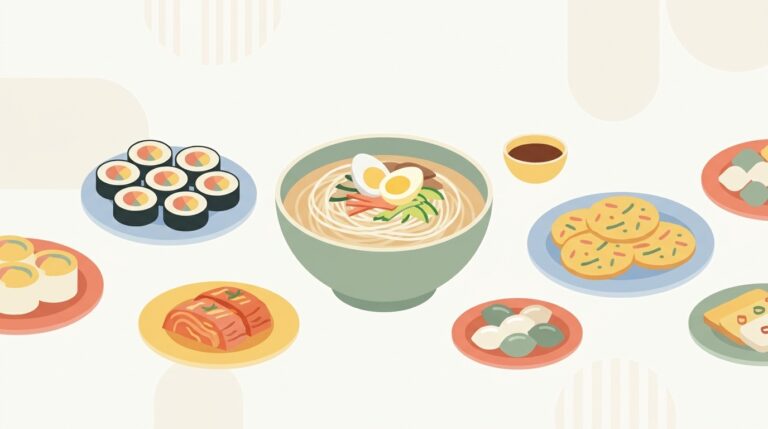
If you go to a Korean wedding buffet, you MUST eat Janchi Guksu (잔치국수). It translates to “Banquet Noodles.” It’s a warm, simple noodle soup in a savory broth.
Why? The long noodles symbolize a long, happy life for the married couple. Even if there are mountains of expensive sushi and ribs, you’ll see Korean guests lining up for this humble bowl of noodles. Make sure to get one and slurp away!
Phase 5: Real-Life Roleplay Scenario
Setting: Saturday afternoon, 1:30 PM. The grand banquet hall of a wedding venue in Gangnam. You just handed in your congratulatory money and got your meal ticket. You fill your plate with Galbi (short ribs) and sushi, and sit at a round table with your friendly coworker, Minsoo.
Characters:
– YOU: A beginner Korean learner, excited but slightly nervous about buffet etiquette.
– Minsoo (32, Coworker): Friendly, loves food, your K-Culture guide for the day.
Dialogue:
Minsoo: 와, 여기 뷔페 진짜 크네요! 많이 가져오셨어요?
(Wa, yeogi bwipe jinjja keuneyo! Mani gajyeoosyeosseoyo?)
[Wow, this buffet is really big! Did you bring a lot?]
YOU: 네! 조금씩 다 가져왔어요.
(Ne! Jogeumssik da gajyeowasseoyo.)
[Yes! I brought a little bit of everything.]
Minsoo: 저기 잔치국수도 꼭 드세요. 결혼식 필수예요!
(Jeogi janchiguksudo kkok deuseyo. Gyeolhonsik pilsuyeyo!)
[Make sure to eat the banquet noodles over there. It’s a wedding must!]
YOU: 아, 정말요? 이따가 먹어볼게요.
(A, jeongmallyo? Ittaga meogeobolgeyo.)
[Oh, really? I’ll try it later.]
(🎭 Stage Direction: Minsoo picks up his chopsticks, ready to dive into his mountain of food.)
Minsoo: 자, 그럼 맛있게 드세요!
(Ja, geureom masitge deuseyo!)
[Well then, enjoy your meal!]
🔀 YOUR TURN! How do you reply before taking your first bite?
– A) (Smile silently and start chewing the Galbi)
– B) 잘 먹겠습니다! (Jal meokgetseumnida!)
– C) 수고하셨습니다! (Sugohasyeotseumnida!)✅ Best Choice: B — Saying “Jal meokgetseumnida” completes the polite dining ritual!
⚠️ Choice A Analysis: Not terrible, but missing a great chance to show your manners.
⚠️ Choice C Analysis: “Sugohasyeotseumnida” means “Thank you for your hard work.” You say this after a meeting or a long day of work, not before a buffet!
Phase 6: 10-Second Shadowing Drill
Practice out loud! Pay attention to the pauses (/) and the emotion tags.
- 😊 밝게 (Brightly): 자, / 잘 / 먹겠습니다! (Ja, / jal / meokgetseumnida!)
- 🍽️ 친절하게 (Kindly): 여러분, / 맛있게 / 드세요~ (Yeoreobun, / masitge / deuseyo~)
- 🥺 부탁하며 (Polite Request): 셰프님, / 고기 / 조금만 주세요. (Syepeunim, / gogi / jogeumman juseyo.)
Phase 7: K-Culture Mini Dictionary
Master these keywords to understand Korean weddings!
1. 식권 (Sik-gwon)
* English: Meal Ticket
* Context: You don’t just walk into a Korean wedding buffet. At the entrance, you give your envelope of money to the reception desk, and in return, they hand you a small paper “식권”. You hand this to the staff at the buffet doors. No ticket, no food!
2. 축의금 (Chu-gui-geum)
* English: Congratulatory Money
* Context: Koreans rarely give wedding gifts like blenders or toasters. White envelopes with crisp cash are the standard. The amount usually depends on how close you are to the couple (and covers the cost of your buffet!).
3. 잔치국수 (Jan-chi-guk-su)
* English: Banquet Noodles
* Context: A simple wheat noodle soup in anchovy broth. Eaten at weddings to symbolize a long, continuous life together.
4. 연회장 (Yeon-hoe-jang)
* English: Banquet Hall
* Context: The massive dining hall where the buffet takes place. Usually on a different floor from the actual wedding ceremony.
Phase 8: Traveler Survival Kit
Even outside of weddings, buffets (like hotel breakfasts or Korean BBQ buffets) are everywhere in Korea. Here are your survival phrases:
🆘 Survival Phrases for the Buffet
– 🇰🇷 “접시 어디 있어요?” (Jeopsi eodi isseoyo?)
– 🗣️ English: Where are the plates?
– 📍 Use it: When you first walk in and look lost.
- 🇰🇷 “화장실 어디예요?” (Hwajangsil eodiyeyo?)
- 🗣️ English: Where is the restroom?
- 📍 Use it: Wedding halls are huge mazes. You will need this!
🇰🇷 “이거 매워요?” (Igeo maewoyo?)
- 🗣️ English: Is this spicy?
- 📍 Use it: Pointing at a mysterious red dish before ruining your tastebuds.
📌 Editor’s Travel Note
– Table Hopping: At Korean weddings, the bride and groom will change into traditional Hanbok (or evening wear) and walk around the buffet tables to thank guests. If they approach your table, stand up, smile, and say “축하합니다!” (Chukahamnida – Congratulations!).
Phase 9: Critical Thinking — “One Step Deeper”
🧠 Think Deeper: Food & Identity
Why is a massive, expensive buffet so central to a Korean wedding? In Korea, the word for family is 식구 (Sikgu), which literally translates to “mouths that eat together.” Sharing a meal is the ultimate bonding experience. By inviting hundreds of people to eat a hearty meal, the couple isn’t just feeding guests; they are symbolically inviting everyone into their expanded community. It’s a modern, large-scale version of old village feasts where the whole town would gather to boil noodles and share meat.💬 Your Turn: How is food handled at weddings in your culture? Is it a plated sit-down dinner, a buffet, or a casual party? Share in the comments!
Phase 10: FAQ & Avoiding Mistakes
Q: Do I have to eat with strangers?
Yes, often! Wedding tables are large (usually seating 8-10 people). If you are alone or with one friend, you will likely share a table with other guests. Just offer a polite bow and a quiet “맛있게 드세요” when you sit.
Q: Can I take food home from the buffet?
Absolutely not! Taking food in containers from a Korean buffet is strictly forbidden and considered very bad manners.
❌ Common Mistake #1: Losing your meal ticket (식권).
✅ Do this instead: Put the ticket safely in your pocket or bag the moment you receive it at the money desk. You will need it to enter the buffet hall!❌ Common Mistake #2: Sticking your chopsticks straight up into your rice bowl while chatting.
✅ Do this instead: Rest your chopsticks on the edge of your plate or on a chopstick rest. Chopsticks stuck upright in rice look like incense burned for the dead at funerals—definitely not a wedding vibe!
Phase 11: Summary & Action Items
One-Liner Summary: Bring your meal ticket, wait for the elders, and always say “잘 먹겠습니다” before diving into your wedding feast!
Action Mission 3 Steps:
– 🥉 Bronze (Solo): Say “잘 먹겠습니다” out loud before your next meal at home today.
– 🥈 Silver (Online): Comment below with your favorite buffet food using English or basic Korean!
– 🥇 Gold (Real World): Next time you eat at a Korean restaurant or with a Korean friend, confidently use “잘 먹겠습니다” and “맛있게 드세요”.
K-Culture Mission:
Watch a K-Drama this week. Look out for a scene where characters are eating together (it happens in almost every episode!). Listen closely—can you catch them saying “잘 먹겠습니다” before they eat?
Phase 12: Quiz — Interactive Challenge
1. Situational Judgment: You are at the live steak station at the wedding buffet. The chef is about to give you a massive piece of meat, but you are already full. What do you say?
– A) 맛있게 드세요.
– B) 조금만 주세요.
– C) 식권 어디 있어요?
2. True or False – K-Culture Edition: At a Korean wedding, you pay for the buffet inside the dining hall like a normal restaurant.
3. Fill in the Blank: Right before you start eating your Janchi Guksu, you smile at your tablemates and say “____ 먹겠습니다!”
(Answers: 1. B – Give me a little please, 2. False – You give envelope money outside and get a ticket, 3. 잘 – Jal)
Frequently Asked Questions (FAQ)
Q: What does "잘 먹겠습니다 (Jal meokgetseumnida)" mean in Korean and how do you pronounce it?
A: In Korean, "잘 먹겠습니다 (Jal meokgetseumnida)" is pronounced [Jal meok-get-seum-ni-da] and means: I will eat well (Literal) / Thank you for the meal (Real nuance)
Q: What does "맛있게 드세요 (Masitge deuseyo)" mean in Korean and how do you pronounce it?
A: In Korean, "맛있게 드세요 (Masitge deuseyo)" is pronounced [Ma-sit-ge deu-se-yo] and means: Eat deliciously (Literal) / Enjoy your meal (Real nuance)
Q: What does "조금만 주세요 (Jogeumman juseyo)" mean in Korean and how do you pronounce it?
A: In Korean, "조금만 주세요 (Jogeumman juseyo)" is pronounced [Jo-geum-man ju-se-yo] and means: Give me just a little (Literal / Real nuance)







