

Survival Guide for the Korean Christmas Booking War: Secure Your Dream Date Spot!
Hello! This is your Daily Hangul Editor.
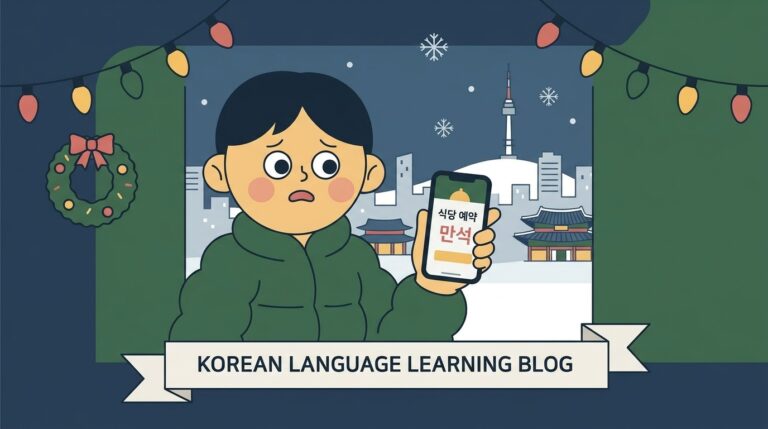
Imagine this: You are watching a K-Drama. The male lead casually walks into a stunning restaurant overlooking the Han River on Christmas Eve, smiles at the staff, and is guided to a candlelit table with snow falling outside. Ah, pure romance! But wait… if you try that in real life Seoul? You will likely hear, “Sorry, we are fully booked.”
Unlike in many Western countries where Christmas is a quiet, cozy family holiday, in Korea, Christmas is the ultimate Couple’s Holiday. And booking a romantic dinner? It is famously known as the ‘Booking War’ (예약 전쟁). If you don’t want to end up eating convenience store ramen shivering in the cold on Christmas Eve, you need to know how to navigate this cultural phenomenon.
Today, I will teach you the exact phrases you need to secure that perfect date spot. This guide is based on real struggles of my expat students who learned the hard way. Let’s dive in!
Phase 2: Core Expressions for the Booking War
1. [크리스마스 이브에 예약 가능한가요?]
- Pronunciation: (keu-ri-seu-ma-seu i-beu-e ye-yak ga-neung-han-ga-yo?) + ‘ga-neung’ sounds like ‘gah-nung’
- Meaning: Is it possible to book on Christmas Eve?
- K-Culture Moment: You are calling that trending wine bar in Seongsu-dong. Your heart is pounding as you hold your breath, waiting for the staff to say yes on the other end of the line.
- Editor’s Insight: The word 가능한가요 (is it possible) is incredibly versatile. It sounds much softer, polite, and natural than just directly asking “Can I book?” (예약할 수 있어요?). It gives the listener room to comfortably say no if they are full.
- Situation Spectrum:
- Casual (Friends): ✅
- Semi-formal (Staff/Clerks): ✅
- Formal (Boss/Elders): ✅
- 🤔 Think About It: Why do Koreans prefer asking “Is it possible?” instead of directly saying “I want to book”? How does this reflect the Korean communication style of being indirect and avoiding putting the listener on the spot?
2. [창가 자리로 부탁드립니다]
- Pronunciation: (chang-ga ja-ri-ro bu-tak-deu-rim-ni-da) + ‘chang’ sounds like ‘chahng’
- Meaning: Please give us a window seat.
- K-Culture Moment: The classic romantic K-Drama confession scene always happens next to a large glass window with the city lights sparkling in the background. This phrase is your ticket to that main character moment.
- Editor’s Insight: 부탁드립니다 is the ultimate magic word in Korean. It literally means “I entrust this to you” or “Please do me this favor.” Use it whenever you make any special request to service staff!
- Situation Spectrum:
- Casual (Friends): 🚫
- Semi-formal (Staff/Clerks): ✅
- Formal (Boss/Elders): ✅
- 🤔 Think About It: In many languages, you might just say “I’d like a window seat.” Why is asking for a ‘favor’ (부탁) used so often in Korean service situations, rather than just stating your preference?
3. [혹시 예약금 있나요?]
- Pronunciation: (hok-si ye-yak-geum in-na-yo?) + ‘hok-si’ sounds like a light sigh ‘hohk-shee’
- Meaning: By any chance, is there a deposit?
- K-Culture Moment: You finally found a place with an open table, but the restaurant sends you a bank account number. Don’t panic! It is just a deposit to prevent ‘no-shows’.
- Editor’s Insight: 혹시 (By any chance) softens any question. It shows you are being considerate and careful. It is the linguistic version of knocking gently on a door before entering.
- Situation Spectrum:
- Casual (Friends): ✅
- Semi-formal (Staff/Clerks): ✅
- Formal (Boss/Elders): ✅
- 🤔 Think About It: The deposit (예약금) culture became huge in Korea recently. What does this tell you about the balance between trusting customers and protecting small businesses in modern Korean society?
Phase 3: Textbook vs. Real Korean
[Checking availability for the 25th]
* 📖 Textbook Korean: 12월 25일에 두 명 예약하고 싶습니다. (I want to book for two people on December 25th.)
* 🗣️ Real Korean: 25일 디너 두 명 자리 있을까요? (Would there be a seat for two for dinner on the 25th?)
* 💡 Why different?: Asking “Would there be a seat?” (자리 있을까요?) is softer and more realistic during the busy holiday season, humbly acknowledging that they might already be fully booked.
[Asking about the menu]
* 📖 Textbook Korean: 크리스마스에 무슨 메뉴가 있습니까? (What menu do you have on Christmas?)
* 🗣️ Real Korean: 혹시 크리스마스 코스만 운영하시나요? (Do you happen to only serve the Christmas course?)
* 💡 Why different?: Many fine dining restaurants in Korea only serve a special (and often expensive) set menu on Christmas. Asking this specifically shows you know how the Korean holiday dining system works!
Phase 4: Cultural Context — K-Culture Deep Dive
4-1. Non-verbal elements: The Power of Nunchi
When planning a Christmas date in Korea, your Nunchi (눈치) needs to be incredibly sharp. Nunchi is the intuitive ability to read the room and anticipate your partner’s expectations. If you wait until December 20th to ask your partner, “So, where should we eat for Christmas?”, you have already failed the Nunchi test. A considerate partner with good Nunchi starts browsing restaurant apps in late November!
4-2. K-Food & K-Drama Connection
Have you noticed that in K-Dramas, couples always seem to eat at a fancy steakhouse, a cozy Italian bistro, or a high-end sushi bar on Christmas? In Korea, Christmas is heavily associated with Western food (양식) and fine dining. While you might personally love Korean BBQ, suggesting a smoky, loud Samgyeopsal place for a Christmas date might make your partner pout! People look for ‘Atmosphere’ (분위기). Restaurants know this, so they create exclusive ‘Christmas Couple Courses’ featuring wine, steak, and a fancy dessert.
Phase 5: Real-Life Roleplay Scenario
Setting: It is December 1st. You are calling a highly-rated Italian restaurant in Yeonnam-dong. You want to impress your date with a perfect evening.
Characters:
* YOU: A determined foreigner trying to secure a romantic table.
* Staff (직원): Polite but incredibly busy restaurant employee.
Staff: 네, 레스토랑 벨라입니다.
(Ne, reseutorang bellaimnida.)
[Yes, this is Restaurant Bella.]
YOU: 안녕하세요, 혹시 크리스마스 이브 디너 예약 가능한가요?
(Annyeonghaseyo, hoksi keuriseumaseu ibeu dineo yeyak ganeunghangayo?)
[Hello, is it possible to book dinner on Christmas Eve?]
Staff: 잠시만요… 네, 8시 타임 바(Bar) 자리 하나 남아있습니다.
(Jamsimanyo… Ne, yeodeol-si taim ba jari hana namaitseumnida.)
[One moment… Yes, we have one bar seat left for the 8 PM slot.]
🔀 Your Turn! How do you respond to get a better seat?
* A) “바 자리는 싫어요. 창가 자리 주세요!” (I hate the bar seat. Give me a window seat!)
* B) “아… 혹시 창가 자리는 다 찼을까요?” (Ah… Are the window seats all full by any chance?)
* C) “오케이, 그거 주세요.” (Okay, give me that.)✅ Best Choice: B — Reason: It gently asks for what you want while acknowledging they are probably full. It is polite and uses great Nunchi.
⚠️ Choice A Analysis: This sounds incredibly rude and demanding! Never use “싫어요” (I hate it / I don’t want it) directly to service staff in Korea.
YOU: 아… 혹시 창가 자리는 다 찼을까요?
(A… hoksi changga jarineun da chaseulkkayo?)
[Ah… Are the window seats all full by any chance?]
Staff: 네, 창가 자리는 11월에 이미 마감되었습니다.
(Ne, changga jarineun sibir-weol-e imi magam-doeeotseumnida.)
[Yes, the window seats were already fully booked in November.]
YOU: 그렇군요. 그럼 바 자리로 예약 부탁드립니다!
(Geureokunyo. Geureom ba jari-ro yeyak butakdeurimnida!)
[I see. Then I will book the bar seat, please!]
Staff: 네, 예약금 안내 문자로 보내드릴게요.
(Ne, yeyak-geum annae munja-ro bonae-deurilgeyo.)
[Yes, I will send you a text message with the deposit information.]
YOU: 감사합니다!
(Gamsahamnida!)
[Thank you!]
Phase 6: 10-Second Shadowing Drill
Read this out loud to practice your flow and tone!
😊 밝게 (Brightly): 안녕하세요! / 혹시 / 크리스마스 이브에 / 예약 가능한가요?
(Annyeonghaseyo! / hoksi / keuriseumaseu i-beu-e / yeyak ganeunghangayo?)
🥺 애교 섞어서 (Polite & slightly pleading): 창가 자리로 / 부탁드립니다!
(Chang-ga ja-ri-ro / bu-tak-deu-rim-ni-da!)
Phase 7: K-Culture Mini Dictionary
1. 예약 전쟁
* Romanization: yeyak jeonjaeng
* English: Booking War
* Context: The fierce competition to book popular restaurants, exhibitions, or train tickets in Korea. For Christmas, the war starts in mid-November!
2. 캐치테이블
* Romanization: kaechiteibeul
* English: Catch Table
* Context: The most popular restaurant reservation app in Korea. A must-have tool for foodies and couples trying to secure fine dining spots.
3. 뷰맛집
* Romanization: byu-matjip
* English: View Matjib (A restaurant famous for its beautiful view)
* Context: A combination of ‘View’ and ‘Matjib’ (delicious place). For Christmas, couples hunt for these places for the perfect romantic Instagram photo.
4. 눈치
* Romanization: nunchi
* English: Social tact / Reading the room
* Context: Knowing when to book, guessing what kind of food your partner secretly wants, and securing a good spot—all of this requires excellent Nunchi.
Phase 8: Traveler Survival Kit
Even if you aren’t booking a Michelin-star restaurant, you will need these phrases when navigating crowded restaurants during the Korean holiday season!
🆘 Survival Phrases TOP 3
* 🇰🇷 “두 명 자리 있나요?” (du myeong jari innayo?)
* 🗣️ English Pronunciation: doo myung jah-ree in-nah-yo?
* 📍 Where to use: Walking into any restaurant or cafe to check for immediate seating.
- 🇰🇷 “웨이팅 얼마나 걸려요?” (weiting eolmana geollyeoyo?)
- 🗣️ English Pronunciation: way-ee-ting ull-mah-nah gull-lyuh-yo?
- 📍 Where to use: When there is a long line outside the restaurant and you need to know the wait time.
🇰🇷 “영문 메뉴판 있나요?” (yeongmun menyupan innayo?)
- 🗣️ English Pronunciation: young-moon meh-nyu-pahn in-nah-yo?
- 📍 Where to use: When you sit down and realize the menu is 100% in Korean.
📌 Editor’s Travel Note
* Useful Apps: Download Catch Table (캐치테이블). The app has an English version and allows you to book fine dining without making a phone call in Korean!
* The Deposit (예약금): Many nice places require a 30,000 to 50,000 KRW deposit via bank transfer. If you don’t have a Korean bank account, the Catch Table app allows foreign credit cards for many restaurants.
* No Tipping: DO NOT tip your server! Excellent service is naturally included in the price in Korea. Leaving money on the table will just cause the staff to chase you down the street thinking you forgot your change.
Phase 9: Critical Thinking — “One Step Deeper”
🧠 Think Deeper: Media vs. Reality
K-Dramas have successfully sold the world a beautiful fantasy of romantic Korean winters. Couples wearing matching scarves, sharing a luxurious meal with zero stress. However, the reality of a Korean Christmas is often a highly commercialized ‘Booking War’. Because it is recognized primarily as a couple’s holiday rather than a family one, the pressure on young people to spend lavishly to prove their affection is immense. Restaurants capitalize on this by replacing their regular menus with overpriced ‘Christmas Sets’. Does true romance require a Han River view and a Michelin-star steak, or have we been conditioned by media to equate money spent with love shown?💬 Your Turn: How is Christmas celebrated in your culture? Is it mostly for family gatherings or for romantic dates? Share your thoughts in the comments!
Phase 10: FAQ & Avoiding Mistakes
- “Can I use casual language (반말) when booking since I am the paying customer?”
- Absolutely NO! In Korea, customers and staff use polite language (존댓말) to each other. Speaking casually to service staff is considered extremely rude and is labeled as Gapjil (갑질 – abuse of power).
- “If I just walk in early around 5 PM, can I get a table on Christmas?”
- Maybe, but very risky. Popular places are 100% pre-booked. You might have better luck at a local mom-and-pop Korean soup restaurant, but definitely not at a romantic Italian bistro.
❌ Common Mistake #1: Forgetting to pay the deposit (예약금). Your reservation is NOT confirmed until the deposit is successfully transferred. Don’t show up empty-handed!
❌ Common Mistake #2: Showing up late. Many places operate in strict 1.5-hour time slots (e.g., 6:00 PM – 7:30 PM) on Christmas. If you are 20 minutes late, you only have 70 minutes to eat your 5-course meal!
Phase 11: Summary & Action Items
- One-Liner Summary: To secure a romantic Christmas date in Korea, start your booking early, use the magic word “부탁드립니다”, and mentally prepare for the booking war!
-
Action Mission 3 Steps:
- 🥉 Bronze (Solo): Say “혹시 크리스마스 이브에 예약 가능한가요?” aloud 3 times in front of a mirror until it sounds natural.
- 🥈 Silver (Online): Download the Catch Table app, switch it to English, and search for a “뷰맛집” in Seoul. Look at their Christmas menus!
- 🥇 Gold (Real Life): Call or walk into a Korean restaurant this week and ask, “창가 자리로 부탁드립니다!”
- K-Culture Mission: Watch a K-Drama this week and spot a scene where couples are eating at a fancy restaurant. Notice how the staff treats them and listen for polite Korean phrases!
Phase 12: Quiz — Interactive Challenge
1. Situational Judgment:
You want a nice table with a view to impress your date. What should you confidently say to the staff?
* A) 창가 자리 내놔! (Give me the window seat!)
* B) 창가 자리로 부탁드립니다. (Window seat, please.)
* C) 저기 앉을래요. (I will sit there.)
2. Fill in the Blank:
You are calling a restaurant. “Excuse me, is it possible to book a table on the 25th?”
* “혹시 25일에 예약 _________?”
3. True or False – K-Culture Edition:
* “In Korea, Christmas is traditionally a quiet time when large extended families gather at home to eat turkey together.” (T/F)
(Scroll down for answers!)
Answers:
1. B (It is polite and uses the magic word for respectful requests. A is incredibly rude!)
2. 가능한가요 (ga-neung-han-ga-yo)
3. False (It is heavily celebrated as a commercial and romantic holiday for young couples, and dining out at fancy restaurants is the norm!)
Frequently Asked Questions (FAQ)
Q: What does "[크리스마스 이브에 예약 가능한가요?]" mean in Korean and how do you pronounce it?
A: In Korean, "[크리스마스 이브에 예약 가능한가요?]" is pronounced [keu-ri-seu-ma-seu i-beu-e ye-yak ga-neung-han-ga-yo?] and means: Is it possible to book on Christmas Eve?
Q: What does "[창가 자리로 부탁드립니다]" mean in Korean and how do you pronounce it?
A: In Korean, "[창가 자리로 부탁드립니다]" is pronounced [chang-ga ja-ri-ro bu-tak-deu-rim-ni-da] and means: Please give us a window seat.
Q: What does "[혹시 예약금 있나요?]" mean in Korean and how do you pronounce it?
A: In Korean, "[혹시 예약금 있나요?]" is pronounced [hok-si ye-yak-geum in-na-yo?] and means: By any chance, is there a deposit?







