

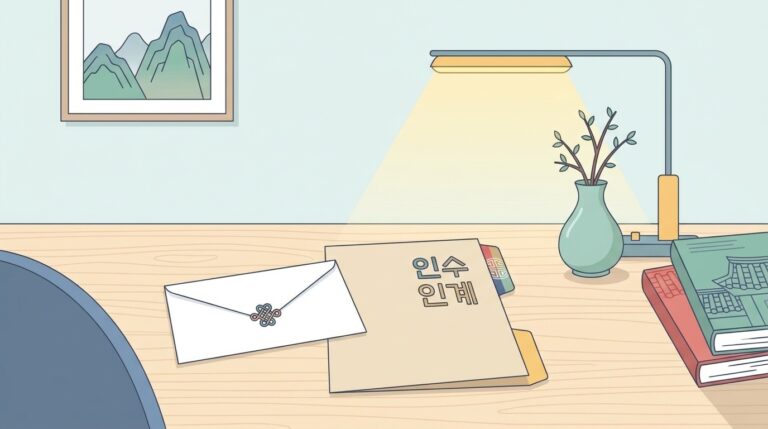
Phase 1: Empathy & The K-Culture Cold Open
Hello! I’m the Daily Hangul Editor.
Picture this classic K-Drama scene: The determined protagonist walks into the HR office, silently places a crisp, white envelope marked 사직서 (Resignation Letter) on the desk, gives a 90-degree bow, and walks out in slow motion. The dramatic music swells. It looks so simple, right?
But real life in a Korean company? It’s not just about dramatic exits. The reality involves weeks of meticulous 인수인계 (Handover), navigating the delicate feelings of your team, and making sure you leave with your professional reputation intact. If you just pack your bags and leave saying a simple I’m sorry, goodbye, you might accidentally burn bridges that you didn’t even know existed.
As someone who has navigated the complex waters of Korean corporate life, I know how intimidating it can be to handle an exit interview or handover in Korean. At a C1 level, you already know how to say I quit. Now, it’s time to learn how to leave like a true insider—with grace, tact, and perfect Nunchi. Everything in this guide comes from real questions my advanced students and expat colleagues have asked me over the years.
Phase 2: Core Expression Deep Dive
Let’s master the advanced expressions that will make you sound like a seasoned Korean professional during your exit process.
1. 인수인계 (Handover / Transfer of Duties)
- Pronunciation: in-su-in-gye + [in sounds like the English ‘in’, su like ‘sue’, gye sounds like ‘gyeh’ with a soft G]
- Meaning: (Literal) Taking over and handing over. (Real nuance) The meticulous process of transferring all your work knowledge, files, and pending tasks to your successor.
- K-Culture Moment: In an office K-Drama, there’s always that chaotic episode where the predecessor leaves a messy in-su-in-gye file, and the newbie has to stay up all night crying over Excel sheets. Doing a perfect in-su-in-gye is considered the ultimate sign of professional respect in Korea.
- Editor’s Insight: This isn’t just a task; it’s a moral obligation. You don’t just ‘pass the baton.’ You create a comprehensive manual. When Koreans leave a company, they pride themselves on leaving a flawless 인수인계서 (handover document).
- Situation Spectrum:
- Casual Coworkers: ✅ (인수인계 잘 끝났어?)
- Semi-formal (Colleagues): ✅ (인수인계 파일 정리 중입니다.)
- Formal (Boss/HR): ✅ (인수인계를 철저히 마무리하겠습니다.)
- 🤔 Think About It: Why is 인수인계 taken so seriously in Korea? It reflects the collective mindset. Your work isn’t just ‘your’ work; it belongs to the team. Leaving a mess hurts the collective harmony. How is this process handled in your home country?
2. 유종의 미를 거두다 (To reap the beauty of a good ending)
- Pronunciation: yu-jong-ui mi-reul geo-du-da + [ui sounds like a quick ‘oo-ee’, eu sounds like the disgusted grunt you make when stepping in gum]
- Meaning: (Literal) To harvest the beauty of the end. (Real nuance) To finish strong, wrapping things up gracefully and professionally until the very last minute.
- K-Culture Moment: During a farewell dinner (송별회), the team leader pours you a glass of Soju and says, Let’s work hard until Friday and reap the beauty of a good ending! It’s the ultimate classy sign-off.
- Editor’s Insight: This is a C1/C2 golden phrase. It originates from Hanja (Chinese characters) and is heavily used in formal exit interviews or final emails. It shows you aren’t mentally checking out early just because you resigned.
- Situation Spectrum:
- Casual Coworkers: ⚠️ (A bit too poetic for a casual chat over coffee)
- Semi-formal (Colleagues): ✅
- Formal (Boss/HR): ✅ (마지막까지 유종의 미를 거두겠습니다.)
- 🤔 Think About It: Korean culture places huge importance on ‘how you end things’—sometimes even more than how you start. Do you have a poetic idiom for finishing strong in your native language?
3. 그동안 많이 배웠습니다 (I learned a lot during my time here)
- Pronunciation: geu-dong-an man-i baewot-seum-ni-da + [baewot rhymes with ‘get’, emphasize the double S sound in seum]
- Meaning: (Literal) I learned a lot during this time. (Real nuance) Thank you for everything; it was an honor working with you.
- K-Culture Moment: When packing up your desk, shaking hands with the senior managers. It’s the standard, humble parting phrase that leaves a good impression for future reference checks (평판 조회).
- Editor’s Insight: Instead of focusing on your own achievements (I did a great job), the Korean way is to elevate the team (I learned so much from you all). It highlights humility and gratitude.
- Situation Spectrum:
- Casual Coworkers: ⚠️ (Sounds a bit stiff for close work-besties)
- Semi-formal (Colleagues): ✅
- Formal (Boss/HR): ✅
- 🤔 Think About It: Language reflects values. Expressing gratitude by saying I learned from you positions you as a humble student of the workplace. Does this level of humility exist in your corporate culture?
Phase 3: Textbook vs Real Korean
Let’s upgrade your corporate vocabulary from textbook robotic to naturally sophisticated.
[Breaking the News that You’re Leaving]
* 📖 Textbook Korean: 저는 회사를 그만둡니다. (I am quitting the company.)
* 🗣️ Real Korean: 저 다음 달에 퇴사하게 되었습니다. (I will be resigning next month.) OR 좋은 기회가 생겨서 이직하게 되었습니다. (A good opportunity came up, so I will be changing jobs.)
* 💡 Why the difference?: Using the passive/indirect form (하게 되었습니다 – it came to be that I am…) softens the blow and sounds much more polite than the abrupt I quit.
[Talking About the Handover]
* 📖 Textbook Korean: 이것이 나의 인수인계 문서입니다. (This is my handover document.)
* 🗣️ Real Korean: 인수인계 파일은 공용 폴더에 다 정리해 뒀습니다. (I’ve organized all the handover files in the shared folder.)
* 💡 Why the difference?: Koreans omit my/나의 in the workplace and focus on the action being completed (정리해 뒀다 – organized and left it there) for the team’s efficiency.
[Saying Goodbye on the Last Day]
* 📖 Textbook Korean: 안녕히 계세요. 모두 감사합니다. (Goodbye. Thank you everyone.)
* 🗣️ Real Korean: 그동안 감사했습니다. 종종 연락드리겠습니다. (Thank you for everything. I’ll keep in touch from time to time.)
* 💡 Why the difference?: 종종 연락드리겠습니다 is polite workplace filler, similar to Let’s grab coffee sometime. You don’t literally have to call them every week, but it maintains the Jeong (warm connection).
Phase 4: Cultural Context — K-Culture Deep Dive
4-1. Non-verbal Elements & Corporate Nunchi
When resigning in Korea, the sequence of who you tell and when is a masterclass in Nunchi (눈치). You absolutely must request a private 1-on-1 meeting (면담) with your direct manager first. If your manager hears about your resignation through office gossip because you told your work bestie first, it’s considered a massive breach of respect. Also, when handing over your final documents, present them with both hands and a slight bow. Never boast about your new salary or new company during an exit interview—keep it humble.
4-2. The K-Drama Connection: The Farewell Hoesik
In dramas like Misaeng, you’ll see the team going out for a heavy dinner (회식) when a beloved character leaves. The farewell dinner (송별회) is a huge part of the exit process. The boss will usually pour you a drink, and this is your cue to pour one back using two hands. This is where you officially clear any bad blood and solidify your network.
Critical perspective: Dramas often make these dinners look overly dramatic with tears and shouting. In reality, modern Korean corporate culture is shifting. Many young professionals now prefer a quiet lunch rather than a heavy, alcohol-fueled dinner.
Phase 5: Real-Life Roleplay Scenario
Setting: It’s a Thursday afternoon. You are sitting in a quiet aesthetic cafe near your office in Yeouido. You’ve just submitted your resignation, and you are having a coffee chat with your trusted senior colleague.
Characters:
* YOU: A foreign professional who has worked at this Korean company for 3 years. You are leaving for a better opportunity.
* Min-su (34): Your senior colleague (대리님). He has mentored you and is a bit sad to see you go, but supportive.
Dialogue:
Min-su: OO씨, 진짜 가는 거예요? 팀장님한테 면담 신청했을 때부터 설마 했는데… ☕
(OO-ssi, jin-jja ga-neun geo-ye-yo? tim-jang-nim-han-te myeon-dam sin-cheong-haet-seul ttae-bu-teo seol-ma haet-neun-de…)
[Are you really leaving? I suspected it when you requested a meeting with the team leader…]
YOU: 네, 대리님. 아까 팀장님께 말씀드렸어요. 다음 달 말까지만 근무하게 되었습니다.
(ne, dae-ri-nim. a-kka tim-jang-nim-kke mal-sseum-deu-ryeot-seo-yo. da-eum dal mal-kka-ji-man geun-mu-ha-ge doe-eot-seum-ni-da.)
[Yes, sir. I told the team leader earlier. I’ll only be working until the end of next month.]
Min-su: 아쉽네요. 그래도 더 좋은 조건으로 이직하는 거니까 축하해요! 인수인계는 어떻게 할 계획이에요?
(a-swip-ne-yo. geu-rae-do deo jo-eun jo-geon-eu-ro i-jik-ha-neun geo-ni-kka chuk-ha-hae-yo! in-su-in-gye-neun eo-tteo-ke hal gye-hoek-i-e-yo?)
[That’s a shame. Still, you’re moving to a better offer, so congratulations! What’s the plan for the handover?]
YOU: 이번 주말까지 담당 업무 매뉴얼 다 작성해서 파일로 넘겨드리려고요.
(i-beon ju-mal-kka-ji dam-dang eom-mu mae-nyu-eol da jak-seong-hae-seo pa-il-ro neom-gyeo-deu-ri-ryeo-go-yo.)
[I’m planning to write up a manual for my tasks by this weekend and hand over the files.]
Min-su: 와, 역시 꼼꼼하네요. 남은 기간 동안 편하게 있다 가요.
(wa, yeok-si kkom-kkom-ha-ne-yo. nam-eun gi-gan dong-an pyeon-ha-ge it-da ga-yo.)
[Wow, thorough as always. Just take it easy for the remaining time.]
🔀 Your Turn! How should you respond to Min-su?
* A) “네, 이제 좀 쉬려고요!” (Yes, I’m going to rest now!)
* B) “아닙니다. 마지막까지 유종의 미를 거둬야죠!” (Not at all. I need to finish strong until the end!)
* C) “그동안 수고하셨습니다. 안녕!” (Good job until now. Bye!)✅ Best Choice: B — Reason: It perfectly matches the C1 professional vibe. It shows dedication and ensures your reputation remains flawless.
⚠️ Choice A Analysis: While honest, saying you’re just going to slack off until you leave lacks Nunchi in front of a senior who will inherit your work.
Min-su: 하하, 그래요. 우리 팀이 OO씨 빈자리 크게 느끼겠네.
(ha-ha, geu-rae-yo. u-ri tim-i OO-ssi bin-ja-ri keu-ge neu-kki-get-ne.)
[Haha, right. Our team is really going to feel your absence.]
YOU: 대리님께서 많이 도와주신 덕분에 그동안 정말 많이 배웠습니다.
(dae-ri-nim-kke-seo man-i do-wa-ju-sin deok-bun-e geu-dong-an jeong-mal man-i baewot-seum-ni-da.)
[Thanks to your help, I really learned a lot during my time here.]
Min-su: 에이, 내가 한 게 뭐 있다고. 송별회는 다음 주 금요일 어때요? 삼겹살에 소주 한잔해야지! 🥩
(e-i, nae-ga han ge mwo it-da-go. song-byeol-hoe-neun da-eum ju geum-yo-il eo-ttae-yo? sam-gyeop-sal-e so-ju han-jan-hae-ya-ji!)
[Oh please, I didn’t do much. How about next Friday for the farewell dinner? We have to do pork belly and Soju!]
YOU: 네, 너무 좋습니다! 기대하고 있겠습니다.
(ne, neo-mu jot-seum-ni-da! gi-dae-ha-go it-get-seum-ni-da.)
[Yes, sounds great! I’ll be looking forward to it.]
Min-su: 그래요. 남은 인수인계 무리하지 말고, 모르는 거 있으면 바로바로 넘겨요.
(geu-rae-yo. nam-eun in-su-in-gye mu-ri-ha-ji mal-go, mo-reu-neun geo it-seu-myeon ba-ro-ba-ro neom-gyeo-yo.)
[Alright. Don’t overwork yourself with the handover, and if there’s anything you don’t know, just pass it to me.]
🎭 Bonus K-Culture Roleplay: The Resignation Trip (퇴사 여행)
It’s very common in Korea to take a month off after quitting to travel before starting a new job. You are at Incheon Airport, ready for your 퇴사 여행 (Resignation Trip). You run into an acquaintance.
Acquaintance: 어? OO씨! 휴가 가세요?
(eo? OO-ssi! hyu-ga ga-se-yo?)
[Oh? OO! Are you going on vacation?]
YOU: 아, 저 이번에 퇴사하고 잠시 재충전하러 여행 가요.
(a, jeo i-beon-e toe-sa-ha-go jam-si jae-chung-jeon-ha-reo yeo-haeng ga-yo.)
[Ah, I resigned recently, so I’m going on a trip to recharge for a bit.]
Acquaintance: 와, 진짜 부럽다! 퇴사 여행이네요. 조심히 잘 다녀와요!
(wa, jin-jja bu-reop-da! toe-sa yeo-haeng-i-ne-yo. jo-sim-hi jal da-nyeo-wa-yo!)
[Wow, so jealous! It’s a resignation trip. Have a safe trip!]
Phase 6: 10-Second Shadowing Drill
Practice your tone! When speaking to a boss during an exit interview, your voice should be calm, grateful, and professional. Pay attention to the pauses.
😤 Professional & Sincere tone:
팀장님, / 그동안 / 정말 많이 배웠습니다. / 마지막 날까지 / 유종의 미를 / 거두겠습니다.
(tim-jang-nim, / geu-dong-an / jeong-mal man-i baewot-seum-ni-da. / ma-ji-mak nal-kka-ji / yu-jong-ui mi-reul / geo-du-get-seum-ni-da.)
Phase 7: K-Culture Mini Dictionary
Here are the essential HR keywords you need in the Korean corporate world:
1. 눈치 (Nunchi)
* Romanization: nunchi
* English: Social situational awareness / Emotional intelligence.
* Context: The core social skill in Korea. In HR terms, having good Nunchi means knowing when to resign (e.g., not during the busiest season) and how to read your manager’s mood before handing in your letter.
2. 회식 / 송별회 (Hoesik / Songbyeolhoe)
* Romanization: hoe-sik / song-byeol-hoe
* English: Company dinner / Farewell party.
* Context: The farewell party is a crucial networking event. Leaving gracefully means attending your Songbyeolhoe and thanking everyone personally.
3. 평판 조회 (Pyeong-pan jo-hoe)
* Romanization: pyeong-pan jo-hoe
* English: Reference check.
* Context: Korean industries are heavily networked. HR will almost certainly call your former team leader. This is why a perfect handover is mandatory.
4. 퇴직금 (Toe-jik-geum)
* Romanization: toe-jik-geum
* English: Severance pay.
* Context: By law, if you work more than one year at a Korean company, you receive one month’s salary per year worked when you resign. This usually funds the famous Resignation Trip!
Phase 8: Traveler Survival Kit
So, you got your 퇴직금 (Severance pay) and you’re embarking on your epic Resignation Trip around Korea! When you’re traveling, leaving an accommodation properly is like doing an 인수인계 with the hotel. Here are advanced phrases for checking out and moving on.
🆘 Survival Phrases for Leaving/Checking Out
* 🇰🇷 “체크아웃 부탁드립니다. 짐을 잠깐 맡겨도 될까요?” (che-keu-a-ut bu-tak-deu-rim-ni-da. jim-eul jam-kkan mat-gyeo-do doel-kka-yo?)
* 🗣️ Pronunciation Guide: [check-out boo-tak-deu-rim-ni-da. jim-eul jam-kkan mat-gyo-do dwehl-kka-yo?]
* 📍 Where to use: Hotel front desk, Airbnb hosts.
* 💡 Pro Tip: Korean accommodations are incredibly generous with luggage holding. Always ask to leave your bags (짐 맡기기) if you have a late flight!📌 Editor’s Travel Note
* Moving out of an apartment: If your resignation means leaving your Korean apartment, remember that you must arrange for 폐기물 스티커 (waste disposal stickers) from the local convenience store to throw away large furniture. You can’t just leave a desk on the street!
* Transportation: When leaving for the airport, the Airport Limousine Bus (공항버스) is often much more comfortable than the subway, especially with heavy luggage packed with Korean snacks.
Phase 9: Critical Thinking Corner — “Going One Step Deeper”
🧠 Think Deeper: Language & Power in the Korean Workplace
Let’s analyze the phrase 그동안 많이 배웠습니다 (I learned a lot during this time). Why is this the standard farewell rather than simply stating your accomplishments? Korean workplace language is heavily influenced by Confucian hierarchies, where humility and recognizing the collective effort are valued over individual boasting. By positioning yourself as a ‘learner’ regardless of your actual skills, you pay respect to the seniority (나이 and 직급) of your colleagues. This protects the ego of the managers staying behind and ensures you leave a legacy of being a well-mannered professional.
💬 Your Turn: In your home culture, when someone resigns, do they highlight their personal achievements to the team, or do they focus on what the team gave them? Share your thoughts in the comments!
Phase 10: FAQ & Avoiding Misconceptions
- Q: Can I just tell HR that I’m leaving, without telling my team leader first?
- No! Absolutely not. Legally, you can. Culturally, it is career suicide. Your direct manager must be the first to know in a private 1-on-1 meeting. Going above their head shows a severe lack of Nunchi.
- Q: Should I tell people where my new job is?
- Maybe. If it’s a direct competitor, keep it vague (다른 업계로 가게 되었습니다 – I’m moving to a different industry). If you’re staying friendly, you can share, but never brag about the salary bump.
- Q: How much notice do I really need to give?
- Usually, Korean contracts ask for 30 days. Giving less than 2-3 weeks is considered very rude because finding a replacement and doing the 인수인계 takes time.
❌ Common Mistake #1: Leaving immediately after giving a 2-week notice without creating an 인수인계 file.
✅ Do this instead: Spend your last weeks documenting every process you handle. Leave your desk perfectly clean.
Phase 11: Summary & Action Items
- One-Liner Summary: Resigning in Korea is an art of leaving things better than you found them—master the 인수인계 (handover) and aim for 유종의 미 (a beautiful conclusion)!
-
Action Mission 3 Steps:
- 🥉 Bronze (Solo): Look in the mirror and practice the phrase: 마지막까지 유종의 미를 거두겠습니다 with a professional, confident expression.
- 🥈 Silver (Online): Go to a Korean learning forum and write a short sentence about what you would do on your 퇴사 여행 (Resignation Trip).
- 🥇 Gold (Real Life): If you are leaving a job, club, or even a long-term class, say 그동안 정말 많이 배웠습니다 to your peers or teachers on the last day!
- K-Culture HR Mission: Watch episode 1 of the drama Misaeng or My Liberation Notes. Pay close attention to how colleagues talk to each other in the office. Notice the polite distance and the subtle Nunchi in their body language!
Phase 12: Quiz — Interactive Challenge
1. Situational Judgment: You are having your final exit interview with your Korean boss. They ask for your final thoughts. Which is the best C1-level response?
* A) 연봉이 너무 낮아서 힘들었어요. (The salary was too low, it was hard.)
* B) 팀장님 덕분에 많이 배웠습니다. 유종의 미를 거두겠습니다. (Thanks to you, I learned a lot. I will finish strong.)
* C) 제 인수인계 파일을 잘 읽어보세요. (Read my handover file carefully.)
2. Fill in the Blank:
“다음 주에 퇴사하시니까, 금요일에 다 같이 ( ____ )를 합시다!”
(Since you are resigning next week, let’s all have a ______ on Friday!)
3. True or False – K-Culture Edition:
It is considered polite to tell your close office friend that you are resigning before you tell your boss. (T/F)
Click here for Answers
1. B – Always stay humble and professional. A is burning a bridge, C sounds arrogant and dictatorial.
2. 송별회 (Farewell party) – The essential networking event before leaving.
3. False – You must always tell your direct manager first to respect the hierarchy and avoid gossip.
Frequently Asked Questions (FAQ)
Q: What does "인수인계 (Handover / Transfer of Duties)" mean in Korean and how do you pronounce it?
A: In Korean, "인수인계 (Handover / Transfer of Duties)" is pronounced [in-su-in-gye + [in sounds like the English 'in', su like 'sue', gye sounds like 'gyeh' with a soft G] and means: (Literal) Taking over and handing over. (Real nuance) The meticulous process of transferring all your work knowledge, files, and pending tasks to your successor.
Q: What does "유종의 미를 거두다 (To reap the beauty of a good ending)" mean in Korean and how do you pronounce it?
A: In Korean, "유종의 미를 거두다 (To reap the beauty of a good ending)" is pronounced [yu-jong-ui mi-reul geo-du-da + [ui sounds like a quick 'oo-ee', eu sounds like the disgusted grunt you make when stepping in gum] and means: (Literal) To harvest the beauty of the end. (Real nuance) To finish strong, wrapping things up gracefully and professionally until the very last minute.
Q: What does "그동안 많이 배웠습니다 (I learned a lot during my time here)" mean in Korean and how do you pronounce it?
A: In Korean, "그동안 많이 배웠습니다 (I learned a lot during my time here)" is pronounced [geu-dong-an man-i baewot-seum-ni-da + [baewot rhymes with 'get', emphasize the double S sound in seum] and means: (Literal) I learned a lot during this time. (Real nuance) Thank you for everything; it was an honor working with you.






