

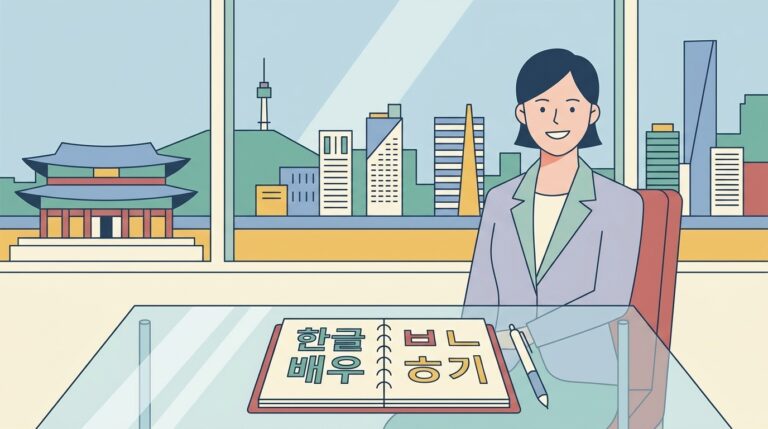
Phase 1: Empathy (Welcome to the Korean Boardroom)
Hello! I am the Head Editor of Daily Hangul, your veteran tutor and local culture navigator.
Imagine this: It is 5:30 PM on a Friday. You are in a glass-walled meeting room in a Gangnam high-rise. The coffee cups are empty, the brainstorming is done, and everyone is secretly thinking about dinner. You think the meeting is over, so you reach for your laptop to pack up. Suddenly, you notice no one else is moving. The room is quiet. Everyone is looking at the boss. Why?
Because in Korean office culture, a meeting isn’t over when the ideas stop. It is only over when the magic closing words are spoken. If you close your laptop before those words, you might get a few shocked stares.
Today, we are going to learn how to expertly summarize a meeting agenda and officially close it. Whether you are leading a team in Seoul or just want to sound like a suave K-Drama CEO, mastering these expressions will instantly upgrade you from an outsider to an office insider.
Let’s dive into the words that actually let you go home!
Phase 2: Core Expressions Deep Dive
1. 오늘 논의한 내용을 정리해 보겠습니다.
- Pronunciation: oneul nonihan naeyongeul jeongnihae bogetseumnida. [o-neul no-nee-han nae-yong-eul jung-nee-hae bo-get-seum-nee-da]
- Sound-alike guide: ‘eu’ sounds like the disgusted sound you make when stepping in gum.
- Meaning: Let’s summarize what we discussed today. (Literal: I will try to organize the contents we discussed today.)
- K-Culture Moment: This is the moment in a K-Drama where the camera pans to the smart, competent lead character who takes control of a chaotic room. They tap their pen on the table and confidently say this to align the team.
- Editor’s Insight: Notice that we use 정리하다 (to organize/tidy up) rather than just 요약하다 (to summarize). In Korean business culture, wrapping up a meeting isn’t just about shortening the text; it is about tidying up the thoughts so everyone has a clear path forward.
- Situation Spectrum:
- Friends (Casual): 🚫 (Too formal)
- Coworkers (Semi-formal): ✅
- Boss/Elders (Formal): ✅
- 🤔 Think About It: Why do Koreans prefer the phrase “I will try to organize” (해 보겠습니다) instead of “I will organize” (정리하겠습니다)? How does this soften the tone in a hierarchical setting?
2. 이것으로 오늘 회의를 마치겠습니다.
- Pronunciation: igeoseuro oneul hoe-uireul machigetseumnida. [ee-guh-seu-ro o-neul hway-ee-reul mah-chee-get-seum-nee-da]
- Meaning: This concludes today’s meeting. (Literal: With this, I will finish today’s meeting.)
- K-Culture Moment: The golden phrase. When the director says this, you will hear the synchronized sound of notebooks closing and chairs pushing back. It is the official “cut!” of the business scene.
- Editor’s Insight: This phrase is an excellent example of polite detachment. You aren’t saying “I am ending the meeting.” You are saying “With this item, the meeting will be finished.” It sounds objective and highly professional.
- Situation Spectrum:
- Friends (Casual): 🚫
- Coworkers (Semi-formal): ✅
- Boss/Elders (Formal): ✅
- 🤔 Think About It: In your native language, how do you officially signal that a formal gathering is over without sounding too abrupt?
3. 다들 수고 많으셨습니다.
- Pronunciation: dadeul sugo maneusyeotseumnida. [dah-deul soo-go mah-neu-syut-seum-nee-da]
- Meaning: Thank you all for your hard work.
- K-Culture Moment: You are walking out of the boardroom. Everyone is bowing slightly to each other, repeating this phrase like a gentle chant. It is the ultimate social glue of the Korean workplace.
- Editor’s Insight: You literally cannot leave a Korean workplace or meeting without hearing this. It acknowledges the collective suffering and effort of the group.
- Situation Spectrum:
- Friends (Casual): ⚠️ (Say “고생했어” instead)
- Coworkers (Semi-formal): ✅
- Boss/Elders (Formal): ✅ (But see FAQ for a crucial warning!)
- 🤔 Think About It: Why is acknowledging someone’s “hard work/suffering” the default way to say “good job” or “goodbye” in Korean work culture?
Phase 3: Textbook vs. Real Korean
Here is how real office workers talk compared to your B2 textbook.
[Setting the Next Meeting]
* 📖 Textbook Korean: 다음 회의 일정은 내일 오후 2시입니다. (The next meeting schedule is tomorrow at 2 PM.)
* 🗣️ Real Korean: 다음 일정은 단톡방에서 다시 맞출까요? (Shall we sync up the next schedule in the group chat?)
* 💡 Why the difference?: Korean corporate life runs on KakaoTalk group chats (단톡방). Decisions and scheduling often happen digitally after the face-to-face meeting ends.
[Saying Goodbye After the Meeting]
* 📖 Textbook Korean: 안녕히 계십시오. (Goodbye – stay well.)
* 🗣️ Real Korean: 고생하셨습니다! 먼저 들어가 보겠습니다. (You’ve worked hard! I will head out first.)
* 💡 Why the difference?: A simple “goodbye” feels incredibly cold in a workplace. Acknowledging effort (고생하셨습니다) is the standard professional parting.
Bottom Note: For B2 level learners, using “먼저 들어가 보겠습니다” (I will head out/go back to my desk first) is a incredibly natural and polite way to excuse yourself from a group.
Phase 4: Cultural Context — K-Culture Deep Dive
4-1. Non-Verbal Nunchi (눈치)
Language is only half the battle. When summarizing and closing a meeting, Nunchi (the art of reading the room) is critical.
If you are not the highest-ranking person in the room, do not pack your bag first. Even if the meeting has officially ended with “마치겠습니다”, wait for the senior leader to stand up or close their laptop. Packing up early sends a non-verbal signal that you are impatient to leave, which can be seen as slightly disrespectful.
4-2. The K-Drama Trope: The “Hoesik” Segue
In K-Dramas, wrapping up a grueling meeting often leads straight to a team dinner. The senior manager closes the file folder, sighs, and says, “수고했어. 오늘 회식 콜?” (Good job. Company dinner tonight, deal?).
While the mandatory Hoesik (회식) culture has decreased significantly in modern Korea, the post-meeting meal is still a very real way to build team solidarity. The tension of the formal meeting dissolves over sizzling pork belly (삼겹살) and a glass of Soju.
Phase 5: Real-life Roleplay Scenario
Setting: 5:00 PM, Friday. A sleek meeting room in a Seoul tech company. You and three Korean colleagues just finished a 2-hour long debate about the new app launch. You are the project lead.
Characters:
* YOU: The foreign project lead, respected but still navigating Korean corporate nuances.
* Min-su (32): Your witty and supportive Korean colleague.
Dialogue:
Min-su: 휴, 드디어 안건이 다 끝났네요. 리더님, 마무리해 주시죠.
(Hyu, deudieo an-geoni da kkeunnatneyo. Lideo-nim, mamurihae jusijo.)
[Phew, we finally went through all the agendas. Lead, please wrap it up for us.]
(Stage Direction: Min-su leans back in his chair and smiles, gesturing toward you.)
YOU: 네, 그럼 제가 오늘 논의한 내용을 정리해 보겠습니다.
(Ne, geureom jega oneul nonihan naeyongeul jeongnihae bogetseumnida.)
[Yes, then I will summarize what we discussed today.]
Min-su: 네, 앱 출시일은 다음 달 15일로 확정된 거죠?
(Ne, aep chulsi-ireun da-eum dal sibo-illo hwakjeongdoen geojyo?)
[Yes, the app launch date is confirmed for the 15th of next month, right?]
YOU: 맞습니다. 세부 일정은 단톡방에서 다시 맞추도록 해요.
(Matseumnida. Sebu iljeongeun dantokbang-eseo dasi matchudorok haeyo.)
[That’s correct. Let’s sync up the detailed schedule in the group chat again.]
Min-su: 완벽합니다. 금요일인데 얼른 퇴근하시죠!
(Wanbyeokamnida. Geumyoil-inde eolleun toegeunhasijo!)
[Perfect. It’s Friday, let’s get off work quickly!]
🔀 Your Turn! How do you officially close the meeting?
* A) “안녕히 계세요. 주말 잘 보내세요.”
* B) “이것으로 회의를 마치겠습니다. 다들 주말 잘 보내세요!”
* C) “끝! 집에 갑시다!”
✅ Best Choice: B — Reason: It uses the professional closing formula, then immediately transitions into a warm, weekend greeting. It establishes your authority while being friendly.
⚠️ Choice C Analysis: “끝!” (Done/Finish!) is very casual. It might be funny if you are super close with your team, but as a project lead, it lacks a bit of professional polish.
Bonus Scenario: Getting out of the building!
You left the meeting, but now you need a taxi to get back to your hotel or next appointment.
YOU: 기사님, 강남역으로 가 주세요.
(Gisanim, Gangnam-yeok-euro ga juseyo.)
[Driver, please go to Gangnam Station.]
Taxi Driver: 네, 알겠습니다. 길이 좀 막히네요.
(Ne, algetseumnida. Gili jom makineyo.)
[Yes, understood. The traffic is a bit congested.]
YOU: 천천히 가셔도 괜찮습니다. 수고하십니다!
(Cheoncheonhi gasyeodo gwaenchanseumnida. Sugohasimnida!)
[It is okay to go slowly. Thank you for your hard work!]
Phase 6: 10-Second Shadowing Drill
Practice speaking like a confident K-Drama executive! Pay attention to the pauses (/) and the emotional tags.
- 😤 단호하게 (Firmly/Professionally):
자, / 이것으로 / 오늘 회의를 / 마치겠습니다.
(Ja, / igeoseuro / oneul hoe-uireul / machigetseumnida.) -
😊 밝게 (Brightly/Warmly):
모두 / 수고 / 많으셨습니다! / 주말 잘 보내세요!
(Modu / sugo / maneusyeotseumnida! / Jumal jal bonaeseyo!)
Phase 7: K-Culture Mini Dictionary
1. 눈치
* Romanization: nunchi
* English: Situational awareness / reading the room
* Context: The core social sense in Korea. Knowing when to speak, when to pack up, and when to suggest a team dinner just by observing the atmosphere.
2. 단톡방
* Romanization: dantokbang
* English: Group chat room (usually on KakaoTalk)
* Context: A portmanteau of 단체 (group) + 카카오톡 (KakaoTalk) + 방 (room). Where actual business scheduling happens post-meeting.
3. 회식
* Romanization: hoesik
* English: Company dinner/gathering
* Context: Often follows big meetings. A vital part of Korean corporate bonding, involving food, drinks, and breaking down formal barriers.
4. 퇴근
* Romanization: toegeun
* English: Leaving work / clocking out
* Context: The most beautiful word to hear on a Friday after a long meeting.
Phase 8: Traveler’s Survival Kit
Even if you are in Korea for business meetings, you are still a traveler navigating Seoul! Here are survival phrases you need immediately after leaving the boardroom.
🆘 Survival Phrase #1: Finding a café to send follow-up emails
* 🇰🇷 “와이파이 비밀번호가 뭐예요?” (wa-i-pa-i bimilbeonhoga mwoyeyo?)
* 🗣️ Sound: wai-pai bee-mil-bun-ho-ga mwo-ye-yo?
* 📍 Where to use: Cafes, hotel lobbies.
🆘 Survival Phrase #2: Getting a Taxi
* 🇰🇷 “영수증 꼭 챙겨 주세요.” (yeongsujeung kkok chaenggyeo juseyo.)
* 🗣️ Sound: young-soo-jeung kkok chaeng-gyuh ju-se-yo.
* 📍 Where to use: In a taxi, to ensure you can expense your travel to your company!
📌 Editor’s Travel Note
* Useful App: Download Kakao T for taxis. You can hail a cab without speaking a word, and the destination is pre-set. Perfect if you are exhausted after a long meeting!
* Tipping: Remember, there is NO tipping culture in Korea. Do not tip your taxi driver or the waitress at your business lunch. They will likely chase you down the street to return your money!
Phase 9: Critical Thinking — “One Step Deeper”
Language & Power (언어와 권력)
In the Korean workplace, language is a direct reflection of power and hierarchy. The phrase “이것으로 회의를 마치겠습니다” is almost exclusively reserved for the highest-ranking person in the room, or the designated MC of the meeting. If a junior employee suddenly says this, it would be seen as an overstep of authority. Furthermore, the way you say “Thank you for your hard work” changes entirely based on who you are speaking to (see the FAQ below!). The Korean language doesn’t just communicate information; it constantly maps out the social structure of the room.
💬 Your Turn: Does your native language have specific phrases that only a boss or leader is “allowed” to use during a meeting? Share in the comments!
Phase 10: FAQ & Avoiding Mistakes
Q: Can I say “수고하세요 (Sugohaseyo)” to my boss?
A: NO! ABSOLUTELY NOT!
This is the biggest trap for B2 learners. “수고하세요” literally implies “Keep working hard/Keep suffering.” It is fine to say to a taxi driver or a delivery person when you leave, but saying it to your boss sounds incredibly arrogant, like you are giving them an order to keep working.
❌ Common Mistake #1: Saying “수고하세요” to a superior.
✅ Do This Instead: Say “고생하셨습니다” (You have worked hard) or “수고 많으셨습니다” (You put in a lot of effort). The past tense makes it a respectful acknowledgment of what they have already done.
Q: Can I use casual language (반말) if my coworkers and I are the same age?
A: MAYBE, but not in the boardroom.
Even if you are “same-age friends” (동갑) who drink together on weekends, meetings require formal language (존댓말). Maintaining professionalism in public spaces is crucial.
Phase 11: Summary & Action Items
One-Liner Summary: To wrap up a Korean meeting like a pro, summarize with “정리해 보겠습니다”, close with “마치겠습니다”, and always acknowledge the group’s effort with “수고 많으셨습니다.”
Action Mission 3-Step:
* 🥉 Bronze (Solo): Stand in front of your mirror and practice the confident CEO wrap-up: “이것으로 회의를 마치겠습니다!”
* 🥈 Silver (Online): Drop a comment on our blog using today’s phrase: “에디터님, 오늘 레슨 정리해 주셔서 감사합니다. 수고하셨습니다!”
* 🥇 Gold (Real Life): Next time you finish an online Korean tutoring session or language exchange, use “수고하셨습니다” to end the call.
🎬 K-Culture Mission: Watch an episode of a Korean office drama (like Misaeng or Start-Up). Pay close attention to the end of a meeting scene. Who speaks last? Who stands up first? Spot the Nunchi!
Phase 12: Quiz — Interactive Challenge
1. Situational Judgment:
You just finished a gruelling 3-hour meeting with your company’s Vice President. It’s time to say goodbye. What is the BEST phrase to use?
* A) 수고하세요! (Sugohaseyo!)
* B) 고생하셨습니다! (Gosaenghasyeotseumnida!)
* C) 안녕히 가세요! (Annyeonghi gaseyo!)
2. True or False — K-Culture Edition:
In a Korean meeting, once someone says “회의를 마치겠습니다” (The meeting is concluded), it is perfectly fine to immediately grab your bag and rush out the door before the boss moves.
(Answers below)
Click to reveal answers
1. Answer: B
Never say “수고하세요” (A) to a superior, as it sounds like a command to keep working. (B) respectfully acknowledges their past effort. (C) is too basic and lacks professional warmth.
2. Answer: False
Nunchi dictates that you should generally wait for the most senior person to begin packing up or standing up before you make a mad dash for the exit!
Frequently Asked Questions (FAQ)
Q: What does "오늘 논의한 내용을 정리해 보겠습니다." mean in Korean and how do you pronounce it?
A: In Korean, "오늘 논의한 내용을 정리해 보겠습니다." is pronounced [oneul nonihan naeyongeul jeongnihae bogetseumnida. [o-neul no-nee-han nae-yong-eul jung-nee-hae bo-get-seum-nee-da] and means: Let's summarize what we discussed today. (Literal: I will try to organize the contents we discussed today.)
Q: What does "이것으로 오늘 회의를 마치겠습니다." mean in Korean and how do you pronounce it?
A: In Korean, "이것으로 오늘 회의를 마치겠습니다." is pronounced [igeoseuro oneul hoe-uireul machigetseumnida. [ee-guh-seu-ro o-neul hway-ee-reul mah-chee-get-seum-nee-da] and means: This concludes today's meeting. (Literal: With this, I will finish today's meeting.)
Q: What does "다들 수고 많으셨습니다." mean in Korean and how do you pronounce it?
A: In Korean, "다들 수고 많으셨습니다." is pronounced [dadeul sugo maneusyeotseumnida. [dah-deul soo-go mah-neu-syut-seum-nee-da] and means: Thank you all for your hard work.







