

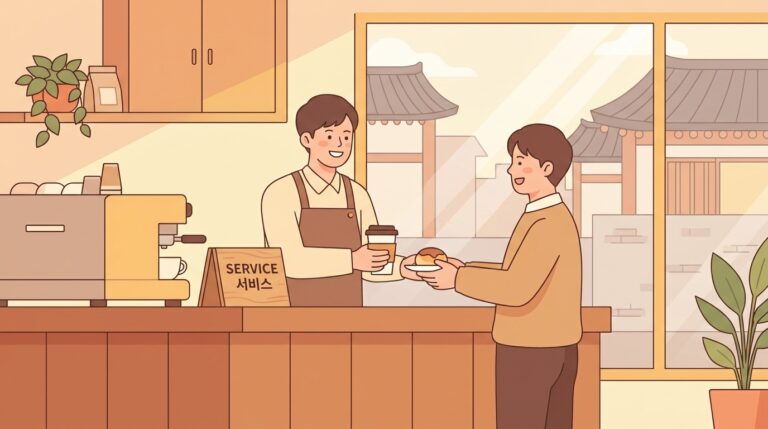
Welcome to the Battlefield of Korean Cafes
Hello! Daily Hangul Editor here.
If you’ve ever walked down a street in Seoul, you’ve probably noticed something astonishing: there are cafes everywhere. Sometimes three on the same block, right next to each other! In a K-Drama, the protagonist often opens a cozy, aesthetically pleasing neighborhood cafe, remembers everyone’s name, and magically succeeds while falling in love. But in reality? The Korean cafe industry is a fierce battlefield.
So, how do local cafes survive and thrive in this ultra-competitive market? The secret weapon lies in 단골 (Dangol – regular customers) and the brilliant, subtle art of Korean cafe marketing. It’s not just about selling coffee; it’s about building a psychological bond through language and culture.
Today, we are diving into the advanced communication skills needed for cafe marketing and managing your loyal regulars. Whether you’re dreaming of opening a business in Korea, working at a local shop, or just want to understand why your favorite barista suddenly gave you a free muffin, this guide is for you.
Phase 2: Core Expressions Deep Dive
Let’s break down the essential expressions that will turn a first-time visitor into a lifelong regular.
1. 단골이시니까 서비스로 드릴게요.
- Pronunciation: dangorisinikka seobiseuro deurilkkeyo. (dan-goal-ee-shee-nee-kka seo-bee-seu-ro deu-ril-kke-yo)
- Meaning: (Literal) Because you are a regular, I will give this as a service. -> (Real nuance) This is on the house, specially for our favorite customer!
- K-Culture Moment: Imagine sitting at your favorite neighborhood cafe working on your laptop. The owner quietly walks over and places a slice of newly baked cake on your table with a warm smile, saying this exact phrase. It instantly makes you feel like a VIP.
- Editor’s Insight: In Korea, 서비스 (Service) does not mean a tip or customer service attitude. It specifically means a free item or complimentary upgrade given by the business owner. Using this phrase makes the transaction feel less like capitalism and more like friendship.
- Situation Spectrum:
- Casual Customers (Friendly tone): ✅
- Loyal Regulars (Warm & Appreciative): ✅
- Corporate/Very Formal Settings: 🚫
- 🤔 Think About It: Why do Korean businesses prefer giving away ‘free physical items’ (service) rather than simply offering a ‘discount’ on the bill? How does receiving a physical gift change the customer’s emotional attachment to the store?
2. 늘 드시던 걸로 준비해 드릴까요?
- Pronunciation: neul deusideon geollo junbihae deurilkkayo? (neul deu-shee-don goll-lo joon-bee-hae deu-ril-kka-yo?)
- Meaning: (Literal) Shall I prepare what you always drank? -> (Real nuance) Shall I get your usual?
- K-Culture Moment: This is the ultimate power move in customer management. In dramas, when the handsome CEO walks into his regular spot, he doesn’t even order. The barista just says this.
- Editor’s Insight: This phrase relies heavily on 눈치 (Nunchi). You have to be 100% sure of their order! If you use this, you are telling the customer, “I see you, I remember you, and you matter to our cafe.”
- Situation Spectrum:
- Close Regulars (Friendly): ✅
- Older Regulars (Respectful): ✅
- First-time visitors: 🚫
- 🤔 Think About It: Remembering personal details is a key business strategy globally. But in the context of Korean culture, how does this phrase reflect the desire for community (정 – Jeong) in an increasingly lonely urban society like Seoul?
3. 동네방네 입소문 많이 내주세요!
- Pronunciation: dongnebangne ipsomun mani naejuseyo! (dong-neh-bang-neh ip-so-moon mah-nee nae-joo-seh-yo!)
- Meaning: (Literal) Please let out many mouth-rumors in every neighborhood! -> (Real nuance) Please spread the word to everyone you know!
- K-Culture Moment: You just gave a customer a massive ‘service’ portion or a beautiful latte art. As they gasp and take photos for Instagram, you playfully toss in this phrase.
- Editor’s Insight: 입소문 (Word of mouth) is the lifeblood of Korean small businesses. Adding ‘동네방네’ (everywhere/all over town) makes the request sound cute and slightly exaggerated, softening the fact that you are asking for free marketing.
- Situation Spectrum:
- Friendly Regulars: ✅
- Young Influencer-type Customers: ✅
- Stiff/Formal Customers: ⚠️
- 🤔 Think About It: South Korea is one of the most hyper-connected societies in the world regarding social media and internet cafes. How does traditional ‘word of mouth’ translate into modern Korean digital marketing (like Naver Blog reviews)?
Phase 3: Textbook vs. Real Korean
At the C1 level, you know the grammar perfectly. Now, let’s learn how to sound like a savvy business owner, not a robot.
[Greeting a returning customer]
* 📖 Textbook Korean: 다시 방문해 주셔서 감사합니다. (Thank you for visiting again.)
* 🗣️ Real Korean: 어? 사장님 또 오셨네요! 완전 환영합니다! (Oh? Boss, you came again! Totally welcome!)
* 💡 Why the difference?: Calling a customer ‘사장님’ (Boss) even if they aren’t a boss is a common Korean linguistic tool to elevate their status playfully. It builds instant intimacy compared to rigid corporate greetings.
[Asking for a review]
* 📖 Textbook Korean: 인터넷에 긍정적인 평가를 작성해 주시길 바랍니다. (Please write a positive evaluation on the internet.)
* 🗣️ Real Korean: 영수증 리뷰 예쁘게 남겨주시면 사랑합니다~ (I’ll love you if you leave a pretty receipt review~)
* 💡 Why the difference?: Korean marketing language heavily utilizes playful hyperbole (like “I love you”) and aesthetic adjectives (예쁘게 – prettily) to make transactional requests feel warm and non-burdening.
Phase 4: Cultural Context — K-Culture Deep Dive
4-1. The Non-Verbal Art of “Service”
When you give ‘service’ (서비스) to a regular, your non-verbal cues are just as important as your words.
If the cafe is full of other customers, you must use high-level 눈치 (Nunchi). Do not announce it loudly, or everyone else will demand free items! Instead, slide the free cookie onto their tray, make brief eye contact, wink slightly, and whisper, “이건 비밀이에요” (This is a secret). This creates an exclusive, secret bond between you and the regular.
4-2. The K-Pop Connection: Fandom Marketing
If you run a cafe in Seoul, you cannot ignore K-Pop culture. One of the biggest marketing strategies for local cafes is hosting 생일 카페 (Birthday Cafes) or 컵홀더 이벤트 (Cup-sleeve events). Fans rent out a cafe (usually by guaranteeing a certain number of drink sales) and decorate it completely with photos of their favorite idol for their birthday.
For a cafe owner, this is a jackpot. You get guaranteed massive foot traffic, and fans will buy multiple drinks just to collect the special cup sleeves. If you know how to communicate warmly with these fandom organizers, your cafe’s reputation will explode within the fan community via X (Twitter).
Phase 5: Real-World Roleplay Scenario
Setting: Friday, 2:00 PM. Your indie cafe in Yeonnam-dong. The espresso machine is humming. The aroma of freshly baked scones fills the air.
Characters:
* YOU: The sharp, observant cafe manager.
* Ji-eun (지은): A 28-year-old local resident. She visits your cafe three times a week and always posts aesthetic photos on her Instagram story.
Dialogue:
YOU: 어서 오세요! 밖이 많이 춥죠?
(eoseo oseyo! bakk-i mani chupjyo?)
[Welcome! It’s really cold outside, right?]
Ji-eun: 네, 오늘 바람이 장난 아니네요.
(ne, oneul baram-i jangnan anineyo.)
[Yes, the wind is no joke today.]
YOU: 늘 드시던 따뜻한 바닐라 라떼로 준비해 드릴까요?
(neul deusideon ttatteushan banilla lattelo junbihae deurilkkayo?)
[Shall I prepare your usual hot vanilla latte?]
Ji-eun: 아, 오늘은 아이스 아메리카노 마실게요. 얼죽아잖아요!
(a, oneul-eun aiseu amerikanolo masilkkeyo. eoljug-ajanayo!)
[Ah, today I’ll have an iced americano. You know I’m an ‘Eol-juk-ah’ (Iced Americano even if I freeze to death)!]
YOU: 아, 맞다! 잠시만요. (You hand her the drink and a small plate) 이건 저희가 새로 구운 휘낭시에인데, 단골이시니까 서비스로 드릴게요.
(a, matda! jamsimanyo. igeon jeohuiga saero guun hwinangsie-inde, dangorisinikka seobiseuro deurilkkeyo.)
[Ah, right! Just a moment. This is a newly baked financier we made. Since you’re a regular, I’ll give it to you as service.]
Ji-eun: 헐, 진짜요? 대박! 너무 예뻐요. 사진 찍어서 인스타에 올려야겠다.
(heol, jinjjayo? daebak! neomu yeppeoyo. sajin jjigeoseo instae ollyeoyagetda.)
[Omg, really? Jackpot! It’s so pretty. I should take a photo and upload it to Insta.]
YOU: 와, 감사합니다! 동네방네 입소문 많이 내주세요!
(wa, gamsahamnida! dongnebangne ipsomun mani naejuseyo!)
[Wow, thank you! Please spread the word all over the neighborhood!]
Ji-eun: 당연하죠! 사장님, 혹시 여기 카페 대관도 하세요?
(dangyeonhajyo! sajangnim, hoksi yeogi kape daegwando haseyo?)
[Of course! Boss, by any chance do you rent out the cafe space?]
YOU: 네, 생일 카페 같은 이벤트 대관도 진행하고 있어요.
(ne, saeng-il kape gateun ibenteu daegwando jinhaenghago isseoyo.)
[Yes, we also do rentals for events like Birthday Cafes.]
Ji-eun: 아싸! 다음 달에 제 최애 아이돌 생일인데, 제가 총대 메고 연락드릴게요!
(assa! daeum dale je choeae aidol saeng-il-inde, jega chongdae mego yeollakdeurilkkeyo!)
[Yay! Next month is my ultimate bias’s birthday, I’ll take charge and contact you!]
🔀 Your Turn! How should you respond to seal the deal with this fan?
– A) 네, 견적서는 이메일로 보내주세요. (Yes, please send the quotation via email.)
– B) 우와, 누군데요? 저희 카페 예쁘게 꾸며주시면 대관료 할인해 드릴게요! (Wow, who is it? If you decorate our cafe beautifully, I’ll give you a discount on the rental fee!)
– C) 아이돌 행사는 너무 시끄러워서 안 받습니다. (We don’t accept idol events because they are too loud.)✅ Best Choice: B — Reason: You are showing genuine interest in her fandom (building rapport) while offering a strategic business incentive (discount for good decoration, which attracts more fans).
⚠️ Choice A Analysis: Too corporate and dry for a neighborhood cafe talking to a regular.
Bonus K-Culture Roleplay: The Event Day
Ji-eun: 사장님, 컵홀더 도착했어요! 전시 어떻게 할까요?
(Boss, the cup-sleeves arrived! How should we display them?)
YOU: 포스기 옆에 메인으로 예쁘게 세팅해 드릴게요. 특전은 뒤쪽에 보관할까요?
(I’ll set them up beautifully right next to the POS machine as the main display. Should we store the special gifts in the back?)
Ji-eun: 네! 아, 그리고 첫 손님 오시면 이거 꼭 챙겨주세요!
(Yes! Ah, and when the first customer arrives, please make sure to give them this!)
Phase 6: 10-Second Shadowing Drill
Practice making your voice sound warm and welcoming!
😊 단골이시니까 / 특별히 / 서비스로 드릴게요!
(dangorisinikka / teukbyeolhi / seobiseuro deurilkkeyo!)
Imagine giving a secret gift. Emphasize ‘특별히’ (specially) to make them feel VIP!
Phase 7: K-Culture Mini Dictionary
1. 단골 (Dangol)
* Romanization: dangol
* English: Regular customer
* Context: The holy grail for any Korean business. Being someone’s ‘dangol’ implies a level of mutual trust and affection.
2. 서비스 (Seobiseu)
* Romanization: seobiseu
* English: On the house / Complimentary item
* Context: A free item given to show appreciation. It is deeply tied to the Korean concept of generosity.
3. 입소문 (Ipsomun)
* Romanization: ipsomun
* English: Word of mouth
* Context: Literally “mouth rumors.” In a dense city like Seoul, ipsomun can make or break a cafe in a matter of weeks.
4. 총대 메다 (Chongdae meda)
* Romanization: chongdae meda
* English: To take charge / To step up for the group
* Context: A slang often used in fandoms or group projects. Literally means “carrying the gun stock.” It means volunteering to handle the difficult organizational work (like booking a cafe for a fan event).
Phase 8: Traveler’s Survival Kit
Even if you aren’t opening a cafe, you will definitely be a customer experiencing this marketing!
🆘 Survival Expressions for Cafe Hopping in Korea
– 🇰🇷 “이거 혹시 서비스예요?” (igeo hoksi seobiseuyeyo?)
– 🗣️ English Guide: Is this by any chance ‘service’ (free)?
– 📍 Where to use: When the barista hands you a cookie you didn’t order.
– 💡 Pro Tip: Act pleasantly surprised! Say “우와, 감사합니다!” (Wow, thank you!)📌 Editor’s Travel Note
– Review Events (리뷰 이벤트): Many cafes have a small sign near the register: “네이버 영수증 리뷰 작성 시 쿠키 증정” (Get a free cookie when you write a Naver Receipt Review). If you have a Naver account, definitely participate! It’s a win-win.
– No Tipping: Remember, giving a tip because they gave you ‘service’ is highly unusual and might cause confusion. Just return the favor by becoming a regular or writing a glowing online review!
Phase 9: Critical Thinking Corner — “A Step Deeper”
🧠 Think Deeper: Language, Business, and “Jeong” (정)
In Western cultures, business transactions are often strictly separated from personal relationships. A transaction is just a transaction. However, the Korean cafe marketing language we learned today—giving “service” and remembering someone’s usual order—blurs the line between capitalism and 정 (Jeong, affection/social bonding). When a cafe owner gives you a free cookie, it’s undeniably a marketing tactic to secure your loyalty. Yet, culturally, it is also genuinely perceived as a warm, human connection. The language reflects this: we don’t say “10% discount,” we say “Since you’re a regular, I’m taking care of you.” This creates a fascinating socio-linguistic environment where modern commerce operates through the vocabulary of traditional village hospitality.💬 Your Turn: In your home country, how do small businesses show appreciation to their regular customers? Does it feel like a purely financial transaction, or is there an emotional bond? Let us know in the comments!
Phase 10: FAQ & Avoiding Misunderstandings
Q: Can I ask the cafe owner for ‘service’?
Absolutely NO. Service is a gift. Asking for it outright (e.g., “사장님, 서비스 주세요!”) is considered rude and entitled, often labeled as 진상 (Jinsang – nightmare customer) behavior. Wait for them to offer it.
Q: Is it okay to call the young cafe owner “아줌마” or “아저씨”?
No! Even if they look older, always use 사장님 (Sajangnim – Boss/Owner). Calling someone Ajumma or Ajeossi in a business setting can sound disrespectful or overly familiar in a negative way.
❌ Common Mistake #1: Treating “서비스” like a right rather than a privilege. If a cafe stops giving you free items, do not complain. It’s their choice!
✅ Do this instead: Continuously support them, bring your friends, and praise their coffee. The ‘service’ will naturally return.
Phase 11: Summary & Action Items
One-Liner Summary: To master Korean cafe marketing, combine flawless memory of your regulars with the generous offering of ‘service’ to trigger powerful word-of-mouth.
Action Mission 3 Steps:
* 🥉 Bronze (Solo): Stand in front of a mirror and practice saying, “늘 드시던 걸로 준비해 드릴까요?” with your most charming, professional barista smile.
* 🥈 Silver (Online): Find a Korean cafe’s Instagram page and leave a sweet comment: “다음에 가면 동네방네 입소문 낼게요!” (Next time I go, I’ll spread the word everywhere!)
* 🥇 Gold (Real-world): Next time you visit your favorite local cafe in Korea, try ordering with “늘 먹던 걸로 부탁드려요” (I’ll have my usual, please) if you think the barista recognizes you!
K-Culture Mission:
Open KakaoMap or Naver Map, search for “생일 카페” (Birthday Cafe) in the Hongdae or Seongsu area. Look at the photos uploaded by fans. Notice how the space is transformed and imagine what kind of marketing conversations happen behind the counter!
Phase 12: Quiz — Interactive Challenge
1. Situational Judgment: You are a cafe owner. A regular customer brought three new friends to your cafe today. What is the most culturally savvy thing to do?
* A) Ignore the friends and only talk to the regular.
* B) Give the table a small plate of cookies and softly say, “단골손님이 친구분들 모시고 와서 특별히 드리는 서비스예요.” (This is special service because our regular brought friends.)
* C) Ask the friends to follow your Instagram before they can order.
2. Fill in the Blank:
“저희 카페 디저트 진짜 맛있으니까, 주변에 _______ 많이 내주세요!”
(Our cafe desserts are really delicious, so please let out a lot of ________ around you!)
3. True or False — K-Culture Edition:
“If a cafe owner gives you a free muffin as ‘service’, you are culturally obligated to leave a 20% tip on the table.”
(Scroll down for answers!)
Click to reveal answers
1. B – This is the ultimate Nunchi move. It makes the regular look incredibly cool and influential in front of their friends, practically guaranteeing the friends will return.
2. 입소문 (ipsomun) – Word of mouth!
3. False – There is absolutely no tipping culture in South Korea. Leaving money on the table will just confuse the owner. Instead, thank them profusely and leave a great online review!
Frequently Asked Questions (FAQ)
Q: What does "단골이시니까 서비스로 드릴게요." mean in Korean and how do you pronounce it?
A: In Korean, "단골이시니까 서비스로 드릴게요." is pronounced [dangorisinikka seobiseuro deurilkkeyo. (dan-goal-ee-shee-nee-kka seo-bee-seu-ro deu-ril-kke-yo] and means: (Literal) Because you are a regular, I will give this as a service. -> (Real nuance) This is on the house, specially for our favorite customer!
Q: What does "늘 드시던 걸로 준비해 드릴까요?" mean in Korean and how do you pronounce it?
A: In Korean, "늘 드시던 걸로 준비해 드릴까요?" is pronounced [neul deusideon geollo junbihae deurilkkayo? (neul deu-shee-don goll-lo joon-bee-hae deu-ril-kka-yo?] and means: (Literal) Shall I prepare what you always drank? -> (Real nuance) Shall I get your usual?
Q: What does "동네방네 입소문 많이 내주세요!" mean in Korean and how do you pronounce it?
A: In Korean, "동네방네 입소문 많이 내주세요!" is pronounced [dongnebangne ipsomun mani naejuseyo! (dong-neh-bang-neh ip-so-moon mah-nee nae-joo-seh-yo!] and means: (Literal) Please let out many mouth-rumors in every neighborhood! -> (Real nuance) Please spread the word to everyone you know!







