

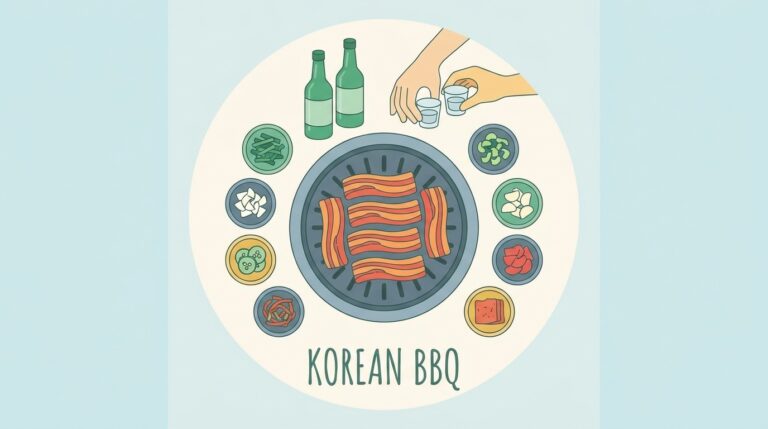
Phase 1: Empathy & The K-Culture Cold Open
Hello! I am the lead editor of Daily Hangul, your local cultural navigator.
Picture this: You are watching a classic K-Drama. The main characters are sitting at a Pojangmacha (a street food tent), the green Soju bottles are lining up, and the youngest character is busily grilling pork belly while the older boss sits back. Suddenly, someone clinks a glass, turns their head completely to the side to drink, and shouts a phrase that the subtitles simply translate as, “Let’s eat!”
But was it really just “Let’s eat”? And why did they turn their head away like they were hiding a secret?
If you have ever dined with Koreans, you might have realized that Korean dining etiquette is completely different from the West. While Western dining focuses heavily on individual plates, keeping elbows off the table, and passing the salt, Korean dining is an intricate social dance of hierarchy, sharing, and Nunchi (reading the room). Knowing these unspoken rules does not just save you from awkward moments; it instantly upgrades you from “foreign tourist” to an “insider” who truly understands the culture.
This guide is built from the real struggles and “aha!” moments of my B2-level students who survived their first Korean company dinners (Hoesik) and lived to tell the tale. Let’s dive in!
Phase 2: Core Expressions Deep Dive
Here are the crucial phrases that dictate the rhythm of a Korean meal.
1. 잘 먹겠습니다 / 잘 먹었습니다
- Pronunciation: Jal meok-get-seum-ni-da (Sounds like: Jal mock-get-soom-nee-da) / Jal meok-eot-seum-ni-da (Sounds like: Jal mock-ot-soom-nee-da)
- Meaning: Literal: “I will eat well” / “I ate well.” Real nuance: “Thank you for this meal (and I respect the effort put into it).”
- K-Culture Moment: In K-Dramas, right before taking the first bite of a steaming bowl of Ramen or beautifully plated banchan, the characters clasp their hands and say this. It is the Korean equivalent of saying grace or “Bon Appétit,” but it is also a direct thank-you to whoever is paying or cooking.
- Editor’s Insight: Think of these phrases as the bookends of a meal. Without them, the meal feels incomplete. If your Korean friend cooks for you or buys you lunch, saying 잘 먹었습니다 loudly at the end makes them feel incredibly proud.
- Situation Spectrum:
- Casual (Close friends): ⚠️ (Friends usually say “잘 먹을게” – I’ll eat well)
- Semi-formal (Co-workers): ✅
- Formal (Boss/Elders): ✅
- 🤔 Think About It: Why does Korean culture emphasize acknowledging that you “will” and “did” eat well? How does this reflect the historical importance of food and sharing in a community?
2. 먼저 드세요
- Pronunciation: Meon-jeo deu-se-yo (Sounds like: Mun-jaw doo-say-yo)
- Meaning: Literal: “Please eat first.” Real nuance: “I honor your seniority, please take the first bite so the rest of us can start.”
- K-Culture Moment: Picture a large family dinner in a K-Drama. Nobody touches their spoon until the grandfather picks up his chopsticks. If a younger person tries to eat first, they might get a light smack on the hand!
- Editor’s Insight: In the West, you wait until everyone is served. In Korea, you wait until the oldest or highest-ranking person takes their first bite. 먼저 드세요 is the magic phrase to politely prompt the elder to start, giving the green light to everyone else.
- Situation Spectrum:
- Casual (Friends): ⚠️ (Not usually needed unless one friend is paying)
- Semi-formal (Co-workers): ✅
- Formal (Boss/Elders): ✅
- 🤔 Think About It: How does this waiting protocol reflect the Confucian values deeply rooted in the Korean language and society?
3. 제가 쏠게요!
- Pronunciation: Je-ga ssol-ge-yo (Sounds like: Jay-gah soul-gay-yo)
- Meaning: Literal: “I will shoot!” Real nuance: “It’s on me! I’m treating everyone!”
- K-Culture Moment: When a K-Pop idol visits their younger junior group, they often proudly pat their wallet and say, “Today, hyung/oppa is shooting!” It is a power move full of affection.
- Editor’s Insight: While “제가 살게요” (I will buy) is the standard textbook phrase, “제가 쏠게요” is the fun, enthusiastic version used among friends or close colleagues. It shows you are excited to treat them.
- Situation Spectrum:
- Casual (Friends): ✅
- Semi-formal (Co-workers): ✅
- Formal (Boss/Elders): 🚫 (Too informal; stick to “제가 대접하겠습니다” – I will host/treat)
- 🤔 Think About It: In many Western countries, going “Dutch” (splitting the bill) is the norm. In Korea, fighting over the bill to pay for everyone is common. Which system do you prefer and why?
Phase 3: Textbook vs. Real Korean
[Getting the Waiter’s Attention]
* Textbook Korean: 여기요! (Over here!)
* Real Korean: 사장님~! (Sa-jang-nim – Boss!) or 이모님~! (I-mo-nim – Auntie!)
* Why the difference?: Calling someone “Boss” or “Auntie” creates a pseudo-familial bond, which is highly valued in Korean service culture. It sounds much friendlier than just shouting “Here!”
[Making a Toast]
* Textbook Korean: 건배! (Geon-bae – Empty the glass!)
* Real Korean: 짠~! (Jjan – The sound effect of glasses clinking) or 원샷! (Won-syat – One shot!)
* Why the difference?: “Jjan” is an onomatopoeia that brings a cute, casual vibe to drinking with friends. “One shot” is Konglish adopted heavily in drinking games.
Bottom Note: At the B2 level, knowing when to use “사장님” instead of “여기요” shows you truly understand the social fabric of Korea, not just its vocabulary.
Phase 4: Cultural Context — K-Culture Deep Dive
4-1. Non-Verbal Elements: The Art of the Pour
If you take away nothing else, remember this: Never pour a drink with one hand for someone older, and never pour your own drink.
In Western culture, it is polite to top up your own glass. In Korea, pouring your own drink is said to bring bad luck (or means you will be single for 3 years!). You must pour for others, and they will pour for you. When pouring or receiving a drink from an elder, always use two hands (or place your left hand lightly under your right elbow or against your chest). And when you drink it? Turn your face away from the elder out of respect. It is the ultimate display of Nunchi.
4-2. K-Food Connection: The Communal Pot
In the West, everyone gets their own plate. Cross-contamination is frowned upon. In traditional Korean dining, a bubbling pot of Doenjang-jjigae (soybean paste stew) is placed in the center, and everyone dips their own spoon into it. This act of sharing is the physical embodiment of 정 (Jeong)—a unique Korean concept of affection, connection, and communal bonding. While modern restaurants now provide individual ladles due to hygiene awareness, the spirit of sharing side dishes (banchan) remains untouched.
Phase 5: Real-Life Roleplay Scenario
Scenario A: The Gangnam BBQ Test
* Setting: Friday, 7 PM. A smoky Korean BBQ restaurant in Gangnam. The sound of sizzling pork belly fills the air. You are sitting at a round metal table with three Korean colleagues.
* Characters:
* YOU: A foreign employee who has been working in Seoul for 3 months.
* Minsu: (32, your friendly senior colleague, currently wielding the meat tongs).
* Manager Park: (45, your boss, looking happy with a Soju glass in hand).
Minsu: 자, 고기 다 익었습니다! 부장님, 먼저 드시죠.
(Ja, gogi da igeot-seumnida! Bujangnim, meonjeo deusi-jyo.)
[Alright, the meat is all cooked! Manager, please eat first.]
(Stage Direction: Minsu gestures toward Manager Park.)
Manager Park: 그래, 다들 고생했어. 많이 먹어!
(Geurae, dadeul gosaeng-haesseo. Mani meogeo!)
[Yeah, good job everyone. Eat up!]
(Stage Direction: Manager Park eats a piece of meat. The green light is given!)
Minsu: 자, OO씨(You)도 많이 먹어요. 한국 삼겹살 어때요?
(Ja, OO-ssi-do mani meogeoyo. Hanguk samgyeopsal eottaeyo?)
[Here, you eat a lot too. How is Korean pork belly?]
Your Turn! How should you respond before taking your first bite?
* A) “맛있어요! 잘 먹을게요!”
* B) “오, 감사합니다! 잘 먹겠습니다!”
* C) “대박! 제가 다 먹을게요!”Best Choice: B. “잘 먹겠습니다” (I will eat well) is the perfect, polite response to colleagues and bosses before eating.
Why not A?: “잘 먹을게요” is slightly too casual for the Manager’s presence.
Why not C?: “대박” (Jackpot/Awesome) is great for close friends, but a bit too slangy in front of the boss.
Manager Park: 자, 오늘 회식은 내가 쏜다! 마시자!
(Ja, oneul hoesigeun naega ssonda! Masija!)
[Alright, tonight’s company dinner is on me! Let’s drink!]
(Stage Direction: Manager Park holds out his Soju glass to you.)
YOU: (Holding your glass with two hands) 건배!
Phase 6: 10-Second Shadowing Drill
Practice this phrase with feeling. The slash (/) indicates a slight pause.
😊 “부장님, / 먼저 / 드세요! / 맛있게 / 잘 먹겠습니다!” meok-get-seum-ni-da!)
(Bu-jang-nim, / meon-jeo / deu-se-yo! / Ma-sit-ge / jal
[Manager, / please / eat first! / I will eat / very well!]
Phase 7: K-Culture Mini Dictionary
Here are the top K-Culture keywords you need for Korean dining.
1. 눈치 (Nunchi)
* Romanization: nunchi
* English: Emotional intelligence / Reading the room.
* Context: In dining, Nunchi is knowing when to pour water for others, when to flip the meat, and noticing if the boss’s glass is empty.
2. 회식 (Hoesik)
* Romanization: hoe-sik
* English: Company dining/drinking.
* Context: A core part of Korean corporate culture used for team building. It usually involves lots of BBQ, Soju, and sometimes karaoke (Noraebang).
3. 막내 (Maknae)
* Romanization: mak-nae
* English: The youngest member.
* Context: In a K-Pop group or a corporate team, the Maknae usually takes on tasks at the dinner table, like grilling meat, setting out utensils, or ordering drinks.
4. 반찬 (Banchan)
* Romanization: ban-chan
* English: Side dishes.
* Context: The glorious array of small dishes (kimchi, pickled radishes, etc.) served with Korean meals. The best part? They are almost always free to refill!
Phase 8: Traveler Survival Kit
If you are traveling in Korea, you will definitely eat out. Here are your survival phrases.
Survival Phrases for the Restaurant
* 🇰🇷 “반찬 좀 더 주시겠어요?” (Ban-chan jom deo ju-si-get-seo-yo?)
* 🗣️ English Guide: Could you please give me some more side dishes?
* 📍 Where to use: Any traditional Korean restaurant.
* 💡 Pro Tip: Point to the empty dish while saying this. It works like a charm.
- 🇰🇷 “이거 맵나요?” (I-geo maem-na-yo?)
- 🗣️ English Guide: Is this spicy?
- 📍 Where to use: When ordering Tteokbokki, stews, or anything that looks suspiciously red.
- 💡 Pro Tip: If they say “신라면 정도예요” (About the level of Shin Ramyun), beware—that’s still quite spicy for many foreigners!
Editor’s Travel Note
* Call Bells: Look for the little button on your table. Don’t wave your hand awkwardly waiting for eye contact. Just push the button!
* Tipping: There is absolutely NO tipping culture in Korea. If you leave money on the table, the waiter might chase you down the street thinking you forgot your change.
* Cutlery Drawers: If you can’t find your spoon and chopsticks, look under the table! Most Korean restaurant tables have a hidden drawer on the side holding napkins and cutlery.
Phase 9: Critical Thinking — “One Step Deeper”
Food & Identity: The Concept of Jeong (정)
In many Western cultures, a meal is about respecting personal boundaries: your plate, your portion, your space. In Korea, however, food is deeply tied to the concept of Jeong (정)—a collective feeling of love, attachment, and community. When an older Korean person puts a piece of choice meat onto your bowl, or when everyone shares from a central boiling pot, it is not a lack of hygiene or boundaries. It is an active demonstration of care. By sharing the same food from the same source, you are symbolically becoming “one family” (Sikgu – 식구, meaning “mouths that eat together”).
Your Turn: In your culture, what is the ultimate way to show someone you care about them through food? Share your thoughts below!
Phase 10: FAQ & Mistake Prevention
Q: Is it rude if I don’t turn my head when drinking with my boss?
Yes! While your boss might forgive you because you are a foreigner, turning your head and covering your glass slightly is a huge sign of respect. Doing it perfectly will earn you massive respect points.
Q: Can I lift my rice bowl to my mouth to eat?
In countries like Japan or China, it is polite to lift your rice bowl. In Korea, it is the opposite! Historically, eating with the bowl on the table was for humans, and lifting it was associated with how animals eat. Keep the bowl on the table and use your spoon.
Common Mistakes to Avoid
* ❌ Mistake #1: Sticking your chopsticks vertically into your bowl of rice.
* ✅ How to fix it: Lay them flat across the bowl or on the table. Vertical chopsticks resemble incense sticks used at funerals to feed spirits!
* ❌ Mistake #2: Pouring drinks with one hand casually.
* ✅ How to fix it: Always use two hands when pouring or receiving, unless you are with very close, same-age friends.
Phase 11: Summary & Action Items
One-Liner Summary: Korean dining is less about the food itself and more about mastering the social dance of respect, sharing, and Nunchi.
Action Mission:
* Bronze: Stand in front of a mirror and practice holding an imaginary glass with two hands while saying “잘 먹겠습니다!”
* Silver: Leave a comment in our community explaining your favorite Korean side dish (Banchan).
* Gold: Go to a local Korean restaurant, press the call bell, and politely ask for a side dish refill using “반찬 좀 더 주시겠어요?”
K-Culture Mission: Watch the next episode of your current K-Drama. Count how many times people clink glasses, who pours the drink, and who turns their head away to drink. It will look completely different to you now!
Phase 12: Quiz — Interactive Challenge
Test your new Nunchi skills!
1. Situational Judgment: You are having dinner with your Korean language professor. The food arrives. What is your first move?
* A) Pick up your chopsticks and start eating immediately.
* B) Wait for the professor to pick up their spoon first, and say “맛있게 드세요” (Please eat deliciously).
* C) Serve yourself a large portion from the shared dish before anyone else.
2. True or False – K-Culture Edition:
* “If the service was amazing at a Korean BBQ place, you should leave a 15% tip on the table.”
3. Fill in the Blank:
You want to get the restaurant owner’s attention in a friendly way. You shout: “______님, 여기 물 좀 주세요!”
* A) 사장 (Sajang)
* B) 회장 (Hoejang)
* C) 선생님 (Seonsaengnim)
(Answers: 1: B, 2: False – never tip in Korea!, 3: A)
Frequently Asked Questions (FAQ)
Q: What does "잘 먹겠습니다 / 잘 먹었습니다" mean in Korean and how do you pronounce it?
A: In Korean, "잘 먹겠습니다 / 잘 먹었습니다" is pronounced [Jal meok-get-seum-ni-da (Sounds like: Jal mock-get-soom-nee-da] and means: Literal: "I will eat well" / "I ate well." Real nuance: "Thank you for this meal (and I respect the effort put into it)."
Q: What does "먼저 드세요" mean in Korean and how do you pronounce it?
A: In Korean, "먼저 드세요" is pronounced [Meon-jeo deu-se-yo (Sounds like: Mun-jaw doo-say-yo] and means: Literal: "Please eat first." Real nuance: "I honor your seniority, please take the first bite so the rest of us can start."
Q: What does "제가 쏠게요!" mean in Korean and how do you pronounce it?
A: In Korean, "제가 쏠게요!" is pronounced [Je-ga ssol-ge-yo (Sounds like: Jay-gah soul-gay-yo] and means: Literal: "I will shoot!" Real nuance: "It's on me! I'm treating everyone!"







