

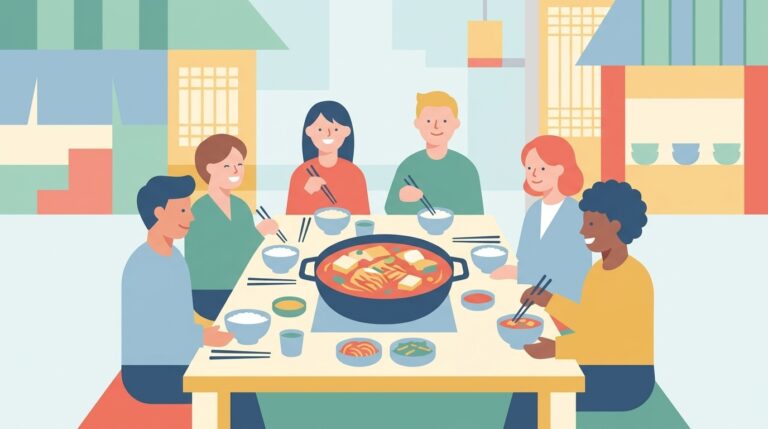
Phase 1: Empathy & The K-Culture Cold Open
Hello! I am the Senior Editor of Daily Hangul. As someone who has taught Korean to hundreds of expats and survived the wild corporate jungle of Seoul for over a decade, I know exactly what your first week at a Korean company feels like.
Imagine this: You are watching a K-Drama like Misaeng (Incomplete Life). The clock strikes 11:50 AM. Suddenly, the entire office stands up in perfect synchronization. Jackets are grabbed, lanyards are worn like badges of honor, and people start moving in packs. You are sitting there, a new A1-level Korean speaker, thinking… Am I supposed to follow them? What do I say? What if I accidentally insult the boss at the lunch table?
Don’t worry! You don’t need a PhD in Korean linguistics to survive lunch time. In fact, just knowing a few key phrases can transform you from “the confused new foreigner” into “the charming insider who respects Korean culture.” This guide is built from the real-life panics of my past students. Let’s make your next office lunch your best one yet!
Phase 2: Core Expressions Deep Dive
Here are the three magical phrases that will save you every single day at 12:00 PM.
1. 잘 먹겠습니다! (Jal meokgetseumnida!)
- Pronunciation: [jal meok-get-seum-ni-da]
- Sound-alike guide: Jal sounds like “Jolly” without the ‘ly’. Meok rhymes with “muck”. Seum has the ‘eu’ sound—imagine the disgusted “Ugh!” sound you make when you step in wet gum.
- Meaning: Literal = “I will eat well!” / Real nuance = “Thank you for this food, let’s have a great meal!”
- K-Culture Moment: You’ve seen this in almost every K-Drama. Before the main character takes their first bite of Ramyeon or Bibimbap, they clap their hands together and happily announce this to the table.
- Editor’s Insight: Think of this as the Korean equivalent of saying “Bon appétit” or “Let’s dig in.” The beautiful thing? You say this even if you are paying for your own meal. It’s just a polite way to acknowledge the start of a shared dining experience.
- Situation Spectrum:
- Friends (Casual): ✅ (Though friends usually say “Jal meogeulge!”)
- Co-workers (Semi-formal): ✅
- Boss/Elders (Formal): ✅
- 🤔 Think About It: Why do Koreans announce their gratitude before eating, even when no one treated them? What does this say about how Korea views food and agriculture? Does your culture have a pre-meal announcement?
2. 맛있게 드세요! (Masitge deuseyo!)
- Pronunciation: [ma-sit-ge deu-se-yo!]
- Sound-alike guide: Ma-sit-ge sounds a bit like “ma-sheet-gay”. Deu-se-yo has that tricky ‘eu’ sound again.
- Meaning: Literal = “Please eat deliciously!” / Real nuance = “Enjoy your meal!”
- K-Culture Moment: The restaurant owner (Imo-nim) drops a boiling pot of Kimchi Jjigae on your table and cheerfully shouts this phrase before walking away.
- Editor’s Insight: You say this to others. If your boss sits down with their food, you look at them and say this to show politeness. It’s the perfect pair with Expression #1!
- Situation Spectrum:
- Friends (Casual): ⚠️ (Use “Masitge meogeo” instead)
- Co-workers (Semi-formal): ✅
- Boss/Elders (Formal): ✅
- 🤔 Think About It: Why is it so important to wish others a delicious meal in Korea before taking your own bite?
3. 점심 뭐 먹을까요? (Jeomsim mwo meogeulkkayo?)
- Pronunciation: [jeom-sim mwo meog-eul-kka-yo?]
- Sound-alike guide: Jeom-sim sounds like “Jum-shim”. Mwo is like “mwah” (like an air kiss).
- Meaning: Literal = “Lunch what shall we eat?” / Real nuance = “What should we get for lunch?”
- K-Culture Moment: It is 11:30 AM. Your chat messenger pings. Your favorite co-worker is secretly messaging you this exact phrase to plan your escape from the office.
- Editor’s Insight: Asking this question shows you want to be part of the group. Koreans rarely eat lunch alone, so initiating the lunch plan gives you massive bonus points for sociability.
- Situation Spectrum:
- Friends (Casual): ✅ (Drop the ‘yo’)
- Co-workers (Semi-formal): ✅
- Boss/Elders (Formal): 🚫 (Too casual; let the boss decide!)
- 🤔 Think About It: In Korea, deciding the lunch menu is often a group negotiation. Why do you think individualism (eating whatever you want alone) is less common in Korean workplaces?
Phase 3: Textbook vs. Real Korean
[Situation 1: Asking “Did you have lunch?”]
* 📖 Textbook Korean: 점심 식사 하셨습니까? (Jeomsim siksa hasyeotseumnikka?) -> Very stiff and military-like.
* 🗣️ Real Korean: 밥 먹었어요? (Bap meogeosseoyo?) or 점심 드셨어요? (Jeomsim deusyeosseoyo?)
* 💡 Why the difference?: Koreans use “Bap” (rice) to mean a meal in general. Asking if someone ate is actually a standard greeting, showing care for their well-being, rather than just curiosity about their digestion!
[Situation 2: Saying “Let’s go to the restaurant”]
* 📖 Textbook Korean: 식당으로 갑시다. (Sikdangeuro gapsida.) -> Sounds like a robot commanding troops.
* 🗣️ Real Korean: 밥 먹으러 가요! (Bap meogeureo gayo!)
* 💡 Why the difference?: The ending “-gapsida” (Let’s) is grammatically correct but can sound aggressive or condescending to a superior. “-gayo” is polite, soft, and natural.
Phase 4: Cultural Context — K-Culture Deep Dive
4-1. Non-Verbal Magic: Table Nunchi (눈치)
Language is only 50% of the game. In a Korean office lunch, your actions speak volumes. When you sit down at the table, observe the “Maknae” (the youngest or newest team member). You will see them opening the little drawer under the table, taking out spoons and chopsticks, and placing them on napkins for everyone. Then, they pour the water. Doing this silently is the ultimate display of Nunchi (the art of reading the room). As a beginner, offering to pour the water will make your Korean colleagues adore you.
4-2. The K-Drama Connection: The “Gang Walk”
Have you noticed in K-Dramas like Vincenzo or Hospital Playlist how the cast always walks to lunch in a slow-motion, powerful V-formation? That’s real! Korean colleagues move in packs. Going to lunch isn’t just a physical movement; it’s a social ritual. It says, “We are one team.” If you try to sneak out to grab a sandwich alone, people might genuinely worry that you are upset or being bullied!
Phase 5: Real-Life Roleplay Scenario
Setting: It’s Friday, 11:50 AM. A bustling, noisy Kimchi Jjigae restaurant near Gangnam Station. The smell of spicy garlic fills the air. You are here with Minsu, your friendly 32-year-old Korean co-worker.
Characters:
* YOU: The foreign newbie, eager to impress but slightly overwhelmed.
* MINSU: Your Korean “work bestie” who loves spicy food.
Dialogue:
Minsu: 11시 50분이네요! 밥 먹으러 가요!
(11-si 50-bunineyo! bap meogeureo gayo!)
[It’s 11:50! Let’s go eat!]
(Stage Direction: Minsu grabs his wallet and stands up quickly.)
YOU: 네, 가요! 점심 뭐 먹을까요?
(Ne, gayo! jeomsim mwo meogeulkkayo?)
[Yes, let’s go! What should we eat for lunch?]
Minsu: 음… 김치찌개 어때요?
(Eum… gimchijjigae eottaeyo?)
[Hmm… How about Kimchi Jjigae?]
YOU: 좋아요!
(Joayo!)
[Sounds good!]
(Stage Direction: You both arrive at the restaurant and sit down. The auntie brings the food.)
Minsu: 오, 나왔다!
(O, nawatda!)
[Oh, it’s out!]
YOU: 우와, 맛있겠어요.
(Uwa, masitgesseoyo.)
[Wow, it looks delicious.]
Minsu: 자, 맛있게 드세요!
(Ja, masitge deuseyo!)
[Here, enjoy your meal!]
YOU: 네, 잘 먹겠습니다!
(Ne, jal meokgetseumnida!)
[Yes, I will eat well!]
(Stage Direction: You both finish eating and stand up. Minsu grabs the bill.)
Minsu: 오늘 점심은 제가 살게요. 환영합니다!
(Oneul jeomsimeun jega salgeyo. hwanyeonghamnida!)
[I’ll buy lunch today. Welcome!]
🔀 Your Turn! How should you respond?
* A) “알겠어요. 안녕!” (Okay. Bye!)
* B) “아니에요! 제가 낼게요!” (No! I will pay!)
* C) “우와, 감사합니다! 잘 먹었습니다!” (Wow, thank you! I ate well!)✅ Best Choice: C — In a Korean workplace, when a senior or host offers to pay for a welcome lunch, gracefully accepting with a big “Thank you” (Gam-sa-ham-ni-da) and “I ate well” (Jal meok-geot-seum-ni-da but past tense: Jal meog-eot-seum-ni-da) is the best etiquette.
⚠️ Choice B Analysis: Doing the “credit card battle” (fighting to pay) is a Korean tradition, but as the new person being welcomed, it’s better to accept and say, “I’ll buy coffee next time!” (다음에 커피는 제가 살게요!).
Bonus Roleplay: The Post-Lunch Cafe
(Stage Direction: You step out of the restaurant. Koreans rarely go straight back to the office.)
Minsu: 커피 한 잔 할까요?
(Keopi han jan halkkayo?)
[Shall we grab a cup of coffee?]
YOU: 네! 아까 밥 사주셨으니까, 커피는 제가 살게요.
(Ne! Akka bap sajusyeosseunikka, keopineun jega salgeyo.)
[Yes! Since you bought food earlier, I’ll buy the coffee.]
Minsu: 오, 센스 최고!
(O, senseu choego!)
[Oh, you have great sense!]
Phase 6: 10-Second Shadowing Drill
Let’s practice the rhythm of Korean! Follow the slash marks for pauses.
- 😊 밝게 (Brightly): 과장님, / 맛있게 / 드세요!
(gwajangnim, / masitge / deuseyo!) - 🙏 감사하게 (Gratefully): 우와, / 잘 / 먹겠습니다!
(uwa, / jal / meokgetseumnida!) - 🤔 궁금하게 (Curiously): 오늘 / 점심 / 뭐 먹을까요?
(oneul / jeomsim / mwo meogeulkkayo?)
Phase 7: K-Culture Mini Dictionary
1. 눈치 (Nunchi)
* Romanization: nunchi
* English: The subtle art of gauging others’ moods and reading the room.
* Context: Handing out napkins before anyone asks? That is top-tier Nunchi.
2. 막내 (Maknae)
* Romanization: maknae
* English: The youngest person in a group, or the newest team member.
* Context: The Maknae usually handles small tasks like ordering or pouring water. Don’t worry, they get treated to a lot of free meals in return!
3. 더치페이 (Deo-chi-pe-i)
* Romanization: deochipei
* English: Going Dutch (splitting the bill).
* Context: While seniors often pay, modern Korean offices among younger workers frequently do “Dutch Pay” using mobile banking apps to split the lunch bill exactly down to the won.
4. 혼밥 (Hon-bap)
* Romanization: honbap
* English: Eating alone (Honja + Bap).
* Context: Historically rare in Korean offices, but becoming very popular among Gen Z workers who want to watch Netflix on their phones during lunch.
Phase 8: Traveler Survival Kit
Even if you aren’t working in an office, these phrases are lifesavers for your trip to Seoul!
🆘 Survival Phrases for K-Restaurants
* 🇰🇷 “저기요!” (Jeogiyo!) -> Excuse me! (To call the staff. Don’t be shy, shout it!)
* 🇰🇷 “물 좀 주세요.” (Mul jom juseyo.) -> Water, please. (Though water is usually self-service in Korea!).
* 🇰🇷 “계산할게요.” (Gyesanhalkeyo.) -> I’ll pay / Check, please. (Usually, you walk to the front counter to pay in Korea).📌 Editor’s Travel Note:
* Tipping: There is absolutely NO tipping in Korea! If you leave money on the table, the waiter might chase you down the street thinking you forgot your change.
* Call Bells: Look for a little bell button on your table. Press it once, and the staff will magically appear.
Phase 9: Critical Thinking — “One Step Deeper”
Food & Identity: The “We” Culture
Have you ever wondered why Korean office workers insist on eating out together every single day, often sharing a giant boiling pot of stew in the center of the table? In Korea, eating together is not just about nutrition; it is the ultimate expression of Jeong (정)—a deep, emotional bond of community and affection. By sharing food, boundaries are lowered, and the rigid office hierarchy softens for an hour. To eat from the same pot means you are “Sik-gu” (식구), a word that literally means “mouths that eat together,” which is also the Korean word for Family.
💬 Your Turn: In your country, do co-workers usually eat together or alone at their desks? How do you feel about sharing a central dish with your boss? Let me know in the comments!
Phase 10: FAQ & Common Mistakes
Q: “Can I use ‘You’ (당신 – Dangsin) to ask my boss if they ate?”
* Absolutely NOT! In Korean, the word for “you” (Dangsin) is actually quite confrontational or used only between married couples. Just omit the subject, or use their title (e.g., “팀장님, 식사하셨어요?” – Team Leader, did you eat?).
Q: “Is it rude to hold my rice bowl in my hand?”
* Yes! Unlike in Japan or China, lifting your rice bowl off the table to eat is traditionally considered bad manners in Korea. Keep the bowl on the table and use your long metal spoon.
❌ Common Mistake #1: Saying “잘 먹겠습니다” (Jal meokgetseumnida) AFTER you finish eating.
✅ How to fix it: Jal meokgetseumnida is ONLY for BEFORE the meal. After the meal, change the ending to the past tense: 잘 먹었습니다! (Jal meog-eot-seumnida!).
Phase 11: Summary & Action Items
One-Liner Summary: Win your Korean colleagues’ hearts by saying “잘 먹겠습니다” before lunch and offering to buy the coffee afterwards!
Your Action Missions:
* 🥉 Bronze (Solo): Stand in front of your mirror and confidently say “잘 먹겠습니다!” with a big smile.
* 🥈 Silver (Online): Comment below with your favorite Korean food you want to eat for lunch using “점심 뭐 먹을까요?”
* 🥇 Gold (Real-world): Next time you visit a Korean restaurant, loudly say “맛있게 드세요!” to your friends before you start eating!
🌟 Special K-Culture Mission:
Watch one episode of a modern K-Drama (like Extraordinary Attorney Woo). Pay close attention to the lunch scenes. Try to spot who sets the table and listen for the magical words “Jal meokgetseumnida!”
Phase 12: Quiz — Interactive Challenge
Test your new office survival skills!
1. You are the newest employee. You sit down at the restaurant table. What is your first Nunchi move?
* A) Start playing with your phone.
* B) Open the table drawer and distribute spoons and chopsticks to everyone.
* C) Shout “I want Bibimbap!”
* (Answer: B! You will be a superstar Maknae.)
2. Fill in the Blank:
Before taking a bite of your delicious spicy pork, you look at your co-workers and say: “Jal _________-seumnida!”
* (Answer: meokget (먹겠) – “Jal meokgetseumnida”)
3. True or False – K-Culture Edition:
“If the restaurant service was amazing, you should leave a 15% tip on the table.”
* (Answer: FALSE! No tipping in Korea. Just a polite “잘 먹었습니다!” as you walk out is the best tip!)
Frequently Asked Questions (FAQ)
Q: What does "잘 먹겠습니다! (Jal meokgetseumnida!)" mean in Korean and how do you pronounce it?
A: In Korean, "잘 먹겠습니다! (Jal meokgetseumnida!)" is pronounced [jal meok-get-seum-ni-da] and means: a key conversational Korean expression covered in this lesson.
Q: What does "맛있게 드세요! (Masitge deuseyo!)" mean in Korean and how do you pronounce it?
A: In Korean, "맛있게 드세요! (Masitge deuseyo!)" is pronounced [ma-sit-ge deu-se-yo!] and means: a key conversational Korean expression covered in this lesson.
Q: What does "점심 뭐 먹을까요? (Jeomsim mwo meogeulkkayo?)" mean in Korean and how do you pronounce it?
A: In Korean, "점심 뭐 먹을까요? (Jeomsim mwo meogeulkkayo?)" is pronounced [jeom-sim mwo meog-eul-kka-yo?] and means: a key conversational Korean expression covered in this lesson.







