

Phase 1: Empathy & Immersion
Hello there! This is your Lead Editor from Daily Hangul.
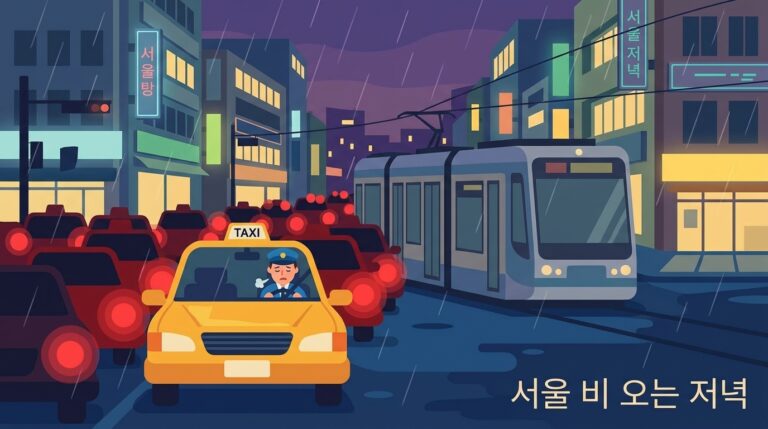
Picture this: You are sitting in the back of a Seoul taxi. It is 6:30 PM on a rainy Friday, right in the middle of Gangnam’s notorious Teheran-ro. The meter is ticking, the brake lights ahead look like an endless sea of red, and the taxi driver lets out a deep sigh. On the radio, a news anchor is passionately debating the introduction of a new Tram system in the city center. The driver shakes his head and mutters a rapid-fire sentence about taxes and parking lots.
In textbooks, you learn how to say The traffic is heavy or I take the subway. But at a C2 level, you are no longer just a tourist asking for directions. You are a resident, a professional, or a seasoned expat who needs to participate in real societal debates.
Public transport policy—specifically the economic feasibility of trams versus the fear of worsening traffic—is a hot topic in Korea right now. Cities like Daejeon and specific districts in Seoul are pushing for eco-friendly trams, but locals are sharply divided. If you can navigate this conversation, you won’t just get a nod of understanding; you will earn deep, genuine respect from Koreans for understanding the very heartbeat of their daily struggles.
Everything in this guide comes from real, heated discussions overheard in Korean taxis, corporate break rooms, and online community forums. Let’s dive in!
Phase 2: Deep Dive into Core Expressions
1. 가뜩이나 차도 막히는데 (gatteugina chado makhineunde)
- Pronunciation: [gah-ddeug-ee-nah / cha-doh / mah-kee-neun-deh] (The ‘가뜩이나’ sounds tight and exasperated, like the sound you make when you are already fed up.)
- Meaning: Literal: Even though the cars are already blocked… / Real nuance: Traffic is already terribly backed up as it is (and now this?)
- K-Culture Moment: You will hear this in K-Dramas whenever a corporate manager is stuck in traffic, slamming the steering wheel because they are late for a crucial board meeting. It is the ultimate expression of adding insult to injury.
- Editor’s Insight: The magic word here is 가뜩이나 (already, as it is). It sets a tone of pre-existing frustration. When you use this, you are showing empathy for Seoul’s notorious rush-hour pain.
- Situation Spectrum:
- Casual with friends: ✅
- Semi-formal with colleagues: ✅
- Formal/Debate: ⚠️ (Better to use 교통 체증이 심한 상황에서)
- 🤔 Think About It: Why do Koreans have so many adverbs expressing compounding frustration (like 가뜩이나, 엎친 데 덮친 격으로)? Could it be linked to the fast-paced Ppalli-ppalli culture where delays are seen as the ultimate enemy?
2. 혈세 낭비 아니에요? (hyeolse nangbi anieyo?)
- Pronunciation: [hyuhl-seh / nang-bee / ah-nee-eh-yo?]
- Meaning: Literal: Isn’t it a waste of blood-tax? / Real nuance: Isn’t this a massive waste of taxpayers’ money?
- K-Culture Moment: Turn on any Korean news channel (YTN, KBS) or look at the comments section of a Naver News article about public infrastructure. This is the absolute go-to phrase for criticizing government spending.
- Editor’s Insight: 혈세 (blood tax) is a powerful, high-level Hanja word. It implies that the money being spent was earned through the literal sweat and blood of the citizens. Using this phrase elevates your Korean from a language learner to an invested resident.
- Situation Spectrum:
- Casual with friends: ✅ (When discussing politics/news)
- Semi-formal with colleagues: ✅
- Formal (To a government official): 🚫 (Too aggressive, use 예산 낭비 instead)
- 🤔 Think About It: How does your native language express the concept of wasted tax money? Does it use dramatic imagery like blood?
3. 득보다 실이 많다 (deukboda siri manta)
- Pronunciation: [deuk-boh-dah / sheel-ee / man-tah]
- Meaning: Literal: There is more loss than gain. / Real nuance: It does more harm than good. The disadvantages outweigh the advantages.
- K-Culture Moment: In corporate K-Dramas like Misaeng, this is what the sharp-witted director says when rejecting a flawed business proposal.
- Editor’s Insight: A classic four-character idiom concept broken down. 득 (Gain) and 실 (Loss). It is concise, highly professional, and perfect for debating the economic feasibility of trams.
- Situation Spectrum:
- Casual with friends: ✅
- Semi-formal with colleagues: ✅
- Formal/Debate: ✅ (Perfect for formal environments)
- 🤔 Think About It: Koreans love using Hanja-based idioms to summarize complex economic arguments. It shows education and analytical thinking. What is your go-to phrase for cost-benefit analysis in English?
Phase 3: Textbook vs. Real Korean
Discussing Traffic Worsening
* 📖 Textbook Korean: 트램을 설치하면 교통 체증이 심해질 것입니다. (If trams are installed, traffic congestion will worsen.)
* 🗣️ Real Korean: 안 그래도 막히는데, 도로 하나 막으면 완전 주차장 되겠네요. (It’s already congested, if they block a lane, it’ll turn into a complete parking lot.)
* 💡 Why the difference?: Koreans use extreme, vivid metaphors (like calling a jammed road a parking lot) to express their collective frustration with urban density.
Debating Economic Feasibility
* 📖 Textbook Korean: 이 프로젝트는 경제성이 부족합니다. (This project lacks economic feasibility.)
* 🗣️ Real Korean: 타당성 조사 통과했어요? 나중에 돈 먹는 하마 되는 거 아니에요? (Did it pass the feasibility study? Isn’t it going to become a money-eating hippo later?)
* 💡 Why the difference?: 돈 먹는 하마 (Money-eating hippo) is a widely used slang in news and daily life for any infrastructure project with high maintenance costs and low returns.
Phase 4: Cultural Context — K-Culture Deep Dive
4-1. Non-Verbal Cues: The Art of the Sigh
When discussing topics like traffic and taxes, words are only half the battle. The non-verbal cues are vital. Before saying 가뜩이나 차도 막히는데, let out a short, audible sigh (한숨). Shake your head slightly. This shows you are commiserating. In Korean culture, shared complaints about public systems are a surprisingly effective way to build rapport. It is a form of collective Nunchi—reading the room and validating the shared urban struggle.
4-2. The Reality Check: K-Drama Romance vs. Seoul Commutes
In K-Dramas, public transport is intensely romanticized. The male lead catches the female lead as the bus suddenly stops, or they share a quiet, soulful moment on an empty late-night subway. Trams look beautiful in European indie films, and Korean politicians often market them as romantic and eco-friendly.
But the reality of Korean public transport? It is a battlefield. The 9호선 (Line 9) subway is famously dubbed 지옥철 (Hell Train) during rush hour. Koreans value speed, efficiency, and predictability above all else. This is why the tram debate is so fierce: it clashes the romantic, eco-friendly ideal with the brutal, fast-paced reality of Korean urban survival.
Phase 5: Real-Life Roleplay Scenario
Setting: It is Thursday at 7:00 PM. You are inside a taxi heading from Jongno to Itaewon. The rain is pouring, and the traffic hasn’t moved an inch in five minutes. The taxi radio is broadcasting a fiery debate about the new downtown Tram project.
Characters:
* YOU: A foreign professional living in Seoul for 3 years. You speak Korean fluently and keep up with local news.
* Mr. Choi (60s): The taxi driver. Chatty, opinionated, and eager to vent about traffic.
Dialogue:
Mr. Choi: 아이고, 또 막히네 또 막혀. 손님, 오늘 약속 늦으시겠어요.
(Aigo, tto makhine tto makhyeo. Sonnim, oneul yaksok neujeusigesseoyo.)
[Oh man, it is jammed again. Passenger, you might be late for your appointment today.]
YOU: 비가 와서 그런지 차가 더 안 빠지네요. 천천히 가셔도 됩니다.
(Biga waseo geureonji chaga deo an ppajineyo. Cheoncheonhi gasyeodo doemnida.)
[Traffic isn’t moving probably because of the rain. It is okay, take your time.]
Mr. Choi: 저기 라디오 들려요? 이 좁은 도로에 트램을 깐다잖아요. 제정신인지 원…
(Jeogi radio deullyeoyo? I jobeun doro-e teuraem-eul kkandajanayo. Jejeongsin-inji won…)
[Do you hear the radio? They say they are going to lay tram tracks on this narrow road. Are they out of their minds…]
YOU: 아, 종로 트램 도입 사업이요? 저도 뉴스에서 봤어요.
(Ah, Jongno teuraem doip saeob-iyo? Jeodo nyuseu-eseo bwasseoyo.)
[Ah, the Jongno Tram introduction project? I saw it on the news too.]
Mr. Choi: 차선 하나를 막는다는데, 가뜩이나 차도 막히는데 완전 주차장 될 겁니다.
(Chaseon hanareul mangneundaneunde, gatteugina chado makhineunde wanjeon juchajang doel geomnida.)
[They say they will block one lane. Traffic is already backed up as it is; it will become a complete parking lot.]
🔀 Your Turn! How do you respond?
* A) 외국에는 트램이 많아서 아주 좋습니다. (There are many trams in foreign countries, so it is very good.)
* B) 맞아요. 취지는 좋지만 득보다 실이 많을 것 같아서 걱정이네요. (Right. The intention is good, but I am worried it might do more harm than good.)
* C) 기사님, 운전이나 똑바로 하세요. (Driver, just focus on your driving.)
✅ Best Choice: B — Acknowledges his frustration while elegantly expressing your own analytical opinion using C2-level vocabulary.
⚠️ Choice A Analysis: While true, it completely invalidates the driver’s frustration about local traffic.
🚫 Choice C Analysis: Extremely rude and will guarantee a very uncomfortable (and possibly hostile) ride.
YOU (Choosing B): 맞아요. 취지는 좋지만 득보다 실이 많을 것 같아서 걱정이네요.
(Majayo. Chwijineun jotjiman deukboda siri maneul geot gataseo geokjeong-ineyo.)
[Right. The intention is good, but I am worried it might do more harm than good.]
Mr. Choi: 내 말이 그 말이에요! 외국인 손님이 한국 돌아가는 걸 더 잘 아시네. 혈세 낭비라니까요.
(Nae mari geu mar-ieyo! Oegugin sonnim-i hanguk doraganeun geol deo jal asine. Hyeolse nangbiranikkayo.)
[That’s exactly what I’m saying! A foreign passenger knows how Korea runs better than them. It is a waste of blood-taxes, I tell you.]
Phase 6: 10-Second Shadowing Drill
Read this aloud following the exact pacing and emotion markers. Mastering this will make you sound incredibly natural.
😤 가뜩이나 / 차도 엄청 막히는데 / 트램까지 생기면 / 득보다 실이 / 훨씬 많을 것 같아요.
(gatteugina / chado eomcheong makhineunde / teuraemkkaji saenggimyeon / deukboda siri / hwolssin maneul geot gatayo.)
Phase 7: K-Culture Mini Dictionary
1. 지옥철 (Jiokcheol)
* Romanization: jiokcheol
* English: Hell Train
* Context: A compound of 지옥 (Hell) and 지하철 (Subway). Used to describe incredibly crowded subways during rush hour, particularly Line 2 and Line 9 in Seoul.
2. 탁상행정 (Taksanghaengjeong)
* Romanization: taksanghaengjeong
* English: Desk administration / Armchair theory
* Context: A highly advanced term used to criticize politicians who make policies (like installing trams) from their comfortable desks without understanding the reality of the streets.
3. 혈세 (Hyeolse)
* Romanization: hyeolse
* English: Blood tax
* Context: Taxpayers’ money. Always used in a negative context when complaining about government waste or inefficient public infrastructure projects.
4. 타당성 조사 (Tadangseong josa)
* Romanization: tadangseong josa
* English: Feasibility study
* Context: A mandatory economic and environmental assessment for any large infrastructure project in Korea. Passing or failing this is headline news.
Phase 8: Traveler & Resident Survival Kit
Even if you aren’t debating city planning, navigating Korean transport delays requires specific survival phrases.
🆘 Survival Phrases for Transport Delays
* 🇰🇷 차가 너무 막혀서 조금 늦을 것 같습니다. (chaga neomu makhyeoseo jogeum neujeul geot gatseumnida.)
* 🗣️ English: Traffic is so bad, I think I will be a little late.
* 📍 Where to use: Texting colleagues or friends when stuck in a taxi/bus.
- 🇰🇷 여기서 내려주셔도 될까요? (yeogiseo naeryeojusyeodo doelkkayo?)
- 🗣️ English: Could you drop me off right here?
- 📍 Where to use: When you realize walking is faster than staying in the jammed taxi.
📌 Editor’s Travel Note
* Navigation Apps: Never use Google Maps in Korea for real-time traffic or public transport. Naver Map or KakaoMap are absolute necessities.
* Transfer System (환승): Korean public transport has a world-class free transfer system. You can switch between buses and subways without paying extra, but remember to tap your card when you get off!
Phase 9: Critical Thinking — A Step Deeper
Media vs Reality: The Efficiency Obsession
In K-Dramas, Korea is often portrayed through glossy, wide-angle shots of smooth roads and picturesque public transport. However, the real Korean urban lifestyle is heavily dictated by the concept of 효율성 (Efficiency) and 빨리빨리 (Hurry-hurry) culture. The debate over trams perfectly encapsulates this. Trams are visually appealing and tourist-friendly, fitting the media narrative. Yet, for the average Korean commuter, anything that reduces road space and slows down the daily grind is viewed as a threat to their survival. The resistance isn’t just about traffic; it is a cultural pushback against sacrificing efficiency for aesthetics.
💬 Your Turn: Does your city have a public transport system that is beautiful but highly impractical? How do locals react to it? Share in the comments!
Phase 10: FAQ & Avoiding Common Mistakes
Q: Can I discuss politics or government policies with taxi drivers?
Yes, but tread carefully. Korean taxi drivers love sharing their political views. If you agree with them (like our roleplay above), it will be a fun ride. If you strongly disagree, it is best to just nod and say 아, 그렇군요 (Ah, I see) to avoid a heated argument.
Q: Is it rude to complain about Korean systems as a foreigner?
It depends on the phrasing. If you say 한국은 이게 별로예요 (Korea is bad at this), it is rude. But if you frame it empathetically, like 안 그래도 차가 막히는데 트램은 좀 걱정이네요 (Traffic is already bad, so I am worried about the tram), Koreans will actually appreciate your deep understanding of their daily lives.
❌ Common Mistake #1: Saying 차가 막혀요 (Traffic is blocked) in a formal business meeting when explaining why you are late.
✅ Do This Instead: Use 교통 체증 (Traffic congestion). 죄송합니다. 교통 체증이 심해서 지연되었습니다. (I apologize. I am delayed due to severe traffic congestion.)
Phase 11: Summary & Action Items
One-Liner Summary: To debate public transport like a native C2 speaker, move beyond simple complaints and use expressions like 가뜩이나 (already as it is) and 득보다 실이 많다 (more harm than good) to show empathy and analytical depth.
Action Mission:
* 🥉 Bronze (Solo): Read the Shadowing Drill out loud 3 times, focusing on the exasperated sigh before starting.
* 🥈 Silver (Online): Go to a Korean news YouTube channel, search for 트램 도입 (Tram Introduction), and read the comments. Try to spot the word 혈세 (Tax money) or 탁상행정 (Armchair policy).
* 🥇 Gold (Real Life): The next time you are stuck in traffic with a Korean friend or colleague, casually drop: 안 그래도 막히는데… (It’s already jammed as it is…)
Engagement: Have you ever experienced the Seoul rush hour? Did you take the Hell Train or a jammed bus? Tell us your survival story!
Phase 12: Interactive Challenge Quiz
1. Situational Judgment:
You are in a meeting with your Korean director. He asks for your opinion on a new local policy that seems incredibly expensive but yields very little benefit. What is the most sophisticated C2-level response?
* A) 예산 낭비예요. 너무 비싸요.
* B) 득보다 실이 많을 것 같아 우려됩니다.
* C) 돈 먹는 하마네요!
(Answer: B. A is too simple, and C is slang not suitable for a formal report to a director.)
2. Fill in the Blank:
( ) 차도 막히는데, 비까지 오니까 완전 주차장이네요.
Hint: The word meaning ‘already as it is (making things worse)’.
(Answer: 가뜩이나)
3. True or False — K-Culture Edition:
In Korea, it is considered polite to use the expression 혈세 낭비 (wasting blood tax) when speaking directly to a civil servant at the city hall. (T/F)
(Answer: False. While common in news and amongst citizens, saying this directly to a government official is highly confrontational and aggressive.)
Frequently Asked Questions (FAQ)
Q: What does "가뜩이나 차도 막히는데 (gatteugina chado makhineunde)" mean in Korean and how do you pronounce it?
A: In Korean, "가뜩이나 차도 막히는데 (gatteugina chado makhineunde)" is pronounced [gah-ddeug-ee-nah / cha-doh / mah-kee-neun-deh] and means: Literal: Even though the cars are already blocked... / Real nuance: Traffic is already terribly backed up as it is (and now this?)
Q: What does "혈세 낭비 아니에요? (hyeolse nangbi anieyo?)" mean in Korean and how do you pronounce it?
A: In Korean, "혈세 낭비 아니에요? (hyeolse nangbi anieyo?)" is pronounced [hyuhl-seh / nang-bee / ah-nee-eh-yo?] and means: Literal: Isn't it a waste of blood-tax? / Real nuance: Isn't this a massive waste of taxpayers' money?
Q: What does "득보다 실이 많다 (deukboda siri manta)" mean in Korean and how do you pronounce it?
A: In Korean, "득보다 실이 많다 (deukboda siri manta)" is pronounced [deuk-boh-dah / sheel-ee / man-tah] and means: Literal: There is more loss than gain. / Real nuance: It does more harm than good. The disadvantages outweigh the advantages.






