

Phase 1: The K-Drama Lights-Out Moment
Hello! This is your Daily Hangul Editor.
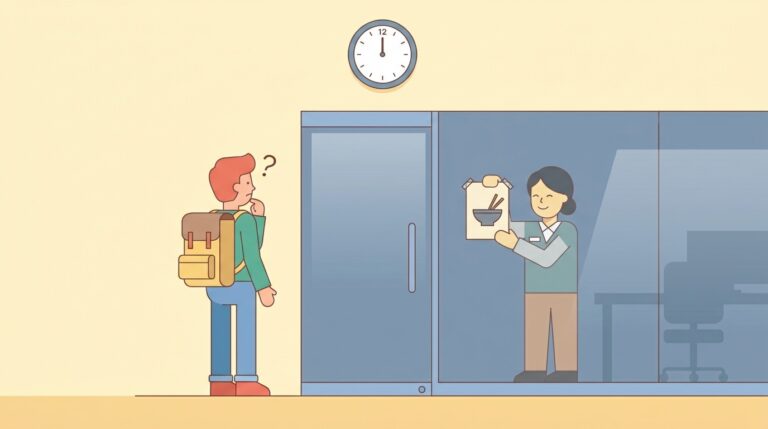
Imagine this: You are the main character in a K-Drama. You finally arrived at the Korean immigration office or the local community center after a one-hour subway ride. You proudly hold your documents. You look at your watch. It is exactly 12:00 PM. Suddenly, the lights go dim. The staff put up a small desk sign, stand up together, and disappear.
Wait, did they close for the day? Did you do something wrong?
No, you just met the legendary 점심시간 (Lunch Time)!
In the past, Korean public offices used rotating shifts so citizens could visit anytime. But recently, many places have adopted a strict lunch break system to protect workers’ rights. Knowing how to navigate this 12:00 PM to 1:00 PM window is a true survival skill for anyone living in or visiting Korea. Let us learn the exact phrases you need so you do not have to wait in the dark!
Phase 2: Core Expressions Deep Dive
1. 지금 점심시간이에요?
- Pronunciation: jigeum jeomsimsigan-ieyo? [jee-geum jum-shim-she-gan-ee-eh-yo?]
- Meaning: Is it lunch time now? (Literal) / Are you on your lunch break right now? (Real nuance)
- K-Culture Moment: You walk into a bank, and it is strangely quiet. Half the counters are empty. You gently approach a security guard and ask this to read the room (눈치, nunchi).
- Editor’s Insight: This is a very polite and soft way to ask why they are not serving people. Instead of asking Why are you not working?, asking Is it lunch time? shows you respect their schedule.
- Situation Spectrum:
- Friends (Casual): 🚫 (You would drop the -eyo: 지금 점심시간이야?)
- Staff/Clerks (Semi-formal): ✅
- Boss/Elders (Formal): ✅
- 🤔 Think About It: In Korea, eating meals at the right time is extremely important. How important is the official lunch hour in your culture?
2. 몇 시까지 기다려야 돼요?
- Pronunciation: myeot sikkaji gidaryeoya dwaeyo? [myut she-kka-jee gee-dah-ryuh-yah dweh-yo?]
- Meaning: Until what time should I wait?
- K-Culture Moment: You are at the post office to send K-Pop merchandise to your friend. The staff says they are on break. You need to know if you have time to grab a coffee or if you should just wait in the chair.
- Editor’s Insight: This phrase is pure gold. It sounds natural and helpless in a cute way, often prompting the staff to give you exact instructions, like Come back at 1 PM.
- Situation Spectrum:
- Friends (Casual): 🚫
- Staff/Clerks (Semi-formal): ✅
- Boss/Elders (Formal): ⚠️ (A bit too direct for a strict boss)
- 🤔 Think About It: Notice the word 기다려야 돼요 (have to wait). Koreans often emphasize the action of waiting rather than simply asking When do you open?
3. 한 시에 다시 올게요.
- Pronunciation: han sie dasi olgeyo. [hahn she-eh dah-she ohl-ggeh-yo]
- Meaning: I will come back at 1 o’clock.
- K-Culture Moment: A classic K-Drama cliffhanger line! I’ll be back. It tells the staff that you understand the situation and will return when their break is over.
- Editor’s Insight: 올게요 (I will come) is a soft promise. It is much more natural than sounding like a robot reading a dictionary.
- Situation Spectrum:
- Friends (Casual): 🚫
- Staff/Clerks (Semi-formal): ✅
- Boss/Elders (Formal): ✅
Phase 3: Textbook vs. Real Korean
Situation: Checking if they are closed
* 📖 Textbook: 사무실이 닫았습니까? (Is the office closed?)
* 🗣️ Real Korean: 지금 점심시간이에요? (Is it lunch time now?)
* 💡 Why it is different: Public offices do not close in the middle of the day; they simply pause. Asking if they are closed sounds too dramatic!
Situation: Leaving and coming back
* 📖 Textbook: 오후 1시에 다시 방문하겠습니다. (I will visit again at 1 PM.)
* 🗣️ Real Korean: 한 시에 다시 올게요. (I will come back at 1.)
* 💡 Why it is different: 방문하다 (to visit) is a very formal, written-style word. Even at a government office, everyday spoken Korean is much simpler.
Phase 4: Cultural Context — K-Culture Deep Dive
4-1. The Non-verbal Rule of Lunch Time
When the clock strikes 12:00 PM, do not try to make eye contact with a clerk who is packing their bag or turning off their monitor. In Korea, this is a matter of 눈치 (Nunchi)—the ability to read the room. If the lights above a specific counter are off, it is an invisible wall. Do not knock on the glass!
4-2. K-Travel & Office Culture Connection
If you travel to Korea, you might visit a 주민센터 (Community Service Center) or a 우체국 (Post Office). Historically, Korea was known for its 빨리빨리 (hurry, hurry) culture, where public workers took turns eating so citizens would not have to wait.
However, there is a massive shift happening right now. To ensure fair labor rights, the 점심시간 휴무제 (Lunch Time Closure System) is becoming the norm. The doors might literally lock, or the lights will go dim. Instead of getting upset, join the locals! Grab a quick lunch nearby. Korea has amazing fast-food options like 김밥 (Gimbap) or 국밥 (Gukbap) that you can eat in 20 minutes!
Phase 5: Real-world Roleplay Scenario
Setting: It is 11:55 AM on a Tuesday. You rushed to the local community center (주민센터) to print a document for your visa. You finally step inside, but a staff member is starting to turn off the counter signs.
Characters:
* YOU: An expat who really needs this paper today.
* Min-su (30s): A polite but tired Korean civil servant looking forward to his lunch.
Dialogue:
YOU: 저기요, 지금 서류 뗄 수 있어요?
(jeogiyo, jigeum seoryu ttel su isseoyo?)
[Excuse me, can I get a document issued right now?]
Min-su: 아, 고객님. 저희가 12시부터 점심시간이라서요.
(a, gogaengnim. jeohuiga yeoldusibuteo jeomsimsigan-iraseoyo.)
[Ah, customer. It’s because our lunch time starts at 12 o’clock.]
YOU: 헉, 점심시간이요? 업무 아예 안 해요?
(heok, jeomsimsigan-iyo? eommu aye an haeyo?)
[Gasp, lunch time? Do you not work at all?]
Min-su: 네, 점심시간 휴무제라서 1시까지 기다려주셔야 합니다.
(ne, jeomsimsigan hyumujeraseo hansikkaji gidaryeojusyeoya hamnida.)
[Yes, because of the lunch time closure system, you have to wait until 1 o’clock.]
YOU: 그럼 번호표는 미리 뽑아도 되나요?
(geureom beonhopyoneun miri ppobado doenayo?)
[Then can I pull a waiting ticket in advance?]
Min-su: 네, 번호표 뽑고 저기 의자에서 기다리셔도 됩니다.
(ne, beonhopyo ppopgo jeogi uijaeseo gidarisyeodo doemnida.)
[Yes, you can pull a ticket and wait on those chairs over there.]
🔀 Your Turn! How do you reply?
* A) 아이씨… 너무하네요! (Ugh… that’s too much!)
* B) 아, 네. 한 시에 다시 올게요! (Ah, yes. I will come back at 1!)
* C) 5분만 해주시면 안 돼요? (Can’t you just do it for 5 minutes?)
Best Choice: B.
Why? In Korea, rules at public offices are very strict now. Begging for 5 minutes (Choice C) rarely works anymore and might make the situation awkward. It is much cooler and more polite to say you will come back!
Phase 6: 10-Second Shadowing Drill
Practice this sentence out loud. Pay attention to the pauses!
🥺 저기요, / 지금 / 점심시간이에요?
(jeogiyo, / jigeum / jeomsimsigan-ieyo?)
[Excuse me, / right now / is it lunch time?]
Editor’s tip: Say it with a slightly apologetic face, as if you are sorry to interrupt their break!
Phase 7: K-Culture Mini Dictionary
1. 점심시간
* Romanization: jeomsimsigan
* English: Lunch time
* Context: Usually exactly 12:00 PM to 1:00 PM in Korea. It is considered sacred!
2. 주민센터
* Romanization: juminsenteo
* English: Community Service Center
* Context: The local ward office where you get everyday paperwork done.
3. 번호표
* Romanization: beonhopyo
* English: Waiting ticket (Number ticket)
* Context: The most important thing in Korean public offices! Always find the machine and pull a number before you do anything else.
4. 눈치
* Romanization: nunchi
* English: Reading the room
* Context: Sensing the atmosphere. If the lights are dim and people are leaving, your nunchi should tell you it’s break time.
Phase 8: Traveler Survival Kit
Even if you are just traveling, you might need to visit a post office (to mail souvenirs) or a bank (to exchange money).
🆘 Survival Expressions TOP 3
* 🇰🇷 번호표 어디 있어요? (beonhopyo eodi isseoyo?) – Where is the number ticket?
* 🇰🇷 외국인 창구 어디예요? (oegugin changgu eodiyeyo?) – Where is the foreigner counter?
* 🇰🇷 화장실 써도 돼요? (hwajangsil sseodo dwaeyo?) – Can I use the restroom?
Editor’s Travel Note
Most public buildings in Korea have public restrooms on the first floor that anyone can use, even during lunch time! Also, remember that while public offices close for lunch, most normal restaurants are incredibly busy during this 12 PM – 1 PM window.
Phase 9: Critical Thinking Corner — One Step Deeper
Media vs Reality: The End of ‘Hurry Hurry’ Culture?
If you watch older Korean movies or dramas, you often see the 빨리빨리 (Ppalli-ppalli / Hurry up) culture. Public servants would eat a bowl of noodles at their desks in 5 minutes just to keep serving citizens. However, modern Korea is changing fast. The younger generation values 워라밸 (Work-Life Balance) and fundamental labor rights. The new Lunch Time Closure rule might seem inconvenient for visitors, but it is a fascinating sign that Korean society is prioritizing the well-being of its workers over pure speed and convenience.
Your Turn: In your country, do government offices close completely for lunch, or do they take turns working? Share your experience in the comments!
Phase 10: FAQ & Avoiding Mistakes
Q: Can I just sit inside the office and wait during lunch time?
Yes! Most places will let you pull a 번호표 (number ticket) and sit in the waiting area. Just don’t be surprised if they turn off half the lights. You can quietly look at your phone.
Q: Is it okay to ask them a quick question if they are sitting at their desk?
If they are clearly on break (looking at their phone, drinking coffee, or lights are off), it is better not to. In Korea, resting time is strictly respected now.
Common Mistakes
* ❌ Mistake #1: Forgetting to pull a 번호표 (number ticket). If you wait 30 minutes without a ticket, you lose your turn!
* ✅ Do this instead: The moment you walk into any Korean bank or office, look for the machine that prints numbers.
Phase 11: Summary & Action Items
One-Liner Summary: When the clock hits 12 PM at a Korean office, use your Nunchi, ask Is it lunch time?, and calmly say you will come back at 1 PM!
Action Mission 3 Steps:
* 🥉 Bronze (Solo): Look at your watch at exactly 12:00 PM today and say 지금 점심시간이에요? out loud.
* 🥈 Silver (Online): Comment below with a time you had to wait a long time at a public office in your country!
* 🥇 Gold (Real-world): Next time you visit a bank or office in Korea, successfully locate the 번호표 (number ticket) machine without asking for help.
K-Culture Mission:
Next time you watch a K-Drama set in an office (like Misaeng or Extraordinary Attorney Woo), pay attention to what happens exactly at 12:00 PM. Notice how everyone moves together as a group to grab lunch!
Phase 12: Quiz — Interactive Challenge
1. Situation Judgment: You walk into the post office at 12:15 PM. The lights are dim, and the staff are chatting quietly with coffee. What is the BEST thing to say?
* A) 일 안 하세요? (Are you not working?)
* B) 지금 점심시간이에요? (Is it lunch time now?)
* C) 빨리 서류 좀 주세요. (Give me the document quickly.)
(Answer: B. It is polite and shows good Nunchi!)
2. True or False – K-Culture Edition:
In Korea, you should just stand in a line behind the counter at the bank or public office.
(Answer: False! You MUST pull a 번호표 [number ticket] and wait for your number to be called on the screen!)
3. Fill in the blank:
You want to tell the staff you will return at 1 o’clock.
한 시에 다시 _________.
(Answer: 올게요)
Frequently Asked Questions (FAQ)
Q: What does "지금 점심시간이에요?" mean in Korean and how do you pronounce it?
A: In Korean, "지금 점심시간이에요?" is pronounced [jigeum jeomsimsigan-ieyo? [jee-geum jum-shim-she-gan-ee-eh-yo?] and means: Is it lunch time now? (Literal) / Are you on your lunch break right now? (Real nuance)
Q: What does "몇 시까지 기다려야 돼요?" mean in Korean and how do you pronounce it?
A: In Korean, "몇 시까지 기다려야 돼요?" is pronounced [myeot sikkaji gidaryeoya dwaeyo? [myut she-kka-jee gee-dah-ryuh-yah dweh-yo?] and means: Until what time should I wait?
Q: What does "한 시에 다시 올게요." mean in Korean and how do you pronounce it?
A: In Korean, "한 시에 다시 올게요." is pronounced [han sie dasi olgeyo. [hahn she-eh dah-she ohl-ggeh-yo] and means: I will come back at 1 o'clock.






