

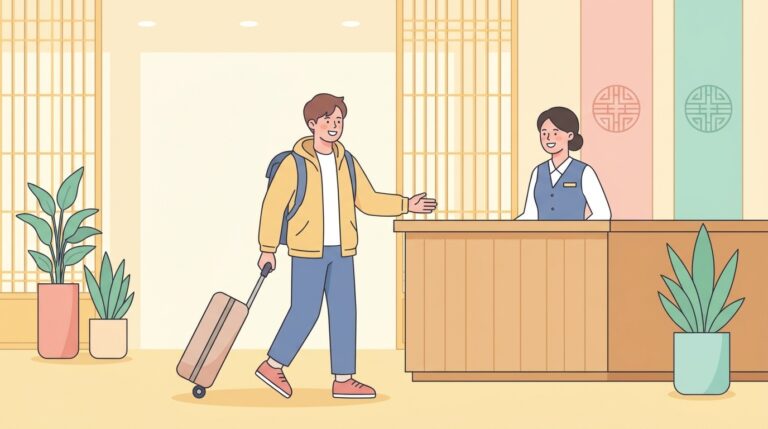
Phase 1: Empathy (Immersive Opening)
Hello! I am your Daily Hangul Editor.
Picture this: It is 11:00 AM in Seoul. The dreaded hotel check-out time. Your flight out of Incheon Airport is not until 8:00 PM. You have a massive 28-inch suitcase, and you really want to eat some delicious street food in Myeongdong or visit one last cafe in Hongdae. But dragging that heavy suitcase through the crowded, hilly streets of Seoul? Absolute nightmare.
In a K-Drama, the main character might miraculously have a luxury car waiting for them. But in reality, you are standing in the hotel lobby, looking at the front desk, wondering, Can I leave my bags here for a few hours?
If you do not know how to ask this properly, you might end up hauling your luggage all day or paying expensive fees for a locker. But do not worry! Today, I am going to teach you exactly how to ask a hotel to hold your luggage like a polite, seasoned traveler. This guide is based on real questions from my students who successfully enjoyed their hands-free Seoul adventures!
Phase 2: Core Expressions Deep Dive
1. 짐 좀 맡겨도 될까요?
- Pronunciation: jim jom matgyeodo doelkkayo? (jeem johm maht-gyeo-doh dwehl-kka-yo?)
- Meaning: Can I leave my luggage? (Literal: Is it okay if I entrust my luggage a little?)
- K-Culture Moment: You will hear this everywhere in Korea, not just at hotels. If you are at a crowded K-BBQ restaurant with a huge winter coat, the staff might say, 옷 좀 맡겨드릴까요? (Shall I keep your coat for you?). The verb 맡기다 (to entrust/deposit) is incredibly useful.
- Editor’s Insight: The word 좀 literally means a little, but Koreans use it constantly to soften a request. Without 좀, the sentence sounds a bit demanding. Adding it makes you sound polite and considerate.
- Situation Spectrum:
- Casual (to a friend): 🚫 (You would use 반말: 짐 좀 맡길 수 있어?)
- Semi-formal (Hotel staff): ✅
- Formal (Very high-end hotel): ✅
- 🤔 Think About It: Why do Koreans add 좀 (a little) to requests? Does making a request sound smaller make it more polite in your culture too?
2. 체크아웃 후에도 짐 보관이 가능한가요?
- Pronunciation: chekeu-aut huedo jim bogwani ganeunghangayo? (check-oo-out hoo-eh-doh jeem boh-gwan-ee gah-neung-hahn-gah-yo?)
- Meaning: Is luggage storage available even after check-out?
- K-Culture Moment: When planning a 호캉스 (Hocance: Hotel + Vacance), Koreans love to maximize their stay. They will check out at 11 AM, leave their bags, and go to the hotel bakery or nearby spots until the evening.
- Editor’s Insight: This phrase uses the formal noun 보관 (storage) and 가능한가요 (is it possible?). It sounds very professional and is perfect for emailing the hotel in advance or asking at a 5-star hotel front desk.
- Situation Spectrum:
- Casual (to a friend): 🚫
- Semi-formal (Business/Hotel): ✅
- Formal (High-end Hotel): ✅
- 🤔 Think About It: Notice the mix of English (check-out) and Korean formal words. How much English do you think is mixed into modern Korean daily conversations?
3. 몇 시까지 찾으러 오면 될까요?
- Pronunciation: myeot sikkaji chajeureo omyeon doelkkayo? (myeot shee-kka-jee chah-jeu-reo oh-myun dwehl-kka-yo?)
- Meaning: By what time should I come to pick it up?
- K-Culture Moment: After the staff says yes, you need to know the deadline. Koreans are very punctual. If you say you will be back by 5 PM, it is good manners to be there by 5 PM.
- Editor’s Insight: The verb 찾다 usually means to find, but when it comes to luggage, parcels, or reserved items, it means to pick up or to claim. So, 찾으러 오다 means to come to pick up.
- Situation Spectrum:
- Casual (to a friend): 🚫
- Semi-formal (Hotel staff): ✅
- Formal (High-end Hotel): ✅
- 🤔 Think About It: Does your language use the same word for finding a lost item and picking up a stored item? Korean does!
Phase 3: Textbook vs Real Korean
Situation 1: Asking the hotel to hold your bags
* 📖 Textbook Korean: 저의 수하물을 보관해 주실 수 있습니까? (Could you please store my baggage?)
* 🗣️ Real Korean: 저, 짐 좀 맡길 수 있을까요? (Um, could I leave my bags here?)
* 💡 Why is it different?: 수하물 (suhamul) is a highly formal word usually reserved for airport announcements (checked baggage). In everyday life, everyone just says 짐 (jim – luggage/stuff).
Situation 2: Coming back to pick up your bags
* 📖 Textbook Korean: 보관한 수하물을 돌려받고 싶습니다. (I want to receive my stored baggage back.)
* 🗣️ Real Korean: 아까 맡긴 짐 찾으러 왔는데요. (I came to pick up the luggage I left earlier.)
* 💡 Why is it different?: Saying I want to get it back sounds too direct. Ending the sentence with ~는데요 softens the statement, leaving room for the staff to respond naturally.
Bottom Note: For a B1 level, focusing on the verb 맡기다 (to leave/entrust) and 찾다 (to pick up) will make your Korean sound incredibly natural and fluent.
Phase 4: Cultural Context — K-Culture Deep Dive
4-1. Non-verbal Elements
When handing over your luggage or receiving your luggage claim tag (보관증), try to use both hands or support your right arm with your left hand. This is a classic sign of respect in Korea. Also, practice 눈치 (Nunchi): if the front desk is dealing with a long line of checking-out guests at 11:00 AM exactly, wait patiently for your turn rather than interrupting.
4-2. K-Travel Connection
Leaving your luggage is a core part of the Korean travel experience. Whether you are staying at a fancy hotel in Gangnam or a cozy guesthouse in Hongdae, almost all accommodations offer this service for free before or after check-in.
However, what if you are in an Airbnb or a place that does not hold luggage? You will need to use a 물품보관함 (Coin Locker). You can find these at almost every subway station in Seoul. Knowing the word 짐 (luggage) will help you navigate locker menus, which often have options like 짐 보관 (Store Luggage) and 짐 찾기 (Retrieve Luggage).
Phase 5: Real-life Roleplay Scenario
Setting: Friday, 11:00 AM. The bustling lobby of a popular hotel in Myeongdong. People are lining up to check out. You have your suitcase ready and finally step up to the front desk.
Characters:
* YOU: An eager traveler who wants to eat Myeongdong Kalguksu before heading to the airport.
* Front Desk Staff (Jiwon): A polite and efficient hotel employee in a crisp uniform.
Dialogue:
Jiwon: 체크아웃 도와드릴까요?
(chekeu-aut dowadeurilkkayo?)
[Shall I help you with your check-out?]
YOU: 네, 여기 객실 키요. 705호입니다.
(ne, yeogi gaeksil kiyo. chil-baek-o-ho-imnida.)
[Yes, here is the room key. It is room 705.]
Jiwon: 네, 결제 완료되셨습니다. 이용해 주셔서 감사합니다.
(ne, gyeolje wallyodoesyeotseumnida. i-yong-hae jusyeoseo gamsahamnida.)
[Yes, your payment is complete. Thank you for staying with us.]
YOU: 저기요… 질문이 하나 있는데요.
(jeogiyo… jilmuni hana inneundeyo.)
[Excuse me… I have a question.]
Jiwon: 네, 고객님. 말씀해 주세요.
(ne, gogaengnim. malsseumhae juseyo.)
[Yes, sir/ma’am. Please tell me.]
🔀 Your Turn! How will you ask?
* A) 제 수하물을 보관하십시오. (Store my baggage.)
* B) 짐 좀 맡겨도 될까요? (Can I leave my luggage?)
* C) 가방 주세요. (Give me bag.)
✅ Best Choice: B — It is polite, natural, and softens the request.
⚠️ Choice A & C Analysis: Choice A sounds like a military command. Choice C means Give me the bag, which is the opposite of what you want!
(Continuing with Choice B)
YOU: 비행기 시간 때문에 그런데… 짐 좀 맡겨도 될까요?
(bihaenggi sigan ttaemune geureonde… jim jom matgyeodo doelkkayo?)
[Because of my flight time… can I leave my luggage here?]
Jiwon: 네, 가능합니다. 몇 시쯤 찾으러 오실 예정이신가요?
(ne, ganeunghamnida. myeot ssijjeum chajeureo osil yejeongisingayo?)
[Yes, it is possible. Around what time do you plan to come pick it up?]
YOU: 오후 4시쯤이요.
(ohu ne-sijjeum-iyo.)
[Around 4 PM.]
Jiwon: 알겠습니다. 여기 짐 보관증입니다. 잃어버리지 않게 조심하세요.
(algetseumnida. yeogi jim bogwanjeung-imnida. ileobeoriji anke josimhaseyo.)
[Understood. Here is your luggage claim tag. Please be careful not to lose it.]
YOU: 네, 감사합니다! 이따 올게요.
(ne, gamsahamnida! itta olgeyo.)
[Yes, thank you! I will be back later.]
Phase 6: 10-Second Shadowing Drill
Read these out loud! Pay attention to the pauses (/) and the emotion tags.
- 🥺 Polite & slightly cautious:
저기요, / 짐 좀 / 맡겨도 될까요?
(jeogiyo, / jim jom / matgyeodo doelkkayo?) - 😊 Cheerful & confirming:
오후 네 시쯤 / 찾으러 올게요!
(ohu ne-sijjeum / chajeureo olgeyo!) - 😌 Relieved & grateful:
아까 맡긴 짐 / 찾으러 왔는데요.
(akka matgin jim / chajeureo wanneundeyo.)
Phase 7: K-Culture Mini Dictionary
1. 짐 (Jim)
* Meaning: Luggage, bags, load, or burden.
* Context: Used for physical bags, but also emotionally. You will often hear K-Drama characters say 내 짐이 너무 무거워 (My burden is too heavy) when talking about life struggles!
2. 보관증 (Bogwanjeung)
* Meaning: Claim tag, storage ticket.
* Context: The paper or plastic number tag the hotel gives you. Do not lose this! In Korea, losing it might mean verifying your identity, which takes precious vacation time.
3. 눈치 (Nunchi)
* Meaning: Reading the room, social awareness.
* Context: Asking a receptionist a complicated question while there are 20 angry people waiting behind you shows a lack of Nunchi. Timing is everything!
4. 호캉스 (Hocance)
* Meaning: Hotel + Vacance (Vacation).
* Context: A huge trend in Korea. Instead of traveling far, people book a nice local hotel for a weekend getaway to enjoy room service and the pool.
Phase 8: Traveler’s Survival Kit
Since this topic is deeply tied to travel, here are the top survival expressions for handling your luggage in Korea.
🆘 Survival Expression #1: Finding a Locker
* 🇰🇷 여기 근처에 물품보관함 있어요?
* 🗣️ yeogi geuncheo-e mulpumbogwanham isseoyo?
* 📍 Where to use: Subway stations, train stations, large malls.
🆘 Survival Expression #2: Missing Luggage Tag
* 🇰🇷 보관증을 잃어버렸어요.
* 🗣️ bogwanjeung-eul ileobeoryeosseoyo.
* 📍 Where to use: Hotel front desk, coat checks.
🆘 Survival Expression #3: Too heavy!
* 🇰🇷 이거 너무 무거워요.
* 🗣️ igeo neomu mugeowoyo.
* 📍 Where to use: When asking a friend for help lifting a bag up the subway stairs.
📌 Editor’s Travel Note
* Useful App: Download the T-Locker (또타라커) app. It shows you the real-time availability of subway coin lockers in Seoul. You can even reserve them!
* Tipping Culture: Remember, there is NO tipping culture in Korea. If a bellboy helps with your luggage, a warm 감사합니다 (Thank you) and a bow of the head is perfectly enough. Giving money will only confuse them!
Phase 9: Critical Thinking Corner — One Step Deeper
Language & Power: The Service Industry Korean (서비스직 한국어)
If you listen closely to the hotel staff in our roleplay, they use extremely high honorifics, sometimes even honoring the objects themselves! You might hear things like 결제 완료되셨습니다 (The payment has been completed – with an honorific suffix on the payment). Grammatically, honoring an object is incorrect. However, in the highly competitive Korean hospitality industry, staff often over-apply honorifics to ensure the customer feels immensely respected. This reflects a culture where the guest is king, but it has sparked debates in Korea about the emotional labor of service workers.
💬 Your Turn: Does the service industry in your country use a completely different, overly polite style of language compared to everyday speech? Share your thoughts below!
Phase 10: FAQ & Mistake Prevention
Q: Can I ask an Airbnb host to keep my luggage using this phrase?
Yes! You can message them: 체크아웃 후에 짐 좀 맡겨도 될까요? However, because Airbnbs do not always have lobbies, be prepared for them to say no or direct you to a subway locker.
Q: Can I use 반말 (casual language) if the hotel staff looks younger than me?
Absolutely NOT. In Korea, professional settings require formal language regardless of age. Using casual language to service workers is considered extremely rude.
❌ Common Mistake #1: Saying 가방 주세요 (Give me the bag) when picking up luggage.
✅ Do this instead: Say 짐 찾으러 왔어요 (I came to pick up my luggage). It sounds much more natural and polite.
❌ Common Mistake #2: Trying to tip the staff for keeping the bags.
✅ Do this instead: Just smile and say 감사합니다. Tipping can create awkward situations.
Phase 11: Summary & Action Items
- One-Liner Summary: Use 짐 좀 맡겨도 될까요? (jim jom matgyeodo doelkkayo?) to smoothly ask any hotel to hold your luggage.
Action Mission 3 Steps:
* 🥉 Bronze (Solo): Stand in front of the mirror and confidently say 짐 좀 맡겨도 될까요? three times.
* 🥈 Silver (Online): Leave a comment in our community with what you plan to do in Korea after you drop off your luggage!
* 🥇 Gold (Real-world): On your next trip to Korea, use this exact phrase at your hotel front desk and enjoy walking around empty-handed.
🎬 K-Culture Mission: Go to YouTube and search for 한국 호텔 브이로그 (Korean Hotel Vlog). Skip to the end where they check out, and see if you can hear them use the word 짐!
Phase 12: Quiz — Interactive Challenge
Q1. You are at the hotel front desk at 11 AM. You want to leave your bags until 3 PM. Which phrase is the MOST natural?
* A) 내 수하물을 보관하라.
* B) 짐 좀 맡겨도 될까요?
* C) 가방을 숨겨주세요.
Q2. True or False: In Korea, you should tip the bellboy $2-$5 for taking care of your luggage.
Q3. Fill in the blank:
When you return to the hotel at 3 PM, you hand over your claim tag and say: 아까 맡긴 짐 _____ 왔는데요. (I came to pick up…)
* A) 버리러 (to throw away)
* B) 찾으러 (to pick up)
(Answers: Q1-B, Q2-False – Korea has no tipping culture!, Q3-B)
Frequently Asked Questions (FAQ)
Q: What does "짐 좀 맡겨도 될까요?" mean in Korean and how do you pronounce it?
A: In Korean, "짐 좀 맡겨도 될까요?" is pronounced [jim jom matgyeodo doelkkayo? (jeem johm maht-gyeo-doh dwehl-kka-yo?] and means: Can I leave my luggage? (Literal: Is it okay if I entrust my luggage a little?)
Q: What does "체크아웃 후에도 짐 보관이 가능한가요?" mean in Korean and how do you pronounce it?
A: In Korean, "체크아웃 후에도 짐 보관이 가능한가요?" is pronounced [chekeu-aut huedo jim bogwani ganeunghangayo? (check-oo-out hoo-eh-doh jeem boh-gwan-ee gah-neung-hahn-gah-yo?] and means: Is luggage storage available even after check-out?
Q: What does "몇 시까지 찾으러 오면 될까요?" mean in Korean and how do you pronounce it?
A: In Korean, "몇 시까지 찾으러 오면 될까요?" is pronounced [myeot sikkaji chajeureo omyeon doelkkayo? (myeot shee-kka-jee chah-jeu-reo oh-myun dwehl-kka-yo?] and means: By what time should I come to pick it up?







