

Phase 1: Empathy & K-Culture Cold Open
Hello! I am the Lead Editor of Daily Hangul, your Korean tutor and local culture navigator.
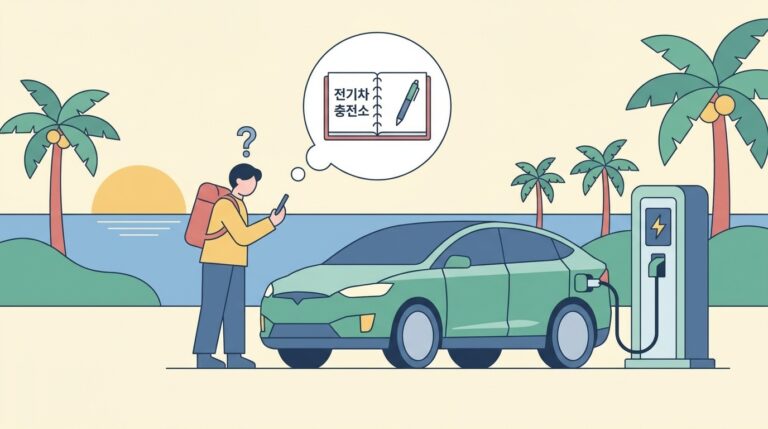
Picture this K-Travel moment: You are on a dream road trip in Jeju Island. The ocean breeze is perfect, your favorite K-Pop playlist is blasting, and you are driving a sleek, rented Electric Vehicle (EV). Suddenly, the dashboard flashes red. 10% battery left!
You pull into a giant underground parking lot at a resort, but you cannot find the charger anywhere. You see a busy parking attendant walking by. Your palms start to sweat. You know how to say “Hello” and “Thank you,” but how do you ask about EV chargers without sounding like a broken dictionary?
If you don’t know the right expressions, you might end up wandering the parking lot for an hour, or worse, getting stranded! This post is inspired by the actual panic moments of our intermediate (B2) learners who rented EVs in Korea. By the end of this guide, you will be navigating Korean charging stations like a true local.
Phase 2: Core Expressions Deep Dive
1. 전기차 충전소 어디에 있어요?
- Pronunciation: jeon-gi-cha chung-jeon-so eo-di-e i-sseo-yo?
- Sound Analogy: ‘jeon’ sounds like ‘John’ but with a tight ‘ee’ sound. ‘chung’ sounds like the ‘choong’ you make when imitating a martial arts punch!
- Meaning: Where is the EV charging station? (Literal & Real nuance are the same)
- K-Culture Moment: You will use this the moment you pull into a highway rest area (휴게소) or a large mart.
- Editor’s Insight: This is your absolute baseline survival phrase. It is polite, direct, and gets the job done. If you want to sound even more fluent, you can drop the ‘에’ and just say “충전소 어디 있어요?”
- Situation Spectrum:
- Casual (Friends): ✅ (Drop the ‘요’ -> 어디 있어?)
- Semi-formal (Staff/Strangers): ✅
- Formal (Boss/Elders): ⚠️ (Better to use “어디에 있습니까?”)
- 🤔 Think About It: Notice how the subject (“I” or “You”) is completely missing? Why do Koreans drop pronouns so often? It’s because Korean is a “high-context” language. If you are holding a car key and looking around, everyone already knows who is looking for the charger!
2. 급속 충전기 있나요?
- Pronunciation: geup-sok chung-jeon-gi in-na-yo?
- Meaning: Do you have a fast charger?
- K-Culture Moment: Fast chargers (급속) are the holy grail of Korean road trips. In Korea’s “Ppalli-ppalli” (hurry up) culture, no one wants to wait 8 hours for a slow charge during a trip.
- Editor’s Insight: The word ‘급속’ (fast/rapid) is key here. If you just ask for a charger, they might point you to a ‘완속’ (slow) charger, which will ruin your travel itinerary. The ending ‘-있나요?’ is a very soft, polite way of asking a question without sounding demanding.
- Situation Spectrum:
- Casual: ✅ (급속 있어?)
- Semi-formal: ✅
- Formal: ✅
- 🤔 Think About It: How does the speed of technology reflect a country’s culture? In Korea, speed isn’t just a convenience; it’s an expected standard.
3. 여기 일반 차가 주차되어 있어요.
- Pronunciation: yeo-gi il-ban cha-ga ju-cha-doe-eo i-sseo-yo.
- Meaning: A regular (gas) car is parked here.
- K-Culture Moment: You finally find the EV spot, but a huge gasoline SUV is parked there. This is called “ICED” (Internal Combustion Engine’d) in English. In Korea, you need to report this to the staff so they can call the owner.
- Editor’s Insight: Instead of aggressively saying “They stole my spot!”, Koreans state the objective fact. It’s a non-confrontational way of saying, “Please fix this problem for me.”
- Situation Spectrum:
- Casual: 🚫 (Too stiff for friends)
- Semi-formal: ✅
- Formal: ✅
Phase 3: Textbook vs Real Korean
[Situation 1: Asking if a spot is for EVs]
* 📖 Textbook Korean: 여기는 전기 자동차 전용 구역입니까? (Is this an exclusive zone for electric vehicles?)
* 🗣️ Real Korean: 여기 전기차 자리예요? (Is this an EV spot?)
* 💡 Why the difference?: Efficiency! Koreans shorten “전기 자동차” (Electric Automobile) to “전기차” (Electric Car), and “전용 구역” (Exclusive Zone) is casually just called “자리” (Seat/Spot).
[Situation 2: Telling someone the charger is broken]
* 📖 Textbook Korean: 이 충전기는 고장이 났습니다. (This charger is broken.)
* 🗣️ Real Korean: 이거 고장 났어요. or 이거 안 돼요. (This is broken / This doesn’t work.)
* 💡 Why the difference?: “안 돼요” (It doesn’t work / It’s not allowed) is the ultimate Korean catch-all phrase for anything malfunctioning or prohibited. It is universally understood.
Phase 4: Cultural Context — K-Culture Deep Dive
4-1. Non-Verbal Cues & Nunchi
When asking for directions in a parking lot, use your whole hand to point, not just your index finger. Also, read the room (Nunchi). If a charger is occupied and the driver is sitting inside eating a snack, do not hover right next to their window. Park slightly away and wait patiently.
4-2. The Highway Rest Area (휴게소) Culture
If you rent an EV in Korea, you will spend a lot of time at highway rest areas (휴게소 – hyugeso). In Korean K-Dramas and variety shows, rest areas are famous not for bathrooms, but for K-Food!
While your car is plugged into the fast charger for 40 minutes, you must participate in the Korean tradition of eating Sotteok Sotteok (Sausage and Rice Cake skewers) or a hot bowl of Udon. The charging time isn’t a delay; it’s a culinary event! However, be careful with your Nunchi: By law, you must move your car after 40 minutes at a fast charger. If you stay longer to finish your noodles, you will get a fine and dirty looks from other drivers.
Phase 5: Real-Life Roleplay Scenario
Setting: Friday afternoon. The underground parking lot of a luxury hotel in Jeju Island. It is dark, echoing, and packed with cars. You are holding a charging card provided by your rental company.
Characters:
* YOU: A traveler on Day 2 of a Jeju road trip. Your EV battery is at 15%.
* Mr. Kang: (50s, Hotel Parking Attendant). Friendly, speaks very fast, wearing a neon safety vest.
Dialogue:
YOU: 저기요, 혹시 전기차 충전소 어디에 있나요?
(jeogi-yo, hok-si jeon-gi-cha chung-jeon-so eo-di-e in-na-yo?)
[Excuse me, by any chance, where is the EV charging station?]
(Stage Direction: You approach Mr. Kang, holding up your rental car key)
Mr. Kang: 아, 전기차요? 저쪽 기둥 뒤로 돌아가시면 있어요.
(a, jeon-gi-chayo? jeo-jjok gi-dung dwi-ro do-ra-ga-si-myeon i-sseo-yo.)
[Ah, EV? Go around behind that pillar over there.]
YOU: 혹시 급속 충전기인가요?
(hok-si geup-sok chung-jeon-gi-in-ga-yo?)
[Is it a fast charger, by any chance?]
Mr. Kang: 아니요, 호텔 안에는 완속밖에 없어요. 급속은 시청 쪽으로 가셔야 돼요.
(a-ni-yo, ho-tel a-ne-neun wan-sok-ba-kke eop-seo-yo. geup-sok-eun si-cheong jjog-eu-ro ga-syeo-ya dwae-yo.)
[No, inside the hotel we only have slow chargers. For fast chargers, you have to go towards City Hall.]
YOU: 아… 밤새 충전해도 괜찮을까요?
(a… bam-sae chung-jeon-hae-do gwaen-chan-eul-kka-yo?)
[Ah… Is it okay if I charge it overnight?]
Mr. Kang: 네, 완속은 밤새 꽂아두셔도 돼요. 렌터카 카드 있으시죠?
(ne, wan-sok-eun bam-sae kko-ja-du-syeo-do dwae-yo. ren-teo-ka ka-deu i-sseu-si-jyo?)
[Yes, you can leave it plugged in overnight for slow charging. You have a rental car card, right?]
YOU: 네, 여기 있어요. 감사합니다!
(ne, yeo-gi i-sseo-yo. gam-sa-ham-ni-da!)
[Yes, here it is. Thank you!]
(Stage Direction: You drive to the pillar, but a massive gasoline truck is parked in the EV spot! You walk back to Mr. Kang.)
🔀 Your Turn! How do you report this to Mr. Kang?
* A) “아저씨! 누가 내 자리를 뺏었어요!” (Mister! Someone stole my spot!)
* B) “저기요, 일반 차가 주차되어 있어요.” (Excuse me, a regular car is parked there.)
* C) “이 차 당장 빼주세요.” (Move this car right now.)
✅ Best Choice: B — Reason: It states the problem objectively. Mr. Kang is not the one who parked the truck, so getting angry at him (Choice A or C) will just cause unnecessary tension. In Korea, presenting the fact politely allows the staff to take action on your behalf.
⚠️ Choice C Analysis: This is extremely direct and aggressive. You only use this if you are talking directly to the offending driver, and even then, it can start an argument.
Phase 6: 10-Second Shadowing Drill
Repeat this out loud to master the natural rhythm. Pay attention to the pauses (/)!
🥺 저기요, / 급속 충전기 / 어디에 있나요?
(jeogi-yo, / geup-sok chung-jeon-gi / eo-di-e in-na-yo?)
(Emotion: Speak slightly urgently but very politely, as if you really need help.)
Phase 7: K-Culture Mini Dictionary
1. 눈치
* Romanization: nunchi
* English: Social awareness / Reading the room
* Context: The vital skill of knowing when to unplug your EV and move your car so others can use the charger.
2. 휴게소
* Romanization: hyugeso
* English: Highway rest area
* Context: Not just a bathroom stop, but a cultural hub for K-Food, shopping, and EV charging during road trips.
3. 빨리빨리
* Romanization: ppalli-ppalli
* English: Hurry, hurry!
* Context: The Korean cultural obsession with speed, which explains why ‘급속’ (fast chargers) are always in high demand.
4. 렌터카
* Romanization: renteoka
* English: Rental car
* Context: A direct English loanword. If you visit Jeju Island, renting a ‘renteoka’ is practically mandatory.
Phase 8: Traveler’s Survival Kit
🆘 Survival Expression 1: 얼마나 걸려요?
– Romanization: eol-ma-na geol-lyeo-yo?
– English: How long does it take?
– Context: Asking the staff or the machine’s display time.🆘 Survival Expression 2: 결제는 어떻게 해요?
– Romanization: gyeol-je-neun eo-tteo-ke hae-yo?
– English: How do I pay?
– Context: When the machine asks for a membership card you don’t have.🆘 Survival Expression 3: 카드로 결제할게요.
– Romanization: ka-deu-ro gyeol-je-hal-ge-yo.
– English: I will pay by card.
– Context: Korea is a cashless society. Always have a physical card ready.📌 Editor’s Travel Note:
Must-have Apps: Download “KakaoMap” or “EV Infra” before your trip. Google Maps does not work well for driving directions in Korea!
Charging Cards: If you rent an EV, the rental company will usually give you a prepaid charging card. Just tap and go!
Phase 9: Critical Thinking Corner — “One Step Deeper”
🧠 Think Deeper: Language & Global Tech Integration
Have you noticed the mix of Korean and English words in tech? “Electric Vehicle” is translated into native Sino-Korean as 전기차 (jeon-gi-cha). But words like “Card” (카드) and “App” (앱) are just English loanwords. As Korea adopts global technology rapidly, the Korean language creates a fascinating hybrid. EV chargers will prompt you with “Kadeu-reul taeg-eu hae-juseyo” (Please tag the card). This shows how the Korean language prioritizes practical, global communication in modern daily life over linguistic purity.
💬 Your Turn: How does your native language handle new tech vocabulary? Do you invent new words or just use the English terms? Share your thoughts in the comments!
Phase 10: FAQ & Avoiding Misunderstandings
Q: Someone’s car is at 100% but still plugged in. Can I unplug it?
* Maybe, but be careful. Technically, some public chargers allow you to pull the plug once it’s done. However, culturally, touching someone else’s car can cause a massive argument. Look at the dashboard; Koreans always leave their phone number visible. It is safer to send a polite text: “차 빼주실 수 있나요?” (Could you move your car?).
Q: Do I have to pay for parking while charging?
* Usually, public charging stations give you 1 free hour of parking while charging. But always double-check the signs!
❌ Common Mistake #1: Confusing 완속 (wan-sok / slow) and 급속 (geup-sok / fast).
✅ How to fix it: Memorize the word ‘급’ (Urgent/Fast). It’s the same ‘급’ used in ‘급행’ (Express train).
❌ Common Mistake #2: Saying “배터리 없어요” (I have no battery) to a mechanic.
✅ How to fix it: While this makes sense, they might think your car is completely dead and needs a tow truck. Say “충전해야 돼요” (I need to charge) instead.
Phase 11: Summary & Action Items
One-Liner Summary: Remember to ask for a Geup-sok (fast) charger, use KakaoMap to find stations, and enjoy the rest area food while you wait!
Action Mission 3 Steps:
* 🥉 Bronze (Solo): Read the 10-second shadowing sentence out loud 3 times today.
* 🥈 Silver (Online): Go to a Korean mapping app (like KakaoMap) and type ‘전기차 충전소’ to see what pops up in Seoul!
* 🥇 Gold (Real Life): If you are in Korea, locate the nearest EV charging station in your building or neighborhood just to practice reading the signs.
K-Culture Mission:
Go to YouTube and search “Korean Highway Rest Area Food.” Pick which snack you would eat while waiting for your EV to charge. (I highly recommend the walnut pastries – 호두과자!)
Phase 12: Interactive Quiz
1. Situational Judgment:
You are at a highway rest area. You want to charge quickly and get back on the road. What do you ask the staff?
* A) 완속 충전기 있나요?
* B) 급속 충전기 어디에 있나요?
* C) 주차장 어디에 있나요?
2. Fill in the Blank:
You found an EV spot, but a gas car is parked there.
“여기 일반 차가 _____되어 있어요.”
* A) 충전 (charging)
* B) 주차 (parked)
* C) 고장 (broken)
3. True or False – K-Culture Edition:
You can leave your car plugged into a fast charger (급속 충전기) for 3 hours while you sleep at a rest area. (T / F)
(Answers: 1. B, 2. B, 3. False – There is a strict 40-minute limit for fast chargers by law!)
Frequently Asked Questions (FAQ)
Q: What does "전기차 충전소 어디에 있어요?" mean in Korean and how do you pronounce it?
A: In Korean, "전기차 충전소 어디에 있어요?" is pronounced [jeon-gi-cha chung-jeon-so eo-di-e i-sseo-yo?] and means: a key conversational Korean expression covered in this lesson.
Q: What does "급속 충전기 있나요?" mean in Korean and how do you pronounce it?
A: In Korean, "급속 충전기 있나요?" is pronounced [geup-sok chung-jeon-gi in-na-yo?] and means: Do you have a fast charger?
Q: What does "여기 일반 차가 주차되어 있어요." mean in Korean and how do you pronounce it?
A: In Korean, "여기 일반 차가 주차되어 있어요." is pronounced [yeo-gi il-ban cha-ga ju-cha-doe-eo i-sseo-yo.] and means: A regular (gas) car is parked here.







