

Phase 1: Empathy
Hello there! This is your Daily Hangul Lead Editor.
Picture this: You are watching a critically acclaimed K-Drama about life in Seoul. The protagonist, exhausted from the relentless 빨리빨리 (Ppali-ppali, hurry-hurry) culture, stands on a rooftop looking at the blinding neon crosses and endless streams of headlights. They take a deep breath, close their eyes, and a single tear falls. The subtitle simply says, ‘I need to breathe.’ But in Korean, they whisper something much more profound.
As advanced learners of Korean (and navigators of this fast-paced world), you already know that learning a language is not just about memorizing vocabulary; it is about adopting a new lens through which to view life. Korea, a country that rebuilt itself from ashes at breakneck speed, has historically pushed mental health to the margins. But today, a massive cultural shift is happening. Millennials and Gen Z are actively seeking 힐링 (healing), booking weekend Temple Stays, and attending modern mindfulness studios in trendy neighborhoods like Seongsu-dong.
If you struggle with anxiety, or simply need to find your center in a chaotic world, mastering the Korean vocabulary of mental care will not only help you articulate your inner world but also connect deeply with a society that is collectively learning how to heal. Let us dive into the beautiful, visceral language of Korean meditation and mental health.
Phase 2: Core Expressions Deep Dive
1. 알아차림
- Pronunciation: aracharim (The ‘a’ sounds like a soft ‘ah’, and the ‘cha’ is lightly aspirated like cha-cha-cha. The ‘rim’ rolls off the tongue.)
- Meaning: Literal = The act of knowing and preparing; Real nuance = Mindfulness, Awareness, or ‘Noticing’ (in a non-judgmental, meditative context).
- K-Culture Moment: You will hear this in Korean meditation apps or during a Temple Stay with a monk. It is the cornerstone of overcoming anxiety—simply ‘noticing’ the anxious thought without letting it consume you.
- Editor’s Insight: This word comes from the verb 알아차리다 (to realize or notice). In meditation, it shifts from an intellectual realization to a gentle, detached observation. It feels much softer and more forgiving than the English word ‘observation’.
- Situation Spectrum:
- Casual conversations: ⚠️ (A bit too formal/spiritual for chatting over beer)
- Therapy/Meditation settings (Formal): ✅
- Self-reflection journals: ✅
- 🤔 Think About It: Why does the Korean word for mindfulness include the root 차리다 (to set, prepare, or recover, as in ‘setting a table’ or ‘recovering one’s senses’)? Does true awareness require us to actively ‘set the table’ for our thoughts to rest upon?
2. 마음챙김
- Pronunciation: maeumchaenggim (ma-eum sounds like ‘mah-um’, chaeng-gim sounds like a gentle chime.)
- Meaning: Literal = Mind-packing / Mind-caring; Real nuance = Mindfulness.
- K-Culture Moment: Look at the bestselling book section in Kyobo Bookstore in Gwanghwamun. Half the self-help section will have 마음챙김 in the title. It is the modern urbanite’s survival tool.
- Editor’s Insight: The verb 챙기다 is deeply cultural. Koreans use it to mean ‘to take care of’ (e.g., 밥 챙겨 먹어 – Make sure you eat). For decades, Koreans only ‘packed’ or ‘took care of’ others—their families, their bosses, their elders. 마음챙김 is the radical act of finally taking care of oneself.
- Situation Spectrum:
- Casual wellness chats: ✅
- Clinical psychology: ✅
- Business emails: 🚫
- 🤔 Think About It: How does the concept of ‘taking care of someone’s meals’ translate into ‘taking care of one’s own mind’?
3. 내려놓음
- Pronunciation: naeryeonoeum (nae-ryeo sounds like ‘neh-ryuh’, no-eum flows together softly.)
- Meaning: Literal = Putting something down; Real nuance = Letting go, relinquishing control, or surrendering the ego.
- K-Culture Moment: When K-Pop idols go on hiatus for their mental health, they often write letters to their fans saying, ‘무거운 짐을 잠시 내려놓으려 합니다’ (I am going to put down this heavy burden for a while).
- Editor’s Insight: Anxiety often comes from tightly gripping onto outcomes. 내려놓다 is a very physical verb applied to the psychological state. It brings to mind dropping a heavy backpack after a grueling hike up Bukhansan Mountain. It is about surrender, not defeat.
- Situation Spectrum:
- Deep talks with friends: ✅
- Formal interviews (discussing overcoming hardship): ✅
- Daily trivial inconveniences: ⚠️ (A bit too dramatic for dropping your coffee)
- 🤔 Think About It: In highly competitive societies, ‘letting go’ is often mistaken for giving up. How does the nuance of 내려놓음 protect one’s dignity while allowing them to rest?
Phase 3: Textbook vs. Real Korean
Expressing Severe Anxiety
* 📖 Textbook Korean: 저는 지금 몹시 불안합니다. (I am very anxious right now.)
* 🗣️ Real Korean: 아, 완전 멘탈 털렸어요. (Ah, my mental state is completely shaken/robbed.) OR 심장이 쫄려요. (My heart is being squeezed.)
* 💡 Why the difference?: C2 learners, take note! Koreans frequently use visceral, physical metaphors (털리다 – to be robbed/shaken, 쫄리다 – to be physically squeezed) to describe psychological distress. It is a coping mechanism through slang.
Describing a Meditative State / Finding Peace
* 📖 Textbook Korean: 명상을 통해 마음의 안정을 찾습니다. (I find peace of mind through meditation.)
* 🗣️ Real Korean: 물멍 때리면서 힐링하고 있어요. (I am healing while hitting the water-mung / spacing out looking at water.)
* 💡 Why the difference?: The modern generation has rebranded meditation as 멍 때리기 (spacing out). Whether it is 불멍 (spacing out at a fire) or 물멍 (spacing out at water), it removes the religious undertones of traditional meditation and makes it an accessible, trendy lifestyle choice.
Bottom Note: As C2 learners, integrating words like 멘탈 털리다 with close friends shows native-like fluency, but always return to terms like 마음챙김 when discussing mental health seriously or in professional settings.
Phase 4: Cultural Context — K-Culture Deep Dive
4-1. Non-verbal Elements: The Deep Sigh (한숨)
Historically in Korea, elders would scold you for sighing heavily (한숨 쉬다), warning that ‘your luck will escape with your breath’ (복 달아난다). However, in modern mental health and meditation guides, the deep exhale is reclaiming its space. When practicing 알아차림, the instructor will deliberately ask you to exhale audibly. When doing this in Korea, it is no longer a sign of bad luck, but a conscious release of 화병 (Hwabyeong – internalized stress).
4-2. K-Culture Connections
K-Drama Connection:
Think of the recent wave of ‘healing’ K-Dramas set in psychiatric wards or quiet seaside villages. These shows are systematically breaking the stigma around anxiety and depression. They frequently contrast the harsh, honorific-heavy, hierarchical language of the corporate world with the gentle, soft-spoken, almost poetic language of therapy. In these dramas, therapists rarely say ‘Do this’ (하세요). Instead, they use the suggestive, inclusive ending: ‘우리 같이 호흡해 볼까요?’ (Shall we breathe together?). This inclusive language is a linguistic warm blanket for someone suffering from anxiety.
K-Travel Connection: The Temple Stay
If you travel to Korea, a Temple Stay (템플스테이) is the ultimate mental health retreat. Hidden in the mountains, away from the 5G networks and neon lights, monks guide you through 참선 (Chamseon – Zen meditation). The language here is sparse. Silence (묵언) is highly valued. Understanding words like 비움 (emptying) and 내려놓음 (letting go) will elevate your experience from a mere tourist activity to a profound spiritual journey.
Phase 5: Interactive Roleplay Scenario
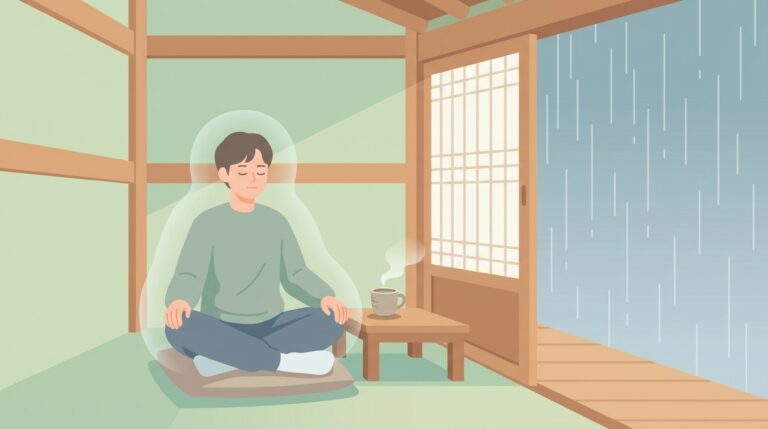
Setting: Friday evening, 8 PM. A minimalist, dimly lit tea house in Bukchon Hanok Village. Rain is softly tapping against the traditional tiled roof. You are sitting on a floor cushion across from your close Korean friend and mentor, Ji-an, who brought you here after noticing you have been having panic attacks due to your high-stress job in Seoul.
Characters:
– YOU: A foreign professional working in Seoul. You speak fluent Korean (C2) but have been overwhelmed by the pressure to be perfect.
– Ji-an (34): Your Korean friend. Calm, perceptive, and practices mindfulness.
Dialogue:
Ji-an: 요즘 회사 일 때문에 많이 힘들지? 얼굴이 반쪽이 됐어.
(Yojeum hoesa il ttaemune mani himdeulji? Eolguri banjjogi dwaesseo.)
[You’ve been having a hard time with work lately, right? You’ve lost so much weight (Literal: Your face has become half).]
YOU: 어… 솔직히 말하면, 밤에 잠을 잘 못 자. 계속 심장이 뛰고 불안해서.
(Eo… soljiki malhamyeon, bame jameul jal mot ja. Gyesok simjangi ttwigo buranhaeseo.)
[Yeah… honestly, I can’t sleep well at night. My heart keeps racing and I feel anxious.]
Ji-an: 그럴 땐 억지로 자려고 하지 말고, 그냥 그 불안한 마음을 알아차림 해보는 건 어때?
(Geureol ttaen eokjiro jaryeogo haji malgo, geunyang geu buranhan maeumeul aracharim haeboneun geon eottae?)
[When that happens, don’t force yourself to sleep. How about just practicing ‘awareness’ of that anxious feeling?]
YOU: 알아차림? 그냥 가만히 내버려 두라는 거야?
(Aracharim? Geunyang gamanhi naebeoryeo duraneun geoya?)
[Awareness? You mean just leave it alone?]
Ji-an: 응. ‘아, 내가 지금 불안하구나’ 하고 제3자처럼 바라보는 거지. 완벽해야 한다는 강박을 이제 좀 내려놓을 때가 된 것 같아.
(Eung. ‘A, naega jigeum buranhaguna’ hago jesamjacheoreom baraboneun geoji. Wanbyeokhaeya handaneun gangbageul ije jom naeryeonoeul ttaega doen geot gata.)
[Yeah. Like a third party observing, ‘Ah, I am feeling anxious right now.’ I think it’s time you ‘let go’ of the obsession to be perfect.]
🔀 Your Turn! How do you respond?
– A) “알겠어. 내일부터 무조건 완벽하게 명상할게!” (I got it. From tomorrow, I will meditate perfectly no matter what!)
– B) “내려놓는 게 말처럼 쉽지 않네. 그래도 숨 쉬는 것부터 해볼게.” (Letting go isn’t as easy as it sounds. But I’ll start with just breathing.)
– C) “아 몰라, 그냥 멘탈 다 털렸어. 술이나 마시자!” (Ah, whatever, my mental is totally wrecked. Let’s just drink!)✅ Best Choice: B — Reason: It acknowledges the difficulty of letting go but shows a willingness to try in a healthy way. It fits the C2 level of nuanced emotional expression.
⚠️ Choice A Analysis: This is a paradox! Trying to be “perfect” at meditation defeats the purpose of letting go. Ji-an would probably sigh.
⚠️ Choice C Analysis: While natural for venting (using the slang 멘탈 털렸어), it avoids the deeper healing conversation Ji-an is trying to offer.
Phase 6: 10-Second Shadowing Drill
Let’s practice the cadence of a Korean meditation guide. The tone should be incredibly soothing, slow, and soft.
😌 깊게 / 숨을 / 들이마시고… (gipge / sumeul / deurimasigo…)
🍃 천천히 / 내쉽니다. (cheoncheonhi / naeswimnida.)
🧘♀️ 지금 / 이 순간에 / 온전히 / 머무릅니다. (jigeum / i sungane / onjeonhi / meomureumnida.)
Guide: Pause at the slashes (/). Elongate the last syllables softly. The energy should drop into your belly.
Phase 7: K-Culture Mini Dictionary
1. 화병
* Romanization: Hwabyeong
* English: A culturally bound syndrome of internalized anger/stress.
* Context: Literally “fire disease.” A medically recognized condition in Korea historically caused by suppressing anger to maintain social harmony (Confucian values). Modern mental health practices directly aim to cure this.
2. 멍때리기
* Romanization: Meong-ttaerigi
* English: Zoning out / Spacing out.
* Context: Once scolded by teachers, it is now celebrated as a brain-resetting tool. Seoul even hosts an annual “Space-out Competition” (멍때리기 대회) where the person with the steadiest heart rate wins!
3. 마음의 감기
* Romanization: Maeumui gamgi
* English: The common cold of the mind (Euphemism for depression/anxiety).
* Context: To reduce the stigma of psychiatric disorders, Korean media and doctors started calling depression/anxiety “a cold of the mind.” It implies that anyone can catch it, and with rest and treatment, anyone can recover.
4. 소확행
* Romanization: Sohwakhaeng
* English: Small but certain happiness.
* Context: A lifestyle trend where people stop stressing over massive life goals (buying a house in Seoul) and find mindful joy in small things, like a perfectly brewed cup of tea or petting a cat.
Phase 8: Traveler Survival Kit (Wellness Retreat Edition)
If you are traveling in Korea to find peace, whether at a Temple Stay or a meditation studio, here are the top phrases you need.
🆘 Survival Phrases
– 🇰🇷 “명상 프로그램 예약할 수 있을까요?” (myeongsang peurogeuraem yeyakhal su isseulkkayo?)
– 🗣️ English: Can I book a meditation program?
– 📍 Where to use: Temple Stay offices, wellness centers in Jeju Island or Seoul.
- 🇰🇷 “카페인 없는 따뜻한 차 있나요?” (kapein eomneun ttatteutan cha innayo?)
- 🗣️ English: Do you have warm caffeine-free tea?
- 📍 Where to use: Traditional tea houses when you need to calm your nervous system.
🇰🇷 “잠시 혼자 조용히 있어도 될까요?” (jamsi honja joyonghi isseodo doelkkayo?)
- 🗣️ English: Would it be okay if I stay quietly by myself for a moment?
- 📍 Where to use: When traveling with intense Korean tour groups or friends and you need to set a boundary for your mental space.
📌 Editor’s Travel Note
– Finding Quiet: Korea is loud. If you suffer from sensory overload, seek out traditional Hanok cafes in off-peak hours, or visit royal palaces (like Changdeokgung’s Secret Garden) which strictly limit visitor numbers.
– Apps: Download the “Temple Stay” app. It has English support and allows you to book retreats categorized by “Relaxation” (휴식형) or “Experiential” (체험형). If you have anxiety, choose Relaxation!
Phase 9: Critical Thinking — “One Step Deeper”
🧠 Think Deeper: Media vs Reality in Korea’s Healing Culture
In recent years, K-Dramas and K-Pop idols have beautifully championed the 힐링 (Healing) culture, openly discussing panic disorders and anxiety. This media representation is incredibly powerful. However, as C2 learners, we must look at the dichotomy between this aestheticized healing and the stark reality. South Korea still battles one of the highest stress and suicide rates in the OECD. The rapid rise of aesthetic meditation cafes and “spacing out” retreats is, in a way, a desperate commercial response to a society that structurally refuses to slow down. True mental care (마음챙김) requires systemic changes in work hours and social safety nets, not just a weekend Temple Stay. Are we treating the symptom (through trendy healing cafes) or the disease (the hyper-competitive society)?💬 Your Turn: How does your culture view the balance between structural societal pressure and individual “mindfulness” practices? Let us know in the comments!
Phase 10: FAQ & Avoiding Misunderstandings
Q: Can I casually tell a Korean coworker, “나 우울증이야” (I have depression)?
* Editor’s Advice: Be careful. While the stigma is fading, the word 우울증 (clinical depression) or 정신과 (psychiatric ward) can still carry heavy weight with older generations. If you want to express temporary anxiety or feeling down without causing alarm, use 요즘 마음이 좀 답답해요 (My mind feels a bit heavy/stifled lately) or 번아웃이 온 것 같아요 (I think I’ve hit burnout).
Q: At a Temple Stay, do I have to use highly formal language with the monks?
* Editor’s Advice: Yes. Always use 합장 (Hapjang – bringing your hands together at the chest) and bow slightly. Use standard honorifics (존댓말). You call a monk 스님 (Seunim).
❌ Common Mistake #1: Confusing ‘mindfulness’ with ‘emptying the mind’ completely. Do not say “마음을 버리다” (Throw away the mind – this sounds like going crazy!).
✅ Do this instead: Use 마음을 비우다 (To empty the mind of greed/stress) or 내려놓다 (To let go).
Phase 11: Summary & Action Items
One-Liner Summary: True healing in Korean culture is shifting from taking care of others to taking care of oneself through 마음챙김 (mindfulness) and 내려놓음 (letting go).
Action Mission 3 Steps:
– 🥉 Bronze (Solo): Tonight, close your eyes, take a deep breath, and whisper to yourself: “불안을 알아차리고, 내려놓습니다.” (I notice the anxiety, and I let it go.)
– 🥈 Silver (Online): Write a 3-sentence diary entry in Korean about one small thing that brought you peace today (your 소확행), using the word 마음챙김.
– 🥇 Gold (Real World): Visit a quiet space (a park, a museum, or a temple if you are in Korea) and practice 10 minutes of 멍때리기 without your phone!
K-Culture Mission:
Find a K-Drama that deals with mental health (like It’s Okay to Not Be Okay or Daily Dose of Sunshine). Watch one episode and listen closely for the words 위로 (comfort), 호흡 (breath), or 내려놓다. Notice how the tone of voice drops an octave when these words are spoken!
Phase 12: Quiz — Interactive Challenge
1. Situational Judgment:
You are feeling overwhelmed with Korean language studies and life in general. You want to tell your close Korean friend that you need to stop obsessing over being perfect and just relax. What is the most natural, C2-level phrase to use?
* A) 완벽주의를 파괴할 거야.
* B) 이제 좀 내려놓으려고.
* C) 마음을 쓰레기통에 버릴게.
2. True or False – K-Culture Edition:
In modern Korea, “spacing out” (멍때리기) is strictly viewed as a sign of laziness and is heavily punished in all social settings. (T/F)
3. Fill in the Blank:
When we meditate, we do not judge our thoughts. We simply practice _________ (noticing/awareness).
* “내 감정에 대한 _________이 필요해.”
(Highlight the blank space below to see the answers!)
[ Answers: 1. B (Letting go), 2. False (It is now a popular wellness trend!), 3. 알아차림 ]
Frequently Asked Questions (FAQ)
Q: What does "알아차림" mean in Korean and how do you pronounce it?
A: In Korean, "알아차림" is pronounced [aracharim (The 'a' sounds like a soft 'ah', and the 'cha' is lightly aspirated like cha-cha-cha. The 'rim' rolls off the tongue.] and means: Literal = The act of knowing and preparing; Real nuance = Mindfulness, Awareness, or 'Noticing' (in a non-judgmental, meditative context).
Q: What does "마음챙김" mean in Korean and how do you pronounce it?
A: In Korean, "마음챙김" is pronounced [maeumchaenggim (ma-eum sounds like 'mah-um', chaeng-gim sounds like a gentle chime.] and means: Literal = Mind-packing / Mind-caring; Real nuance = Mindfulness.
Q: What does "내려놓음" mean in Korean and how do you pronounce it?
A: In Korean, "내려놓음" is pronounced [naeryeonoeum (nae-ryeo sounds like 'neh-ryuh', no-eum flows together softly.] and means: Literal = Putting something down; Real nuance = Letting go, relinquishing control, or surrendering the ego.







