

Phase 1: Empathy
Hello! I am the lead editor of Daily Hangul.
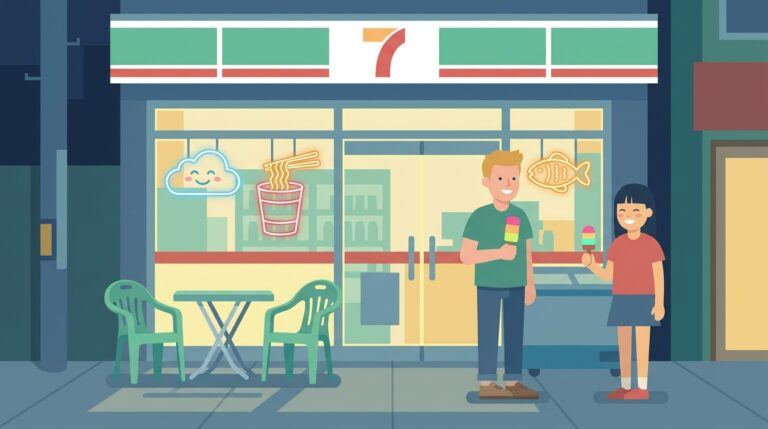
Picture this: You are watching your favorite K-Drama. The main characters just had a massive argument, but then they sit on those little plastic chairs outside a Korean convenience store (CVS). They silently share a green Melona ice cream bar, and suddenly, everything is forgiven.
Now, you are finally in Seoul! It is a hot summer night, you just ate some spicy Tteokbokki, and you step into a GS25 or CU. The freezer is a magical wonderland of colorful ice creams. But wait… there are tags everywhere saying 1+1 and 2+1. The cashier says something super fast, pointing back at the freezer. You freeze. Did you do something wrong?
Do not worry! As an A1 beginner, convenience stores are the best places to practice real-life survival Korean. By the end of this guide, you will know exactly how to grab that sweet deal and walk out like a true Seoul local. This guide is based on real moments my beginner students experienced during their first trips to Korea!
Phase 2: Core Expressions Deep Dive
1. 이거 얼마예요? (How much is this?)
- Pronunciation: igeo eolmayeyo? [EE-guh UHL-mah-yeh-yo?]
- Meaning: How much is this thing?
- K-Culture Moment: You find an ice cream with no price tag. Instead of awkwardly guessing if you have enough cash, you can just hold it up and ask this magic phrase.
- Editor’s Insight: This is the most powerful sentence in Korea. You can use it at the CVS, street markets, or underground malls. It sounds polite but very natural.
- Situation Spectrum:
- Casual with friends: ⚠️ (Use 이거 얼마야? instead)
- Semi-formal (Cashier/Staff): ✅
- Formal (Elders/Boss): ✅
- 🤔 Think About It: Why is it so important to ask prices? In Korea, CVS prices are fixed, but street markets are not. Asking confidently shows you are an informed traveler!
2. 투플러스원 맞아요? (Is this 2+1?)
- Pronunciation: tu-peul-leo-seu-won majayo? [TOO-peul-luh-seu-wuhn MAH-jah-yo?]
- Meaning: Is this Two-Plus-One? (Buy 2, get 1 free)
- K-Culture Moment: You grab two ice cream cones. The cashier points at the freezer. They want you to know it is a 2+1 deal! You can ask this to confirm before running back to grab your free ice cream.
- Editor’s Insight: Koreans literally say the English words Two-Plus-One but with a Korean accent. If it is Buy 1 Get 1 Free, they say 원플러스원 (won-peul-leo-seu-won) or just 원플원 (won-peul-won) for short!
- Situation Spectrum:
- Casual with friends: ✅
- Semi-formal (Cashier/Staff): ✅
- Formal (Elders/Boss): ✅
- 🤔 Think About It: Why do Korean stores love 2+1 deals instead of just lowering the price? It encourages sharing! In Korea, giving food is a way of showing affection (Jeong).
3. 봉투 필요 없어요. (I do not need a bag.)
- Pronunciation: bongtu piryo eopseoyo. [BOHNG-too PEE-ryoh UHP-suh-yo.]
- Meaning: Bag need do-not-have. (I do not need a bag.)
- K-Culture Moment: You are buying a single ice cream to eat right outside on those drama-famous plastic chairs. The cashier holds up a plastic bag with a questioning look. You wave your hand and say this.
- Editor’s Insight: By law, Korean convenience stores must charge 20 to 50 won for a plastic bag. Save the earth and your coins by carrying it out!
- Situation Spectrum:
- Casual with friends: 🚫 (You wouldn’t say this to a friend)
- Semi-formal (Cashier/Staff): ✅
- Formal (Elders/Boss): ✅
Phase 3: Textbook vs. Real Korean
Situation 1: Asking about a discount or promotion
* 📖 Textbook Korean: 할인이 됩니까? (Is a discount applied?)
* 🗣️ Real Korean: 이거 원플원이에요? (Is this 1+1?)
* 💡 Why the difference?: Koreans love efficiency. They shorten English words to make fast, trendy slang. 원플원 (Won-peul-won) is much faster to say!
Situation 2: Telling the cashier you do not need a plastic bag
* 📖 Textbook Korean: 비닐봉지를 주지 않으셔도 됩니다. (You do not have to give me a plastic bag.)
* 🗣️ Real Korean: 그냥 들고 갈게요. (I will just carry it as it is.)
* 💡 Why the difference?: Real Korean is all about action. Simply stating what you will do (I will carry it) sounds much more natural and friendly.
Bottom Note: For A1 beginners, it is perfectly fine to just use body language and say 아니요, 괜찮아요 (No, it is okay) when they offer a bag!
Phase 4: Cultural Context — K-Culture Deep Dive
4-1. Non-verbal Elements: The Two-Handed Handover
In Korea, hands matter! When you hand your credit card or cash to the cashier for your ice cream, try to use two hands. If your other hand is full, lightly place your left hand on your right elbow or lower arm while handing the card over. It is a tiny gesture, but the cashier will instantly think, Wow, this foreigner knows our manners!
4-2. K-Drama Connection: The Convenience Store Therapy
Have you noticed that K-Drama characters never eat ice cream inside their big houses? When they are sad, stressed, or secretly in love, they always go to the convenience store. They sit on the green plastic chairs outside, peeling the wrapper off a Popsicle (하드).
In real Korea, this is exactly what we do. After a heavy Korean BBQ dinner with coworkers (Hoesik), it is almost a rule for the youngest person or the boss to say, 아이스크림 먹으러 가자! (Let’s go eat ice cream!). It is a cheap, sweet way to extend the night and have deep conversations away from the noisy restaurant.
Phase 5: Real-Life Roleplay Scenario
Setting: Friday, 10:30 PM. Outside a CU convenience store in Hongdae. You just had spicy chicken with your Korean friend, Min-su. Your mouth is burning.
Characters:
* YOU: A traveler visiting Seoul. You love sweets.
* Min-su (28): Your friendly Korean language exchange partner.
* Cashier: A busy university student working the night shift.
Min-su: 아, 맵다! 우리 아이스크림 먹을까?
(ah, maepda! uri aiseukeurim meogeulkka?)
[Ah, spicy! Should we eat ice cream?]
YOU: 좋아요! 매운 거 먹고 단 거 먹어야죠.
(joayo! maeun geo meokgo dan geo meogeoyajyo.)
[Sounds good! After eating spicy, we must eat sweet.]
Min-su: (Opening the freezer) 뭐 먹을래? 내가 살게!
(mwo meogeullae? naega salge!)
[What do you want to eat? I will buy it!]
YOU: 음… 메로나! 이거 얼마예요?
(eum… merona! igeo eolmayeyo?)
[Um… Melona! How much is this?]
Min-su: 천이백 원. 근데 그거 투플러스원(2+1)이야. 하나 더 가져와!
(cheonibaek won. geunde geugeo tu-peul-leo-seu-won-iya. hana deo gajyeowa!)
[1,200 won. But that is 2+1. Go bring one more!]
🔀 Your Turn! How do you reply?
* A) 진짜요? 그럼 제가 하나 더 고를게요! (Really? Then I will pick one more!)
* B) 아니요, 배불러요. 두 개만 살게요. (No, I am full. I will just buy two.)
* C) 그냥 제가 계산할게요! (I will just pay!)
✅ Best Choice: A.
In Korea, refusing a free 2+1 item is a missed opportunity! Plus, since Min-su offered to pay, happily picking the bonus item shows you are enjoying his treat.
⚠️ Choice B Analysis: Paying for two when the third is free means you are losing money! You always get the 3rd one and save it for later, or give it to the cashier as a nice gesture!
Phase 6: 10-Second Shadowing Drill
Practice this sentence out loud. Follow the slashes for natural pausing!
😊 밝게 (Brightly): 이거 / 투플러스원 / 맞아요?
(igeo / tu-peul-leo-seu-won / majayo?)
🙅♂️ 단호하게 (Firmly but politely): 아니요 / 봉투 / 필요 없어요.
(aniyo / bongtu / piryo eopseoyo.)
Phase 7: K-Culture Mini Dictionary
1. 편의점
* Romanization: pyeonuijeom
* English: Convenience Store
* Context: Korea’s 24/7 lifesavers. GS25, CU, 7-Eleven, and Emart24 are everywhere. They are not just stores; they are mini-restaurants, package delivery centers, and ATMs.
2. 투플원 / 원플원
* Romanization: tu-peul-won / won-peul-won
* English: 2+1 / 1+1
* Context: Buy two get one free, or Buy one get one free. Look for the little tags sticking out under the products!
3. 하드
* Romanization: hadeu
* English: Popsicle / Ice bar
* Context: Derived from the English word hard. It refers to ice cream on a stick, like the famous Melona bar.
4. 눈치
* Romanization: nunchi
* English: Situational awareness / Reading the room
* Context: If there is a long line behind you at the convenience store, having good nunchi means having your card ready so you do not hold up the line!
Phase 8: Traveler Survival Kit
Are you planning a trip to Korea soon? Save these crucial phrases to your phone.
🆘 Survival Expression #1
* 🇰🇷 이거 하나에 얼마예요? (igeo hana-e eolmayeyo?)
* 🗣️ English Guide: EE-guh HAH-nah-eh UHL-mah-yeh-yo?
* 📍 Where to use: Anytime you want to know the price of a single item, especially when confusing 2+1 tags are everywhere.
🆘 Survival Expression #2
* 🇰🇷 영수증 버려주세요. (yeongsujeung beoryeojuseyo.)
* 🗣️ English Guide: YUHNG-soo-jeung BUH-ryuh-joo-seh-yo.
* 📍 Where to use: When the cashier prints the receipt and you do not want it. (Please throw away the receipt).
📌 Editor’s Travel Note
* Payment: Korea is a card-heavy society. You can buy a 1,000 won ice cream with a credit card. No cash needed!
* T-Money: Did you know you can pay for CVS snacks using your T-Money subway card? It is super convenient!
* Trash: There are usually trash cans right outside or inside the convenience store to throw away your ice cream wrapper.
Phase 9: Critical Thinking Corner — One Step Deeper
🧠 Think Deeper: Food & Identity
Why are Korean convenience store tables so popular, and why do 2+1 deals exist for almost every snack? In Korea, eating alone was historically considered sad or lonely. Food is meant to be shared. The 2+1 marketing strategy perfectly targets the Korean cultural concept of Jeong (정)—a feeling of deep connection and affection. When you buy a snack, it feels natural to hand the extra +1 item to your friend, coworker, or even the person you just met. It is a small investment to build a relationship.
💬 Your Turn: Does your country have Buy 1 Get 1 Free deals at convenience stores? How do people usually eat snacks in your culture? Share in the comments!
Phase 10: FAQ & Mistake Prevention
Q: Can I mix and match flavors for a 2+1 deal?
Yes! Usually, if the price is exactly the same and the brand is the same, you can mix flavors (e.g., two strawberry milks and one banana milk). The cashier’s register will automatically calculate it.
Q: Is it rude to eat inside the convenience store?
Not at all! Most stores have a small counter facing the window specifically for eating. Just remember to clean up your trash.
❌ Common Mistake #1: Taking only two items for a 2+1 deal.
✅ Do this instead: The cashier might say 하나 더 가져오세요 (Please bring one more). If you only want two, you will still be charged the price of two. You might as well grab the free third one!
❌ Common Mistake #2: Tipping the cashier.
✅ Do this instead: There is absolutely no tipping culture in Korea. If you leave coins on the counter, the cashier will run outside to give them back to you!
Phase 11: Summary & Action Items
One-Liner Summary: Next time you are at a Korean convenience store, spot the 2+1 deals, ask 이거 얼마예요?, and enjoy your ice cream like a true local!
🎯 Action Missions:
* 🥉 Bronze (Solo): Stand in front of a mirror and say 투플러스원 맞아요? out loud 3 times with confidence.
* 🥈 Silver (Online): Find a Korean snack in your local Asian market. Imagine you are buying it in Seoul and practice today’s phrases in your head.
* 🥇 Gold (Real Life): Go to a local Korean grocery store, buy an ice cream, and politely say 봉투 필요 없어요 at the counter!
🌟 K-Culture Mission:
Watch one episode of any modern K-Drama this week. I guarantee you will spot a convenience store scene. Try to pause and see if they are eating a Popsicle (하드) or ramen!
Phase 12: Quiz — Interactive Challenge
Test your new survival skills!
1. Situation Judgment: You pick up a chocolate ice cream. The tag says 1+1. You go to the counter with only ONE ice cream. What will the cashier most likely say?
* A) 영수증 필요하세요? (Do you need a receipt?)
* B) 하나 더 가져오세요. (Please bring one more.)
* C) 안녕히 가세요. (Goodbye.)
2. True or False: You must pay with cash if the ice cream is very cheap (like 1,000 won).
* True / False
3. Fill in the Blank:
You do not want a plastic bag.
봉투 _____ 없어요.
* A) 얼마
* B) 필요
* C) 맞아요
Answers:
1. B (Because it is 1+1, they will kindly tell you to go grab your free second item!)
2. False (Korea is almost entirely cashless. Cards are perfectly fine for tiny amounts!)
3. B (봉투 필요 없어요 – I do not need a bag.)
Frequently Asked Questions (FAQ)
Q: What does "이거 얼마예요? (How much is this?)" mean in Korean and how do you pronounce it?
A: In Korean, "이거 얼마예요? (How much is this?)" is pronounced [igeo eolmayeyo? [EE-guh UHL-mah-yeh-yo?] and means: How much is this thing?
Q: What does "투플러스원 맞아요? (Is this 2+1?)" mean in Korean and how do you pronounce it?
A: In Korean, "투플러스원 맞아요? (Is this 2+1?)" is pronounced [tu-peul-leo-seu-won majayo? [TOO-peul-luh-seu-wuhn MAH-jah-yo?] and means: Is this Two-Plus-One? (Buy 2, get 1 free)
Q: What does "봉투 필요 없어요. (I do not need a bag.)" mean in Korean and how do you pronounce it?
A: In Korean, "봉투 필요 없어요. (I do not need a bag.)" is pronounced [bongtu piryo eopseoyo. [BOHNG-too PEE-ryoh UHP-suh-yo.] and means: Bag need do-not-have. (I do not need a bag.)







