

Hello! Daily Hangul Editor here.
Have you ever watched a K-Drama where the wealthy villain or the struggling protagonist receives an envelope, and suddenly, the background music turns incredibly ominous? The camera zooms in on the stark black text and a red stamp. The character’s hands tremble. That envelope isn’t just a simple letter; it is a Naeyong Jeungmyeong (내용증명), or a Contents Certification.
As a C2-level Korean learner and someone navigating adult life in South Korea, you are past the stage of just ordering iced Americanos. You might be signing a housing lease, investing in a business, or freelancing. But what happens when a landlord refuses to return your massive Jeonse (전세) deposit, or a client ghosts you without paying? In Korea, you don’t jump straight to a lawsuit. You send a Naeyong Jeungmyeong.
This isn’t just a legal document; it is a cultural and psychological weapon. It politely but firmly screams, Fix this, or see you in court. Today, we are diving deep into the legal, linguistic, and cultural nuances of drafting this powerful document. This guide is based on real-world experiences of expats who had to fight for their rights in Seoul.
Phase 2: Core Expressions Deep Dive
Here are the three heavy-hitting expressions you must master when dealing with legal disputes and drafting a Contents Certification in Korea.
1. 내용증명 (Contents Certification)
- Pronunciation: [naeyong jeungmyeong] (Sounds like: nay-yong jeung-myung)
- Meaning: Literal: Content proof. Real nuance: A certified formal warning letter sent via the post office.
- K-Culture Moment: In the drama Vincenzo, legal documents flying back and forth act as declarations of war. When a Naeyong Jeungmyeong lands on a desk, it means the talking phase is over. The sender has officially started a legal paper trail.
- Editor’s Insight: This document doesn’t instantly freeze assets or send someone to jail. Its true power is psychological pressure. The Korean Post Office keeps a copy for three years, proving exactly what was said and when it was delivered. It eliminates the opponent’s ability to say, I never got the notice.
- Situation Spectrum:
- Casual friends: 🚫
- Semi-formal colleagues: ⚠️
- Formal/Legal/Business: ✅
- 🤔 Think About It: Korea is a highly relational society where maintaining social harmony (기분, Gibun) is crucial. Why do Koreans use this formal postal method instead of just confronting someone directly? How does your culture handle the step right before a lawsuit?
2. 전세보증금 반환 (Return of Jeonse Deposit)
- Pronunciation: [jeonse-bojeunggeum banhwan] (Sounds like: jeon-seh bo-jeung-geum ban-hwan)
- Meaning: Return of the housing lease deposit.
- K-Culture Moment: Turn on any Korean news channel, and you will hear about Jeonse fraud (전세 사기). It is a uniquely Korean system where you give a massive lump sum to the landlord instead of monthly rent. Getting this money back at the end of the contract is the #1 reason foreigners and locals alike must send a Naeyong Jeungmyeong.
- Editor’s Insight: You never use this casually. When writing your document, you state: I formally request the return of my Jeonse deposit by X date. It must sound completely objective and devoid of emotion.
- Situation Spectrum:
- Casual friends: 🚫
- Semi-formal colleagues: 🚫
- Formal/Legal/Business: ✅
- 🤔 Think About It: Language shapes reality. Because the Jeonse system exists only in Korea, there is an entire vocabulary dedicated to it. What unique financial vocabulary exists in your mother tongue that doesn’t translate well?
3. 법적 조치를 취하다 (To take legal action)
- Pronunciation: [beopjeok jochireul chwihada] (Sounds like: beop-jeok jo-chi-reul chwi-ha-da)
- Meaning: Literal: To take legal measures. Real nuance: I will sue you, attach your assets, and hold you liable.
- K-Culture Moment: The classic corporate boardroom scene where the CEO adjusts their tie and calmly delivers this line, sending chills down the opponent’s spine.
- Editor’s Insight: This is the punchline of your Naeyong Jeungmyeong. You don’t say I’m going to call the police. You use this sophisticated, chillingly polite phrase to wrap up your letter.
- Situation Spectrum:
- Casual friends: 🚫
- Semi-formal colleagues: ⚠️
- Formal/Legal/Business: ✅
- 🤔 Think About It: Notice the verb 취하다 (to take/adopt). It sounds much more calculated and deliberate than simply doing something. Why is bureaucratic language designed to sound so detached?
Phase 3: Textbook vs. Real Korean
Let’s compare what you might have learned in advanced grammar classes with the actual bureaucratic language (문어체) required for legal documents.
[Requesting your money back]
* 📖 Textbook Korean: 제 돈을 빨리 돌려주시기 바랍니다. (Please return my money quickly.)
* 🗣️ Real Korean (Legal): 정해진 기한 내에 미반환 시, 민형사상 책임을 물을 것입니다. (If not returned by the designated deadline, civil and criminal liability will be pursued.)
* 💡 Why is it different?: Legal documents rely heavily on Sino-Korean (Hanja) words like 미반환 (non-return) and 민형사상 (civil and criminal). It removes the personal I and You, replacing it with objective consequences.
[Stating the facts of a broken promise]
* 📖 Textbook Korean: 당신이 약속을 안 지켰잖아요. (You didn’t keep your promise.)
* 🗣️ Real Korean (Legal): 귀하는 본 계약의 의무를 불이행하였습니다. (You have defaulted on the obligations of this contract.)
* 💡 Why is it different?: 귀하 (You – highly formal written form) and 불이행 (non-performance/default) are emotionally detached. In Korean legal contexts, showing anger weakens your professional stance. Cold logic wins.
Phase 4: Cultural Context — K-Culture Deep Dive
4-1. The Non-verbal Weight of the Red Stamp
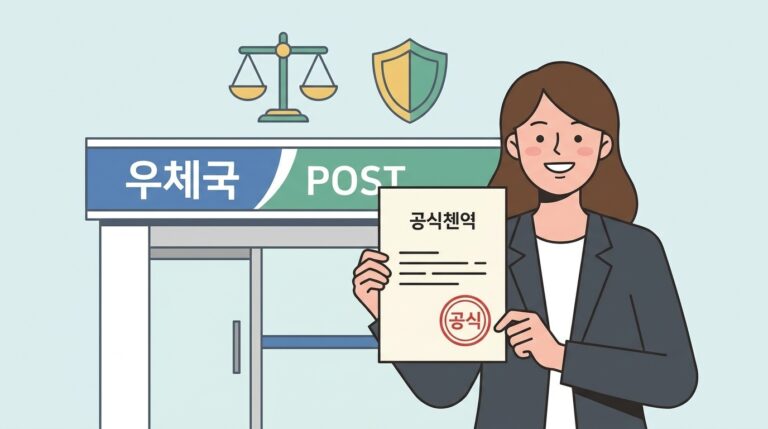
In Korea, drafting the document is only half the battle. The physical act of taking it to the Post Office (우체국) is where the magic happens. You must print exactly three identical copies: one for you, one for the recipient, and one for the post office to keep on record for three years. The postal worker will stamp them with a red official seal. In a highly digital country like Korea, the physical weight of this registered paper mail carries immense psychological gravity.
4-2. K-Drama Connection: The Illusion of Speed
In legal K-Dramas like Extraordinary Attorney Woo, lawsuits seem to happen overnight. A character sends a Naeyong Jeungmyeong, and the next day they are in court slamming gavels.
Critical Perspective: Reality is painfully slow. A civil lawsuit in Korea can take 6 months to 2 years. This is exactly why the Naeyong Jeungmyeong exists! It is a strategic move to scare the other party into settling (합의) out of court, avoiding the excruciatingly slow and expensive legal system. It is less about going to court and more about proving you are willing to go to court.
Phase 5: Real-life Roleplay Scenario
Setting: A quiet, upscale cafe in Gangnam on a Saturday afternoon. You are sitting across from your Korean friend, Ji-hoon, who happens to be a corporate lawyer. You are stressed because your lease is ending, you want to move out, and your landlord has been ignoring your calls for a month.
Characters:
– YOU: An expat who has lived in Seoul for 5 years, fluent in Korean but navigating legal waters for the first time.
– Ji-hoon (34): Your lawyer friend. Sharp, practical, and highly strategic.
Dialogue:
YOU: 지훈아, 나 진짜 스트레스 받아. 집주인이 내 연락을 계속 피해. 😩
(Jihun-a, na jinjja seuteureseu bada. Jipju-ini nae yeollageul gyesok pihae.)
[Ji-hoon, I’m so stressed. My landlord keeps dodging my calls.]
Ji-hoon: 계약 만료가 언제지? 한 달 남았나?
(Gyeyang mallyoga eonjeji? Han dal namanna?)
[When does the contract expire? A month left?]
YOU: 어, 다음 달 15일. 보증금 못 받을까 봐 너무 불안해.
(Eo, da-eum dal sibo-il. Bojeunggeum mot badeulkka bwa neomu buranhae.)
[Yeah, the 15th of next month. I’m so anxious I won’t get my deposit back.]
Ji-hoon: 전화 그만해. 증거가 안 남아. 바로 ‘내용증명’부터 보내.
(Jeonhwa geumanhae. Jeunggeoga an nama. Baro ‘naeyong-jeungmyeong’-buteo bonae.)
[Stop calling. It leaves no evidence. Send a ‘Contents Certification’ right away.]
YOU: 내용증명? 그거 변호사 통해서 보내야 하는 거 아니야? 비싸잖아.
(Naeyong-jeungmyeong? Geugeo byeonhosa tonghaeseo bonaeya haneun geo aniya? Bissajana.)
[A Contents Certification? Don’t I have to send that through a lawyer? That’s expensive.]
Ji-hoon: 아니야. 네가 직접 써도 법적 효력은 똑같아. 그냥 우체국 가서 보내면 돼.
(Aniya. Nega jikjeop sseodo beopjeok hyoryeogeun ttokgata. Geunyang ucheguk gaseo bonaemyeon dwae.)
[No. Even if you write it yourself, the legal effect is the same. You just go to the post office and send it.]
YOU: 아, 진짜? 그럼 뭐라고 써야 해? 욕 써도 돼? 🤬
(A, jinjja? Geureom mworago sseoya hae? Yok sseodo dwae?)
[Oh, really? Then what should I write? Can I swear?]
Ji-hoon: 절대 안 돼! 육하원칙에 맞춰서 객관적인 사실만 써야 해. 감정 빼고.
(Jeoldae an dwae! Yukawonchige matchwoseo gaekgwanjeogin sasilman sseoya hae. Gamjeong ppaego.)
[Absolutely not! You must write only objective facts based on the 5Ws and 1H. Leave emotions out.]
🔀 Your Turn! How should you set the deadline for the landlord?
– A) 최대한 빨리 보증금을 돌려주시기 바랍니다. (Please return it as soon as possible.)
– B) 202X년 X월 X일까지 보증금을 반환하시기 바랍니다. (Please return the deposit by Date/Month/Year.)
– C) 보증금 주실 때까지 이사 안 갑니다. (I won’t move until you give me the deposit.)✅ Best Choice: B — Reason: Legal documents require pinpoint accuracy. ‘As soon as possible’ (A) has no legal standing. You must give a specific, reasonable date (usually 1-2 weeks from the date of the letter) so that if they fail, you can immediately trigger the next legal step.
Ji-hoon: 맞아, 정확한 날짜를 명시해야 해. 그리고 마지막엔 ‘법적 조치를 취하겠다’고 쓰면 돼.
(Maja, jeonghakan naljjareul myeongsihaeya hae. Geurigo majimagen ‘beopjeok jochireul chwihagetda’go sseumyeon dwae.)
[Exactly, you must specify the exact date. And at the end, just write that you will ‘take legal action.’]
YOU: 완벽해. 오늘 당장 우체국 간다. 고마워!
(Wanbyeokhae. Oneul dangjang ucheguk ganda. Gomawo!)
[Perfect. I’m going to the post office right now. Thanks!]
Phase 6: 10-Second Shadowing Drill
Channel your inner highly-paid corporate lawyer. Speak clearly, coldly, and with absolute authority.
😤 정해진 기한 내에 / 보증금을 반환하지 않으실 경우, / 민형사상 / 법적 조치를 취하겠습니다.
(jeonghaejin gihan nae-e / bojeunggeumeul banhwanhaji aneulsil gyeong-u, / minhyeongsasang / beopjeok jochireul chwihagetseumnida.)
Focus on hitting the sharp consonants in 법적 조치 (beop-jeok jo-chi) to sound assertive!
Phase 7: K-Culture Mini Dictionary
1. 내용증명
* Romanization: naeyong jeungmyeong
* English: Contents Certification
* Context: The official postal service that certifies the contents and delivery of a document. The ultimate warning shot in Korean society.
2. 전세
* Romanization: jeonse
* English: Key money deposit lease
* Context: A unique Korean real estate system requiring a massive deposit instead of monthly rent. The root cause of many civil disputes for expats.
3. 우체국
* Romanization: ucheguk
* English: Post Office
* Context: Beyond shipping packages, the Korean post office handles banking, insurance, and legal certifications. It is an administrative powerhouse.
4. 합의
* Romanization: habeui
* English: Settlement / Mutual agreement
* Context: The true goal of sending a Naeyong Jeungmyeong. Koreans prefer to reach a ‘habeui’ rather than endure a years-long court battle.
Phase 8: Traveler & Expat Survival Kit
If you are living in Korea, dealing with administrative tasks is inevitable. Here is your survival kit for the Post Office.
🆘 Survival Expressions at the Post Office
– 🇰🇷 내용증명 보내려고 하는데요. (naeyong jeungmyeong bonaeryeogo haneundeyo.)
– 🗣️ English: I would like to send a Contents Certification.
– 🇰🇷 세 부 다 가져왔습니다. (se bu da gajyeowatseumnida.)
– 🗣️ English: I brought all three copies.
– 🇰🇷 등기번호 영수증 주세요. (deunggi-beonho yeongsujeung juseyo.)
– 🗣️ English: Please give me the receipt with the tracking number.📌 Editor’s Life Note
– 3 Copies Rule: You MUST bring exactly 3 physical copies of your letter. The post office does not print them for you for free.
– Internet Post Office: If you have a Korean digital certificate, you can send an e-Naeyong Jeungmyeong via the Internet Post Office (epost.go.kr) without leaving your house!
– Keep the Receipt: The tracking number (등기번호) is your proof that it arrived. Track it online and screenshot the delivery confirmation.
Phase 9: Critical Thinking Corner — A Step Deeper
🧠 Think Deeper: Language & Power (언어와 권력)
Korean society is built on complex layers of respect, politeness, and maintaining Gibun (social harmony and face). In daily life, requests are softened using indirect phrasing (e.g., 해주시면 감사하겠습니다 – I would appreciate it if you could do this). However, the moment a relationship breaks down and transitions into the legal realm, the Korean language undergoes a fascinating transformation.
Legal documents entirely strip away these polite softeners. They utilize rigid, Sino-Korean vocabulary (문어체) to establish absolute objectivity. By switching from conversational Korean to this highly bureaucratic tone, the sender is signaling a shift in power: We are no longer interacting as individuals within a social hierarchy; we are interacting as legal entities under the absolute authority of the law. This stark contrast highlights how language in Korea is used not just to communicate, but to define the exact boundaries of a relationship.
💬 Your Turn: Does legal language in your culture sound drastically different from everyday speech? Does it feel intimidating, or is it just considered standard procedure? Share your thoughts in the comments!
Phase 10: FAQ & Avoiding Mistakes
- Q: Does a Naeyong Jeungmyeong automatically force the landlord to pay?
- No. It is not a court order. It has no immediate coercive power to seize assets. It is simply legally certified evidence that you demanded your money back. However, it is an essential prerequisite if you do end up going to court.
- Q: Can I write it in English?
- No. While you could technically mail an English letter, the Korean post office must stamp it, and Korean courts operate exclusively in Korean. To have maximum psychological and legal impact, it must be written in flawless, formal Korean.
- Q: Should I hire a lawyer to write it?
- Maybe. If the sum is massive and the case is complex, hiring a lawyer (who will send it under their law firm’s letterhead) adds 100x more psychological pressure. But for straightforward issues, writing it yourself is perfectly valid and costs almost nothing.
❌ Common Mistake #1: Writing an emotional essay. (e.g., I am so sad and stressed because you ignored me…)
✅ Do This Instead: Stick strictly to the facts. Who, what, when, where, and the exact clause of the contract they violated.
Phase 11: Summary & Action Items
One-Liner Summary: A Naeyong Jeungmyeong is a formally certified warning letter that leverages the Korean legal language to apply immense psychological pressure before an actual lawsuit.
Action Mission 3 Steps:
– 🥉 Bronze (Solo): Read the shadowing sentence in Phase 6 out loud three times, channeling your most serious, unbothered CEO energy.
– 🥈 Silver (Online): Draft a mock 3-sentence Naeyong Jeungmyeong in Korean about something trivial (e.g., your roommate stealing your yogurt) and post it in a language community for laughs.
– 🥇 Gold (Real-world): Next time you pass by a Korean 우체국 (Post Office), walk in and locate the forms or counter where registered mail is handled. Just observing the space demystifies the process!
K-Culture Mission:
Watch the first episode of any Korean legal or corporate drama (like Vincenzo, Lawless Lawyer, or Reborn Rich). Keep an eye out for the moment a character slaps an envelope on a table. Notice the specific formal vocabulary they use in that scene!
Engagement: Have you ever had to navigate a contract or legal issue in a foreign language? How did you survive? Let me know in the comments below!
Phase 12: Quiz — Interactive Challenge
1. Situational Judgment:
Your landlord hasn’t returned your Jeonse deposit. The contract ended yesterday. What is your first legal step?
A) Go to the police station and report a theft.
B) Send a Naeyong Jeungmyeong stating the facts and a deadline.
C) Change the locks and refuse to leave without saying anything.
(Answer: B. The police will tell you this is a civil matter, not a criminal one. You must start the paper trail with B.)
2. Fill in the Blank:
정해진 기한 내에 보증금을 반환하지 않을 시, ____ 조치를 취하겠습니다.
(If the deposit is not returned within the set deadline, I will take _____ action.)
(Answer: 법적 – legal)
3. True or False — K-Culture Edition:
Sending a Naeyong Jeungmyeong means your bank accounts are immediately frozen.
(Answer: False. It is merely a certified record of your demand. It applies psychological pressure, but only a court order can freeze assets.)
4. Roleplay Consequence:
In Phase 5, if you chose option C (“I won’t move until you give me the money”) and wrote that emotionally in your letter, what would happen?
(Answer: The letter loses its professional intimidation factor. Legal disputes in Korea are won through cold, calculated logic based on contract clauses, not emotional ultimatums.)
Frequently Asked Questions (FAQ)
Q: What does "내용증명 (Contents Certification)" mean in Korean and how do you pronounce it?
A: In Korean, "내용증명 (Contents Certification)" is pronounced [naeyong jeungmyeong] and means: Literal: Content proof. Real nuance: A certified formal warning letter sent via the post office.
Q: What does "전세보증금 반환 (Return of Jeonse Deposit)" mean in Korean and how do you pronounce it?
A: In Korean, "전세보증금 반환 (Return of Jeonse Deposit)" is pronounced [jeonse-bojeunggeum banhwan] and means: Return of the housing lease deposit.
Q: What does "법적 조치를 취하다 (To take legal action)" mean in Korean and how do you pronounce it?
A: In Korean, "법적 조치를 취하다 (To take legal action)" is pronounced [beopjeok jochireul chwihada] and means: Literal: To take legal measures. Real nuance: I will sue you, attach your assets, and hold you liable.







