

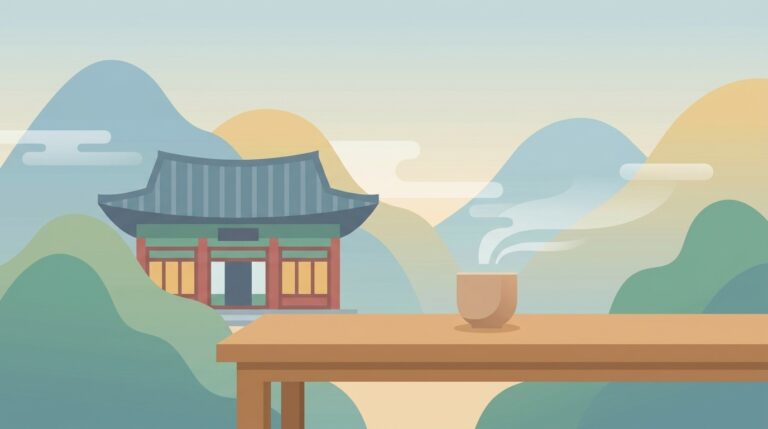
Phase 1: Empathy & The Healing Vibe
Hello! I am your Daily Hangul Editor.
You have probably seen this iconic scene in a K-Drama: The protagonist, overwhelmed by corporate betrayal, a brutal breakup, or the crushing weight of Seoul’s hyper-competitive society, packs a small bag and disappears deep into the mountains. Cut to a breathtaking aerial shot of a traditional temple. Our hero is now wearing a baggy grey uniform, sweeping autumn leaves, or sweating profusely while doing the endless 108 bows before dawn.
Suddenly, they look at peace.
This isn’t just a drama trope; it is a real cultural phenomenon in Korea. In a society famously driven by the Ppalli-Ppalli (hurry-hurry) mindset, the Temple Stay has become the ultimate sanctuary for locals and expats alike.
But here is the catch: Stepping into a traditional Korean temple is not like walking into a modern yoga studio. The vocabulary, the etiquette, and the profound silence require a totally different set of Korean skills. If you just use your textbook café Korean here, you might accidentally break the solemn atmosphere.
This guide is crafted from the experiences of advanced learners who wanted to experience true Korean mindfulness but found themselves lost in translation. Let us master the language of Zen, Korean style!
Phase 2: Deep Dive into Key Expressions
Here are the essential phrases you need to navigate the spiritual depth of a Temple Stay and the tea ceremony.
1. 마음을 비우다
- Pronunciation: ma-eum-eul bi-u-da (ma-eum sounds like “mah-uhm” / bi-u-da sounds like “bee-oo-dah”)
- Meaning: Literal: To empty one’s mind. Real nuance: To let go of greed, stress, or worldly attachments.
- K-Culture Moment: You will hear this not just in temples, but everywhere in Korea. When a friend is stressed about a job interview result, you buy them a drink and say this. It is the Korean equivalent of “let it go.”
- Editor’s Insight: This phrase beautifully captures Eastern philosophy. In the West, we often talk about “filling” ourselves with positive energy. In Korea, peace comes from “emptying” the vessel first.
- Situation Spectrum:
- Casual friends: ✅
- Co-workers: ✅
- Monks/Elders (when speaking about yourself): ✅
- 🤔 Think About It: Why does Korean culture value the act of “emptying” (비움) as a form of healing? How does this contrast with the extreme materialism sometimes seen in modern Korean cities?
2. 번뇌를 내려놓다
- Pronunciation: beon-noe-reul nae-ryeo-no-ta (beon-noe rhymes with “bun-nay” / nae-ryeo-no-ta sounds like “neh-ryuh-no-tah”)
- Meaning: Literal: To put down worldly desires/anguish. Real nuance: To free yourself from agonizing thoughts.
- K-Culture Moment: During the 108 bows (108배), every time you bow, you are symbolically letting go of one of the 108 worldly desires (beon-noe).
- Editor’s Insight: Beon-noe is an advanced, highly poetic Buddhist term. Using this word shows you have a deep, C1-level grasp of Korean cultural vocabulary. It is much more profound than just saying “I am stressed.”
- Situation Spectrum:
- Casual friends: ⚠️ (Might sound too philosophical unless joking)
- Co-workers: 🚫 (Too deep for the office)
- Temple/Meditation contexts: ✅
- 🤔 Think About It: Does your native language have a specific word for “the agonizing desires of the human condition”?
3. 차담을 나누다
- Pronunciation: cha-dam-eul na-nu-da (cha-dam sounds like “chah-dahm”)
- Meaning: Literal/Real nuance: To share a tea conversation.
- K-Culture Moment: The highlight of a Temple Stay is often the Chadam, where you sit on the floor with a monk, drink lotus or green tea, and ask life questions.
- Editor’s Insight: Notice the verb nanuda (to share). In Korea, you don’t just “have” a conversation; you “share” it. It implies an equal exchange of warmth and thoughts.
- Situation Spectrum:
- Casual friends: ⚠️ (A bit formal, usually you just say “차 마시다”)
- Formal invitations: ✅
- Temple Stay itinerary: ✅
- 🤔 Think About It: How does sitting on the floor and pouring tea for each other change the dynamic of a conversation compared to sitting across a desk?
Phase 3: Textbook vs Real Korean
When navigating traditional spaces, textbook Korean often feels too robotic. Here is how to speak with natural grace.
[Expressing Physical Exhaustion after 108 Bows]
* 📖 Textbook Korean: 저는 다리가 아주 아픕니다. (My legs hurt very much.)
* 🗣️ Real Korean: 다리가 후들거려요. (My legs are shaking/giving out.)
* 💡 Why it is different: Koreans love vivid, sensory words (mimetic words/태어). Hudeul-georeoyo perfectly captures the jelly-like feeling in your legs after 108 squats!
[Telling someone you need some quiet time]
* 📖 Textbook Korean: 저는 조용히 있고 싶어요. (I want to be quiet.)
* 🗣️ Real Korean: 생각 좀 정리하려고요. (I am going to organize my thoughts.)
* 💡 Why it is different: Direct statements about wanting to be alone can sound antisocial in community-focused Korea. Framing it as “organizing thoughts” is highly respected.
[Greeting at a Temple]
* 📖 Textbook Korean: 안녕하세요! (Hello!)
* 🗣️ Real Korean: 성불하십시오. (Attain Buddhahood.) Accompanied by a Hapjang bow
* 💡 Why it is different: This is the ultimate insider Buddhist greeting. Using it respectfully to a monk will instantly earn you immense respect.
Phase 4: Cultural Context — K-Culture Deep Dive
4-1. Non-verbal Communication: The Art of Hapjang
In a temple, your body language speaks louder than words. You do not wave, and you definitely do not offer a handshake to a monk. You perform Hapjang (합장): bringing your palms together in front of your chest and bowing slightly. Furthermore, applying Nunchi (눈치) here means reading the silence. If everyone is walking softly on the wooden floors and keeping their voices down, you must instantly adjust your volume.
4-2. K-Drama & The “Healing” Trope
The temple retreat is a staple K-Drama trope. Think of dramas where characters need to escape scandals or intense grief. The media portrays this as a romantic, aesthetic escape. However, the reality of a Temple Stay is often rigorous discipline. You wake up at 4:00 AM (예불), eat vegetarian meals in complete silence where you must consume every single grain of rice (발우공양), and sleep on a thin mat on a hard ondol floor. The media shows the peace, but rarely the physical endurance required to achieve it!
Phase 5: Real-Life Roleplay Scenario
Setting: Saturday morning, 5:30 AM. Deep in the mountains at a centuries-old temple. The morning mist is thick. You have just completed the grueling 108 bows. Your legs are trembling. You are sitting cross-legged in the tea room with a monk and your Korean friend, Min-su.
Characters:
* YOU: An expat in Korea, looking for a break from city life.
* Monk (스님, 50s): Wise, gentle, but has a surprisingly sharp sense of humor.
* Min-su (30s): Your Korean friend who dragged you here. Currently groaning in pain.
Dialogue:
스님: 두 분 다 108배를 끝까지 마치셨군요. 고생하셨습니다. 차 한잔 하시지요.
(du bun da baek-pal-bae-reul kkeut-kka-ji ma-chi-syeot-gun-yo. go-saeng-ha-syeot-seum-ni-da. cha han-jan ha-si-ji-yo.)
(English) Both of you finished the 108 bows to the end. You’ve worked hard. Let’s have a cup of tea.
(Stage Direction: The monk elegantly pours warm tea into small clay cups.)
민수: 아구구… 스님, 저는 다리가 너무 후들거려서 찻잔을 못 들겠습니다.
(a-gu-gu… seu-nim, jeo-neun da-ri-ga neo-mu hu-deul-geo-ryeo-seo chat-jan-eul mot deul-get-seum-ni-da.)
(English) Ouch… Monk, my legs are shaking so much I don’t think I can lift the teacup.
스님: 허허. 몸이 힘들면 잡생각이 사라지는 법이지요. 외국에서 오신 보살님은 어떠셨습니까?
(heo-heo. mom-i him-deul-myeon jap-saeng-gak-i sa-ra-ji-neun beob-i-ji-yo. oe-guk-e-seo o-sin bo-sal-nim-eun eo-tteo-syeot-seum-ni-kka?)
(English) Haha. When the body is exhausted, distracting thoughts naturally disappear. How was it for our guest from abroad?
🔀 Your Turn! How do you answer?
* A) “너무 힘들어요. 집에 가고 싶어요.” (Too honest, breaks the mood.)
* B) “힘들었지만, 마음을 비울 수 있어서 좋았습니다.” (The perfect philosophical answer.)
* C) “완전 대박이었어요! 짱!” (Way too casual for a temple.)
✅ Best Choice: B (him-deul-eot-ji-man, ma-eum-eul bi-ul su it-eo-seo jo-at-seum-ni-da. / It was hard, but it was good because I could empty my mind.)
Why? It shows you understand the purpose of the pain. You acknowledge the physical difficulty but highlight the spiritual benefit using advanced vocabulary.
스님: 훌륭하십니다. 마음을 비운 그 자리에, 따뜻한 차 향기를 채워 가시길 바랍니다.
(hul-lyung-ha-sim-ni-da. ma-eum-eul bi-un geu ja-ri-e, tta-tteut-han cha hyang-gi-reul chae-wo ga-si-gil ba-ram-ni-da.)
(English) Excellent. In that space where you emptied your mind, I hope you fill it with the warm fragrance of tea.
YOU: 좋은 말씀 감사합니다, 스님.
(jo-eun mal-sseum gam-sa-ham-ni-da, seu-nim.)
(English) Thank you for your good words, Monk.
민수: (whispering to you) 야, 너 나보다 한국어 더 잘하는 것 같아…
(ya, neo na-bo-da han-guk-eo deo jal-ha-neun geot gat-a…)
(English) Hey, I think you speak better Korean than I do…
Scenario B: The Silent Meal (발우공양)
You are eating the monastic meal. You realize you took too much pickled radish (단무지) and can’t finish it, but temple rules dictate zero food waste.
민수 (whispering): 어떡해? 남기면 안 되는데.
(eo-tteok-hae? nam-gi-myeon an doe-neun-de.)
(English) What do we do? We aren’t allowed to leave leftovers.
YOU (whispering): 제가 조금 먹어줄게요. 빨리 주세요.
(je-ga jo-geum meok-eo-jul-ge-yo. ppal-li ju-se-yo.)
(English) I will eat a little bit of it for you. Give it to me quickly.
스님 (passing by): 묵언입니다. 조용히 식사하십시오.
(mu-geon-im-ni-da. jo-yong-hi sik-sa-ha-sip-si-o.)
(English) Noble silence. Please eat quietly.
Phase 6: 10-Second Shadowing Drill
Practice this sentence to sound incredibly culturally attuned. Pay attention to the pauses and emotional tone!
😌 스님, / 108배는 힘들었지만 / 마음을 비울 수 있어서 / 정~~~말 좋았습니다.
(seu-nim / baek-pal-bae-neun him-deul-eot-ji-man / ma-eum-eul bi-ul su it-eo-seo / jeong~~~mal jo-at-seum-ni-da.)
(Emotion: Peaceful, respectful, slightly breathing out as if relieved)
Phase 7: K-Culture Mini Dictionary
Here are 4 advanced cultural keywords to elevate your Korean:
1. 108배
* Romanization: baek-pal-bae
* English: 108 Prostrations
* Context: A Buddhist physical meditation practice. Bending the knees, placing the forehead on the floor, and standing back up 108 times to shed 108 human afflictions.
2. 묵언
* Romanization: mu-geon
* English: Noble Silence
* Context: A period in temple life where absolutely no talking is allowed. It forces you to look inward rather than outward.
3. 발우공양
* Romanization: ba-ru-gong-yang
* English: Monastic Meal
* Context: A traditional, highly ritualized way of eating in Buddhism where water is used to clean the bowls at the end, and you must drink that water to ensure zero food waste.
4. 템플스테이
* Romanization: tem-peul-seu-te-i
* English: Temple Stay
* Context: A cultural program started around the 2002 World Cup to allow foreigners to experience temple life. Now, it is wildly popular among stressed Korean millennials.
Phase 8: Traveler Survival Kit
Even if you are seeking inner peace, you still need practical survival skills when traveling to remote mountain temples.
🆘 Survival Expression #1: Finding the Restroom
* 🇰🇷 “해우소가 어디에 있습니까?” (hae-u-so-ga eo-di-e it-seum-ni-kka?)
* 🗣️ Pronunciation: heh-oo-so-gah uh-dee-eh it-seum-nee-kkah?
* 💡 Pro Tip: Temples often use the traditional word Haeuso (해우소 – literally “the place that relieves anxieties”) instead of the modern Hwajangshil (화장실).
🆘 Survival Expression #2: Asking about photos
* 🇰🇷 “여기서 사진 찍어도 됩니까?” (yeo-gi-seo sa-jin jjig-eo-do doem-ni-kka?)
* 🗣️ Pronunciation: yuh-gee-suh sah-jin jjig-uh-doh dwem-nee-kkah?
* 💡 Pro Tip: Never take photos inside the main Buddha hall (Daeungjeon) or during prayer times without explicit permission.
🆘 Survival Expression #3: Dietary Restrictions
* 🇰🇷 “저는 고기를 못 먹습니다.” (jeo-neun go-gi-reul mot meok-seum-ni-da.)
* 🗣️ Pronunciation: juh-neun go-gee-reul moht muhk-seum-nee-dah.
* 💡 Pro Tip: Temple food is inherently vegan (and excludes garlic and onions), but it’s a good phrase to know when eating at restaurants near the mountain trail!
📌 Editor’s Travel Note
* Apps to use: Naver Map is essential. Google Maps will not give you walking directions deep in Korean mountains.
* Footwear: Wear shoes that are incredibly easy to slip on and off. You will be taking your shoes off 20 times a day at a temple.
* Donations: Temples do not expect tips. However, buying a candle or a bag of rice to offer to the Buddha (usually around 10,000 KRW in cash) is a beautiful gesture.
Phase 9: Critical Thinking Corner — “A Step Deeper”
🧠 Think Deeper: Media vs Reality & The Commercialization of Zen
As K-Dramas and K-Pop stars increasingly showcase Temple Stays as trendy “healing” content, the ancient religious practice is subtly shifting into a wellness commodity. Young Koreans flock to temples to escape the crushing pressure of capitalism, yet they pay for the experience and often post aesthetically pleasing photos of their “digital detox” on Instagram. This creates a fascinating paradox: Can true enlightenment and “emptying of the mind” coexist with social media aesthetics and paid wellness tourism? Korean Buddhism has embraced this modern approach to keep traditions alive, showing incredible cultural adaptability.
💬 Your Turn: Does your culture have a traditional or religious practice that has recently been turned into a trendy “wellness” activity? Share your thoughts in the comments!
Phase 10: FAQ & Avoiding Misunderstandings
Q: Can I wear leggings or shorts to a Temple Stay?
A: Absolutely NO. Even in the sweltering summer, temples require modest clothing. Bare shoulders and tight leggings are considered highly disrespectful. The temple will provide you with baggy, comfortable uniform pants and a vest.
Q: Should I bow to every monk I see?
A: Yes! Whenever you cross paths with a monk, stop, perform the Hapjang (palms together), and bow slightly. A simple polite nod is not enough here.
Q: Can I skip the 4:00 AM morning chant (예불)?
A: It depends. If you sign up for an “Experiential” (체험형) Temple Stay, it might be mandatory. If you choose the “Rest” (휴식형) program, you can sleep in. Always check the type of program!
❌ Common Mistake #1: Pointing at the Buddha statue or monks with your index finger.
✅ Do this instead: If you must indicate direction, use your whole hand with the palm facing up.
Phase 11: Summary & Action Items
One-Liner Summary: A Korean Temple Stay is not just a quiet vacation; it is a profound cultural immersion requiring you to physically and linguistically “empty your mind” (마음을 비우다).
Action Mission 3 Steps:
* 🥉 Bronze (Solo): Stand in your room, practice the Hapjang pose, and say “마음을 비우겠습니다” (I will empty my mind) out loud.
* 🥈 Silver (Online): Look up “Korean Temple Stay Vlogs” on YouTube and try to spot the moment they do the 108 bows.
* 🥇 Gold (Real Life): When a Korean friend complains about stress, gently tell them, “마음을 비우세요” and watch their surprised, impressed reaction!
🧘 K-Culture Mission:
Visit the official English website for Korean Temple Stays (eng.templestay.com). Browse the map, find a temple deep in Jirisan or Seoraksan, and imagine yourself drinking tea there. What question would you ask the monk?
Let me know your answers in the comments below! Have you ever experienced anything like a 108-bow meditation?
Phase 12: Quiz — Interactive Challenge
Test your Temple Stay readiness!
1. Situational Judgment: You are talking to a monk during Chadam (tea time). You want to express that the tea is helping you let go of your stressful thoughts. What is the most culturally advanced way to say this?
A) 스트레스가 다 날아갔어요!
B) 번뇌를 내려놓을 수 있어서 좋습니다.
C) 완전 힐링 되네요.
2. True or False – K-Culture Edition:
During a traditional temple meal (발우공양), it is polite to leave a little bit of food on your plate to show you are full. (T / F)
3. Fill in the Blank:
When you legs are shaking uncontrollably after 108 squats, you say: “다리가 _________.”
[Answers & Explanations]
1. B. Options A and C use modern slang/Konglish. Option B uses profound Buddhist terminology that fits the sacred space perfectly.
2. False. You must eat absolutely everything, including the water used to wash the bowl, to practice zero waste and gratitude.
3. 후들거려요 (hu-deul-geo-ryeo-yo). The perfect sensory word for jelly-legs!
Frequently Asked Questions (FAQ)
Q: What does "마음을 비우다" mean in Korean and how do you pronounce it?
A: In Korean, "마음을 비우다" is pronounced [ma-eum-eul bi-u-da (ma-eum sounds like "mah-uhm" / bi-u-da sounds like "bee-oo-dah"] and means: Literal: To empty one's mind. Real nuance: To let go of greed, stress, or worldly attachments.
Q: What does "번뇌를 내려놓다" mean in Korean and how do you pronounce it?
A: In Korean, "번뇌를 내려놓다" is pronounced [beon-noe-reul nae-ryeo-no-ta (beon-noe rhymes with "bun-nay" / nae-ryeo-no-ta sounds like "neh-ryuh-no-tah"] and means: Literal: To put down worldly desires/anguish. Real nuance: To free yourself from agonizing thoughts.
Q: What does "차담을 나누다" mean in Korean and how do you pronounce it?
A: In Korean, "차담을 나누다" is pronounced [cha-dam-eul na-nu-da (cha-dam sounds like "chah-dahm"] and means: Literal/Real nuance: To share a tea conversation.







