

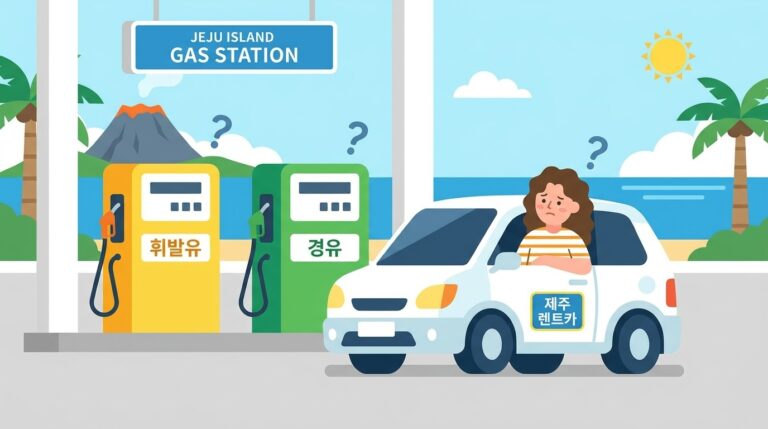
Phase 1: Empathy (Immersive Open)
Hello! This is your Daily Hangul Editor.
Picture this: You are driving down a sparkling coastal road in Jeju Island. The wind is blowing, your favorite K-Pop playlist is on, and you feel exactly like the main character in a romantic K-Drama. But suddenly… beep. The fuel light on the dashboard starts blinking. You pull into the nearest gas station, and an older Korean attendant approaches your window.
He asks you a question. Panic sets in. Gasoline? Diesel? How do you even say that in Korean? You realize that if you put the wrong fuel into your rental car, your perfect road trip could turn into a very expensive disaster!
When renting a car in Korea, knowing the difference between gasoline and diesel is absolutely crucial. Don’t worry! As someone who has navigated countless Jeju road trips and helped many foreigners survive the Korean driving experience, I am here to guide you. By the end of this post, you will be pulling into Korean gas stations with total confidence.
Phase 2: Core Phrases Deep Dive
1. 휘발유 (Gasoline)
- Pronunciation: hwibalyu [hwi-bal-yu]
- Meaning: Gasoline (Literal: Volatile oil)
- K-Culture Moment: You pull up to the gas station in your sleek rental sedan. The attendant looks at your car and confirms, Hwibalyu majayo? (Is it gasoline?).
- Editor’s Insight: The word sounds a bit scientific, right? Unlike many other car parts where Koreans use English loanwords (like handle for steering wheel or break), fuel types use traditional Sino-Korean (Chinese character-based) words. Remember this: Gasoline is Yellow at Korean gas pumps!
- Situation Spectrum:
- Attendant asking you (Formal): ✅
- Telling the attendant (Polite): ✅
- Talking to your friend (Casual): ✅
- 🤔 Think About It: Why do you think Korea uses Chinese-character-based words for fuel, while mostly using English words for car parts? How does your native language handle car terminology?
2. 경유 (Diesel)
- Pronunciation: gyeongyu [gyeong-yu]
- Meaning: Diesel (Literal: Light oil)
- K-Culture Moment: You rented a spacious SUV to fit all your friends and luggage. SUVs and vans in Korea are very often diesel vehicles. When you roll down the window, you confidently say, Gyeongyu neoeojuseyo!
- Editor’s Insight: Diesel pumps in Korea are universally Green (sometimes dark blue/black, but mostly green). If you see a green nozzle, that is Gyeongyu. Memorize the colors, and you will never make a mistake, even at a self-service station.
- Situation Spectrum:
- Formal situations: ✅
- Casual situations: ✅
- 🤔 Think About It: Does your country color-code gas pumps? In some countries, green means unleaded gasoline, but in Korea, green means diesel! Imagine the confusion if you didn’t know this cultural difference.
3. 가득이요 (Fill it up, please)
- Pronunciation: gadeugiyo [ga-deu-gi-yo]
- Meaning: Full, please (Literal: Full, it is)
- K-Culture Moment: Just like in a drama where the rich CEO carelessly tosses his black card and says Fill it up, this is the most common, effortless way to ask for a full tank in Korea.
- Editor’s Insight: Gadeuk means full. Adding ~iyo makes it polite but natural. It is much more natural than saying a full, grammatically perfect sentence. It sounds effortless and perfectly native.
- Situation Spectrum:
- To the gas station attendant (Polite): ✅
- To a boss (Formal): 🚫 (Too brief)
- 🤔 Think About It: Korean language loves efficiency. Instead of saying Please put gasoline in my car until it is full, Koreans just say Gasoline, full. Do you have a similarly efficient phrase in your language?
Phase 3: Textbook vs. Real Korean
[Situation 1: Asking for a full tank of gasoline]
* 📖 Textbook Korean: 제 차에 휘발유를 가득 주유해 주시겠습니까? (Je chae hwibalyureul gadeuk juyuhae jusigetseumnikka?) [Could you please pump a full tank of gasoline into my car?]
* 🗣️ Real Korean: 휘발유 가득이요. (Hwibalyu gadeugiyo.) [Gasoline, full please.]
* 💡 Why is it different?: In fast-paced service situations, Koreans prefer extreme brevity. Long, textbook sentences sound robotic and slow down the process.
[Situation 2: Asking for a specific amount (e.g., 50,000 KRW)]
* 📖 Textbook Korean: 경유를 오만 원어치 넣어주세요. (Gyeongyureul oman woneochi neoeojuseyo.) [Please put in 50,000 won worth of diesel.]
* 🗣️ Real Korean: 경유 오만 원이요. (Gyeongyu oman woniyo.) [Diesel, 50,000 won.]
* 💡 Why is it different?: Again, efficiency is key. Just stating the fuel type and the price with the polite ending ~iyo is the standard, polite way to order.
[Situation 3: The attendant asking what kind of fuel you need]
* 📖 Textbook Korean: 어떤 연료를 넣어드릴까요? (Eotteon yeonlyoreul neoeodeurilkkayo?) [What kind of fuel shall I put in for you?]
* 🗣️ Real Korean: 휘발유 맞으시죠? (Hwibalyu majeushijyo?) [It’s gasoline, right?]
* 💡 Why is it different?: Experienced Korean attendants usually guess the fuel type just by looking at your car model and confirm it with you, rather than asking an open-ended question.
Phase 4: Cultural Context — K-Culture Deep Dive
4-1. Non-Verbal Communication at Gas Stations
In Korea, you don’t need to step out of the car at a full-service station. Roll down your window just enough to hand over your credit card. Hand the card using two hands (or with your right hand, while your left hand lightly touches your right elbow). This small gesture shows respect, and the older attendant will instantly appreciate your manners. A slight head nod while saying Gamsahamnida (Thank you) when receiving the receipt is the perfect K-Etiquette.
4-2. The K-Travel Connection: Jeju Island & Self-Service
If you rent a car for a coastal road trip in Jeju Island (a classic K-Drama and K-Travel bucket list item), you will encounter many 셀프 주유소 (Self Gas Stations).
Here is your survival rule:
Yellow Nozzle = 휘발유 (Gasoline)
Green/Black Nozzle = 경유 (Diesel)
Most self-service kiosks have an English language option on the touch screen. But the physical nozzles only have Korean written on them. If you accidentally put Green (Diesel) into a Yellow (Gasoline) car, the engine will break, and rental car insurance often does NOT cover this mistake. Always double-check your rental car’s fuel type before leaving the rental lot!
Phase 5: Real-Life Roleplay Scenario
Setting: It is 2:00 PM on a sunny day in Jeju Island. You are driving a rented Hyundai Avante. The fuel light comes on, so you pull into an SK Enclean gas station. An older attendant wearing a uniform approaches your driver’s side window. You roll down the window.
Characters:
* YOU: A foreign traveler on a road trip, a bit nervous but ready to use your Korean.
* Ajeossi (Attendant): A friendly Korean man in his 50s. Fast-paced but polite.
Dialogue:
Ajeossi: 어서 오세요. (Eoseo oseyo.)
[English: Welcome.]
You: 안녕하세요! (Annyeonghaseyo!)
[English: Hello!]
Ajeossi: (Looking at your car) 휘발유 맞으시죠? (Hwibalyu majeushijyo?)
[English: It’s gasoline, right?]
You: 네, 맞아요. (Ne, majayo.)
[English: Yes, that’s right.]
Ajeossi: 얼마나 넣어드릴까요? (Eolmana neoeodeurilkkayo?)
[English: How much should I put in?]
🔀 Your Turn! How will you respond?
A) 제 차에 휘발유를 가득 주유해 주시겠습니까? (Textbook perfect, but very long)
B) 가득이요. (Short, natural, polite)
C) 오만 원 주세요. (A bit too direct, sounds like you are buying groceries)✅ Best Choice: B — Gadeugiyo is the absolute best way to ask for a full tank in real life. It shows you know how real Koreans speak!
You: 가득이요. 결제는 카드로 할게요. (Gadeugiyo. Gyeoljeneun kadeuro halgeyo.)
[English: Full, please. I will pay by card.]
(You hand the credit card with two hands)
Ajeossi: 네, 알겠습니다. (Ne, algetseumnida.)
[English: Yes, understood.]
(Ajeossi starts pumping gas and runs the card. After a few minutes, he returns)
Ajeossi: 다 됐습니다. 영수증 여기 있습니다. 여행 재밌게 하세요! (Da dwaetseumnida. Yeongsujeung yeogi itseumnida. Yeohaeng jaemitge haseyo!)
[English: All done. Here is the receipt. Enjoy your trip!]
You: 감사합니다! 수고하세요~ (Gamsahamnida! Sugohaseyo~)
[English: Thank you! Keep up the good work~]
Ajeossi: 네, 안전 운전하세요! (Ne, anjeon unjeonhaseyo!)
[English: Yes, drive safely!]
Phase 6: 10-Second Shadowing Drill
Practice these phrases out loud. Pay attention to the slashes for pausing!
- 😊 밝게 (Polite & Bright):
네 / 휘발유 / 가득이요!(Ne / hwibalyu / gadeugiyo!) [Yes, gasoline full please!] - 😤 단호하게 (Clear & Direct):
경유 / 오만 원어치요.(Gyeongyu / oman woneochiyo.) [Diesel, 50,000 won worth.] - 🥺 질문할 때 (Slightly confused):
이 차는 / 휘발유인가요?(I chaneun / hwibalyuingayo?) [Is this car gasoline?]
Phase 7: K-Culture Mini Dictionary
1. 렌터카
* Romanization: renteoka
* English: Rental Car
* Context: Very common in tourist destinations like Jeju. The biggest companies are Lotte Rent-a-car and SK Rent-a-car. Car-sharing apps like Socar (쏘카) are also hugely popular among younger Koreans.
2. 셀프 주유소
* Romanization: selpeu juyuso
* English: Self-service Gas Station
* Context: Gas stations where you pump your own gas. They are usually slightly cheaper than full-service stations. Look for the big sign that says 셀프 (Self).
3. 휴게소
* Romanization: hyugeso
* English: Highway Rest Area
* Context: Korean rest stops are legendary K-Culture spots. They are food paradises where you can eat walnut pastries (Hodu-gwaja), tteokbokki, and udon while you stop to pump gas during a road trip.
4. 만땅
* Romanization: manttang
* English: Full tank (Slang)
* Context: A very common slang term older drivers use for a full tank. It originates from Japanese, so it is not standard Korean, but you will definitely hear taxi drivers and older attendants use it!
Phase 8: Traveler’s Survival Kit
Are you planning a road trip in Korea? Here is your gas station survival card!
🆘 Survival Phrases TOP 3
🇰🇷 1. 휘발유 가득이요. (Hwibalyu gadeugiyo.) — Gasoline, full please.
🇰🇷 2. 경유 가득이요. (Gyeongyu gadeugiyo.) — Diesel, full please.
🇰🇷 3. 영수증 버려주세요. (Yeongsujeung beoryeojuseyo.) — Please throw away the receipt.📍 Where to use: Gas stations, highway rest areas.
💡 Pro Tip: If you are nervous about your pronunciation, write down 휘발유 (Yellow) or 경유 (Green) on your phone screen and show it to the attendant!📌 Editor’s Travel Note
* Apps: Google Maps does not work well for driving in Korea. You MUST download KakaoMap or Naver Map for accurate navigation.
* Payment: Korean gas stations are 100% card-friendly. You rarely need cash.
* Tipping: Do NOT tip the gas station attendant. There is no tipping culture in Korea, and offering money will only confuse them.
Phase 9: Critical Thinking — “One Step Deeper”
Global Era Korean: The Mix of East and West in Car Culture
Have you noticed something interesting? In Korean, parts of a car are almost entirely English loanwords: 핸들 (handle/steering wheel), 브레이크 (brake), 타이어 (tire), 와이퍼 (wiper). Yet, the most fundamental element—fuel—uses traditional Sino-Korean words: 휘발유 (Hwibalyu/Gasoline) and 경유 (Gyeongyu/Diesel).
This reflects Korea’s modernization history. Basic resources like oil and fuel were classified and named using Chinese characters during early industrialization, long before the influx of American car culture. As the global era brought modern vehicles, the parts kept their English names, but the old fuel names remained. It shows how the Korean language is a fascinating living museum, blending deep Asian roots with rapid global Westernization.
💬 Your Turn: Does your native language mix older traditional words with modern English loanwords when it comes to technology or driving? Share it in the comments!
Phase 10: FAQ & Mistake Prevention
Q: Can I just say “Gasoline” instead of Hwibalyu?
Maybe. Younger attendants might understand the English word “Gasoline,” but older attendants (who mostly work at gas stations) might get confused. It is always safer to say Hwibalyu.
Q: What if I don’t know my rental car’s fuel type?
Check the inside of the fuel door! There is usually a sticker there. Also, the car key tag from the rental company often indicates 휘 (Gasoline) or 경 (Diesel).
❌ Common Mistake #1: Assuming pump colors are international.
✅ Do this instead: Memorize the Korean rule. Yellow = Gasoline, Green = Diesel. Do not rely on the color codes from your home country!❌ Common Mistake #2: Trying to pump your own gas at a full-service station.
✅ Do this instead: Look for the word “셀프” (Self) on the big sign. If it doesn’t say “셀프”, stay in your car and wait for the attendant. Stepping out to touch the pump might alarm them.
Phase 11: Summary & Action Items
One-Liner Summary: Remember Hwibalyu (Yellow/Gasoline) and Gyeongyu (Green/Diesel), and confidently say Gadeugiyo (Full please) to sound like a local!
Action Mission 3 Steps:
* 🥉 Bronze (Solo): Say “Hwibalyu gadeugiyo” and “Gyeongyu gadeugiyo” out loud 3 times right now.
* 🥈 Silver (Online): Look up a picture of a Korean gas station online and try to spot the Yellow and Green pumps.
* 🥇 Gold (Real Life): When you rent a car in Korea, use these exact phrases with the gas station attendant!
K-Culture Mission:
Open Naver Map or KakaoMap right now. Zoom into Jeju Island (제주도) and type “주유소” (Gas station) in the search bar. Check out the street view of the stations. Can you spot the word 셀프 (Self)?
Let’s Chat!
Have you ever made a funny or scary mistake while driving in a foreign country? Tell us your road trip stories in the comments below!
Phase 12: Quiz — Interactive Challenge
1. Situational Judgment:
You pulled into a gas station. The sign does NOT say “셀프” (Self). What should you do?
* A) Get out of the car and grab the yellow nozzle.
* B) Honk the horn until someone comes.
* C) Roll down your window and wait for the attendant.
2. Fill in the Blank:
You want to ask the attendant to fill up your gasoline car completely.
“휘발유 _________.”
* A) 가득이요 (gadeugiyo)
* B) 조금이요 (jogeumiyo)
* C) 만 원이요 (man woniyo)
3. True or False — K-Culture Edition:
* T/F: In Korea, a green nozzle at a gas station means unleaded gasoline.
Click to see the answers!
1. C – If it is not a self-service station, you must stay in your car and let the attendant do it for you. Stepping out is unnecessary and might surprise them!
2. A – 가득이요 (Gadeugiyo) means “full, please.”
3. False – Green means DIESEL (경유) in Korea! Yellow is Gasoline (휘발유).
Frequently Asked Questions (FAQ)
Q: What does "휘발유 (Gasoline)" mean in Korean and how do you pronounce it?
A: In Korean, "휘발유 (Gasoline)" is pronounced [hwibalyu [hwi-bal-yu] and means: Gasoline (Literal: Volatile oil)
Q: What does "경유 (Diesel)" mean in Korean and how do you pronounce it?
A: In Korean, "경유 (Diesel)" is pronounced [gyeongyu [gyeong-yu] and means: Diesel (Literal: Light oil)
Q: What does "가득이요 (Fill it up, please)" mean in Korean and how do you pronounce it?
A: In Korean, "가득이요 (Fill it up, please)" is pronounced [gadeugiyo [ga-deu-gi-yo] and means: Full, please (Literal: Full, it is)






