

Phase 1: Empathy (Immersive Open)
Hello! This is your Daily Hangul Editor.
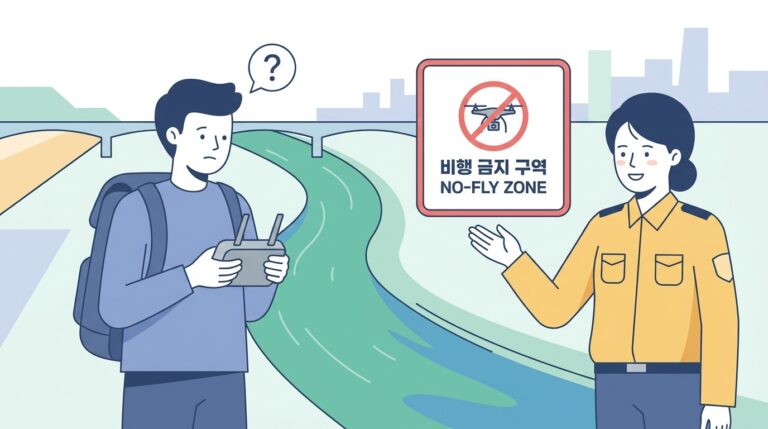
Imagine this: You’re standing by the magnificent Han River at sunset. The golden hour light is perfect, looking exactly like a scene from your favorite K-Drama. You take out your brand-new DJI drone, ready to capture that cinematic Itaewon Class sweeping shot. You press the launch button, the propellers hum, and within exactly 30 seconds… a security guard comes running over, blowing a whistle and crossing his arms in a giant ‘X’ shape.
Your heart drops. He is speaking fast Korean, and all you can do is stand there holding your remote. What did he just say? Are you going to jail? Are you getting fined?
If you want to capture Korea’s stunning landscapes on your drone without accidentally breaking strict national security laws (yes, it gets that serious!), you need more than just good piloting skills. You need the right vocabulary. Today, we are going to dive into the essential Korean phrases and the unspoken cultural rules of drone photography in Korea. Let’s make sure you get those breathtaking shots safely and legally!
Phase 2: Core Expressions Deep Dive
1. 여기 드론 띄워도 돼요?
- Pronunciation: Yeogi deuron ttiwodo dwaeyo? [yuh-gee deu-ron ttee-wo-do dway-yo?]
- Meaning: Can I fly a drone here? (Literal: Is it okay if I float a drone here?)
- K-Culture Moment: You’ll use this when you arrive at a beautiful spot like a quiet beach in Jeju Island or a park, and you spot a park manager or a local official. It’s the ultimate ‘better safe than sorry’ question.
- Editor’s Insight: Notice the verb 띄우다 (to float/launch). While you can say 날리다 (to fly), 띄우다 sounds much more natural when talking about launching a drone. It gives off the vibe that you respect the airspace.
- Situation Spectrum:
- Casual (Friends): ✅ (You can drop the ‘요’ and say 띄워도 돼?)
- Semi-formal (Staff/Strangers): ✅
- Formal (Police/Officials): ⚠️ (Better to use a more formal structure like 드론 비행이 가능한가요?)
- 🤔 Think About It: In Korean, we don’t just ‘fly’ drones; we ask for permission to ‘float’ them in shared space. How does your native language handle verbs for modern technology like drones?
2. 비행 승인 받았어요.
- Pronunciation: Bihaeng seung-in badasseoyo. [bee-hang seung-in ba-da-sseo-yo]
- Meaning: I got flight approval.
- K-Culture Moment: When the security guard (Ajussi) approaches you with that intimidating look, this is your magic shield. If you have the permit, saying this immediately calms the situation.
- Editor’s Insight: 승인 (Approval) is a powerful, formal word. It shows you know the system and went through the official government channels (like the One-Stop civil service portal).
- Situation Spectrum:
- Casual (Friends): 🚫 (Too formal, just say 허가 받았어)
- Semi-formal (Staff/Strangers): ✅
- Formal (Police/Officials): ✅
- 🤔 Think About It: Korea is extremely fast-paced and digital. Why do you think a country so technologically advanced still requires such strict, formal approval words for flying a camera?
3. 촬영 허가증 보여주시겠어요?
- Pronunciation: Chwaryeong heogajeung boyeojusigesseoyo? [chwal-young huh-ga-jeung bo-yuh-joo-shee-ge-sseo-yo?]
- Meaning: Could you show me your filming permit?
- K-Culture Moment: This is what you will hear from police or military personnel if you fly near restricted zones (which is almost everywhere in Seoul!).
- Editor’s Insight: Don’t panic when you hear 보여주시겠어요? (Could you show me?). It’s an extremely polite but firm way of demanding something. In Korea, authority figures often use polite language while enforcing strict rules.
- Situation Spectrum:
- Casual (Friends): 🚫
- Semi-formal (Staff/Strangers): ✅
- Formal (Police/Officials): ✅ (Used by them to you)
- 🤔 Think About It: Even when enforcing the law, Korean officials use honorifics. What does this tell us about the separation of personal emotion and public duty in Korean society?
Phase 3: Textbook vs. Real Korean
Asking for Permission to Fly
* 📖 Textbook Korean: 이곳에서 드론을 비행하는 것이 허용됩니까? (Is flying a drone permitted in this location?)
* 🗣️ Real Korean: 여기 드론 띄워도 돼요? (Can I fly a drone here?)
* 💡 Why the difference?: Textbook Korean sounds like a military manual. In real life, Koreans prefer the softer, action-oriented verb 띄우다 (to launch/float) combined with the permission-seeking grammar 아/어도 돼요.
Warning About a No-Fly Zone
* 📖 Textbook Korean: 이곳은 비행 금지 구역입니다. (This is a no-fly zone.)
* 🗣️ Real Korean: 여기 드론 날리시면 안 돼요. (You shouldn’t fly drones here.)
* 💡 Why the difference?: While you will see ‘비행금지구역’ on official signs, when Koreans speak to you directly, they frame it as an action you shouldn’t do (날리시면 안 돼요), softening the directness of a noun-based command.
Bottom Note: For B2 level learners, using ‘띄워도 돼요?’ instead of direct translation shows you really understand the rhythm of conversational Korean!
Phase 4: Cultural Context — K-Culture Deep Dive
4-1. Non-Verbal Cues: The Art of Apologetic Nunchi
If you get caught flying a drone where you shouldn’t, your body language is just as important as your Korean. Do not argue aggressively or use wide hand gestures. Instead, slightly bow your head, use both hands if you are putting the drone away, and show 눈치 (Nunchi)—the ability to read the room. A swift, polite apology will often get you a warning rather than a heavy fine.
4-2. K-Travel Link: The Invisible Borders in the Sky
Seoul is a travel paradise, but for drones, it’s a fortress. Because South Korea is technically still in a ceasefire with the North, the airspace over Seoul is heavily restricted for national security (especially near the Blue House, Presidential office, and military bases).
If you want to fly freely, you must visit designated ‘Drone Parks’ like the Gwangnaru Hangang Drone Park.
Survival Travel Phrases for Drone Pilots:
1. 제일 가까운 드론 공원이 어디예요? (Where is the nearest drone park?)
2. 여기서 촬영하면 불법인가요? (Is it illegal to film here?)
3. 사진만 찍고 바로 내릴게요. (I will just take a photo and land it right away. – Note: This rarely works with strict guards, but it’s good to know!)
Phase 5: Real-Life Roleplay Scenario
Setting: Saturday afternoon at Han River Park. The weather is beautiful. You just launched your drone to get a shot of the bridge. A park security guard (Ajussi in a neon vest) approaches you rapidly.
Characters:
* YOU: A foreign tourist who loves photography, but didn’t check the local airspace map.
* Guard (Ajussi): 50s, strict but not unreasonable, just doing his job.
Dialogue:
Guard: 저기요! 여기서 드론 날리시면 안 됩니다!
(Jeogiyo! Yeogiseo deuron nallisimyeon an deumnida!)
[Excuse me! You cannot fly a drone here!]
(🎭 Stage Direction: The guard blows his whistle and points at your drone in the sky)
YOU: 아, 정말요? 몰랐어요.
(A, jeongmallyo? Mollasseoyo.)
[Oh, really? I didn’t know.]
Guard: 서울 한강공원은 대부분 비행금지구역이에요. 허가증 있으세요?
(Seoul hangang-gong-woneun daebubun bihaenggeumjiguyeogieyo. Heogajeung isseuseyo?)
[Most of the Han River parks in Seoul are no-fly zones. Do you have a permit?]
YOU: 아니요, 작은 드론이라 괜찮을 줄 알았어요.
(Aniyo, jageun deuronira gwaenchaneul jul arasseoyo.)
[No, I thought it would be okay since it’s a small drone.]
Guard: 크기와 상관없이 사전에 승인을 받아야 해요. 과태료 나올 수 있습니다.
(Keugiwa sang-gwaneopsi sajone seung-ineul badaya haeyo. Gwataeryo naol su itseumnida.)
[Regardless of size, you must get prior approval. You could get fined.]
🔀 Your Turn! How do you respond?
* A) “왜 안 돼요? 저 사람도 찍고 있잖아요!” (Why not? That person is filming too!)
* B) “죄송합니다. 규정을 잘 몰랐어요. 바로 내릴게요.” (I’m sorry. I didn’t know the rules well. I’ll land it right away.)
* C) “이거 장난감이에요, 진짜 드론 아니에요.” (This is a toy, not a real drone.)✅ Best Choice: B — Apologizing immediately and showing intent to comply (바로 내릴게요) is the best way to activate the guard’s leniency (정).
⚠️ Choice A Analysis: Pointing fingers at others is seen as very rude and will likely make the guard enforce the fine strictly.
YOU: 죄송합니다. 규정을 잘 몰랐어요. 바로 내릴게요.
(Joesonghamnida. Gyujeong-eul jal mollasseoyo. Baro naerilgeyo.)
[I’m sorry. I didn’t know the rules well. I’ll land it right away.]
(🎭 Stage Direction: You quickly use the joystick to bring the drone down safely)
Guard: 네, 다음부터는 꼭 ‘레디투플라이’ 앱으로 확인하고 날리세요.
(Ne, daeumbuteoneun kkok ‘reditupellai’ aebeuro hwaginhago nalliseyo.)
[Okay, from next time, make sure to check with the ‘Ready to Fly’ app before flying.]
YOU: 네, 친절하게 알려주셔서 감사합니다! 좋은 하루 보내세요.
(Ne, chinjeolhage allyeojusyeoseo gamsahamnida! Joeun haru bonaeseyo.)
[Yes, thank you for kindly letting me know! Have a good day.]
Phase 6: 10-Second Shadowing Drill
Practice speaking like a native! Follow the pauses (/) and try to match the emotion.
- 🥺 Apologetic: 아, 정말요? / 규정을 / 잘 몰랐어요. / 죄송합니다.
(A, jeongmallyo? / gyujeong-eul / jal mollasseoyo. / joesonghamnida.) -
😤 Firm (Like a Guard): 여기는 / 비행 금지 / 구역입니다.
(Yeogineun / bihaeng geumji / guyeogimnida.) -
😊 Polite: 사진만 찍고 / 바로 / 내릴게요!
(Sajinman jjikgo / baro / naerilgeyo!)
Phase 7: K-Culture Mini Dictionary
Here are 4 must-know keywords for photographers and drone pilots in Korea:
1. 눈치
* Romanization: nunchi
* English: Situational awareness / reading the room
* Context: If you see signs with a crossed-out drone, use your nunchi and keep it in your bag.
2. 비행금지구역
* Romanization: bihaeng-geumji-guyeok
* English: No-fly zone
* Context: You will see this written in red on many signs in Seoul. Ignore it, and you might meet the local police.
3. 인생샷
* Romanization: insaeng-syat
* English: The shot of a lifetime
* Context: The whole reason you brought the drone! Koreans constantly hunt for their insaeng-syat at famous cafes or nature spots.
4. 핫플
* Romanization: hat-peul
* English: Hot place (Trendy spot)
* Context: A popular cafe or location on Instagram. Usually, hat-peuls are extremely crowded, making drone flying both dangerous and often illegal without permits.
Phase 8: Traveler Survival Kit
🆘 Survival Phrases for Content Creators
* 🇰🇷 “허가증 여기 있습니다.” (Heogajeung yeogi itseumnida.)
* 🗣️ English: Here is my permit.
* 📍 Where to use: Security checkpoints, national parks, historical palaces.
* 💡 Pro Tip: Never fly drones near Gyeongbokgung Palace or the Blue House area without military clearance. It is heavily monitored!📌 Editor’s Travel Note
* Must-Download App: Search for “Ready to Fly” (레디투플라이) on your app store. It’s the official map app showing Korean airspace. Red means NO, green means GO.
* Drone Sizes: In Korea, even sub-250g drones (like DJI Mini) are subject to strict no-fly zone rules in Seoul. Don’t assume small means unregulated!
* The One-Stop Portal: You must apply for flight and filming permits online via the ‘Drone One-Stop’ government website at least a few days in advance.
Phase 9: Critical Thinking — “One Step Deeper”
Media vs Reality: The K-Drama Illusion
When you watch Queen of Tears or Crash Landing on You, you see gorgeous sweeping drone shots of Seoul’s skyline, the Han River, and the N Seoul Tower. This creates an illusion for travelers that Seoul is a drone-friendly city. In reality, South Korea is in a unique geopolitical situation, technically still at war. Therefore, the airspace over the capital is one of the most heavily restricted in the world. Those beautiful drama shots take weeks of paperwork, military clearance, and police coordination to film.
🧠 Think Deeper:
The contrast between the romanticized, open skies in K-Dramas and the strict, security-focused reality shows how media shapes our expectations of a country.💬 Your Turn: Have you ever visited a famous location from a movie or drama and found that the rules there were completely different from what was shown on screen? Share your experience!
Phase 10: FAQ & Avoiding Misunderstandings
- Q: Can I just plead ignorance since I’m a foreigner?
- No. While a friendly guard might let you off with a warning if you apologize immediately, police officers can fine you up to 3 million KRW (around $2,200 USD) for flying in restricted military airspace, regardless of your nationality.
- Q: Is it okay to fly at night?
- Absolutely No. Night flying is strictly prohibited everywhere in Korea without a special waiver.
- Q: Can I use “안 돼요?” to a guard to ask why?
- Maybe, but be careful. If you say “왜 안 돼요?” with a sharp tone, it sounds rebellious. If you really want to know, say softly: “아, 혹시 이유를 알 수 있을까요?” (Ah, by any chance, could I know the reason?).
❌ Common Mistake #1: Assuming “Toy Drones” are exempt from all rules.
✅ Do this instead: Check the “Ready to Fly” app. In Seoul’s red zones, even a 100-gram toy drone is illegal to fly outdoors.
Phase 11: Summary & Action Items
One-Liner Summary: Always ask “여기 드론 띄워도 돼요?” and respect the 비행금지구역 (No-fly zones) to enjoy a penalty-free trip in Korea!
Action Mission 3 Steps:
* 🥉 Bronze (Solo): Say “여기 드론 띄워도 돼요?” out loud 3 times pretending you are holding a controller.
* 🥈 Silver (Online): Find an Instagram reel of a Korean landscape and comment: “여기 드론 비행 가능한 핫플인가요?” (Is this a hot place where drone flying is allowed?)
* 🥇 Gold (Real Life): Download the “Ready to Fly” app, find a green zone in Korea, and plan your future drone shot!
📸 K-Culture Photography Mission:
Go to Kakao Maps or Google Street View, explore the area around Gwangnaru Hangang Park (one of the few legal drone parks in Seoul), and imagine yourself successfully telling a local, “비행 승인 받았어요!” (I got flight approval!).
Phase 12: Quiz — Interactive Challenge
1. Situational Judgment:
You are at a beautiful beach in Busan. You want to launch your drone, but you see a lifeguard nearby. What is the most natural way to ask?
* A) 비행금지구역입니까?
* B) 여기 드론 띄워도 돼요?
* C) 촬영 허가증 보여주시겠어요?
2. Fill in the Blank:
Guard: 저기요, 여기서 드론 ( ____ ) 안 돼요!
* A) 먹으시면
* B) 날리시면
* C) 주무시면
3. True or False — K-Culture Edition:
Because my drone is under 250g, I can fly it freely next to the N Seoul Tower just like in the K-Dramas.
* True / False
4. Roleplay Prediction:
In Phase 5, if you had chosen Option A (“왜 안 돼요? 저 사람도 찍고 있잖아요!”), what would the Guard most likely do?
* A) Say sorry and let you fly.
* B) Ask for your ID and issue a heavy fine for non-compliance.
* C) Ask to take a selfie with your drone.
(Answers: 1: B, 2: B, 3: False – Seoul is heavily restricted regardless of weight, 4: B)
Frequently Asked Questions (FAQ)
Q: What does "여기 드론 띄워도 돼요?" mean in Korean and how do you pronounce it?
A: In Korean, "여기 드론 띄워도 돼요?" is pronounced [Yeogi deuron ttiwodo dwaeyo? [yuh-gee deu-ron ttee-wo-do dway-yo?] and means: Can I fly a drone here? (Literal: Is it okay if I float a drone here?)
Q: What does "비행 승인 받았어요." mean in Korean and how do you pronounce it?
A: In Korean, "비행 승인 받았어요." is pronounced [Bihaeng seung-in badasseoyo. [bee-hang seung-in ba-da-sseo-yo] and means: I got flight approval.
Q: What does "촬영 허가증 보여주시겠어요?" mean in Korean and how do you pronounce it?
A: In Korean, "촬영 허가증 보여주시겠어요?" is pronounced [Chwaryeong heogajeung boyeojusigesseoyo? [chwal-young huh-ga-jeung bo-yuh-joo-shee-ge-sseo-yo?] and means: Could you show me your filming permit?







