

The Warm Trap of Korean Jeong
Hello! I am the editor of Daily Hangul.
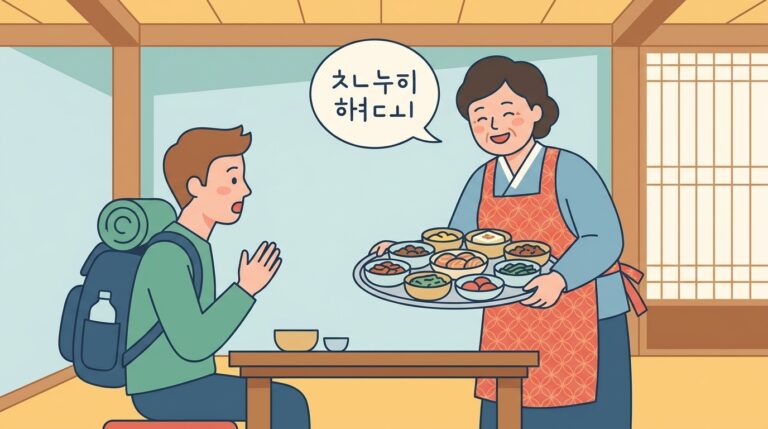
Picture this: You are at a bustling K-BBQ restaurant. The friendly owner, a warm-hearted Imo (auntie), suddenly brings over a steaming bowl of fluffy steamed egg. ‘Service!’ she announces. You are already so full you can barely breathe. You want to say, ‘No, thank you,’ but looking at her proud, beaming smile, the words just will not come out. Welcome to the magical, sometimes overwhelming world of Jeong (정)!
In Korea, Jeong is the invisible superglue of society. It means affection, compassion, and taking care of others. Because of this deep-rooted cultural trait, outright refusing a favor, a gift, or extra food can feel too cold or harsh. Today, we are going completely beyond the textbook. I will show you how to navigate these warm but tricky waters like a true local! This guide is based on real struggles from learners just like you.
Core Expressions Deep Dive
1. 아유, 뭘 이런 걸 다… (Oh, you shouldn’t have…)
- Pronunciation: Ayu, mwol ireon geol da… (Sounds like a playful sigh followed by a gentle complaint)
- Meaning: Literal: Oh, what is all this… / Real Nuance: I am incredibly grateful, but I feel bad you went through this trouble.
- K-Culture Moment: Imagine visiting a Korean friend’s house. Their mother hands you a heavy bag of premium Korean pears when you leave. You use this phrase while grabbing the bag with both hands!
- Editor’s Insight: This is the ultimate polite refusal that is actually an acceptance phrase. You are showing humility. You are not really saying no, you are saying your generosity is too much for me.
- Situation Spectrum:
- Casual: ⚠️
- Semi-formal: ✅
- Formal: ✅ (Add ‘주시고 그러세요’ for elders)
- 🤔 Think About It: Why do Koreans feel the need to pretend they don’t want a gift at first? Does your culture have a polite refusal dance?
2. 마음만 받을게요 (I’ll just accept your heart)
- Pronunciation: Maeumman badeulgeyo (Focus on the soft ‘m’ sounds)
- Meaning: Literal: I will only receive your heart. / Real Nuance: Thank you so much for the thought, but I must genuinely decline.
- K-Culture Moment: A coworker tries to give you an expensive welcome gift, but company policy forbids it. This phrase saves the relationship while keeping the rules!
- Editor’s Insight: This is a lifesaver. It protects the other person’s Jeong (their warm intention) while firmly setting a boundary.
- Situation Spectrum:
- Casual: ✅
- Semi-formal: ✅
- Formal: ✅ (Use ‘마음만 감사히 받겠습니다’ for bosses)
- 🤔 Think About It: How beautifully poetic is it to accept someone’s heart? It shows that in Korea, the intention behind the gesture is valued more than the physical object.
3. 다음에 제가 꼭 쏠게요! (I will definitely treat you next time!)
- Pronunciation: Daeume jega kkok ssolgeyo! (‘Ssolgeyo’ sounds like a sharp, energetic promise)
- Meaning: Literal: I will shoot next time. / Real Nuance: Let me pay you back for your generosity next time.
- K-Culture Moment: Fighting over the bill at a restaurant! Your older friend snatches the receipt. You realize you lost the battle. This is your surrender phrase.
- Editor’s Insight: Refusing someone treating you can hurt their pride. Yielding gracefully and promising a future meal keeps the relationship going.
- Situation Spectrum:
- Casual: ✅
- Semi-formal: ✅
- Formal: 🚫 (Use ‘다음에 제가 꼭 대접하겠습니다’ instead)
- 🤔 Think About It: Why is splitting the bill historically less common in Korea? It is all about taking turns to show Jeong!
Textbook vs. Real Korean
[When refusing extra food at a restaurant]
* 📖 Textbook Korean: 아니요, 배가 부릅니다. 감사합니다. (No, I am full. Thank you.)
* 🗣️ Real Korean: 아유 이모님 너무 맛있는데 진짜 배 터질 것 같아요! (Auntie, it’s so delicious but my stomach is literally going to explode!)
* 💡 Why the difference?: Adding a compliment cushions the refusal. Just saying ‘No’ can sound like you disliked the food!
[When a friend tries to pay for your coffee]
* 📖 Textbook Korean: 제 커피는 제가 계산하겠습니다. (I will pay for my coffee.)
* 🗣️ Real Korean: 에이~ 이번엔 제가 살게요! (Hey~ Let me buy it this time!)
* 💡 Why the difference?: The textbook version sounds robotic. ‘에이’ adds a friendly, playful tone that matches the warm situation.
K-Culture Deep Dive
Non-verbal Cues & Nunchi
When you refuse something out of politeness, your hands must do the talking! Koreans often wave both hands side to side rapidly in front of their chest while smiling gently. Also, avoiding direct, intense eye contact while refusing makes you look more humble. This is all part of Nunchi (reading the room). If the person looks genuinely disappointed by your refusal, you should gracefully accept!
K-Food Connection: The Power of Sharing
Have you ever noticed that Korean meals revolve around sharing? A big pot of Kimchi Jjigae in the middle, side dishes everywhere. Sharing food is the physical manifestation of Jeong. When an elder puts a choice cut of meat on your rice bowl, it is essentially a hug in food form. Rejecting it is like rejecting a hug! That is why, even if you are full, accepting at least one piece with a bright smile is the ultimate cultural hack.
Real-world Roleplay Scenario
Setting: Friday evening, 7 PM. A bustling Samgyeopsal (pork belly) restaurant near Gangnam Station. The air is thick with delicious smoke. You are at a team dinner.
Characters:
* YOU: An expat working in Korea for six months.
* Ji-hoon (35): Friendly team leader who loves taking care of his junior staff.
Ji-hoon: 자, 여러분! 오늘 고생 많았어요. 제가 쏘는 거니까 마음껏 먹어요!
(Ja, yeoreobun! oneul gosaeng manasseoyo. jega ssoneun geonikka maeumkkeot meogeoyo!)
[Translation: Alright, everyone! You worked hard today. I’m paying, so eat as much as you want!]
(Stage Direction: Ji-hoon smiles broadly and raises his Soju glass)
YOU: 아, 팀장님! 감사합니다.
(A, timjangnim! gamsahamnida.)
[Translation: Ah, Team Leader! Thank you.]
Ji-hoon: 더 시켜요! 고기 안 끊기게.
(Deo sikyeoyo! gogi an kkeungige.)
[Translation: Order more! Don’t let the meat stop coming.]
YOU: 저는 진짜 배부릅니다. 너무 잘 먹었어요!
(Jeoneun jinjja baebureumnida. neomu jal meogeosseoyo!)
[Translation: I am really full. I ate so well!]
Ji-hoon: 에이, 외국에서 와서 고생하는데. 하나만 더 먹어요.
(Ei, oegugeseo waseo gosaenghaneunde. hanaman deo meogeoyo.)
[Translation: Hey, you are working hard far from home. Just have one more piece.]
(Stage Direction: Ji-hoon picks up a huge lettuce wrap and offers it to you)
🔀 Your Turn! How do you respond?
* A) ‘No, I said I am full! Stop!’
* B) ‘아… 진짜 배부르지만, 팀장님이 주시니까 먹을게요!’
* C) ‘마음만 받을게요.’
✅ Best Choice: B — Ah… I am really full, but since you are giving it to me, I will eat it! Reason: You acknowledge his Jeong, accept the gesture gracefully, but hint that you really cannot eat anymore after this.
⚠️ Choice C Analysis: ‘마음만 받을게요’ is polite, but in a casual team dinner setting when a boss is holding food out for you, taking the bite is usually the warmest response.
Bonus Roleplay: The Jeju Bus Grandma
You are on a local bus in Jeju Island. An elderly lady next to you pulls out a tangerine and hands it to you.
Grandma: 이거 하나 먹어봐요. (Igeo hana meogeobwayo – Try eating this.)
YOU: 아유, 감사합니다! 잘 먹겠습니다! (Ayu, gamsahamnida! jal meogeotseumnida! – Oh, thank you! I will eat it well!)
(Do not refuse! Just take it with two hands and smile!)
10-Second Shadowing Drill
Follow the slashes for pauses and match the emotion!
* 😊 Brightly: 다음에 / 제가 꼭 / 쏠게요! (daeume / jega kkok / ssolgeyo!)
* 🥺 With soft charm: 아유~ / 뭘 이런 걸 / 다 주시고 그러세요~ (ayu~ / mwol ireon geol / da jusigo geureoseyo~)
* 😤 Firm but polite: 감사합니다만 / 마음만 / 받을게요. (gamsahamnidaman / maeumman / badeulgeyo.)
K-Culture Mini Dictionary
1. 정
* Romanization: jeong
* English: Deep affection, attachment, bond.
* Context: The emotional bond that connects Koreans. It is why people give you extra food or refuse to let you pay.
2. 눈치
* Romanization: nunchi
* English: Social situational awareness.
* Context: The art of sensing what others feel. If someone offers you a gift, your Nunchi tells you whether to accept or refuse politely.
3. 한턱내다
* Romanization: hanteok-naeda
* English: To treat someone (to a meal/drinks).
* Context: A common way to show Jeong in Korea. If someone treats you, it is good manners to treat them to coffee afterwards!
4. 서비스
* Romanization: seobiseu
* English: On the house / Freebies.
* Context: Free items given by shop owners. Never refuse Service at a restaurant—it is pure Jeong!
Traveler Survival Kit
🆘 Survival Expression #1: Medical Excuse!
* 🇰🇷 아, 제가 알러지가 있어서요. (A, jega alleojiga isseoseoyo.)
* 🗣️ English Guide: Ah, I have an allergy.
* 📍 Where to use: Restaurants, homestays.
* 💡 Pro Tip: When an enthusiastic host keeps pushing food you cannot eat, mentioning an allergy or stomachache is the ultimate, unquestionable polite exit ticket. No feelings hurt!
📌 Editor’s Travel Note
* Tipping: There is NO tipping culture in Korea! If you try to leave money on the table, the owner will chase you down the street thinking you forgot your change.
* Receiving gifts: Always receive items with two hands. It shows massive respect!
Critical Thinking: One Step Deeper
🧠 Think Deeper: Food & Identity
Why is refusing food so difficult in Korea? In Korea, asking ‘Have you eaten?’ (밥 먹었어요?) is a standard greeting, equal to ‘How are you?’. Historically, food was scarce, so sharing a meal meant sharing life. Food is deeply tied to the Korean identity as a community (우리 – We). When you accept a shared meal or a piece of food placed on your plate, you are not just eating; you are being accepted into their ‘We’ circle. Rejecting the food can subconsciously feel like rejecting the relationship.
💬 Your Turn: How does your culture handle food offerings? Is it completely okay to just say ‘No, thanks’ in your hometown? Let us know in the comments!
FAQ & Avoiding Misunderstandings
Q: Can I use ‘마음만 받을게요’ to my boss?
Yes, but add formal endings: ‘말씀은 감사하지만, 마음만 감사히 받겠습니다’ (I appreciate your words, but I will gratefully accept just the thought).
Q: A street vendor is aggressively trying to sell me something. Do I need to be polite?
No! Jeong is for genuine interactions. For aggressive sales, a simple ‘괜찮습니다’ (I’m okay) without smiling, and walking away, is the standard local move.
❌ Common Mistake #1: Saying ‘아니요’ (No) too abruptly to a kind offer.
✅ Do this instead: Soften the blow with an excuse or a compliment. ‘너무 좋은데… 제가 약속이 있어서요’ (It’s so great, but… I have plans).
Summary & Action Items
One-Liner Summary: In Korea, refusing a warm gesture requires a delicate dance of showing gratitude, expressing mild guilt, and protecting the other person’s Jeong.
Action Mission 3 Steps:
* 🥉 Bronze (Solo): Practice the ‘Oh, you shouldn’t have’ sigh (아유~) in front of a mirror until it sounds perfectly natural.
* 🥈 Silver (Online): Comment below about a time someone tried to give you something and you didn’t know how to refuse!
* 🥇 Gold (Action): The next time a Korean friend treats you to a meal, use ‘다음에 제가 쏠게요!’
K-Culture Mission: Watch any Korean drama this weekend. Pay close attention to scenes where families or coworkers eat together. Can you spot someone putting a side dish on someone else’s rice?
Quiz: Interactive Challenge
1. Situational Judgment: Your Korean friend buys you a very expensive coffee. You want to show you appreciate it and will return the favor. What should you say?
A) 아니요, 괜찮습니다.
B) 다음에 제가 쏠게요!
C) 마음만 받을게요.
(Answer: B! This accepts the gesture but promises to reciprocate, which is the perfect cycle of Jeong.)
2. True or False – K-Culture Edition: If a restaurant owner gives you a free Service dish, you should leave a tip to say thank you.
(Answer: False! Tipping is not a thing in Korea. Just say ‘감사합니다, 잘 먹겠습니다!’ enthusiastically!)
Frequently Asked Questions (FAQ)
Q: What does "아유, 뭘 이런 걸 다... (Oh, you shouldn't have...)" mean in Korean and how do you pronounce it?
A: In Korean, "아유, 뭘 이런 걸 다... (Oh, you shouldn't have...)" is pronounced [Ayu, mwol ireon geol da... (Sounds like a playful sigh followed by a gentle complaint] and means: Literal: Oh, what is all this... / Real Nuance: I am incredibly grateful, but I feel bad you went through this trouble.
Q: What does "마음만 받을게요 (I'll just accept your heart)" mean in Korean and how do you pronounce it?
A: In Korean, "마음만 받을게요 (I'll just accept your heart)" is pronounced [Maeumman badeulgeyo (Focus on the soft 'm' sounds] and means: Literal: I will only receive your heart. / Real Nuance: Thank you so much for the thought, but I must genuinely decline.
Q: What does "다음에 제가 꼭 쏠게요! (I will definitely treat you next time!)" mean in Korean and how do you pronounce it?
A: In Korean, "다음에 제가 꼭 쏠게요! (I will definitely treat you next time!)" is pronounced [Daeume jega kkok ssolgeyo! ('Ssolgeyo' sounds like a sharp, energetic promise] and means: Literal: I will shoot next time. / Real Nuance: Let me pay you back for your generosity next time.







