

Phase 1: Empathy & K-Culture Cold Open
Hello! Daily Hangul Editor here. Welcome back to another survival guide for your Korean journey.
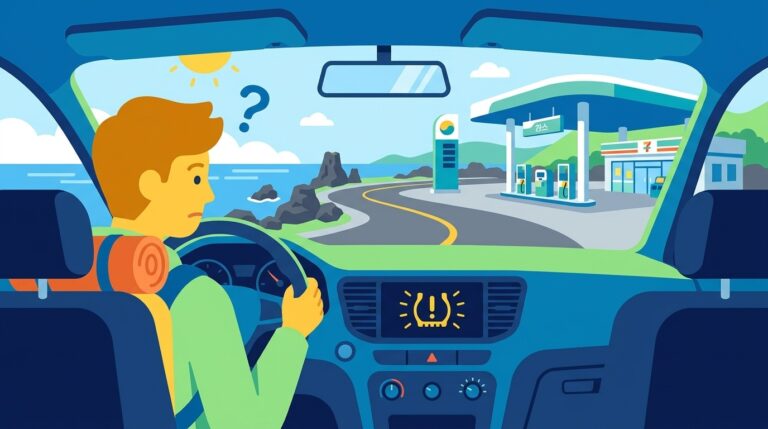
Picture this: You have finally rented that car for your dream road trip in Jeju Island. It is just like a scene from the K-Drama Hometown Cha-Cha-Cha or Welcome to Samdal-ri. The coastal breeze is hitting your face, your favorite K-Pop playlist is blasting, and life is perfect. But suddenly… BEEP! A weird yellow exclamation mark pops up on your dashboard. Low tire pressure!
Panic sets in. You pull into a local Korean gas station (주유소). You see an attendant, but your mind goes blank. How do you say tire pressure? Will they understand if you just point at the wheel and make hissing noises?
Do not worry! This guide is entirely based on the real panicked messages I have received from my students touring Korea. By the time you finish this, you will not only know exactly what to say, but you will sound like a local who has been driving in Korea for years. Let’s dive in!
Phase 2: Core Expressions Deep Dive
Here are the most important phrases you need at an A2 (Beginner) level. They are simple, polite, and highly effective.
1. 타이어 바람 좀 넣으려고요.
- Pronunciation: ta-i-eo ba-ram jom neo-eu-ryeo-go-yo. (The eu sound is like the disgusted sound you make when stepping in gum!)
- Meaning: Literal: I am intending to put some wind in the tire. / Real nuance: I’d like to put some air in my tires.
- K-Culture Moment: You will hear this exact phrase at any local repair shop or gas station. Notice how Koreans use the word ba-ram (wind) instead of the technical term for air pressure. It is folksy, natural, and instantly understood.
- Editor’s Insight: This phrase sounds soft and polite because of the ending -ryeogoyo (planning to / intending to). Instead of demanding help, you are gently stating your intention, which invites the staff to assist you.
- Situation Spectrum:
- Friends (Casual): 🚫 (Too formal)
- Gas Station Staff (Semi-formal/Formal): ✅
- 🤔 Think About It: Why do Koreans prefer using a nature word like wind (바람) for machines instead of a technical word like air (공기)? Does your native language do something similar?
2. 공기 주입기는 어디에 있어요?
- Pronunciation: gong-gi ju-ip-gi-neun eo-di-e is-seo-yo?
- Meaning: Literal: As for the air injector, where is it? / Real nuance: Where is the air pump?
- K-Culture Moment: Most Korean gas stations nowadays are Self (셀프) stations. The staff will not do it for you, so you need to find the machine yourself. This phrase is your best friend when you are wandering around a huge rest stop!
- Editor’s Insight: gong-gi ju-ip-gi is the official name written on the machine. If that is too hard to remember, just point to your tire and ask, 바람 넣는 곳 어디예요? (ba-ram neon-neun got eo-di-ye-yo? – Where is the place to put wind?).
- Situation Spectrum:
- Friends (Casual): ⚠️ (Friends wouldn’t know where it is either!)
- Gas station staff (Formal): ✅
- 🤔 Think About It: Finding things yourself is common in Korea’s fast-paced bali-bali (hurry-hurry) culture. How prevalent are self-service stations in your country?
Phase 3: Textbook vs. Real Korean
Let’s see how the language transforms from the textbook to the streets!
[Asking someone to check your tires]
* 📖 Textbook Korean: 타이어 공기압을 확인해 주십시오. (ta-i-eo gong-gi-ab-eul hwa-gin-hae ju-sip-si-o.) – Please check the tire air pressure.
* 🗣️ Real Korean: 사장님, 여기 타이어 바람 좀 봐주세요! (sa-jang-nim, yeo-gi ta-i-eo ba-ram jom bwa-ju-se-yo!) – Boss, please look at the tire wind here!
* 💡 Why the difference?: Koreans rarely use formal business endings (-sipsio) in everyday life. Also, calling shop owners Sajang-nim (Boss) is the ultimate cheat code for polite, friendly service!
[When you found the machine but it’s not working]
* 📖 Textbook Korean: 이 기계가 작동하지 않습니다. (i gi-gye-ga jak-dong-ha-ji an-seum-ni-da.) – This machine is not operating.
* 🗣️ Real Korean: 이거 안 되는데요? (i-geo an doe-neun-de-yo?) – This isn’t working?
* 💡 Why the difference?: An doeda (not becoming / not working) is the magic verb for anything broken, from a gas pump to a Wi-Fi connection. It is short, practical, and heavily used.
Phase 4: Cultural Context — K-Culture Deep Dive
4-1. Non-verbal Communication: The Art of Nunchi
When you pull up to a gas station in Korea, you need a bit of Nunchi (reading the room). If you see the word 셀프 (Self) in huge letters, do not wait in your car for someone to come! Step out and look for the air pump. If you need to ask for help, do not honk your horn. Step out, find an employee, bow your head slightly, and use two hands to gesture toward your car.
4-2. K-Travel Link: The Jeju Road Trip
Renting a car in Korea (especially Jeju Island) is a must-do for many travelers. In dramas, couples often drive along the beautiful Aewol coast. But reality hits when the rental car’s tire pressure drops due to temperature changes. When returning a rental car in Korea, they usually don’t penalize you for tire pressure, but for your safety, dropping by a gas station is essential. Many gas stations along the Jeju highways offer free air pumps!
Phase 5: Real-Life Roleplay Scenario
Setting: A windy Friday afternoon on a coastal road in Jeju. You pulled into a local gas station because your tire light is blinking. The station owner, a friendly older man, is wiping a window nearby.
Characters:
* YOU: A traveler trying to use your A2 Korean skills.
* Sajang-nim (Owner): A friendly local gas station owner.
Dialogue:
YOU: 저기요, 사장님! 타이어 바람 좀 넣으려고요.
(jeo-gi-yo, sa-jang-nim! ta-i-eo ba-ram jom neo-eu-ryeo-go-yo.)
[Excuse me, boss! I’m intending to put some air in my tires.]
Sajang-nim: 아, 공기압이요? 저쪽 끝에 기계 있어요.
(a, gong-gi-ab-i-yo? jeo-jjok kkeu-te gi-gye is-seo-yo.)
[Ah, tire pressure? The machine is at the far end over there.]
(🎭 Stage Direction: He points towards the car wash area)
YOU: 아, 감사합니다. (You drive over, but the machine is turned off.)
사장님, 이거 안 되는데요?
(sa-jang-nim, i-geo an doe-neun-de-yo?)
[Boss, this isn’t working?]
Sajang-nim: 어이구, 스위치를 안 켰네. 내가 해줄게요. 렌터카예요?
(eo-i-gu, seu-wi-chi-reul an kyeot-ne. nae-ga hae-jul-ge-yo. ren-teo-ka-ye-yo?)
[Oh my, I didn’t turn on the switch. I’ll do it for you. Is it a rental car?]
🔀 YOUR TURN! How do you reply?
* A) 네, 렌터카예요. 감사합니다! (ne, ren-teo-ka-ye-yo. gam-sa-ham-ni-da!)
* B) 아니요, 제 차예요. (a-ni-yo, je cha-ye-yo.)
* C) 대박! 완전 짱! (dae-bak! wan-jeon jjang!)✅ Best Choice: A — It is polite, answers his question directly, and shows gratitude.
⚠️ Choice C Analysis: Saying Daebak (Awesome) to an older shop owner in this context is way too casual and might make you look like a teenager from a 2010s K-Drama!
Phase 6: 10-Second Shadowing Drill
Practice reading these out loud. Pay attention to the pauses (/) and the emotions!
- 🥺 Politely asking for help:
사장님 / 타이어 바람 / 좀 / 넣어주실 수 / 있나요?
(sa-jang-nim / ta-i-eo ba-ram / jom / neo-eo-ju-sil su / in-na-yo?) -
😤 When the machine is broken:
기계가 / 작동을 / 안 해요.
(gi-gye-ga / jak-dong-eul / an hae-yo.)
Phase 7: K-Culture Mini Dictionary
Here are 4 keywords related to driving and gas stations in Korea!
1. 렌터카
* Romanization: ren-teo-ka
* English: Rental Car
* Context: A classic Konglish (Korean-English) word. Do not say rent car, say ren-teo-ka!
2. 셀프 주유소
* Romanization: sel-peu ju-yu-so
* English: Self-service Gas Station
* Context: It is usually cheaper to pump gas yourself. Look for the big yellow or red signs saying 셀프.
3. 사장님
* Romanization: sa-jang-nim
* English: Boss / Store Owner
* Context: The safest and most respectful way to call an adult working at a business, restaurant, or gas station.
4. 휴게소
* Romanization: hyu-ge-so
* English: Highway Rest Stop
* Context: Korean rest stops are legendary! They are practically food theme parks. You can eat tteokbokki, walnut cakes, and check your tire pressure all in one place.
Phase 8: Traveler Survival Kit
If you are driving in Korea, memorize these top 3 survival phrases for the gas station!
🆘 Survival Phrase #1: Pumping Gas
* 🇰🇷 가득 넣어주세요. (ga-deuk neo-eo-ju-se-yo.)
* 🗣️ English meaning: Please fill it up (Full).
* 📍 Where to use: At full-service gas stations.
* 💡 Pro Tip: Older taxi drivers might say Man-ttang (a mix of Chinese and Japanese slang), but Ga-deuk is the standard and polite Korean word!🆘 Survival Phrase #2: Paying
* 🇰🇷 영수증 주세요. (yeong-su-jeung ju-se-yo.)
* 🗣️ English meaning: Please give me the receipt.
* 📍 Where to use: Gas stations, cafes, restaurants.🆘 Survival Phrase #3: Asking for directions
* 🇰🇷 화장실 어디예요? (hwa-jang-sil eo-di-ye-yo?)
* 🗣️ English meaning: Where is the restroom?
* 📍 Where to use: Literally everywhere.
📌 Editor’s Travel Note:
* Apps you need: Google Maps does not work well for driving in Korea. Download Naver Map or Kakao T. They have English versions!
* Payment: Most gas pumps take credit cards only. T-money cards usually do not work for pumping gas.
Phase 9: Critical Thinking — “One Step Deeper”
🧠 Think Deeper: Korean in the Global Era (Konglish)
When you drive in Korea, you will notice something fascinating: many car-related words are English, but not quite English. The steering wheel is called a handle (핸들), the horn is a claxon (클랙슨/크락션), the rearview mirror is a room mirror (룸미러), and putting air in is often done at a Self (셀프) station.
As Korea rapidly modernized and adopted Western technology, they absorbed English words but adapted them to fit the Korean tongue and efficiency. It is a perfect example of how language evolves for practicality.💬 Your Turn: Does your language have words borrowed from English that have completely changed their meaning? Share them in the comments!
Phase 10: FAQ & Avoiding Misunderstandings
Q: Can I just honk my horn to get the attendant’s attention like in the movies?
No! Honking is considered aggressive in Korea. Instead, roll down your window or step out of the car, make eye contact, and wave slightly.
Q: At a Self gas station, can I ask the staff to pump air for me?
Yes and no. They usually won’t pump your gas, but if you politely say you don’t know how to use the air pump (공기 주입기를 잘 못 쓰겠어요), they are usually very kind and will come over to help you.
❌ Common Mistake #1: Yelling “야!” (Hey!) or “아저씨!” (Mister!) forcefully at the staff.
✅ Do this instead: Call them 사장님 (Sajang-nim – Boss) politely. It instantly creates a friendly dynamic!
Phase 11: Summary & Action Items
- One-Liner Summary: To check your tire pressure, politely find the owner and say, “타이어 바람 좀 넣으려고요!”
-
Action Mission 3 Steps:
- 🥉 Bronze (Solo): Stand in front of your mirror and practice saying “Sajang-nim! Ta-i-eo ba-ram jom neo-eu-ryeo-go-yo!” three times with a friendly smile.
- 🥈 Silver (Online): Write a comment below using the word 사장님 in a sentence!
- 🥇 Gold (Real World): If you are in Korea, go to a gas station or repair shop and successfully locate the 공기 주입기 (Air pump) using today’s phrase!
- K-Culture Mission: Open Naver Map, search for a random gas station in Jeju Island, use the Street View feature to look around, and see if you can spot the word 셀프 (Self) on the signs!
Phase 12: Quiz — Interactive Challenge
1. Fill in the blank:
You want to put air in your tires. You say: “타이어 ( ____ ) 좀 넣으려고요.”
A) 물 (Water)
B) 바람 (Wind)
C) 불 (Fire)
2. Situational Judgment:
You are at a gas station. The machine is broken. What is the most natural Korean thing to say to the boss?
A) 이 기계가 작동하지 않습니다. (Formal/Textbook)
B) 사장님, 이거 안 되는데요? (Natural)
C) 기계 나빠요! (The machine is bad!)
3. True or False – K-Culture Edition:
In Korea, it is polite to honk your horn to call the gas station attendant. (T/F)
(Answers: 1. B, 2. B, 3. False)
Did you enjoy this guide? Next time you are driving in Korea, you won’t need to panic when that little tire light turns on! Safe travels! 🚗💨
Frequently Asked Questions (FAQ)
Q: What does "타이어 바람 좀 넣으려고요." mean in Korean and how do you pronounce it?
A: In Korean, "타이어 바람 좀 넣으려고요." is pronounced [ta-i-eo ba-ram jom neo-eu-ryeo-go-yo. (The eu sound is like the disgusted sound you make when stepping in gum!] and means: Literal: I am intending to put some wind in the tire. / Real nuance: I'd like to put some air in my tires.
Q: What does "공기 주입기는 어디에 있어요?" mean in Korean and how do you pronounce it?
A: In Korean, "공기 주입기는 어디에 있어요?" is pronounced [gong-gi ju-ip-gi-neun eo-di-e is-seo-yo?] and means: Literal: As for the air injector, where is it? / Real nuance: Where is the air pump?






