

Hello! It’s your Daily Hangul Editor.
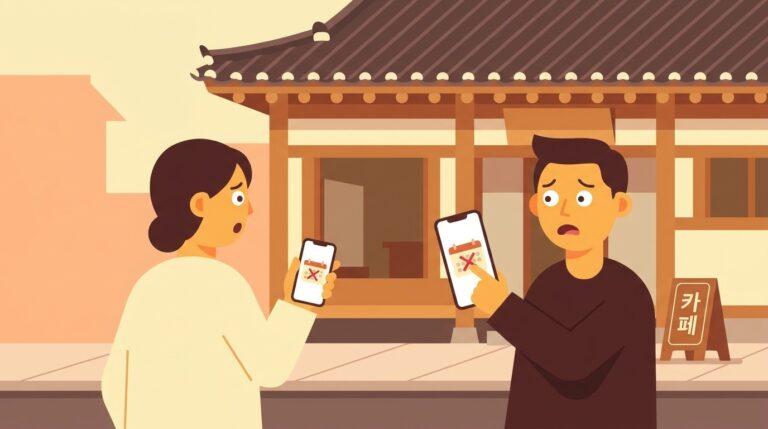
Imagine this: You are watching a K-Drama. The main character suddenly freezes on a busy street in Seoul. The camera zooms in on their horrified face. The background music drops. They slowly check their phone and realize… they completely forgot their blind date (소개팅 – sogaeting) or a crucial meet-up with a scary senior at college!
Has this ever happened to you in real life? We are all human, and sometimes we forget things. But when you are in Korea, simply translating “I’m sorry” into a robotic textbook phrase won’t cut it. To truly mend the situation and show your sincerity, you need to use the right level of politeness and the right cultural nuances.
This guide is transparently based on real, panicked messages I’ve received from my students over the years. Let’s learn how to apologize like a true cultural insider!
Phase 2: Core Expressions Deep Dive
1. 제가 깜빡했어요 (jega kkamppakaesseoyo)
- Pronunciation: je-ga kkam-ppak-haess-eo-yo. The kkam-ppak part sounds like a very tight, tense ‘gahm-pahk’. Imagine the quick, sharp sound of a camera shutter snapping shut!
- Meaning: Literal: I blinked. / Real nuance: It completely slipped my mind!
- K-Culture Moment: This is the ultimate “I had a brain fart” expression. You’ll hear this all the time in Korean offices when a coworker forgets to send an email, or among friends when someone forgets to bring a promised item.
- Editor’s Insight: This phrase feels very human and relatable. It admits fault but in a way that shows it was an honest, momentary lapse of memory, not a deliberate act of ignoring the person.
- Situation Spectrum:
- Casual (Friends): ✅ (내가 깜빡했어!)
- Semi-formal (Co-workers): ✅ (제가 깜빡했어요)
- Formal (Strict Boss/Elders): 🚫 (Too casual. Use 착각했습니다 instead)
- 🤔 Think About It: Why does a word originally meaning “to blink” (깜빡하다) evolve to mean “forgetting”? Does your native language have a physical action that represents a mental lapse?
2. 날짜를 착각했어요 (naljjareul chakgakaesseoyo)
- Pronunciation: nal-jja-reul chak-gak-haess-eo-yo. Chak-gak sounds like ‘chuck-gack’. Make the consonants sharp!
- Meaning: Literal: I had an illusion about the date. / Real nuance: I mixed up the dates / I got the date wrong.
- K-Culture Moment: You show up at a K-Pop concert venue, but it’s completely empty. You check your ticket… the concert is next week. You just had a 착각!
- Editor’s Insight: Use this when you didn’t forget the meeting entirely, but your brain confidently stored the wrong information. It sounds slightly more professional than 깜빡했어요.
- Situation Spectrum:
- Casual (Friends): ✅
- Semi-formal (Co-workers): ✅
- Formal (Strict Boss/Elders): ✅ (날짜를 착각했습니다)
- 🤔 Think About It: Koreans heavily rely on shared schedules. How important is punctuality and date accuracy in your culture compared to Korea’s fast-paced society?
3. 진짜 미안, 어떻게 사과해야 할지 모르겠어 (jinjja mian, eotteoke sagwahhaeya halji moreugesseo)
- Pronunciation: jin-jja mi-an, eo-tteo-ke sa-gwa-hae-ya hal-ji mo-reu-gess-eo.
- Meaning: I am so sorry, I don’t even know how to apologize.
- K-Culture Moment: When you commit a massive blunder—like standing up your best friend on their birthday—this is the dramatic, heartfelt line you drop while holding their hands.
- Editor’s Insight: This is heavy-duty apology material. It shows deep remorse. Don’t use this if you just forgot to buy milk; save it for real relationship-saving moments.
- Situation Spectrum:
- Casual (Friends): ✅
- Semi-formal (Co-workers): ⚠️ (A bit too emotional for work)
- Formal (Strict Boss/Elders): 🚫
Phase 3: Textbook vs. Real Korean
Apologizing to a close friend
* 📖 Textbook Korean: 저는 약속을 잊었습니다. 죄송합니다. (I forgot our appointment. I am sorry.)
* 🗣️ Real Korean: 헐, 미안! 내가 날짜를 아예 깜빡했어! (OMG, sorry! I completely blanked on the date!)
* 💡 Why is it different?: Friends use exclamation words like 헐 (Heol) to show genuine shock at their own mistake, making the apology feel authentic rather than robotic.
Suggesting a new time
* 📖 Textbook Korean: 다른 날로 일정을 변경해도 될까요? (May I change the schedule to another day?)
* 🗣️ Real Korean: 혹시 다음 주로 미뤄도 될까? 밥은 내가 쏠게! (Can we push it to next week? I’ll buy the food!)
* 💡 Why is it different?: In Korean culture, a sincere apology for breaking plans is almost always followed by offering to pay for the next meal as a peace offering.
Phase 4: Cultural Context — K-Culture Deep Dive
4-1. The Non-Verbal Nunchi (눈치)
When you forget a date, your words are only 50% of the apology. The other 50% is your body language. Do not make direct, defiant eye contact while apologizing. Lower your head slightly, widen your eyes in realization, and use a distressed tone. Korean Nunchi (the art of reading the room) dictates that the person who messed up must look genuinely flustered. If you look too calm, the other person might think you don’t care about them!
4-2. K-Drama Trope: The Rain and The Apology Meal
Have you noticed a common K-Drama trope? When someone forgets a date, the person waiting is almost always caught in a sudden downpour of rain without an umbrella. When the apologizer finally realizes their mistake, they run desperately through the streets. Once they reunite, the apology isn’t just a simple “I’m sorry.” The guilty party will treat the other person to a warm meal—usually Samgyeopsal (pork belly) and Soju, or a fancy dinner—saying, “오늘 내가 다 살게! (I’ll buy everything today!)” Food is the ultimate love language and apology tool in Korea!
Phase 5: Real-Life Roleplay Scenario
Setting: Friday night, 7:30 PM. A loud, crowded Samgyeopsal restaurant near Gangnam Station. The smell of roasted pork is in the air. You are at your hotel, in your pajamas. You thought your dinner with Min-su was tomorrow. Your phone rings. It’s Min-su.
Characters:
* YOU: An expat who has been in Korea for 3 months. You love Korean BBQ but are terrible with dates.
* Min-su (29): Your Korean language exchange partner. Friendly, but currently sitting alone in front of a hot grill.
Dialogue:
Min-su: 여보세요? 어디쯤이에요? 고기 굽기 시작할까요?
(yeoboseyo? eodijjeumieyo? gogi gupgi sijakalkkayo?)
[Hello? Where are you? Should I start grilling the meat?]
YOU: 네? 고기요? 우리 내일 만나는 거 아니었어요?
(ne? gogiyo? uri naeil mannaneun geo anieosseoyo?)
[What? Meat? Weren’t we meeting tomorrow?]
Min-su: 헐… 오늘 금요일이잖아요. 우리 오늘 만나기로 했는데요?
(heol… oneul geumyoilijanayo. uri oneul mannagiro haenneundeyo?)
[OMG… Today is Friday. We agreed to meet today, though?]
YOU: 헉! 정말 죄송해요. 제가 날짜를 완전히 착각했어요!
(heok! jeongmal joesonghaeyo. jega naljjareul wanjeonhi chakgakaesseoyo!)
[Gasp! I am so sorry. I completely mixed up the dates!]
Min-su: 아… 그래요? (Slightly disappointed tone) 그럼 오늘 못 나오는 거예요?
(a… geuraeyo? geureom oneul mot naoneun geoeyo?)
[Ah… really? Then you can’t come out today?]
🔀 Your Turn! How should you respond?
* A) 네, 미안해요. 맛있게 드세요! (Yes, sorry. Enjoy your meal!)
* B) 너무 미안해요. 제가 지금 바로 택시 타고 갈게요! 오늘 고기는 제가 쏠게요! (I’m so sorry. I will take a taxi right now! I’m paying for the meat today!)
* C) 내일 만나요! (Let’s meet tomorrow!)
✅ Best Choice: B — If you are relatively close by, showing the effort to rush over (and offering to pay) is the ultimate way to save the relationship.
⚠️ Choice A Analysis: Telling someone who has been waiting for you to “Enjoy your meal” alone at a K-BBQ place is a cultural disaster. K-BBQ is meant to be eaten together!
Min-su: 오, 진짜요? 알겠어요! 천천히 조심히 와요!
(o, jinjjayo? algesseoyo! cheoncheonhi josimhi wayo!)
[Oh, really? Got it! Take your time and come safely!]
Phase 6: 10-Second Shadowing Drill
Read this out loud. Pay attention to the pauses and emotion tags!
- 😱 헉! / 정말 / 죄송해요! / 제가 날짜를 / 깜~~~빡했어요!
- (heok! / jeongmal / joesonghaeyo! / je-ga nal-jja-reul / kkam~~~ppak-haess-eo-yo!)
- Pro tip: Notice how we stretch the “kkam~~~” to emphasize how completely we forgot!
Phase 7: K-Culture Mini Dictionary
1. 눈치 (nunchi)
* English: The art of reading the room / social intelligence.
* Context: When apologizing in Korea, having good ‘nunchi’ means knowing exactly how upset the other person is and tailoring your apology to match the severity of your mistake.
2. 약속 (yaksok)
* English: Promise / Appointment / Plans.
* Context: In English, an “appointment” sounds like a doctor’s visit. In Korea, any scheduled meeting with a friend, date, or colleague is a 약속. Breaking it is taken seriously!
3. 핑계 (pinggye)
* English: Excuse.
* Context: Koreans value taking responsibility. If you forgot the date, just admit it. Making up a 핑계 often makes the situation worse!
4. 쏘다 (ssoda)
* English: To shoot (Literal) / To treat someone to a meal (Slang).
* Context: The most common way to make up for a mistake in Korea. “내가 쏠게” (I’ll treat you) is the ultimate peace offering.
Phase 8: Traveler’s Survival Kit
Even as a traveler, you might get your dates mixed up for a Hanbok rental, a K-Pop agency tour, or a Michelin restaurant reservation.
🆘 Essential Survival Phrases
* 🇰🇷 “예약 날짜를 착각했어요. 혹시 내일로 변경 가능할까요?”
* (yeyak naljjareul chakgakaesseoyo. hoksi naeillo byeonggyeong ganeunghalkkayo?)
* English: I mixed up the reservation date. Is it possible to change it to tomorrow?
* 📍 Where to use: Hotels, salons, clinics, tour agencies.
* 🇰🇷 “제가 늦어서 정말 죄송합니다.”
* (jega neujeoseo jeongmal joesonghamnida.)
* English: I am so sorry for being late.
* 📍 Where to use: When you realize your mistake but are rushing to get there anyway.
📌 Editor’s Travel Note:
* No-Show Culture: Korea is becoming very strict about “No-Shows” at restaurants and clinics. If you realize you forgot an appointment or booked the wrong date, ALWAYS call or message them to cancel or apologize, even if it’s late. Many places will kindly rebook you if you are polite!
* Translation Apps: Papago is your best friend here. It understands polite Korean contexts much better than other translators.
Phase 9: Critical Thinking — “One Step Deeper”
🧠 Think Deeper: Food & Identity (음식과 정체성)
Why is offering to buy food (“내가 쏠게”) the default apology for missing a date in Korea? In traditional Korean culture, sharing a meal is the foundation of community and affection. The word for family members, 식구 (sikgu), literally means “mouths that eat together.” When you break an appointment, you aren’t just messing up a schedule; you are breaking the social bond of sharing time and sustenance. By offering to buy the next meal, you are actively repairing that communal bond.
💬 Your Turn: Does your culture use food as an apology? Or do you have another go-to method for making peace? Share your thoughts in the comments!
Phase 10: FAQ & Avoiding Misunderstandings
- Q: Can I use “깜빡했어요” with my boss?
- A: NO. It sounds too casual, almost like you didn’t take the meeting seriously. If you forget a work meeting, use formal language: “제가 일정을 착각했습니다. 죄송합니다” (I mistook the schedule. I apologize.)
- Q: Should I text or call to apologize for missing a date?
- A: CALL. If you completely forgot a date and the person is waiting, a text message shows bad nunchi. A panicked, sincere phone call is required to convey your genuine regret.
❌ Common Mistake #1: Saying “미안해” (mianhae) to an older person or a senior at work.
✅ Do this instead: Always use “죄송합니다” (joesonghamnida) when apologizing to elders, seniors, or staff members. “미안해” is strictly for close friends and people younger than you!
Phase 11: Summary & Action Items
One-Liner Summary: When you forget a date, admit it honestly with “깜빡했어요” or “착각했어요,” and be prepared to buy them dinner!
Action Mission:
* 🥉 Bronze (Solo): Look in the mirror, make your most apologetic face, and say “헉! 제가 깜빡했어요!” three times.
* 🥈 Silver (Online): Write a short comment below in Korean apologizing to your favorite K-Pop idol for missing their live stream!
* 🥇 Gold (Real Life): The next time you make a small mistake with a Korean friend, try using the phrases you learned today instead of English!
🎬 K-Culture Mission:
Watch a K-Drama this week. Pay close attention to scenes where characters are running late or miss a meeting. Notice if they offer to buy food to apologize!
Phase 12: Interactive Quiz
1. Situational Judgment: You were supposed to meet your language partner who is 2 years older than you. You completely forgot. What is the most natural thing to text them while you run to the subway?
* A) 저는 약속을 잊었습니다.
* B) 헐, 미안! 내가 깜빡했어!
* C) 정말 죄송해요. 제가 깜빡했어요! 지금 바로 갈게요!
* (Answer: C. A is textbook robot, B is too casual for someone older, C is perfectly polite and shows urgency!)
2. True or False – K-Culture Edition: “If you forget a reservation at a Korean restaurant, it’s totally fine to just ignore it and not call them.”
* (Answer: False! Korea strongly discourages ‘No-shows’. Always call to apologize and cancel properly!)







