

Hello! I am the lead editor of Daily Hangul.
Picture this: You just arrived in Seoul after a 12-hour flight. You are at a trendy boutique hotel in Hongdae. The receptionist hands you a key card and smiles, saying, 손님, 방은 삼백사호입니다 (Sonnim, bangeun sambaeksa-ho-imnida). You nod confidently, take the card, and walk to the elevator. Then you look at the card… no numbers, just a QR code. Wait, what room did they just say? Three-something?
If you do not know Sino-Korean numbers, finding your hotel room or an Airbnb can feel like an escape room challenge. But do not worry! This guide is built from the real struggles of my beginner students. By the end of this post, you will read Korean room numbers naturally like a local.
Phase 2: Core Expressions Deep Dive
1. 층 (Floor)
- Pronunciation: cheung (Sounds like the start of “chew” but ending with an “ng” like in “song”)
- Meaning: Floor or Level
- K-Culture Moment: In K-Dramas, when the CEO steps into the elevator, the secretary confidently presses the top button and says, 대표님, 삼십층입니다 (Daepyonim, samsip-cheung-imnida – Boss, it is the 30th floor).
- Editor’s Insight: We always use Sino-Korean numbers (일, 이, 삼…) for floors. Never use native Korean numbers (하나, 둘) here!
- Situation Spectrum:
- Casual: ✅
- Semi-formal: ✅
- Formal: ✅
- 🤔 Think About It: Why does Korean have two number systems (Native and Sino)? How does your native language handle counting items versus naming locations?
2. 호 (Room)
- Pronunciation: ho (Sounds like Santa’s “Ho ho ho!”)
- Meaning: Room number
- K-Culture Moment: You order late-night fried chicken to your hotel. The delivery rider calls and asks, 몇 호실이세요? (Myeot hosil-iseyo? – Which room are you in?).
- Editor’s Insight: While 방 (bang) means room, 호 (ho) is used specifically for the room number.
- Situation Spectrum:
- Casual: ✅
- Semi-formal: ✅
- Formal: ✅
- 🤔 Think About It: Koreans often add 실 (sil) to make 호실 (hosil). Adding syllables often makes words sound more polite and formal in Korean!
3. 이백사호 (Room 204)
- Pronunciation: i-baek-sa-ho
- Meaning: Room 204 (Literally: Two-hundred-four-room)
- K-Culture Moment: In dramas like Crash Course in Romance, finding the right apartment is crucial. If you live in Room 204, you read it as the full number 204 (i-baek-sa), not digit by digit.
- Editor’s Insight: English speakers usually say “Two-oh-four.” In Korean, we say “Two-hundred four.” This is the biggest mental switch you need to make!
- Situation Spectrum:
- Casual: ✅
- Semi-formal: ✅
- Formal: ✅
Phase 3: Textbook vs. Real Korean
[Reading Room 305]
* 📖 Textbook Korean: 삼 영 오 호 (sam yeong o ho – Three zero five room)
* 🗣️ Real Korean: 삼백오호 (sambaego-ho – Three-hundred five room)
* 💡 Why is it different?: It is much faster and more natural to read it as hundreds rather than individual digits.
[Saying ‘First Floor’]
* 📖 Textbook Korean: 일층 (il-cheung – First floor)
* 🗣️ Real Korean: 로비 (lobi – Lobby)
* 💡 Why is it different?: Just like in English, the first floor of a hotel or office is commonly referred to by the English loanword Lobby!
Bottom Note: For A1 beginners, just remember the word 백 (baek – hundred). It will solve 90% of your room number problems!
Phase 4: Cultural Context — K-Culture Deep Dive
4-1. Non-verbal Communication
When listening to numbers like 일 (1 – il) and 이 (2 – i), they sound very similar over the phone or behind a mask. Koreans will often hold up one or two fingers to clarify, or emphasize the vowel sound. Pay attention to their hands!
4-2. The Missing 4th Floor (K-Travel Connection)
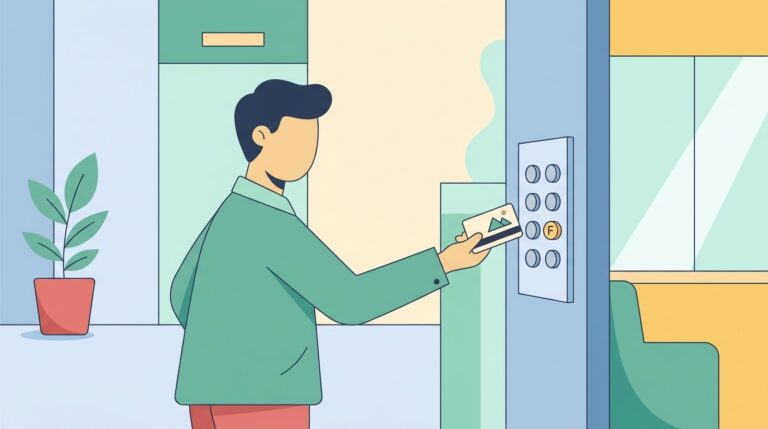
Have you ever been in a Korean elevator and noticed there is no button for the 4th floor? Instead, there is an F. This is a huge part of Korean culture! The Sino-Korean number 4 is 사 (sa). The Chinese character for “death” is also pronounced 사 (sa). Because of this superstition, older buildings skip the 4th floor entirely, and modern buildings often replace the 4 button with an “F” (for Four). So if your room is 501, you might actually be on the 4th physical floor!
Phase 5: Real-life Roleplay Scenario
Setting: 3:00 PM. The lobby of a sleek hotel in Myeongdong. You have just handed over your passport for check-in.
Characters:
– YOU: A traveler excited to explore Seoul.
– Ji-eun (20s): The polite and professional hotel receptionist.
Ji-eun: 여권 확인 감사합니다. 예약하신 방은 칠백팔호입니다.
(Yeogwon hwagin gamsahamnida. Yeyakasin bangeun chilbaekpal-ho-imnida.)
[Thank you for confirming your passport. Your reserved room is 708.]
YOU: 아, 네! 감사합니다. 몇 층이에요?
(A, ne! Gamsahamnida. Myeot cheung-ieyo?)
[Ah, yes! Thank you. What floor is it?]
Ji-eun: 칠 층입니다. 엘리베이터는 저쪽에 있습니다.
(Chil cheung-imnida. Ellibeiteoneun jeojjoge itseumnida.)
[It is the 7th floor. The elevator is over there.]
YOU: 조식은 몇 층이에요?
(Josigeun myeot cheung-ieyo?)
[What floor is breakfast?]
Ji-eun: 조식은 이 층 식당에서 드실 수 있습니다.
(Josigeun i cheung sikdangeseo deusil su itseumnida.)
[You can have breakfast at the restaurant on the 2nd floor.]
🔀 Your Turn! How do you reply?
– A) “칠백팔호… 이 층… 오케이!” (Chilbaekpal-ho… i cheung… okei!)
– B) “네, 감사합니다. 수고하세요!” (Ne, gamsahamnida. Sugohaseyo!)
– C) “대박! 배고파요.” (Daebak! Baegopayo.)✅ Best Choice: B — “Yes, thank you. Keep up the good work!” This is the perfect, polite way to end a service interaction in Korea.
⚠️ Choice C Analysis: “Daebak” (Awesome/Crazy) is way too casual for a hotel receptionist!
Phase 6: 10-Second Shadowing Drill
Let’s practice! Follow the intonation and pauses.
😊 방은 / 칠백이호 / 입니다. (bangeun / chil-baek-i-ho / imnida.)
[The room is 702.]
🤔 엘리베이터는 / 몇 층이에요? (ellibeiteoneun / myeot cheung-ieyo?)
[What floor is the elevator?]
😤 아, / 사 층이 아니라 / 에프(F) 층이네요! (a, / sa cheungi anira / epeu cheung-ineyo!)
[Ah, it’s not the 4th floor, it’s the F floor!]
Phase 7: K-Culture Mini Dictionary
1. 프런트
* Romanization: peureonteu
* English: Front desk / Reception
* Context: Konglish for the hotel reception area. Always useful when you need help!
2. 천사호 (1004호)
* Romanization: cheonsa-ho
* English: Room 1004 / Angel Room
* Context: 1004 is pronounced “cheon-sa”, which also means “Angel” in Korean. It is considered a very lucky and cute room number!
3. 호실
* Romanization: hosil
* English: Room (formal)
* Context: Used in hotels, hospitals, and office buildings instead of just “bang” (room).
4. 눈치
* Romanization: nunchi
* English: Social sense / reading the room
* Context: If you forget your room number and block the hotel hallway looking at your phone, you might need to use your nunchi to step aside for others!
Phase 8: Traveler Survival Kit
🆘 Survival Expressions TOP 3
1. 🇰🇷 “몇 층이에요?” (Myeot cheung-ieyo?)
– 🗣️ Guide: [Myuht choong-ee-eh-yo?]
– 📍 Where: Elevator, Hotel lobby, Department store
- 🇰🇷 “방 키를 잃어버렸어요.” (Bang kireul ileobeoryeosseoyo.)
– 🗣️ Guide: [Bang key-reul eel-uh-buh-ryuh-sso-yo.]
– 📍 Where: Front desk
- 🇰🇷 “체크아웃 할게요.” (Chekeu-aut halgeyo.)
– 🗣️ Guide: [Check-out hal-geh-yo.]
– 📍 Where: Leaving the hotel📌 Editor’s Travel Note
– Map Apps: Google Maps does not work well for walking in Korea. Download Naver Map or KakaoMap!
– Elevator Etiquette: Koreans are fast! The “Close Door” (닫힘) button in Korean elevators is often worn out because people press it so much.
Phase 9: Critical Thinking Corner — “One Step Deeper”
Language & Superstition (언어와 미신)
Why do Koreans replace the 4th floor with an “F”? This shows how deeply Hanja (Chinese characters) influence Korean culture and psychology. The fear of the number 4 (Tetraphobia) is common in East Asia because of its phonetic similarity to the word for “death” (사/死). It is fascinating how a simple linguistic coincidence physically changes the architecture and elevator buttons of an entire country!
💬 Your Turn: Are there any numbers in your culture that are considered unlucky? Do buildings in your country skip the 13th floor? Share in the comments!
Phase 10: FAQ & Preventing Mistakes
- “Can I just say my room number in English?”
Yes, mostly! In big hotels in Seoul, English is perfectly fine. But if you visit a cozy Hanok stay in Jeonju or a local motel, knowing Sino-Korean numbers is a lifesaver. - “Is it rude to ask someone’s room number?”
Yes, for privacy and safety, do not ask a stranger’s room number. Only hotel staff or delivery riders should ask 몇 호실이세요?
❌ Mistake #1: Using Native numbers (하나, 둘, 셋) for floors. (e.g., 하나 층)
✅ Fix: Always use Sino-Korean numbers! (일 층, 이 층)❌ Mistake #2: Reading room numbers digit by digit. (이 영 사 호)
✅ Fix: Read them as hundreds! (이백사호 – 204호)
Phase 11: Summary & Action Items
One-Liner Summary: Use Sino-Korean numbers and read them in hundreds (백) to find your room (호) and floor (층) like a local!
Action Mission 3 Steps:
* 🥉 Bronze (Solo): Say your own home or apartment number in Korean out loud.
* 🥈 Silver (Online): Write your dream hotel room number in the comments below using Hangeul!
* 🥇 Gold (Real Life): Next time you are in an elevator, silently translate the floor numbers into Korean as they light up.
K-Culture Mission: Watch a K-Drama today and look closely at the elevator buttons. Can you spot the “F” instead of the “4”?
Phase 12: Quiz — Interactive Challenge
1. Fill in the Blank: You are on the 5th floor. You press the button and say, “______ 층입니다.”
* A) 다섯 (Daseot)
* B) 오 (O)
2. True or False: Room 1004 is considered lucky because it sounds like the Korean word for “Angel”.
3. Situational Judgment: You want to say Room 305. How should you pronounce it?
* A) 삼 영 오 호 (Sam yeong o ho)
* B) 삼백오호 (Sambaego-ho)
(Scroll down for answers!)
Click here for Answers!
1: B (Always use Sino-Korean for floors!), 2: True (1004 is Cheon-sa, meaning Angel), 3: B (Read room numbers in hundreds!)
Frequently Asked Questions (FAQ)
Q: What does "층 (Floor)" mean in Korean and how do you pronounce it?
A: In Korean, "층 (Floor)" is pronounced [cheung (Sounds like the start of "chew" but ending with an "ng" like in "song"] and means: Floor or Level
Q: What does "호 (Room)" mean in Korean and how do you pronounce it?
A: In Korean, "호 (Room)" is pronounced [ho (Sounds like Santa's "Ho ho ho!"] and means: Room number
Q: What does "이백사호 (Room 204)" mean in Korean and how do you pronounce it?
A: In Korean, "이백사호 (Room 204)" is pronounced [i-baek-sa-ho] and means: Room 204 (Literally: Two-hundred-four-room)







