

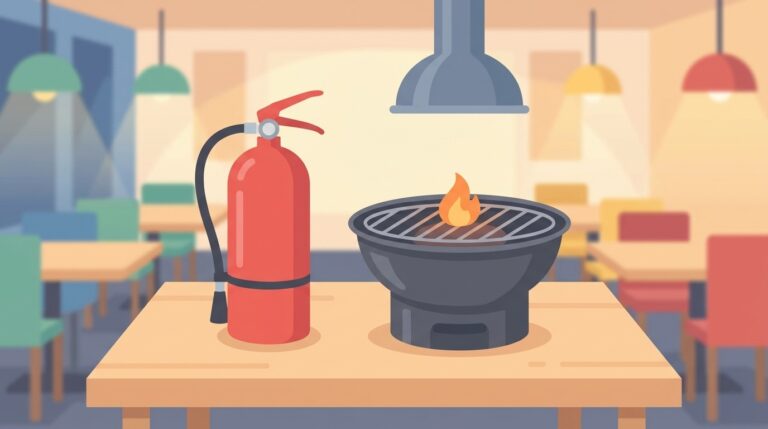
Phase 1: The K-BBQ Flare-Up
Hello! I’m your Daily Hangul Editor, your personal guide to not just surviving, but thriving in Korea!
Imagine this: It’s Friday night in Seoul. You are at a bustling K-BBQ joint in Hongdae. The air is thick with the delicious smell of sizzling pork belly (samgyeopsal). But suddenly, too much grease drips onto the charcoal, and WHOOSH! A massive flame shoots up from your grill.
In a K-Drama, this is the moment time slows down, and the handsome lead throws his jacket over the fire. But in real life? The restaurant is loud, people are chatting, and you need to act fast. You want to shout “Fire!” or ask “Where’s the fire extinguisher?!” but your mind goes blank.
Don’t worry! Today, we are learning the absolute essential A1 (Beginner) survival phrases for fire emergencies. Knowing these won’t just make you sound like a local—it could literally save your life (or at least save your dinner). Let’s dive in!
Phase 2: Core Expressions Deep Dive
1. 불이야! (Fire!)
- Pronunciation: bul-i-ya! [Sounds like: bull-ee-ya!]
- Meaning: Literal: It is fire! / Real nuance: Fire!
- K-Culture Moment: You’ve definitely seen this in a thriller K-Drama. Someone runs down a smoky hallway, banging on doors and screaming “불이야!” at the top of their lungs to wake up the neighbors.
- Editor’s Insight: This is the universal, urgent cry for a fire. Notice it doesn’t end in a polite “~요” (yo). In life-or-death emergencies, Koreans completely drop formal language. You just need to be loud!
- Situation Spectrum:
- 친구 사이(Casual): ✅
- 직장 동료(Semi-formal): ✅
- 직장 상사·어른(Formal): ✅ (Survival beats politeness!)
- 🤔 Think About It: Why do you think Korean society, which strictly values polite language for elders, entirely drops those rules during an emergency? Does your culture do something similar?
2. 소화기 어디 있어요? (Where is the fire extinguisher?)
- Pronunciation: so-hwa-gi eo-di is-seo-yo? [Sounds like: so-hwa-gee uh-dee ee-soh-yo?]
- Meaning: Literal/Real nuance: Where is the fire extinguisher?
- K-Culture Moment: If you walk into any Korean subway station or apartment building, you will see bright red fire extinguishers (so-hwa-gi) everywhere. Korea takes fire safety very seriously after historical incidents, so they are incredibly easy to spot.
- Editor’s Insight: “어디 있어요?” (eo-di is-seo-yo?) is the magic A1 phrase. It means “Where is…?” You can put anything in front of it. Bathroom? Hwajangsil eo-di is-seo-yo? Fire extinguisher? Sohwagi eo-di is-seo-yo? Learn this pattern!
- Situation Spectrum:
- 친구 사이(Casual): ⚠️ (Drop the ‘yo’ and just say ‘소화기 어디 있어?’)
- 직장 동료(Semi-formal): ✅
- 직장 상사·어른(Formal): ✅
- 🤔 Think About It: When you travel to a new country, do you check where the emergency exits and tools are?
3. 도와주세요! (Help me!)
- Pronunciation: do-wa-ju-se-yo! [Sounds like: doh-wah-joo-seh-yo!]
- Meaning: Literal: Please give me help! / Real nuance: Help me!
- K-Culture Moment: From K-Pop stars playing scary prank games on variety shows to dramatic historical K-Dramas, “도와주세요” is everywhere.
- Editor’s Insight: While “불이야!” is specific to fires, “도와주세요!” is your universal SOS. If you freeze and forget the word for fire extinguisher, just yell this and point at the fire.
- Situation Spectrum:
- 친구 사이(Casual): ⚠️ (Say ‘도와줘!’ do-wa-jwo!)
- 직장 동료(Semi-formal): ✅
- 직장 상사·어른(Formal): ✅
- 🤔 Think About It: “주세요” (ju-se-yo) means “please give.” Why is asking for help framed as “giving” a favor in Korean?
Phase 3: Textbook vs. Real Korean
[Shouting for a Fire]
* 📖 Textbook Korean: 화재가 발생했습니다. (hwa-jae-ga bal-saeng-haet-seum-ni-da. – A fire has occurred.)
* 🗣️ Real Korean: 불이야! (bul-i-ya! – Fire!)
* 💡 Why the difference?: Textbooks teach news-anchor vocabulary. In reality, saving breath and time is crucial. Short, punchy words save lives.
[Asking for the Extinguisher]
* 📖 Textbook Korean: 소화기를 주십시오. (so-hwa-gi-reul ju-sip-si-o. – Please provide the fire extinguisher.)
* 🗣️ Real Korean: 저기요! 소화기 어디 있어요?! (jeo-gi-yo! so-hwa-gi eo-di is-seo-yo?! – Excuse me! Where is the fire extinguisher?!)
* 💡 Why the difference?: You rarely ask someone to hand you the heavy extinguisher; you ask where it is so you can grab it, usually starting with “저기요” to grab the staff’s attention.
Phase 4: Cultural Context — K-Culture Deep Dive
4-1. Non-Verbal Tips: Ditch the “Nunchi”
In Korea, Nunchi (눈치) is the art of reading the room. Normally, you shouldn’t shout or cause a scene in a restaurant. But in an emergency? Throw Nunchi out the window. Point directly, shout loudly, and wave your arms. Koreans will appreciate your quick action over your quiet politeness when the grill is catching fire!
4-2. K-Travel & Safety Culture Connection
Korea is extremely safe, but accidents happen. The emergency number for Fire and Ambulance in Korea is 119 (not 911 or 999). When you call 119, they often have translation services available for English speakers. Also, when traveling on the Seoul Subway, you will notice safety masks and flashlights in glass cabinets alongside the fire extinguishers. This is a unique K-Travel safety feature prepared for underground emergencies.
Phase 5: Real-Life Roleplay Scenario
Setting: Friday night, 7:30 PM. A lively Samgyeopsal (K-BBQ) restaurant in Gangnam. K-Pop is blasting. You are eating with your Korean friend, Min-su. Suddenly, a huge grease fire erupts on your grill!
Characters:
* YOU: An excited traveler enjoying your first authentic BBQ.
* Min-su: (28, your Korean friend) Loves food, but panics easily in stressful situations.
Min-su: Whoa, this pork belly is amazing! 🥩
(우와, 이 삼겹살 진짜 대박이다!)
u-wa, i sam-gyeop-sal jin-jja dae-bak-i-da!
YOU: Yes, it is! But wait, look at the grill!
(응, 맞아! 근데 잠깐만, 불판 좀 봐!)
eung, ma-ja! geun-de jam-kkan-man, bul-pan jom bwa!
Min-su: Huh? Oh no, the grease!
(어? 헐, 기름이!)
eo? heol, gi-reum-i!
YOU: The flame is getting too big!
(불이 너무 커지고 있어!)
bul-i neo-mu keo-ji-go is-seo!
Min-su: Water! Pour some water!
(물! 물 좀 부어봐!)
mul! mul jom bu-eo-bwa!
YOU: No! Never put water on a grease fire!
(안 돼! 기름에 물 부으면 절대 안 돼!)
an dwae! gi-reum-e mul bu-eu-myeon jeol-dae an dwae!
(🎭 Stage Direction: You grab Min-su’s hand holding the water cup)
Min-su: Then what do we do?!
(그럼 어떡해?!)
geu-reom eo-tteok-hae?!
YOU: We need a fire extinguisher!
(우리 소화기 필요해!)
u-ri so-hwa-gi pi-ryo-hae!
Min-su: Quick, ask the staff!
(빨리, 직원한테 물어봐!)
ppal-li, ji-gwon-han-te mul-eo-bwa!
🔀 Your Turn! How do you reply?
* A) “아저씨, 불 좋아해요?” (Mister, do you like fire?)
* B) “저기요! 소화기 어디 있어요?!” (Excuse me! Where is the fire extinguisher?!)
* C) “화재가 발생했습니다.” (A fire has occurred.)
✅ Best Choice: B — Perfect! You start with “저기요” (Excuse me) to grab the busy waiter’s attention, and directly ask for the extinguisher.
⚠️ Choice A & C Analysis: Choice A is hilarious but will just confuse the waiter. Choice C sounds like a robotic news anchor; no one speaks like that in a panic!
Phase 6: 10-Second Shadowing Drill
Speak out loud! Follow the pacing marks (/) and match the emotion!
- 😤 Loud and Urgent: 불이야!!! / 소화기 / 어디 있어요?!
(bul-i-ya!!! / so-hwa-gi / eo-di is-seo-yo?!) - 🥺 Desperate and Loud: 여기요! / 제발 / 도와주세요!
(yeo-gi-yo! / je-bal / do-wa-ju-se-yo!)
Phase 7: K-Culture Mini Dictionary
1. 119
* Romanization: il-il-gu
* English: Fire & Medical Emergency Number
* Context: In Korea, 119 is for fire and medical emergencies, while 112 is for the police. Memorize “il-il-gu”!
2. 눈치
* Romanization: nunchi
* English: Situational awareness / Reading the room
* Context: Normally, Koreans use great nunchi to not bother others. In an emergency, you must ignore nunchi and scream for help!
3. 삼겹살
* Romanization: sam-gyeop-sal
* English: Pork Belly (Korean BBQ)
* Context: The most popular BBQ meat in Korea. Because it’s so fatty, it’s the #1 cause of sudden (but usually harmless) mini-fires at dinner tables.
4. 빨리빨리
* Romanization: ppal-li-ppal-li
* English: Hurry, hurry / Fast-paced culture
* Context: Korea’s famous culture of speed. In an emergency, the ppalli-ppalli culture means firefighters and ambulances arrive incredibly fast.
Phase 8: Traveler Survival Kit
🆘 Survival Expressions for Emergencies
* 🇰🇷 “불이야!” (bul-i-ya! – Fire!)
* 🇰🇷 “소화기 어디 있어요?” (so-hwa-gi eo-di is-seo-yo? – Where is the fire extinguisher?)
* 🇰🇷 “도와주세요!” (do-wa-ju-se-yo! – Help me!)
* 🇰🇷 “119 불러주세요!” (il-il-gu bul-leo-ju-se-yo! – Please call 119!)
📌 Editor’s Travel Note
* Emergency App: Download the “Emergency Ready App” (안전디딤돌) provided by the Korean government. It has English support for disaster alerts and locating nearby shelters/hospitals.
* Small BBQ Fires: If your K-BBQ grill flares up slightly, don’t scream “불이야” right away! Usually, the staff will calmly walk over with a piece of lettuce or tongs to smother the grease fire. Just raise your hand and say “저기요!” (Excuse me!).
Phase 9: Critical Thinking — “One Step Deeper”
🧠 Think Deeper: Language & Power in Survival
Korean is famous for its complex hierarchy. Usually, speaking casually (반말, banmal) to a stranger or an elder is a huge cultural mistake. However, in emergency situations like a fire, the linguistic hierarchy completely dissolves. Shouting “불이야!” (casual) instead of “불이에요!” (polite) is not considered rude; it’s considered efficient. It shows that in Korean culture, while respect is a core pillar of daily life, the collective survival and well-being of the community instantly override social status when danger strikes.
💬 Your Turn: Does your native language change its rules during a fast-paced emergency? Share your thoughts in the comments!
Phase 10: FAQ & Avoiding Mistakes
Q: “Can I shout ‘불이야’ even if there are older people in the room?”
Yes, absolutely! Do not add polite endings to “불이야”. Just yell it loudly.
Q: “Do I need to bow when asking for the fire extinguisher?”
No! Body language should reflect the emergency. Point, wave your hands, and make eye contact.
Q: “What if the fire is small, like just on the BBQ grill?”
In that case, don’t cause a massive panic. Make eye contact with the staff, say “저기요!” (Excuse me), and point to the grill. They deal with it 100 times a day!
❌ Common Mistake #1: Calling 911 or 999.
✅ Do This Instead: Dial 119 in Korea for fire and medical emergencies!
❌ Common Mistake #2: Pouring your drinking water on a flaming BBQ grill.
✅ Do This Instead: Never put water on a grease fire. Ask for the staff’s help immediately.
Phase 11: Summary & Action Items
One-Liner Summary: When you see a dangerous fire, forget Nunchi and politeness—just shout “불이야!” (bul-i-ya) and ask “소화기 어디 있어요?” (so-hwa-gi eo-di is-seo-yo).
Action Mission 3-Step:
* 🥉 Bronze (Solo): Look at a red object in your room right now, point to it, and say “소화기 어디 있어요?” 3 times out loud.
* 🥈 Silver (Online): Find a YouTube video of a Korean walking tour or a K-Drama scene, and try to spot a red fire extinguisher in the background.
* 🥇 Gold (Real Life): Next time you visit a Korean restaurant or a Korean subway station, actually locate the fire extinguisher before you sit down!
K-Culture Mission: Watch any action or thriller K-Drama tonight. I guarantee you will hear someone shout “도와주세요!” (Help me!) in a tense scene. Notice their tone and volume!
Phase 12: Quiz — Interactive Challenge
1. Situational Judgment: You are eating Samgyeopsal and the grill gets a bit too smoky with a tiny flame. What is the most culturally appropriate reaction?
* A) Scream “불이야!!!” and run out.
* B) Calmly say “저기요~” to the waiter and point at the grill.
* C) Throw your glass of water on the grease.
* (Answer: B. A is an overreaction for a tiny BBQ flame, and C will cause a dangerous grease explosion!)
2. Fill in the Blank:
You need to find the fire extinguisher fast.
“저기요! [ ________ ] 어디 있어요?”
* (Answer: 소화기 / so-hwa-gi)
3. True or False — K-Culture Edition:
In a life-threatening fire, it is considered very rude to drop formal language to an older person. (True / False)
* (Answer: False! Survival comes first. Drop the formalities and shout!)
Frequently Asked Questions (FAQ)
Q: What does "불이야! (Fire!)" mean in Korean and how do you pronounce it?
A: In Korean, "불이야! (Fire!)" is pronounced [bul-i-ya! [Sounds like: bull-ee-ya!] and means: Literal: It is fire! / Real nuance: Fire!
Q: What does "소화기 어디 있어요? (Where is the fire extinguisher?)" mean in Korean and how do you pronounce it?
A: In Korean, "소화기 어디 있어요? (Where is the fire extinguisher?)" is pronounced [so-hwa-gi eo-di is-seo-yo? [Sounds like: so-hwa-gee uh-dee ee-soh-yo?] and means: Literal/Real nuance: Where is the fire extinguisher?
Q: What does "도와주세요! (Help me!)" mean in Korean and how do you pronounce it?
A: In Korean, "도와주세요! (Help me!)" is pronounced [do-wa-ju-se-yo! [Sounds like: doh-wah-joo-seh-yo!] and means: Literal: Please give me help! / Real nuance: Help me!







