

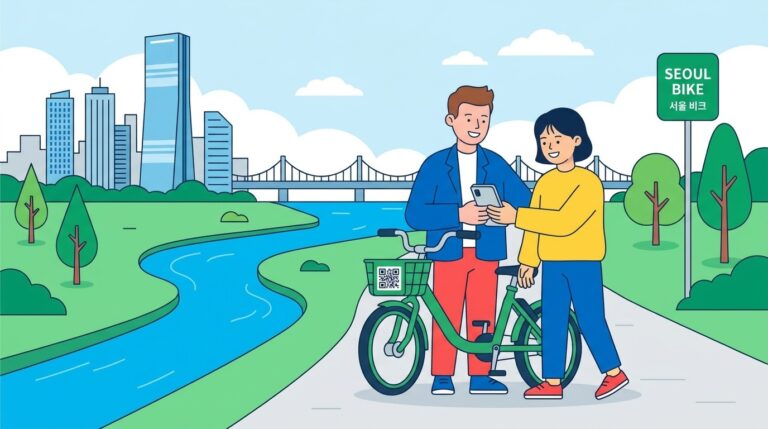
Navigating Korea’s Shared Mobility: Ride Like a Local 🛴
Phase 1: Empathy (The K-Culture Cold Open)
Hello! I’m your Daily Hangul Editor. Imagine this: It’s 11:30 PM on a Friday night in Gangnam or Hongdae. You’ve just finished a fun dinner with your Korean friends, but the subway is about to close, and catching a taxi on the Kakao T app feels like winning the lottery. Suddenly, your Korean friend points to a row of green bicycles or electric scooters on the sidewalk and says, “Hey, let’s just grab one of these!”
You’ve probably seen this in K-Dramas—the romantic night ride along the Han River on a public bike. But in reality, Korea’s shared mobility (공유 모빌리티) isn’t just for romance; it’s a hardcore urban survival tool fueled by the Korean “Ppalli-ppalli” (빨리빨리, hurry up) culture. At the C1 level, you shouldn’t just know how to say “bicycle.” You need to know how to navigate apps, understand return zones, and read the “Nunchi” of sidewalk parking. Let’s dive into the phrases that will make you a true local navigator!
Phase 2: Core Expressions Deep Dive
1. 가까우니까 따릉이 타고 갈까요?
- Pronunciation: gakkaunikka ttareungi tago galkkayo? [Gah-kkah-oo-nee-kkah ttah-reung-ee tah-go gahl-kkah-yo?]
- Meaning: (Literal) Because it’s close, shall we ride Ttareungi and go? / (Real nuance) It’s a short distance, let’s just grab a Seoul Bike.
- K-Culture Moment: “Ttareungi” (따릉이) is the official name of Seoul’s public bike system. It mimics the “ring-ring” sound of a bicycle bell. When a 15-minute walk feels too long, Koreans instinctively look for a Ttareungi.
- Editor’s Insight: You don’t say “자전거 빌릴까요?” (Shall we rent a bike?). Using the proper noun “따릉이” instantly makes you sound like someone who actually lives in Seoul.
- Situation Spectrum:
- Casual with friends: ✅
- Co-workers (Semi-formal): ✅
- Boss/Elders (Formal): ⚠️ (Better to offer a taxi to elders)
- 🤔 Think About It: Why do Koreans prefer shared mobility for short distances instead of walking? How does this reflect the “Ppalli-ppalli” culture of maximizing time efficiency?
2. 여기 반납 금지 구역이에요.
- Pronunciation: yeogi bannap geumji guyeogieyo. [Yuh-gee bahn-nahp geum-jee goo-yuh-gee-eh-yo.]
- Meaning: (Literal) This is a return-prohibited zone. / (Real nuance) You can’t park/end your ride here.
- K-Culture Moment: You arrive at your destination and try to lock your e-scooter, but the app starts beeping, and you get a penalty warning. Shared mobility apps in Korea have strict GPS-based return zones to prevent sidewalk clutter.
- Editor’s Insight: Notice the word “반납” (return). We don’t usually say “주차” (parking) for shared scooters/bikes because you don’t own them. You “return” them to the system.
- Situation Spectrum:
- Casual with friends: ✅
- Co-workers (Semi-formal): ✅
- Boss/Elders (Formal): ✅
- 🤔 Think About It: Parking an e-scooter right in the middle of a narrow sidewalk is considered a huge lack of “Nunchi” (눈치). How does public space etiquette differ in your home country?
3. 앱에서 면허증 인증해야 돼요.
- Pronunciation: aebeseo myeonheojeung injeunghaeya dwaeyo. [Ab-eh-suh myun-huh-jeung in-jeung-hae-ya dwae-yo.]
- Meaning: (Literal) You must authenticate your driver’s license on the app. / (Real nuance) You need to verify your ID in the app to ride.
- K-Culture Moment: Your foreign friend tries to unlock a kickboard but gets stuck. Since 2021, Korean law strictly requires a valid driver’s license to ride electric scooters.
- Editor’s Insight: “인증하다” (to verify/authenticate) is a crucial digital era verb in Korea. You’ll use it for everything from mobility apps to food delivery and online banking.
- Situation Spectrum:
- Casual with friends: ✅
- Co-workers (Semi-formal): ✅
- Boss/Elders (Formal): ✅
Phase 3: Textbook vs. Real Korean
[Renting a Bicycle/Scooter]
* 📖 Textbook: 자전거를 대여하겠습니다. (I will rent a bicycle.)
* 🗣️ Real Korean: 따릉이 바코드 찍을게요. (I’ll scan the Ttareungi barcode.)
* 💡 Why?: In the digital age, “renting” is physically done by scanning a QR code. Koreans focus on the action (“scanning”) rather than the concept (“renting”).
[Ending the Ride]
* 📖 Textbook: 여기서 이용을 종료하겠습니다. (I will end the usage here.)
* 🗣️ Real Korean: 여기서 반납할게요. (I’ll return it here.)
* 💡 Why?: “반납” (returning) implies returning the shared property back to the community, reflecting a high-density urban lifestyle.
[Drunk Riding]
* 📖 Textbook: 술을 마시고 전동 킥보드를 타면 안 됩니다. (You must not ride an electric scooter after drinking alcohol.)
* 🗣️ Real Korean: 음주 킥보드는 면허 취소각이에요. (Drunk kickboard riding is a sure case for license cancellation.)
* 💡 Why?: “~각이다” (slang meaning “a sure scenario/angle for…”) is a popular C1-level slang used among Millennials and Gen Z to predict an obvious outcome.
Phase 4: Cultural Context — K-Culture Deep Dive
4-1. Non-verbal Cues & Nunchi (눈치)
When parking a shared scooter, “Nunchi” is everything. If you park it blocking a tactile paving for the visually impaired (점자블록) or right in front of a store entrance, you will get glaring looks from passersby. Always park it neatly next to a tree or a designated parking box.
4-2. The “First & Last Mile” in K-Drama vs. Reality
In K-Dramas, characters leisurely ride bikes along the Han River while an indie acoustic OST plays in the background. In reality, shared mobility is Korea’s “last-mile” solution. Because the subway and bus systems are incredibly well-connected, Koreans use Ttareungi or kickboards to cover the 10-minute gap between the station and their ultimate destination. It’s less about a breezy ride and more about seamless, high-speed urban transit.
Phase 5: Real-Life Roleplay Scenario
Setting: 10:30 PM, Friday near the Han River Park. You and your Korean friend Minsoo just had Chimaek (Chicken and Beer). You need to get to Yeouido Station, which is a 15-minute walk away.
Characters:
– YOU: An expat living in Seoul, familiar with basic apps but cautious about the rules.
– Minsoo (30): Your energetic Korean friend who hates walking.
Dialogue:
Minsoo: 아, 배부르다! 역까지 걸어가기 너무 귀찮은데. 킥보드 탈까요?
(Ah, baebureuda! Yeokkaji georeogagi neomu gwichaneunde. Kikbodeu talkkayo?)
[Ah, I’m full! It’s too annoying to walk to the station. Shall we take a kickboard?]
(🎭 Stage Direction: Minsoo pulls out his phone and opens a mobility app.)
YOU: 킥보드요? 지금 저기 있는 초록색 전동 킥보드 말하는 거예요?
(Kikbodeuyo? Jigeum jeogi inneun choroksaek jeondong kikbodeu malhaneun geoeyo?)
[A kickboard? Are you talking about the green electric scooter over there?]
Minsoo: 네! 지쿠터나 씽씽이 타면 3분이면 가요. 제가 앱으로 열어줄게요.
(Ne! Jikuteona ssingssingi tamyeon sambunimyeon gayo. Jega aebeuro yeoreojulgeyo.)
[Yes! If we take a G-cooter or Xingxing, it takes 3 minutes. I’ll unlock it with my app.]
YOU: 잠깐만요. 우리 아까 치킨 먹으면서 맥주 마셨잖아요.
(Jamkkanmanyo. Uri akka chikin meogeumyeonseo maekju masyeotjanayo.)
[Wait a minute. We had beer with our chicken earlier.]
Minsoo: 에이, 맥주 한 잔은 괜찮아요. 경찰도 안 잡아요.
(Ei, maekju han janeun gwaenchanayo. Gyeongchaldo an jabayo.)
[Come on, one glass of beer is fine. The police won’t catch us.]
🔀 Your Turn! How do you respond?
– A) “아, 그래요? 그럼 빨리 타고 가요!” (Oh, really? Then let’s ride it quickly!)
– B) “절대 안 돼요! 음주 킥보드 타면 면허 취소각이에요. 따릉이 타거나 걸어가요.” (Absolutely not! Drunk kickboarding is a sure license cancellation. Let’s take a Ttareungi or walk.)
– C) “저 면허증 앱에 인증 안 했어요.” (I haven’t verified my license on the app.)✅ Best Choice: B — Why? In Korea, riding an e-scooter after drinking is legally identical to drunk driving a car (음주운전). It results in hefty fines and license cancellation. Asserting the law using the native slang “~각이다” shows you are highly fluent and culturally aware!
⚠️ Choice A Analysis: Highly dangerous and illegal. Even a short distance can lead to serious legal trouble.
Minsoo: 아, 맞다! 외국인 친구가 저보다 한국 법을 더 잘 아네요. 미안해요, 걸어갑시다!
(A, matda! Waegugin chinguga jeoboda hanguk beobeul deo jal aneyo. Mianhaeyo, georeogapsida!)
[Oh, right! My foreign friend knows Korean law better than I do. Sorry, let’s walk!]
Phase 6: 10-Second Shadowing Drill
Follow the rhythm and intonation! The slash (/) indicates a micro-pause.
😤 단호하게 (Firmly):
음주 킥보드는 / 절대 안 돼요! / 면허 / 취소각이에요!
(eumju kikbodeuneun / jeoldae an dwaeyo! / myeonheo / chwisogagieyo!)
😊 밝게 (Brightly):
가까우니까 / 우리 / 따릉이 타고 갈까요?
(gakkaunikka / uri / ttareungi tago galkkayo?)
Phase 7: K-Culture Mini Dictionary
1. 따릉이
* Romanization: Ttareungi
* English: Seoul Public Bike
* Context: The iconic green and white bikes of Seoul. Other cities have their own (e.g., ‘Tashu’ in Daejeon, ‘Nubija’ in Changwon).
2. 전동 킥보드
* Romanization: Jeondong kikbodeu
* English: Electric scooter
* Context: Koreans use the Konglish word “kickboard” for e-scooters. Popular brands include Kickgoing, Xingxing, and Beam.
3. 환승
* Romanization: Hwanseung
* English: Transfer
* Context: Korea’s legendary public transit transfer system. Many mobility apps now offer “transfer discounts” (환승 할인) if you switch from a subway/bus to a shared bike.
4. 쏘카 / 그린카
* Romanization: Socar / Greencar
* English: Car-sharing platforms
* Context: When young Koreans need a car for a weekend trip but don’t own one, they “Socar it” (쏘카 빌리다). It’s essentially the Zipcar of Korea, integrated deeply into daily life.
Phase 8: Traveler Survival Kit 🆘
🆘 Survival Phrases for Mobility
– 🇰🇷 “이거 어떻게 빌려요?” (igeo eotteoke billyeoyo?)
– 🗣️ Pronunciation: [Ee-guh uh-ttuh-keh bil-lyuh-yo?]
– 📍 Where to use: Asking a local how to unlock a bike/scooter.
– 💡 Pro Tip: Point to the QR code. Most locals will just tell you to download the app.📌 Editor’s Travel Note
– Must-have Apps: Kakao T (for taxis and their own e-bikes), Tmoney GO (for Ttareungi and express buses).
– Payment: You MUST register a card on the app beforehand. Foreign credit cards sometimes glitch on domestic apps, so having a Korean bank card or a specialized travel card (like NAMANE or WOWPASS) makes this 100x easier.
– Helmets: By law, you must wear a helmet on a kickboard. Many shared kickboards have helmets attached, but they disappear often. Ride at your own risk!
Phase 9: Critical Thinking — “One Step Further”
🧠 Think Deeper: Korean in the Global Era (Konglish & Mobility)
Have you noticed how much English is used in Korean mobility culture? Words like “앱 (App)”, “바코드 (Barcode)”, “킥보드 (Kickboard)”, and “인증 (Authentication – derived from IT infrastructure)” completely dominate the landscape. In the past, learning Korean meant memorizing pure Korean vocabulary. Today, C1-level fluency requires mastering “Konglish”—English words that have been adopted, shortened, or culturally altered by Koreans. For instance, “Kickboard” in English usually means a swimming float, but in Korea, it strictly means a scooter. This shows how language rapidly adapts to technological convenience.💬 Your Turn: Are there English words in your country that are used completely differently when it comes to technology or transport? Share in the comments!
Phase 10: FAQ & Avoiding Misunderstandings
Q: Can two people ride one electric scooter?
A: NO! It is illegal and highly dangerous. You will often see young couples doing this (called ‘킥라니’ – a mix of Kickboard and Water Deer, meaning a nuisance on the road), but police actively crack down on it.
Q: Can I ride Ttareungi on the sidewalk?
A: Legally, bicycles should use the bike lane or the right edge of the road. However, many Korean sidewalks are designated as “shared paths” for pedestrians and bikes. Just ring the bell politely or wait if it’s crowded.
❌ Common Mistake #1: Thinking you can just drop the scooter ANYWHERE.
✅ Do This Instead: The app will show red “No Parking” zones (반납 금지 구역). If you park there, you will be charged an extra 10,000 won penalty. Always check the map before ending the ride!
Phase 11: Summary & Action Items
One-Liner Summary: Master “인증” (verification) and “반납” (returning) to seamlessly blend into Korea’s fast-paced shared mobility lifestyle!
Action Mission:
– 🥉 Bronze (Solo): Practice saying “여기 반납 금지 구역이에요” in front of a mirror with a frustrated tone.
– 🥈 Silver (Online): Check out Kakao T or Tmoney GO on the App Store and read the Korean reviews. Spot the word “환승” or “결제” (payment).
– 🥇 Gold (Real-world): Next time you’re in Korea, successfully rent a Ttareungi, ride it to a park, and say “여기서 반납할게요!” to your travel buddy.
K-Culture Mission: Search YouTube for “따릉이 타는 브이로그” (Ttareungi riding vlog) and observe where locals usually park their bikes at the end!
Phase 12: Interactive Quiz
1. Fill in the Blank:
You arrive at your destination on a kickboard, but the app won’t let you end the ride because it’s a ______ 구역 (zone).
(A) 대여 (Rental)
(B) 환승 (Transfer)
(C) 반납 금지 (No-Return)
2. True or False — K-Culture Edition:
If you only had one glass of Soju, it is completely legal and culturally acceptable to ride a shared e-scooter home.
(Answers: 1. C / 2. False! It is considered DUI and can cancel your driver’s license!)







