

Phase 1: Empathy (Immersive Opening)
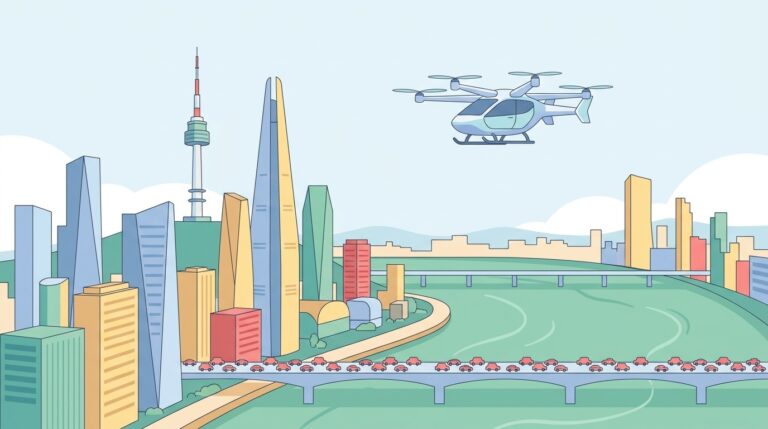
Hello! I am your Daily Hangul Editor. Picture this: It is 6:30 PM on a Friday. You are sitting in a taxi on the Olympic Daero (올림픽대로), the massive highway running alongside the Han River. The red taillights of thousands of cars stretch out like an endless, glowing snake. Your K-Drama loving heart might find the Seoul skyline beautiful, but your practical side is screaming because you are going to be late for a very important dinner appointment in Gangnam.
Now, imagine looking out the window and seeing a sleek, drone-like vehicle zipping through the sky, completely bypassing the traffic.
Welcome to the future. Seoul is currently heavily investing in Urban Air Mobility (UAM), or ‘Drone Taxis.’ While it sounds like pure sci-fi, the Korean government and massive conglomerates are pushing to make this a reality over the Han River soon.
But how do you discuss this high-level tech topic in Korean? If you are at a C2 level, you aren’t just saying ‘I want to ride a flying car.’ You are debating the viability, safety, and economic impact of UAM with your Korean colleagues over a pint of beer. Today, we are going to learn how to sound not just fluent, but like a true Korean tech insider.
Phase 2: Core Expression Deep Dive
To debate Future Tech like a local, you need these three C2-level power expressions.
1. 시기상조 아닌가요? (Isn’t it premature?)
- Pronunciation: [sigi-sangjo aningayo?] / [shee-gee-sang-jo ah-neen-gah-yo?]
- Meaning: Literal: ‘It is too early in timing.’ / Real nuance: ‘Aren’t we jumping the gun? The technology/society isn’t ready for this yet.’
- K-Culture Moment: You will hear this in corporate boardrooms or on Korean news panels. In a K-Drama, the cautious older executive will say this to the ambitious young CEO who wants to launch a flying taxi service immediately.
- Editor’s Insight: ‘시기상조’ is a four-character idiom (Saja-seongeo). Using Saja-seongeo correctly instantly elevates your Korean to an elite level. It shows you understand the rhythm and historical depth of the language.
- Situation Spectrum:
- Close Friends (Casual): ✅ (e.g., 야, 그건 시기상조지!)
- Co-workers (Semi-formal): ✅
- Boss/Elders (Formal): ✅ (Very appropriate for formal debates)
- 🤔 Think About It: Korean debates often rely on four-character idioms (Hanja) to succinctly summarize complex situations. Why do you think condensing an argument into four syllables is so effective in professional Korean settings?
2. 부르는 게 값일 텐데요 (It’ll probably cost whatever they ask for)
- Pronunciation: [bureuneun ge gapsil tende-yo] / [boo-reu-neun geh gap-shil ten-deh-yo]
- Meaning: Literal: ‘What they call is the price.’ / Real nuance: ‘It’s going to be astronomically expensive because there is no set market price yet (a monopoly or rare tech).’
- K-Culture Moment: This is exactly what your Korean friend will say when you ask how much a UAM ride from Incheon Airport to Gangnam will cost. It’s the perfect expression for any early-adoption tech.
- Editor’s Insight: This phrase captures the slight cynicism Koreans have towards new, hyper-luxurious services. It’s a great conversational connector to transition from talking about the ‘coolness’ of tech to the ‘economic reality.’
- Situation Spectrum:
- Close Friends (Casual): ✅
- Co-workers (Semi-formal): ✅
- Boss/Elders (Formal): ⚠️ (A bit too casual for a strict boardroom presentation, but fine for a business dinner)
- 🤔 Think About It: How does this idiom reflect the free-market dynamics of new technology? Do you have an idiom in your language for ‘astronomically expensive due to novelty’?
3. 상용화되려면 한참 멀었어요 (It’s a long way from commercialization)
- Pronunciation: [sang-yong-hwa-doeryeomyeon hancham meoreosseo-yo] / [sang-yong-hwa-dweh-ryuh-myun han-cham muhr-uh-ssuh-yo]
- Meaning: Literal: ‘To become commercialized, it is a long time away.’ / Real nuance: ‘Don’t hold your breath. It won’t be available to the public anytime soon.’
- K-Culture Moment: A tech YouTuber reviewing the latest UAM prototype will inevitably use this phrase to bring their viewers back to reality after showing off the sleek CGI renders.
- Editor’s Insight: ‘상용화’ (Commercialization) is a must-know C2 tech vocabulary word. Combining it with ‘한참 멀었다’ (a long way off) creates a very natural, native-sounding sentence structure.
- Situation Spectrum:
- Close Friends (Casual): ✅
- Co-workers (Semi-formal): ✅
- Boss/Elders (Formal): ✅
- 🤔 Think About It: Koreans love the concept of ‘상용화’ because of the ‘Ppalli-ppalli’ (hurry up) culture. As soon as a tech is announced, the immediate question is always, ‘When can I buy/use it?’
Phase 3: Textbook vs. Real Korean
Let’s see how textbook Korean compares to the real, street-level tech talk.
[Scenario 1: Discussing the launch date]
* 📖 Textbook Korean: 드론 택시는 언제 대중교통이 됩니까? (When will drone taxis become public transportation?)
* 🗣️ Real Korean: 드론 택시 언제쯤 상용화될까요? (When do you think drone taxis will be commercialized?)
* 💡 Why the difference?: ‘상용화’ is the exact business term Koreans use for tech hitting the market. ‘대중교통’ sounds like you are asking when it will become a public bus.
[Scenario 2: Worrying about safety]
* 📖 Textbook Korean: 그것은 안전하지 않을 수 있습니다. (That might not be safe.)
* 🗣️ Real Korean: 근데 저거 가다가 떨어지면 어떡해요? (But what if that thing falls while it’s going?)
* 💡 Why the difference?: Real conversations are visceral. Rather than abstractly saying ‘unsafe,’ Koreans vividly describe the worst-case scenario with a worried tone.
[Scenario 3: Talking about the benefits]
* 📖 Textbook Korean: 교통 체증이 줄어들 것입니다. (Traffic congestion will decrease.)
* 🗣️ Real Korean: 강남까지 15분 컷이면 무조건 타야죠! (If it’s a 15-minute cut to Gangnam, I’m absolutely riding it!)
* 💡 Why the difference?: Adding ‘컷’ (cut/time limit) from gaming culture emphasizes the speed, and ‘무조건 타야죠’ shows active enthusiasm rather than passive observation.
Phase 4: Cultural Context — K-Culture Deep Dive
4-1. Non-verbal Elements in Tech Debates
When debating whether UAM will succeed, Koreans will often do the ‘Ssshh’ sound (inhaling sharply through the teeth) to express skepticism. If someone says, “UAM will replace cars by 2030,” a Korean might inhale sharply, tilt their head slightly, and say, “쓰읍… 그건 시기상조 아닌가요?” (Ssshh… isn’t that premature?). It is the ultimate non-verbal cue of polite disagreement.
4-2. The ‘Ppalli-ppalli’ Culture and Seoul’s Layout
Why is Korea so obsessed with UAM? It all comes back to 빨리빨리 (Ppalli-ppalli / Hurry-hurry) culture and the geography of Seoul.
The Han River geographically splits Seoul in half, creating massive bottlenecks at the bridges. In a society that values hyper-efficiency and fast delivery (think of K-Food delivery apps getting you hot noodles in 20 minutes), being stuck in traffic is culturally unacceptable. UAM represents the ultimate ‘Ppalli-ppalli’ fantasy: slicing through the sky in a straight line. If you watch K-Dramas like Queen of Tears or Crash Landing on You, wealthy chaebols use helicopters. UAM is seen as the democratization of that VIP airspace… eventually.
Phase 5: Real-world Roleplay Scenario
Scenario A: The Tech After-Party in Yeouido
- Setting: It is 9:00 PM in a high-rise craft beer pub in Yeouido, the financial and tech hub of Seoul. You are looking out over the glowing Han River.
- Characters:
- YOU: An international tech consultant who believes UAM is the future.
- Min-su (34): A skeptical Korean infrastructure engineer.
Min-su: 저기 올림픽대로 막히는 것 좀 봐요. 답이 없어요 진짜. 🚗
(Jeogi ollimpik-daero makhineun geot jom bwayo. Dabi eopseoyo jinjja.)
[Look at the traffic jam on the Olympic Daero over there. There’s truly no answer.]
YOU: 그래서 드론 택시가 빨리 상용화돼야 해요. 한강 위로 날아가면 강남까지 15분 컷이잖아요. 🚁
(Geuraeseo deuron taeksiga ppalli sangyonghwa-dwaeya haeyo. Hangang wiro naragamyeon gangnamkkaji sibo-bun keosijanayo.)
[That’s why drone taxis need to be commercialized quickly. If we fly over the Han River, it’s a 15-minute trip to Gangnam.]
Min-su: 에이, 그게 말처럼 쉽나요? 인프라 구축도 그렇고, 아직은 시기상조죠.
(Ei, geuge malcheoreom swipnayo? Inpeura guchukdo geureoko, ajigeun sigisangjojyo.)
[Hey, is it as easy as it sounds? Building the infrastructure and all, it’s still premature.]
YOU: 한국은 IT 강국이니까 마음만 먹으면 금방 할 걸요? 💻
(Hangugeun aiti gangguginikka maeumman meogeumyeon geumbang hal geollyo?)
[Korea is an IT powerhouse, so if they set their minds to it, they’ll do it quickly, won’t they?]
Min-su: 기술력 문제가 아니라, 법적인 규제가 엄청날 거예요. 게다가 초반에는 요금도 엄청 비쌀 텐데… 💸
(Gisullyeok munjega anira, beopjeogin gyujega eomcheongnal geoyeyo. Gedaga chobaneneun yogeumdo eomcheong bissal tende…)
[It’s not a matter of tech capability, the legal regulations will be massive. Plus, initially, the fare will be incredibly expensive…]
🔀 Your Turn! How do you respond?
– A) “비싸도 타는 사람들이 있을 거예요.” (Sure, but some people will ride it even if it’s expensive. – A bit plain)
– B) “맞아요, 처음엔 완전 부르는 게 값이겠죠. 그래도 시간은 돈이니까요.” (Right, at first they’ll charge whatever they want. But time is money.)
– C) “저 돈 많아요. 제가 쏠게요!” (I have a lot of money. I’ll treat you! – Funny, but misses the tech debate point)✅ Best Choice: B — Reason: You acknowledge his point using the native idiom “부르는 게 값이다” while gracefully defending your stance. It shows high-level conversational judo.
Scenario B: Bonus Roleplay – Conversing with a Current Taxi Driver
You are in a regular taxi, stuck in traffic near Mapo Bridge.
Taxi Driver: 아이고, 또 막히네. 손님, 바쁘신데 죄송해서 어쩌나.
(Aigo, tto makhine. Sonnim, bappeusinde joesonghaeseo eojjeona.)
[Oh my, it’s blocked again. Customer, I’m so sorry since you are busy.]
YOU: 괜찮아요 기사님. 나중에 하늘을 나는 택시 나오면 그거 타야겠어요! 하하.
(Gwaenchanayo gisa-nim. Najunge haneureul naneun taeksi naomyeon geugeo tayagesseoyo! Haha.)
[It’s okay, driver. Later when flying taxis come out, I’ll have to ride that! Haha.]
Taxi Driver: 에휴, 그게 제 평생에 나오려나 모르겠네요. 나오면 제 밥줄 다 끊기는 거지 뭐!
(Ehyu, geuge je pyeongsaenge naoryeona moreugenneyo. Naomyeon je bapjul da kkeunkineun geoji mwo!)
[Sigh, I don’t know if that’ll come out in my lifetime. If it does, my livelihood is completely cut off!]
Phase 6: 10-Second Shadowing Drill
Let’s practice the rhythm of a Korean tech debate.
😤 (Slightly skeptical) 쓰읍... / 그건 / 아직 너무 / 시~~기상조 / 아닌가요?
(Ssseu-eup… / geugeon / ajik neomu / shi~~gi-sang-jo / a-nin-ga-yo?)
Tip: Elongate the ‘시’ (shi) slightly to emphasize your doubt, and raise the pitch at the end of ‘가요’ (ga-yo).
😊 (Excited) 상용화만 되면 / 강남까지 / 15분 / 컷이에요!
(Sang-yong-hwa-man doe-myeon / gang-nam-kka-ji / sibo-bun / keo-si-e-yo!)
Tip: Hit the word ‘컷’ (keot) sharply and crisply!
Phase 7: K-Culture Mini Dictionary
1. 빨리빨리 (Ppalli-ppalli)
* Romanization: ppalli-ppalli
* English: Hurry, hurry / Speed culture
* Context: The driving force behind Korean innovation. It’s the reason why the idea of a drone taxi skipping traffic resonates so deeply with the Korean public.
2. 상용화 (Sang-yong-hwa)
* Romanization: sang-yong-hwa
* English: Commercialization
* Context: A crucial business and tech term. Tech isn’t considered ‘real’ in Korea until it achieves ‘상용화’.
3. 밥줄 (Bap-jul)
* Romanization: bap-jul
* English: Source of income / Livelihood (Lit: Rice rope)
* Context: When discussing disruptive future tech like UAM or AI, Koreans often worry about losing their ‘bap-jul’ (jobs). It adds a human element to tech discussions.
4. 인프라 (In-peu-ra)
* Romanization: in-peu-ra
* English: Infrastructure
* Context: Koreans use the English loanword heavily, but pronounce it with Korean phonetics. It refers to the physical systems needed for UAM (vertiports, charging stations).
Phase 8: Traveler’s Survival Kit
While UAM isn’t here yet, you are likely talking about tech and travel while taking current transportation.
🆘 Survival Expressions for the Modern & Future Traveler
– 🇰🇷 “기사님, 여기로 가주세요.” (gisa-nim, yeogiro gajuseyo.) – Please go here, driver. (Show your map app).
– 🇰🇷 “차가 많이 막히나요?” (chaga mani makhinayo?) – Is there a lot of traffic?
– 🇰🇷 “얼마나 걸릴까요?” (eolmana geollilkkayo?) – How long will it take?
– 💡 Pro Tip: In Seoul, predicting traffic is a national pastime. Use map apps like Naver Map or Kakao T. They are incredibly accurate. Don’t rely on Google Maps for driving/walking directions in Korea, as local security laws restrict its real-time data!📌 Editor’s Travel Note
– When taking a taxi in Korea, tipping is NOT expected. In fact, handing the driver a tip might confuse them.
– To hail a cab, use the Kakao T app. It works just like Uber, and you can connect an international credit card to it.
Phase 9: Critical Thinking Corner — “One Step Deeper”
🧠 Think Deeper: Technology and Inequality (기술과 불평등)
When discussing UAM in Korea, the conversation inevitably turns to social inequality. Koreans are highly sensitive to the wealth gap, often referred to through the ‘Spoon Class Theory’ (수저계급론). UAM presents a fascinating cultural dilemma: Will the sky simply become another exclusive highway for the ‘Gold Spoons’ (wealthy elites) to physically fly over the ‘Earth Spoons’ (working class) stuck in ground traffic? In K-Dramas, the physical elevation of a character (living in a penthouse, taking a private helicopter) directly correlates to their power. As a C2 learner, bringing up this socioeconomic angle—”결국 부자들만 하늘로 다니는 거 아닐까요?” (In the end, won’t only the rich travel through the sky?)—will prove that you understand not just the language, but the soul of modern Korean society.
💬 Your Turn: How does your culture view futuristic transportation? Is it seen as a public good or a luxury for the rich? Share your thoughts in the comments!
Phase 10: FAQ & Avoiding Misunderstandings
- Q: Can I use ‘시기상조’ with my boss during a presentation?
- Yes, absolutely. It sounds professional, educated, and objective. Just ensure you follow it up with solid reasons, otherwise, you just sound pessimistic.
- Q: Is it rude to tell a taxi driver that drone taxis will replace them?
- Yes, be careful! While it’s a theoretical tech debate to you, to them, it’s their ‘밥줄’ (livelihood). Use the bonus roleplay example to frame it as a distant future joke rather than an imminent threat.
❌ Common Mistake: Confusing ‘대중화’ (Popularization) with ‘상용화’ (Commercialization).
✅ Do this instead: Use 상용화 for when a product hits the market (e.g., Apple Vision Pro). Use 대중화 for when everyone is actually using it (e.g., Smartphones). UAM will achieve 상용화 long before it achieves 대중화!
Phase 11: Summary & Action Items
- One-Liner Summary: To debate Future Tech like UAM in Korean, use C2 expressions like ‘시기상조’ (premature) and ‘상용화’ (commercialization) to show deep analytical skills.
-
Action Mission 3 Steps:
- 🥉 Bronze (Solo): Read a short Korean news article about ‘UAM 한강’ and highlight the word ‘상용화’.
- 🥈 Silver (Online): Go to a Korean tech YouTube channel reviewing UAM and leave a comment: “아직은 시기상조 같지만, 기대되네요!” (Seems premature, but I’m looking forward to it!)
- 🥇 Gold (Real-world): Next time you are stuck in Seoul traffic with a Korean friend, sigh dramatically and say, “아… 빨리 드론 택시 상용화됐으면 좋겠다.”
- K-Culture Mission: Watch a sci-fi K-Drama (like Alienoid or Sisyphus) and listen closely for the high-level vocabulary used when scientists or politicians are debating new phenomena.
Phase 12: Quiz — Interactive Challenge
1. Situational Judgment: You are at a tech startup pitch. The founder says they will have UAMs replacing all subways by next year. How do you politely express extreme doubt like a native?
– A) 거짓말하지 마세요. (Don’t lie.)
– B) 그건 좀 시기상조 아닌가요? (Isn’t that a bit premature?)
– C) 저는 걷는 게 좋아요. (I like walking.)
(Answer: B. It questions the timing and readiness politely but firmly.)
2. Fill in the Blank:
“아직 가격이 정해지지 않아서, 출시되면 완전 (_______)일 텐데요.”
(Answer: 부르는 게 값)
3. True or False – K-Culture Edition:
“If you tell a Korean friend that a new tech will help them commute faster (빨리빨리), they will generally be interested in it.”
(Answer: True. Commute time and efficiency are massive pain points in Seoul!)
Frequently Asked Questions (FAQ)
Q: What does "시기상조 아닌가요? (Isn't it premature?)" mean in Korean and how do you pronounce it?
A: In Korean, "시기상조 아닌가요? (Isn't it premature?)" is pronounced [sigi-sangjo aningayo?] and means: Literal: 'It is too early in timing.' / Real nuance: 'Aren't we jumping the gun? The technology/society isn't ready for this yet.'
Q: What does "부르는 게 값일 텐데요 (It'll probably cost whatever they ask for)" mean in Korean and how do you pronounce it?
A: In Korean, "부르는 게 값일 텐데요 (It'll probably cost whatever they ask for)" is pronounced [bureuneun ge gapsil tende-yo] and means: Literal: 'What they call is the price.' / Real nuance: 'It's going to be astronomically expensive because there is no set market price yet (a monopoly or rare tech).'
Q: What does "상용화되려면 한참 멀었어요 (It's a long way from commercialization)" mean in Korean and how do you pronounce it?
A: In Korean, "상용화되려면 한참 멀었어요 (It's a long way from commercialization)" is pronounced [sang-yong-hwa-doeryeomyeon hancham meoreosseo-yo] and means: Literal: 'To become commercialized, it is a long time away.' / Real nuance: 'Don't hold your breath. It won't be available to the public anytime soon.'







