

Phase 1: Empathy & Immersion (Opening)
Hello! I’m your Editor from Daily Hangul.
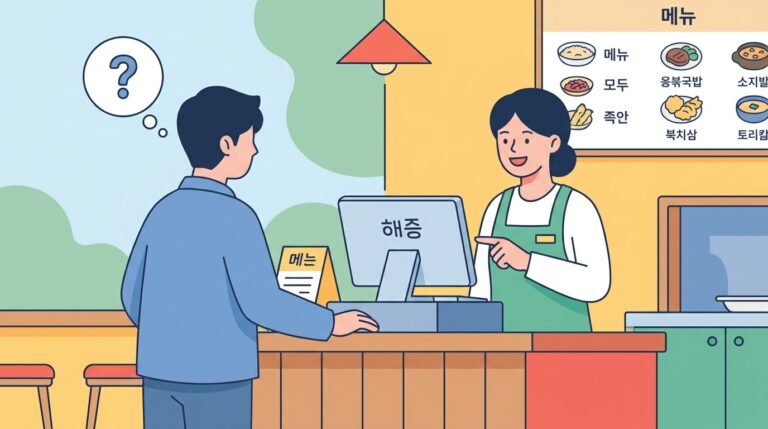
Imagine this: You just finished a fantastic Korean BBQ dinner. Your stomach is full, your heart is happy, and you walk up to the counter feeling like the main character in a K-Drama. You confidently hand over a crisp 50,000 won bill. The cashier takes it, smiles, and suddenly fires off a rapid question:
“Hyeon-geum yeong-su-jeung pil-yo-ha-se-yo?”
You freeze. The smile drops. The line behind you is waiting. In the K-Dramas, people just tap their shiny black cards and walk away! What is she asking? Did you not pay enough? Did you do something wrong?
Don’t worry! This is the most common “panic moment” for beginners traveling in Korea. Today, we are going to learn exactly what this mysterious phrase means, why Koreans ask it every single time you pay with cash, and the one magical sentence you need to smoothly escape the situation like a true insider.
(Note: This post is entirely based on the real, sweaty-palmed experiences of our Daily Hangul beginner students!)
Phase 2: Deep Dive into Core Expressions
Let’s break down the magic words you will hear and use at the register.
1. 현금 영수증 필요하세요? (Do you need a cash receipt?)
- Pronunciation: hyeon-geum yeong-su-jeung piryohaseyo? [Hyun-gum young-soo-jung peel-yo-ha-say-yo?]
- Meaning: Literal: Do you need a cash receipt? / Real Nuance: Are you a Korean citizen who wants to register this cash transaction for your year-end tax deduction?
- K-Culture Moment: You will hear this in convenience stores, restaurants, and cafes the moment you hand over paper money. The cashier will often look at a small keypad on the counter while asking this.
- Editor’s Insight: To a tourist, a “receipt” is just a piece of paper. But in Korea, a “cash receipt” is tied to a phone number to prove to the government you spent cash, which helps locals get tax returns. As a tourist, this is completely useless to you!
- Situation Spectrum:
- Casual: ⚠️ (Usually, staff use polite language)
- Semi-formal (Staff to Customer): ✅
- Formal: ✅
- 🤔 Think About It: Why does the government need to know about cash transactions? Korea is a highly digital, transparent society when it comes to tracking money. Does your country have a system to track cash spending for tax benefits?
2. 아니요, 괜찮아요. (No, it’s okay/fine.)
- Pronunciation: aniyo, gwaenchanayo. [Ah-nee-yo, gwen-chan-ah-yo]
- Meaning: Literal: No, it is okay. / Real Nuance: No thank you, I don’t need it.
- K-Culture Moment: This is your Absolute Survival Shield. Someone asks you a question at a store and you don’t understand? Just wave your hand gently and say this.
- Editor’s Insight: This isn’t a rude “NO!” It’s a very polite, soft way to decline something. The tone should be gentle, not defensive.
- Situation Spectrum:
- Casual: 🚫 (You’d drop the ‘yo’ for friends: 아니, 괜찮아)
- Semi-formal: ✅
- Formal: ✅
- 🤔 Think About It: Korean culture values indirectness to maintain harmony. Instead of a blunt “I don’t want it,” saying “It’s okay (as it is)” protects the feelings of the person offering.
3. 영수증 버려주세요. (Please throw away the receipt.)
- Pronunciation: yeong-su-jeung beoryeojuseyo. [Young-soo-jung bur-yuh-joo-say-yo]
- Meaning: Literal: Please throw away the receipt for me. / Real Nuance: I don’t need the paper receipt, please toss it.
- K-Culture Moment: You pay with a credit card. The machine prints a receipt. Instead of taking it and stuffing it in your pocket, you ask the cashier to trash it immediately. Very common fast-paced Korean behavior!
- Editor’s Insight: Koreans love efficiency (Pali-pali culture). If they don’t need the paper for expenses, they don’t even want to touch it.
- Situation Spectrum:
- Casual: 🚫
- Semi-formal: ✅
- Formal: ✅
- 🤔 Think About It: Notice the word “주세요 (juseyo – please do for me)”. Even when asking someone to throw garbage away, Korean grammar frames it as asking for a favor!
Phase 3: Textbook vs. Real Korean
How do real Koreans talk at the checkout compared to your textbook?
[Refusing the Cash Receipt]
* 📖 Textbook Korean: 아니요, 현금 영수증은 필요 없습니다. (No, I do not need a cash receipt.)
* 🗣️ Real Korean: 괜찮아요. (It’s okay.) or just a polite head shake and “아니요” (No).
* 💡 Why the difference?: Speed! The line is moving. You don’t need to repeat the whole noun back to them. Keep it short and polite.
[Choosing Payment Method]
* 📖 Textbook Korean: 신용카드로 계산하겠습니다. (I will calculate with a credit card.)
* 🗣️ Real Korean: 카드로 할게요. (I’ll do card.) or simply holding up the card and saying “카드요.” (Card, please.)
* 💡 Why the difference?: Efficiency rules the Korean counter. The moment they see the card, they already know what to do.
Bottom Note: For A1 (Beginners), don’t worry about making perfect, long sentences at the register. “괜찮아요 (It’s fine)” and “카드요 (Card)” are all you need to sound like a local!
Phase 4: Cultural Context — K-Culture Deep Dive
4-1. Non-Verbal Cues (The Counter Dance)
When paying in Korea, body language speaks volumes:
* The Two-Handed Handover: When giving your credit card or cash to the cashier, try using two hands, or place your left hand lightly on your right elbow or forearm. It’s a subtle sign of respect.
* Eye Contact: You don’t need to maintain intense eye contact with the cashier. A polite nod of the head when taking your card back is perfect.
4-2. K-Travel & K-Food Connection: The “Counter” Culture
If you watch a lot of K-Dramas, you might notice that people rarely leave cash on the table after eating. In Korean restaurants, you do not wait at the table for the bill.
When you are finished eating, you stand up, grab the small printed bill usually left on your table (or just go up if there isn’t one), and pay at the front counter near the door. The cashier area is a high-speed zone. Knowing the flow—hand over card/cash -> decline receipt -> nod and leave—will save you from any awkward Nunchi (reading the room) moments where you are holding up the line.
Phase 5: Real-Life Roleplay Scenario
Scenario A: The Checkout Panic
- Setting: Friday night, 8 PM. A busy, noisy Samgyeopsal (pork belly) restaurant in Myeongdong. Meat is sizzling on tables around you. You are heading to the front door to pay.
- Characters:
- YOU: A traveler on day 2 in Seoul. You only have cash right now.
- Cashier (Ajumma): Fast, efficient, friendly but in a rush.
Cashier: 맛있게 드셨어요? 5만 원입니다.
(masitge deuseosseoyo? oman wonimnida.)
[Translation] Did you enjoy the meal? It’s 50,000 won.
(🎭 Stage Direction: The cashier smiles quickly and holds out her hand)
YOU: 네! 여기요.
(ne! yeogiyo.)
[Translation] Yes! Here you go.
(🎭 Stage Direction: You hand over a 50,000 won bill)
Cashier: 네~ 현금 영수증 해드릴까요?
(ne~ hyeon-geum yeong-su-jeung haedeurilkkayo?)
[Translation] Okay~ shall I do a cash receipt for you?
🔀 Your Turn! How should you reply?
– A) “네! (Yes!)”
– B) “아니요, 괜찮아요. (No, it’s fine.)”
– C) “그게 뭐예요? (What is that?)”✅ Best Choice: B — By saying “아니요, 괜찮아요,” the transaction ends instantly, she gives you your change, and you look like a pro.
⚠️ Choice A Analysis: If you say “Yes,” she will point to a keypad and wait for you to type in a Korean phone number. As a tourist, you don’t have a registered one, leading to massive confusion!
YOU: 아니요, 괜찮아요.
(aniyo, gwaenchanayo.)
[Translation] No, it’s okay.
Cashier: 네, 잔돈 여기 있습니다. 안녕히 가세요!
(ne, jandon yeogi itseumnida. annyeonghi gaseyo!)
[Translation] Okay, here is your change. Goodbye!
Scenario B: The Convenience Store (Bonus)
You buy a bottle of water with a card.
Cashier: 영수증 드릴까요?
(yeong-su-jeung deurilkkayo? / Shall I give you the receipt?)
YOU: 아니요, 버려주세요.
(aniyo, beoryeojuseyo. / No, please throw it away.)
Cashier: 네, 감사합니다.
(ne, gamsahamnida. / Okay, thank you.)
Phase 6: 10-Second Shadowing Drill
Practice this until it becomes a reflex. It’s your ultimate survival phrase!
😊 아니요, / ✋ 괜찮아요. (a-ni-yo, / gwaen-cha-na-yo.)
(Tone: Gentle, smiling, slightly waving one hand side-to-side)
Phase 7: K-Culture Mini Dictionary
1. 영수증 (yeong-su-jeung)
* English: Receipt
* Context: You will hear this word constantly. Whenever you hear “yeong-su-jeung,” get ready to say “괜찮아요” (It’s okay).
2. 눈치 (nunchi)
* English: Social sense / Reading the room
* Context: Taking too long at the counter because you don’t know what “cash receipt” means might give you bad nunchi because the line is waiting. Knowing the phrases helps your nunchi!
3. 더치페이 (deochi-pei)
* English: Dutch Pay (Splitting the bill)
* Context: While older Koreans often fight to pay the whole bill, younger generations and friends usually ask to “Dutch pay” and split the card payment exactly at the counter.
4. 잔돈 (jandon)
* English: Change (Coins/Small bills)
* Context: The money returned to you after paying with cash.
Phase 8: Traveler Survival Kit
Since this situation happens every time you open your wallet, here are the top survival phrases for shopping and eating.
🆘 Survival Phrases TOP 3
– 🇰🇷 “이거 얼마예요?” (igeo eolmayeyo?)
– 🗣️ Pronunciation: [ee-guh ul-ma-yay-yo?]
– 📍 Where to use: Markets, street food stalls, underground malls.
– 💡 Pro Tip: Point at the item when you say this!
- 🇰🇷 “카드 돼요?” (kadeu dwaeyo?)
- 🗣️ Pronunciation: [ka-deu dway-yo?]
- 📍 Where to use: Small stalls, taxis.
- 💡 Pro Tip: It means “Do you accept cards?”
🇰🇷 “따로 계산할게요.” (ttaro gyesanhalgeyo.)
- 🗣️ Pronunciation: [tta-ro gye-san-hal-gay-yo.]
- 📍 Where to use: Restaurants when you want to split the bill with friends.
📌 Editor’s Travel Note
– Card Heaven: Korea is practically a cashless society. You can use a credit card for a $1 pack of gum. However, street food stalls (like Tteokbokki carts) and small traditional markets still prefer or only accept cash.
– NO Tipping: There is absolutely no tipping culture in Korea. If you leave money on the table, the waiter might chase you down the street thinking you forgot your change!
Phase 9: Critical Thinking Corner — “A Step Deeper”
Language & The Global Era: The Cashless Society
Korea is moving incredibly fast toward becoming a completely cashless society. In many cafes and fast-food chains now, you won’t even see a cashier; you must order through a touchscreen kiosk (키오스크). The phrase “Do you need a cash receipt?” is actually becoming slightly less common simply because locals rarely use cash anymore. However, for foreign tourists who still exchange currency, cash is king, which means you will encounter this specific Korean administrative quirk more often than a local would!
💬 Your Turn: Does your home country still use a lot of cash, or is it mostly digital like Korea? How do you feel about traveling in a country where everything is done by card or app? Tell us in the comments!
Phase 10: FAQ & Avoiding Mistakes
Q: “Can I say ‘괜찮아요 (It’s okay)’ to an older cashier?”
A: Yes! “괜찮아요” ends in ‘요 (yo)’, which makes it polite. It is perfectly safe to use with older staff or anyone you don’t know.
Q: “Do I need to leave a tip if the service was amazing?”
A: NO. Really. It will cause confusion. Excellent service is included in the price. A polite “잘 먹었습니다 (I ate well)” on your way out is the best “tip” you can give.
Q: “What if I want a receipt just to check the price?”
A: Say “영수증 주세요 (yeong-su-jeung juseyo – Please give me the receipt).” They will print the normal paper receipt, not the tax-deduction “cash receipt.”
❌ Common Mistake #1: Waiting at the table for the waiter to bring the bill to you.
✅ Do this instead: Look for the small bill on your table, grab your bags, and walk to the front counter to pay.❌ Common Mistake #2: Saying “네 (Yes)” to the cash receipt question out of panic.
✅ Do this instead: Remember your shield! “아니요, 괜찮아요 (No, it’s fine).”
Phase 11: Summary & Action Items
One-Liner Summary: When paying with cash, if the cashier asks a long question ending in “…seyo?”, they are asking about a cash receipt—just smile and say “아니요, 괜찮아요!”
Action Mission 3 Steps:
– 🥉 Bronze (Solo): Say “아니요, 괜찮아요” out loud 3 times right now, pretending you are waving off a receipt.
– 🥈 Silver (Online): Write “카드요” (Card, please) in the comments below!
– 🥇 Gold (Real Life): Next time you buy something at a Korean convenience store with cash, listen carefully for the words “현금 영수증 (hyeon-geum yeong-su-jeung)” and confidently decline it!
K-Culture Mission: Watch a K-Drama episode today. Pay close attention to scenes where characters eat at a restaurant. Do they pay at the table, or do they walk to the counter?
Phase 12: Quiz — Interactive Challenge
1. Situational Judgment: You hand the cashier a 10,000 won bill for a coffee. She asks, “현금 영수증 필요하세요?” What is your best response as a tourist?
A) 네, 주세요. (Yes, please give it to me.)
B) 카드로 할게요. (I’ll pay by card.)
C) 아니요, 괜찮아요. (No, it’s fine.)
2. True or False – K-Culture Edition:
“If the service at a Korean BBQ place is amazing, you should leave a 10% tip on the table.”
3. Fill in the Blank:
If you want the cashier to throw away your receipt, you say: “영수증 __________ 주세요.”
A) 버려 (beoryeo – throw away)
B) 먹어 (meogeo – eat)
(Answers below)
Click to reveal answers!
1. Answer: C. (A is wrong because you don’t have a Korean phone number for the tax receipt. B is weird because you already handed her cash!).
2. Answer: False. There is no tipping culture in Korea. Just say “잘 먹었습니다” (I ate well).
3. Answer: A. (Please do not ask the cashier to eat your receipt!)
Frequently Asked Questions (FAQ)
Q: What does "현금 영수증 필요하세요? (Do you need a cash receipt?)" mean in Korean and how do you pronounce it?
A: In Korean, "현금 영수증 필요하세요? (Do you need a cash receipt?)" is pronounced [hyeon-geum yeong-su-jeung piryohaseyo? [Hyun-gum young-soo-jung peel-yo-ha-say-yo?] and means: Literal: Do you need a cash receipt? / Real Nuance: Are you a Korean citizen who wants to register this cash transaction for your year-end tax deduction?
Q: What does "아니요, 괜찮아요. (No, it's okay/fine.)" mean in Korean and how do you pronounce it?
A: In Korean, "아니요, 괜찮아요. (No, it's okay/fine.)" is pronounced [aniyo, gwaenchanayo. [Ah-nee-yo, gwen-chan-ah-yo] and means: Literal: No, it is okay. / Real Nuance: No thank you, I don't need it.
Q: What does "영수증 버려주세요. (Please throw away the receipt.)" mean in Korean and how do you pronounce it?
A: In Korean, "영수증 버려주세요. (Please throw away the receipt.)" is pronounced [yeong-su-jeung beoryeojuseyo. [Young-soo-jung bur-yuh-joo-say-yo] and means: Literal: Please throw away the receipt for me. / Real Nuance: I don't need the paper receipt, please toss it.






