

Phase 1: Empathy & The “K-Drama” Moment
Hello! I’m the lead editor of Daily Hangul, your personal guide to the Korean language and culture.
Imagine this: You’re watching a K-Drama. The main character goes through a dramatic breakup, walks into a chic hair salon, and walks out with stunning, perfectly styled ash-brown hair. Inspired, you walk into a trendy salon in Hongdae or Gangnam, ready for your own “K-Pop idol transformation.” The stylish hair designer smiles, hands you an iced Americano, and asks, “어떻게 해드릴까요? (How can I help you?)”
Suddenly, your mind goes blank. You just want to say, “I want to dye my hair!” but all you can remember is how to order a coffee.
If you don’t know the exact words for a hair salon, you might end up with just a trim—or worse, a color you didn’t want. Don’t worry! This guide is based on real SOS messages from our beginner students. Today, we’re going to learn exactly how to get that dream hair color like a true local!
Phase 2: Core Expressions Deep Dive
Here are the 3 golden phrases you need for your K-Beauty transformation.
1. 염색하고 싶어요 (I want to dye my hair)
- Pronunciation: [yeom-saek-ha-go si-po-yo] (The ‘염’ sounds like ‘yum’ in yummy!)
- Meaning: I want to dye my hair. (Literal: I want to do hair-dyeing.)
- K-Culture Moment: You walk into the salon, and the receptionist asks what you’re here for. Saying this confidently immediately sets the tone!
- Editor’s Insight: In English, “dye” is a verb. But in Korean, 염색 (yeom-saek) is a noun meaning “dyeing.” We attach 하다 (to do) to make it an action. Add -고 싶어요 (I want to), and you have a perfect A2 beginner sentence!
- Situation Spectrum:
- Casual (to a friend): 염색하고 싶어 ✅
- Semi-formal (to staff): 염색하고 싶어요 ✅
- Formal (business meeting): 🚫 (Not a business topic!)
- 🤔 Think About It: Why does Korean use “Noun + Do” (like 쇼핑하다 – to do shopping, 염색하다 – to do dyeing) so much? It makes creating new verbs incredibly efficient!
2. 이 사진처럼 해주세요 (Please make it like this picture)
- Pronunciation: [i sa-jin-cheo-reom hae-ju-se-yo]
- Meaning: Please do it like this photo.
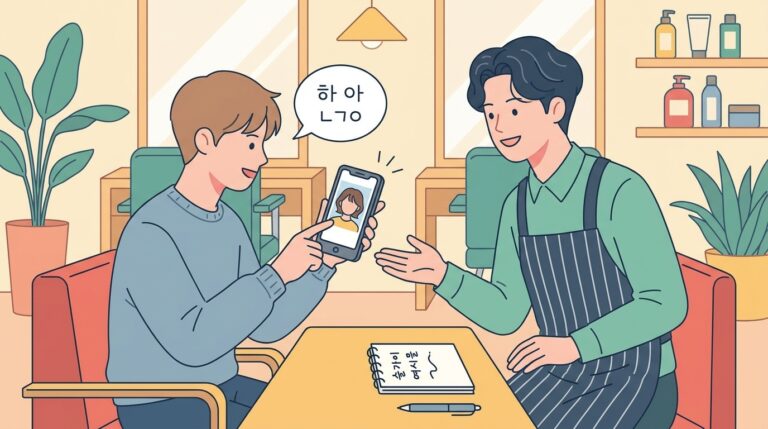
- K-Culture Moment: Explaining “ashy rose gold” is hard even in your native language. Showing a picture of Blackpink’s Rosé on your phone and saying this phrase is the ultimate local hack.
- Editor’s Insight: 처럼 (cheo-reom) means “like” or “similar to.” 해주세요 (hae-ju-se-yo) literally means “please do it for me.” It’s the most useful magic wand phrase in Korea!
- Situation Spectrum:
- Casual: 이 사진처럼 해줘 ⚠️ (Too rude for salon staff)
- Semi-formal (to staff): 이 사진처럼 해주세요 ✅
- Formal: 이 사진처럼 해주시면 감사하겠습니다 ✅
- 🤔 Think About It: “주세요 (Please give/do for me)” is used everywhere in Korea, from cafes to salons. It reflects the strong service culture where the provider is “giving” a service to the customer.
3. 탈색도 해야 돼요? (Do I have to bleach it too?)
- Pronunciation: [tal-saek-do hae-ya dwae-yo?]
- Meaning: Do I need to bleach my hair as well?
- K-Culture Moment: Korean hair is naturally very dark. To get those bright K-Pop colors, bleach is almost always required.
- Editor’s Insight: 탈색 (tal-saek) means “bleach” (literally: escaping color). -야 돼요? (-ya dwae-yo?) is the essential A2 grammar for “Do I have to…?”
- Situation Spectrum:
- Casual: 탈색도 해야 돼? ✅
- Semi-formal (to staff): 탈색도 해야 돼요? ✅
Phase 3: Textbook vs. Real Korean
Let’s see how textbook Korean differs from what you’ll actually hear in a Gangnam salon.
[Situation 1: Asking for a root touch-up]
* 📖 Textbook: 뿌리 부분을 염색하고 싶습니다. (I would like to dye the root part.)
* 🗣️ Real Korean: 뿌염 하러 왔어요. (I came to do ‘ppu-yeom’.)
* 💡 Why the difference?: Koreans LOVE efficiency. “뿌리 염색” (Root dye) is shortened to “뿌염” (Ppu-yeom). It’s a widely accepted slang even adults use!
[Situation 2: Changing to a darker color for Autumn]
* 📖 Textbook: 어두운 갈색으로 염색해 주세요. (Please dye it dark brown.)
* 🗣️ Real Korean: 톤다운 하고 싶어요. (I want to tone down.)
* 💡 Why the difference?: K-Beauty heavily borrows English words but gives them a unique Korean context. “Tone down” simply means dyeing your hair a darker shade.
Bottom Note: At the A2 level, you don’t need to memorize complex chemical terms. Just use “톤다운” (tone down) or “톤업” (tone up) + “하고 싶어요”!
Phase 4: Cultural Context — K-Culture Deep Dive
4-1. Non-Verbal Culture: The Mirror Conversation
In a Korean salon, the designer will often stand behind you and talk to you through the mirror. Don’t twist your neck to look at them directly! It’s perfectly polite in Korea to maintain eye contact via the mirror. This is part of the salon Nunchi (눈치) — keeping a comfortable physical distance while chatting.
4-2. K-Beauty & The “Vibe” (느낌)
In K-Beauty, it’s less about the exact technical color and more about the “느낌” (neuk-kim – vibe/feeling).
When you sit down, the designer will do a thorough consultation. They might say, “This color has a warm vibe (따뜻한 느낌), but your skin tone suits a cool vibe (시원한 느낌).”
Also, don’t be shy about showing photos of K-Pop idols or K-Drama actors! Korean designers actually prefer this. It’s completely normal to say, “I want a vibe like this actor.” They won’t judge you; they’ll appreciate the clear visual reference.
Phase 5: Real-Life Roleplay Scenario
Setting: Saturday afternoon, 2 PM. A bright, aesthetic hair salon in Cheongdam-dong. Soft K-R&B music is playing. You are seated in a comfortable chair, wearing a salon gown.
Characters:
* YOU: An expat who wants to try a bold K-Pop style (Ash Gray) for the first time.
* Ji-a: (28, your hair designer) Very friendly, trendy, and speaks a little English but prefers Korean.
Dialogue:
Ji-a: 안녕하세요! 예약하셨나요? 😊
(an-nyeong-ha-se-yo! ye-yak-ha-syeon-na-yo?)
[Hello! Did you make a reservation?]
(🎭 Stage Direction: Ji-a bows slightly and checks her tablet.)
YOU: 네, 예약했어요.
(ne, ye-yak-hae-sseo-yo.)
[Yes, I made a reservation.]
Ji-a: 네, 이쪽으로 앉으세요. 음료는 어떤 걸로 드릴까요?
(ne, i-jjog-eu-ro an-jeu-se-yo. eum-nyo-neun eo-tteon geol-lo deu-ril-kka-yo?)
[Yes, please sit here. What kind of drink can I get you?]
(🎭 Note: Premium Korean salons offer free cafe-style drinks!)
YOU: 아이스 아메리카노 부탁드립니다.
(a-i-seu a-me-ri-ka-no bu-tak-deu-rim-ni-da.)
[Iced Americano, please.]
Ji-a: 네~ 오늘 머리 어떻게 해드릴까요?
(ne~ o-neul meo-ri eo-tteo-ke hae-deu-ril-kka-yo?)
[Okay~ How would you like your hair done today?]
YOU: 저… 염색하고 싶어요.
(jeo… yeom-saek-ha-go si-po-yo.)
[Um… I want to dye my hair.]
Ji-a: 오! 생각하신 색깔 있으세요?
(o! saeng-gak-ha-sin saek-kkal i-sseu-se-yo?)
[Oh! Do you have a color in mind?]
YOU: (Showing your phone) 이 사진처럼 해주세요.
(i sa-jin-cheo-reom hae-ju-se-yo.)
[Please make it like this picture.]
Ji-a: (Looking closely) 아~ 애쉬 그레이네요. 너무 예뻐요! 그런데 이 색은…
(a~ ae-swi geu-re-i-ne-yo. neo-mu ye-ppeo-yo! geu-reon-de i sae-geun…)
[Ah~ It’s Ash Gray. So pretty! But this color…]
YOU: 탈색도 해야 돼요?
(tal-saek-do hae-ya dwae-yo?)
[Do I have to bleach it too?]
Ji-a: 네, 맞아요. 모발이 어두워서 탈색 두 번 해야 돼요. 머릿결이 많이 상할 수 있는데 괜찮으세요?
(ne, ma-ja-yo. mo-ba-ri eo-du-wo-seo tal-saek du beon hae-ya dwae-yo. meo-rit-gyeo-ri ma-ni sang-hal su in-neun-de gwaen-cha-neu-se-yo?)
[Yes, that’s right. Because your hair is dark, we have to bleach it twice. Your hair might get very damaged, is that okay?]
🔀 Your Turn! How will you respond?
* A) 네, 그냥 해주세요. (Yes, just do it.)
* B) 아… 그럼 머릿결 안 상하는 어두운 색으로 할게요. (Ah… Then I’ll do a dark color that won’t damage my hair.)
* C) 진짜요? 대박! (Really? Awesome!)✅ Best Choice: B — If you are worried about damage, it’s best to pivot. Korean designers are very honest about hair damage!
⚠️ Choice A Analysis: Safe grammatically, but prepare to pay extra for hair treatments (클리닉 – clinic) to save your hair!
Phase 6: 10-Second Shadowing Drill
Practice these sentences out loud to get the rhythm of natural Korean! Slashes (/) show where to pause.
- 🥺 (Politely) 저기요, / 염색하고 / 싶어요.
(jeo-gi-yo, / yeom-saek-ha-go / si-po-yo.) - 📱 (Excitedly pointing at phone) 이 사진처럼 / 똑같이 / 해주세요!
(i sa-jin-cheo-reom / ttok-ga-chi / hae-ju-se-yo!) - 🤔 (A bit worried) 혹시… / 탈색도 / 해야 돼요?
(hok-si… / tal-saek-do / hae-ya dwae-yo?)
Phase 7: K-Culture Mini Dictionary
Here are 4 must-know vocabulary words for your salon visit:
1. 미용실
* Romanization: mi-yong-sil
* English: Hair salon
* Context: The general term for a hair salon. You might also see “헤어샵” (Hair shop) on signs.
2. 탈색
* Romanization: tal-saek
* English: Bleach
* Context: Literally “escaping” (탈) “color” (색). Essential for any pastel or ash K-Pop colors.
3. 뿌염
* Romanization: ppu-yeom
* English: Root dye (touch-up)
* Context: A highly common abbreviation of 뿌리 염색.
4. 클리닉
* Romanization: keul-ri-nik
* English: Hair treatment
* Context: Literally “clinic.” If you bleach your hair, the designer will highly recommend adding a “clinic” to repair the protein damage.
Phase 8: Traveler’s Survival Kit
Even if you’re just traveling, getting your hair done in Korea is a top bucket-list item. Here are your survival phrases:
🆘 Survival Phrases for the Salon
– 🇰🇷 “얼마예요?” (eol-ma-ye-yo?)
– 🗣️ Meaning: How much is it?
– 📍 Use it: ALWAYS ask this before they start mixing the bleach!
- 🇰🇷 “얼마나 걸려요?” (eol-ma-na geol-lyeo-yo?)
- 🗣️ Meaning: How long will it take?
- 📍 Use it: Dyeing and bleaching can take 3-4 hours. Ask so you don’t miss your dinner plans.
📌 Editor’s Travel Note
– No Tipping! There is zero tipping culture in Korean hair salons. Don’t try to hand cash to the person who washes your hair; they will politely decline and feel awkward.
– Useful App: If you want to browse prices and book in advance, download the Kakao Hairshop (카카오헤어샵) app or use Naver Map to book appointments. Walk-ins are often turned away in popular areas like Hongdae or Seongsu!
Phase 9: Critical Thinking Corner — “One Step Deeper”
🧠 Think Deeper: Media vs. Reality (Language & Identity)
If you watch K-Pop music videos, you’ll see idols with neon pink, electric blue, and silver hair. Because of this media exposure, many foreigners think bright hair colors are the norm in everyday Korea. However, the reality is quite different.
In traditional Korean corporate culture, having “neat” (단정한) black or natural brown hair is still considered a sign of professionalism and respect. Showing up to a conservative Korean office with bleached blonde hair might cause some raised eyebrows! The wild hair colors of idols represent a “fantasy” and an escape from strict societal norms, rather than the everyday reality of a Korean office worker.
💬 Your Turn: In your home country, does your workplace or school have strict rules about hair color? Tell us in the comments!
Phase 10: FAQ & Avoiding Common Mistakes
Q: “Can I use ‘페인트(paint)’ for hair? Like, 머리를 페인트하고 싶어요?”
No! ❌ This is a very common mistake for English speakers. In Korean, “페인트” is strictly for painting walls or cars. For hair, you MUST use the specific word 염색 (yeom-saek). If you say you want to paint your hair, the designer will laugh!
Q: “Is it rude to say ‘안 할래요’ (I don’t want to do it) if it’s too expensive?”
It’s a bit too direct. If the price is too high after the consultation, a more polite (and very Korean) way to escape is saying: “생각보다 비싸네요. 다음에 다시 올게요.” (It’s more expensive than I thought. I will come back next time.)
Q: “Can I use 반말 (casual language) to the hair designer if they look younger than me?”
Absolutely not! 🚫 Even if they look 10 years younger than you, they are providing a professional service. Always use 존댓말 (polite language, ending in -요) in a salon.
Phase 11: Summary & Action Items
- One-Liner Summary: To get your dream hair color in Korea, say “염색하고 싶어요” (I want to dye my hair) and show a picture saying “이 사진처럼 해주세요” (Please make it like this picture)!
🚀 Action Mission 3 Steps:
* 🥉 Bronze (Solo): Stand in front of your bathroom mirror and practice saying “염색하고 싶어요” 3 times out loud.
* 🥈 Silver (Online): Find a picture of a hair color you want on Instagram or Pinterest. Post it in a Korean learning group and write: “이 사진처럼 염색하고 싶어요!”
* 🥇 Gold (Real Life): Next time you visit a Korean salon (or even a Korean restaurant!), try using the magic phrase “~처럼 해주세요” (Please do it like ~)!
🎬 K-Culture Mission:
Open YouTube and search for “Korean hair salon vlog.” Watch how the designer talks to the customer through the mirror and listen carefully to see if you can hear the word 염색 (yeom-saek) or 뿌염 (ppu-yeom)!
Phase 12: Quiz — Interactive Challenge
Q1. You want to touch up your dark roots. What is the most natural “Real Korean” way to ask?
A) 페인트 해주세요.
B) 뿌염 하러 왔어요.
C) 뿌리 부분 염색을 원합니다.
Q2. True or False: In a Korean salon, it is considered polite to leave a 10% tip for the person who washed your hair.
Q3. Fill in the blank: “I want to dye my hair.” -> “_____하고 싶어요.”
(Scroll down for answers!)
Answers:
1. B (A uses the word for wall paint, C is too robotic and textbook-like. B uses the natural slang ‘ppu-yeom’.)
2. False! (There is no tipping culture in Korea. The service fee is all included.)
3. 염색 (yeom-saek)
Frequently Asked Questions (FAQ)
Q: What does "염색하고 싶어요 (I want to dye my hair)" mean in Korean and how do you pronounce it?
A: In Korean, "염색하고 싶어요 (I want to dye my hair)" is pronounced [yeom-saek-ha-go si-po-yo] and means: I want to dye my hair. (Literal: I want to do hair-dyeing.)
Q: What does "이 사진처럼 해주세요 (Please make it like this picture)" mean in Korean and how do you pronounce it?
A: In Korean, "이 사진처럼 해주세요 (Please make it like this picture)" is pronounced [i sa-jin-cheo-reom hae-ju-se-yo] and means: Please do it like this photo.
Q: What does "탈색도 해야 돼요? (Do I have to bleach it too?)" mean in Korean and how do you pronounce it?
A: In Korean, "탈색도 해야 돼요? (Do I have to bleach it too?)" is pronounced [tal-saek-do hae-ya dwae-yo?] and means: Do I need to bleach my hair as well?







