

Phase 1: Empathy & K-Culture Cold Open
Hello, C1 learners! I’m your Senior Editor at Daily Hangul.
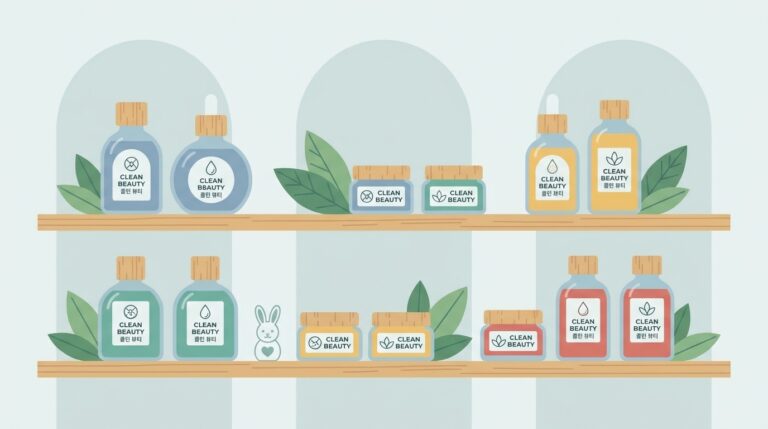
Imagine this: You’re strolling through the bustling streets of Seongsu-dong, the undisputed mecca of Seoul’s pop-up culture. You step into a beautifully minimalist cosmetic store. A K-pop idol’s face smiles at you from a giant poster next to words like 비건 (Vegan), 클린 뷰티 (Clean Beauty), and 크루얼티 프리 (Cruelty-Free).
A decade ago, K-Beauty was all about 10-step routines, snail mucin, and dramatic whitening effects. But today? The trend has completely shifted. Korean consumers, exhausted by fine dust (미세먼지) and high-stress lifestyles, are demanding products that are not only kind to their hyper-sensitive skin but also kind to the planet.
But here is the catch: While words like ‘Vegan’ are borrowed from English, the way Koreans talk about skincare ingredients, ethical consumption, and recycling is deeply rooted in local nuances. If you only know textbook phrases like “화장품을 사고 싶습니다” (I want to buy cosmetics), you’re missing out on the rich, advanced vocabulary that actual beauty insiders use in Seoul.
This guide is built from the real experiences of my advanced students who wanted to shop ethically in Korea but found themselves lost in a sea of scientific ingredient lists and eco-campaign jargon. Let’s upgrade your K-Beauty vocabulary to a true C1 level!
Phase 2: Core Expressions Deep Dive
Let’s break down the essential, high-level expressions you need when navigating the clean beauty sector.
1. 성분이 순해서 민감성 피부에 딱이에요.
- Pronunciation: seongbuni sunhaeseo mingamseong pibue ttagieyo. [seong-boon-ee / soon-hae-suh / min-gam-sung / pee-boo-eh / ddak-ee-eh-yo]
- Meaning: Literal: The ingredients are mild, so it is exactly for sensitive skin. / Real nuance: It has a gentle formula, making it perfect for sensitive skin.
- K-Culture Moment: You’ll hear this constantly from Olive Young staff. In modern Korea, almost everyone claims to have 민감성 피부 (sensitive skin) due to environmental factors like fine dust and seasonal changes.
- Editor’s Insight: The word 순하다 (sun-ha-da) is the holy grail of modern K-Beauty. Originally used to describe a gentle personality (like a docile puppy), it’s now the ultimate compliment for skincare. It means the product won’t cause breakouts or sting.
- Situation Spectrum:
- Casual with friends: ✅ (이거 완전 순해!)
- Shopping/Semi-formal: ✅
- Formal/Business: ✅
- 🤔 Think About It: Why is “gentleness” (순하다) prized over “effectiveness” (효과적이다) in recent K-Beauty trends? How does the high-stress, fast-paced Korean lifestyle play into this desire for “soothing” products?
2. 동물성 원료가 배제된 비건 인증 제품인가요?
- Pronunciation: dongmulseong wollyoga baejedoen bigeon injeung jepumingayo? [dong-mool-sung / won-lyo-ga / bae-jeh-dwen / bee-gun / in-jeung / jeh-poom-in-ga-yo]
- Meaning: Literal: Is this a vegan-certified product from which animal-derived ingredients are excluded? / Real nuance: Is this certified vegan and free of animal ingredients?
- K-Culture Moment: When you’re at an indie beauty pop-up in Yeonnam-dong and want to double-check their ethical claims. Korean consumers are highly meticulous, often verifying certifications like the ‘Eve Vegan’ mark.
- Editor’s Insight: 배제되다 (to be excluded) is a sophisticated, C1-level passive verb. Instead of saying “동물성 원료가 없어요” (There are no animal ingredients), using “배제된” shows a high level of fluency and implies intentional, ethical manufacturing.
- Situation Spectrum:
- Casual with friends: ⚠️ (A bit too formal; friends just say “이거 비건이야?”)
- Shopping/Semi-formal: ✅ (Perfect for asking store clerks)
- Formal/Business: ✅
- 🤔 Think About It: Koreans love official “certifications” (인증). Why does Korean society place such high trust in official stamps and institutional validation, even in beauty?
3. 공병 수거 캠페인에 참여할 수 있나요?
- Pronunciation: gongbyeong sugeo kaempeine chamyeohal su innayo? [gong-byung / soo-guh / cam-peh-in-eh / cham-yuh-hal / soo / in-na-yo]
- Meaning: Literal: Can I participate in the empty bottle collection campaign? / Real nuance: Do you take back empty bottles for recycling?
- K-Culture Moment: Brands like Innisfree or Aromatica offer reward points when you return your empties. It’s a huge part of the 클린 뷰티 (Clean Beauty) movement.
- Editor’s Insight: 공병 (gongbyeong) translates to “empty bottle.” Knowing this word instantly marks you as a local insider who doesn’t just buy, but also recycles properly according to Korea’s strict waste management culture.
- Situation Spectrum:
- Casual with friends: ✅
- Shopping/Semi-formal: ✅
- Formal/Business: ✅
- 🤔 Think About It: Korea has one of the highest recycling rates in the world. How does this collective responsibility reflect in consumer marketing?
Phase 3: Textbook vs. Real Korean
Let’s upgrade your textbook Korean to what we actually say on the streets of Seoul.
[Asking for Eco-Friendly Recommendations]
* 📖 Textbook: 환경을 보호하는 화장품을 추천해 주시겠습니까? (Could you recommend cosmetics that protect the environment?)
* 🗣️ Real Korean: 요즘 잘 나가는 클린 뷰티템 추천해 주세요. (Please recommend some popular clean beauty items these days.)
* 💡 Why the difference?: Koreans love adding 템 (tem), from the English “item,” to categorize products (e.g., 꿀템 for great items, 비건템 for vegan items). It’s faster and sounds much trendier.
[Describing the Product’s Feel]
* 📖 Textbook: 이 제품은 피부에 자극이 없습니다. (This product has no irritation to the skin.)
* 🗣️ Real Korean: 이거 완전 순둥순둥해서 트러블 하나도 안 올라와요. (This is so super gentle, I don’t get any breakouts at all.)
* 💡 Why the difference?: “순둥순둥하다” is an adorable, mimetic slang derived from “순하다”. Also, instead of saying “acne” (여드름), modern Koreans use the catch-all English loanword 트러블 (trouble) for any skin issue.
Phase 4: Cultural Context — K-Culture Deep Dive
4-1. Non-Verbal Elements: The Art of “Swatching” and “Nunchi”
When testing clean beauty products, there is an unwritten rule. Don’t just pump a massive amount! Apply a tiny drop on the back of your hand, gently tap it in with your ring finger, and smell it. Because vegan/clean products often lack artificial fragrances (인공 향료 무첨가), Koreans pay close attention to the natural, earthy scents. Also, use your 눈치 (Nunchi) at Olive Young during big sales (올영세일)—if the aisle is packed, test quickly and step aside!
4-2. The “Hwahae” App Culture
In Korea, you cannot talk about clean beauty without mentioning the app 화해 (Hwahae). It’s an ingredient analysis app that flags toxic chemicals. In K-Dramas, you might see characters casually scanning barcodes to check for “EWG Green Grade” ingredients. As a C1 learner, if you walk into a store and say, “이거 화해 앱에서 평점 높던데 맞나요?” (Is it true this has a high rating on the Hwahae app?), the clerk will treat you like an absolute beauty guru.
Phase 5: Real-life Roleplay Scenario
Setting: A Friday afternoon in Seongsu-dong. You are inside a beautifully designed flagship store for a trendy vegan skincare brand. The interior is decorated with real moss and recycled wood. You approach the counter.
Characters:
– YOU: An expat living in Seoul, highly conscious about ethical consumption and currently dealing with a sudden skin breakout.
– Se-yeon (세연, 26): The friendly and highly knowledgeable store clerk.
Dialogue:
세연: 어서 오세요! 혹시 찾으시는 제품 있으신가요? 🌱
(eoseo oseyo! hoksi chajeusineun jepum isseusingayo?)
[Welcome! Are you looking for any specific product?]
YOU: 아, 네. 제가 요즘 미세먼지 때문인지 피부가 확 뒤집어져서요. 진정 효과 있는 스킨케어 라인 좀 볼 수 있을까요?
(a, ne. jega yojeum misemeonji ttaemuninji pibuga hwak dwijibeojyeoseoyo. jinjeong hyogwa inneun seukinkeeo rain jom bol su isseulkkayo?)
[Ah, yes. My skin completely broke out recently, maybe because of the fine dust. Could I see a skincare line with a soothing effect?]
세연: 아유, 속상하시겠어요. 그럼 이 병풀 추출물 들어간 세럼 어떠세요? 동물성 원료가 완전히 배제된 비건 인증 제품이에요.
(ayu, soksanghasigesseoyo. geureom i byeongpul chuchulmul deureogan sereum eotteoseyo? dongmulseong wollyoga wanjeonhi baejedoen bigeon injeung jepumieyo.)
[Oh, that must be upsetting. Then how about this serum with Centella Asiatica extract? It’s a vegan-certified product completely free of animal-derived ingredients.]
YOU: 향료나 색소 같은 유해 성분은 안 들어갔죠?
(hyangryona saekso gateun yuhae seongbuneun an deureogatjyo?)
[It doesn’t contain harmful ingredients like artificial fragrances or colorants, right?]
세연: 네, 전 성분 EWG 그린 등급이고 피부 자극 테스트도 완료해서 엄청 순해요. 손등에 한번 테스트해 보시겠어요?
(ne, jeon seongbun EWG geurin deungeubigo pibu jageuk teseuteudo wallyohaeseo eomcheong sunhaeyo. sondeunge hambeon teseuteuhae bosigesseoyo?)
[Yes, all ingredients are EWG Green Grade, and it’s completed skin irritation tests, so it’s incredibly gentle. Would you like to test it on the back of your hand?]
(🎭 Stage Direction: You tap the serum into your skin.)
YOU: 오, 흡수도 빠르고 끈적임이 없네요. 이걸로 할게요. 아, 혹시 다 쓰고 나서 공병 수거 캠페인 참여하면 포인트 적립 되나요?
(o, heupsudo ppareugo kkeunjeogimi eomneyo. igeollo halgeyo. a, hoksi da sseugo naseo gongbyeong sugeo kaempein chamyeohamyeon pointeu jeongnip doenayo?)
[Oh, it absorbs fast and isn’t sticky. I’ll take this. Oh, by the way, do I get points if I participate in the empty bottle return campaign after using it all?]
세연: 네, 물론이죠! 공병 가져오시면 500포인트 적립해 드려요. 결제 도와드릴게요.
(ne, mullonijyo! gongbyeong gajyeoosimyeon obaek-pointeu jeongniphae deuryeoyo. gyeolje dowadeurilgeyo.)
[Yes, of course! If you bring the empty bottle, we reward you with 500 points. Let me help you with the checkout.]
🔀 Your Turn! How do you answer the final question?
세연: 쇼핑백 필요하신가요? (Do you need a shopping bag?)
- A) 네, 비닐봉지로 주세요. (Yes, give me a plastic bag.)
- B) 아뇨, 괜찮아요. 제 텀블러 백에 넣을게요. (No, it’s fine. I’ll put it in my tumbler bag.)
- C) 쇼핑백 얼마예요? (How much is the shopping bag?)
✅ Best Choice: B — Reason: In the spirit of “Clean Beauty” and “Eco-friendly” (친환경), bringing your own eco-bag or tumbler bag aligns perfectly with the cultural context.
⚠️ Choice A Analysis: Korea has banned free single-use plastic bags in most stores, and asking for “비닐봉지” in a clean beauty store might get you a polite but awkward refusal!
Phase 6: 10-Second Shadowing Drill
Let’s practice your intonation. The key is to sound genuinely curious and polite.
🥺 이거 / 비건 인증 / 받은 건가요? / 피부가 많이 / 예민해서요.
(igeo / bigeon injeung / badeun geongayo? / pibuga mani / yeminhaeseoyo.)
[Is this / vegan certified? / Because my skin is / very sensitive.]
Tip: Drag the “많~이” slightly to emphasize just how sensitive your skin is. It evokes empathy from the clerk!
Phase 7: K-Culture Mini Dictionary
1. 올영 (Ol-yeong)
* Romanization: ol-yeong
* English: Short for Olive Young
* Context: Korea’s dominant health and beauty store. If a product is “올영 1위” (Olive Young #1), it means the entire nation trusts it.
2. 착한 소비 (Chakhan sobi)
* Romanization: chak-han so-bi
* English: Ethical/Good consumption
* Context: Buying products that are eco-friendly, fair-trade, or vegan. Brands aggressively market themselves as “착한 브랜드” (Good brands).
3. 트러블 (Teureobeul)
* Romanization: teu-reo-beul
* English: Skin breakouts/acne
* Context: A prime example of Konglish. Koreans rarely say “acne” (여드름) in cosmetics marketing; “trouble” covers redness, pimples, and irritation.
4. 비건 (Bigeon)
* Romanization: bi-geon
* English: Vegan
* Context: Interestingly, while dietary veganism is still growing slowly in Korea, cosmetic veganism has exploded. It is associated with purity and safety rather than just animal rights.
Phase 8: Traveler’s Survival Kit
Exploring beauty shops in Myeongdong or Seongsu? Keep these lifesavers handy!
🆘 Survival Expressions
– 🇰🇷 “테스터 써봐도 되나요?” (teseuteo sseobwado doenayo?)
– 🗣️ Pronunciation: [tes-ter / ssuh-bwa-do / dwe-na-yo?]
– 📍 Where to use: Any cosmetic store before touching a product.
– 💡 Pro Tip: Never apply a tester directly to your face! Always use the back of your hand.
- 🇰🇷 “택스 리펀드 되나요?” (taekseu ripeondeu doenayo?)
- 🗣️ Pronunciation: [tax / ree-pun-deu / dwe-na-yo?]
- 📍 Where to use: Checkout counters.
📌 Editor’s Travel Note
– Useful App: Download the 화해 (Hwahae) app if you want to check ingredient safety like a true local.
– Samples: Clean beauty brands often substitute plastic sachets with eco-friendly paper samples. Don’t be afraid to ask: “샘플 좀 챙겨주실 수 있나요?” (Could you give me some samples?)
Phase 9: Critical Thinking — “One Step Deeper”
Global Era’s Korean: Why not use Korean words?
Have you noticed how much English is used in K-Beauty? “클린 뷰티” (Clean Beauty), “비건” (Vegan), “크루얼티 프리” (Cruelty-Free). Why doesn’t the Korean beauty industry use native Korean words like “채식주의 화장품” (Vegetarian cosmetics) or “동물 실험 반대” (Anti-animal testing)?
In modern Korean marketing, English loanwords carry a premium, trendy, and globalized nuance. Using the word “비건” instantly connects the product to global ethical trends and a modern lifestyle, whereas traditional Korean terms might sound too clinical or activism-focused. It’s a fascinating look at how language shapes consumer psychology in a hyper-capitalist society.
🧠 Think Deeper:
Does borrowing English terms dilute the purity of the Korean language, or is it a natural evolution of a globalized society?💬 Your Turn: Does your country’s beauty industry borrow foreign words to sound more “premium”? Let me know in the comments!
Phase 10: FAQ & Mistake Prevention
- Q: Can I use “순하다” to describe things other than cosmetics?
- Yes! You can use it for food that isn’t spicy (이 국물 순하네요) or a person with a gentle personality (그 사람 진짜 순해요).
- Q: Can I return an opened skincare product if it breaks me out?
- Usually, NO. In Korea, once the seal (개봉 방지 스티커) is broken, returns are generally not accepted unless you have a doctor’s note proving an allergic reaction. Always test first!
❌ Common Mistake #1: Confusing “천연” (Natural) with “비건” (Vegan).
✅ Do this instead: A product can be 100% natural but still contain beeswax or snail mucin. If you want strict vegan products, explicitly look for the word 비건.
Phase 11: Summary & Action Items
- One-Liner Summary: Mastering words like 순하다, 비건, and 공병 will transform you from a standard tourist into a K-Beauty insider who shops ethically and smartly.
-
Action Mission 3 Steps:
- 🥉 Bronze (Solo): Read the 10-second shadowing drill aloud 3 times, focusing on the soft intonation.
- 🥈 Silver (Online): Go to the Olive Young Global website, search for “Vegan,” and read the Korean product descriptions.
- 🥇 Gold (Real Life): Visit a Korean cosmetic store (or your local K-beauty shop) and ask, “비건 제품 있나요?” (Do you have vegan products?)
- K-Culture Mission:
Watch a YouTube “Get Ready With Me” (GRWM) vlog by a Korean influencer. Listen carefully—I guarantee you will hear them say “이거 성분이 진짜 순해요!” within the first 5 minutes.
Did you learn a new phrase today? What’s your favorite “Clean Beauty” item? Tell me in the comments below!
Phase 12: Interactive Challenge (Quiz)
1. Situational Judgment:
You’re at a pop-up store, and the clerk asks why you are hesitant to buy a strong peeling gel. What is the most natural C1-level response?
– A) 피부가 나쁩니다. (My skin is bad.)
– B) 화장품이 아픕니다. (The cosmetics hurt.)
– C) 제가 민감성 피부라서 성분이 순한 걸 찾고 있어요. (I have sensitive skin, so I’m looking for something with gentle ingredients.)
(Answer: C. A and B are unnatural and grammatically awkward in this context.)
2. True or False – K-Culture Edition:
In Korea, you can throw your empty glass skincare bottles directly into the regular trash bin if they are small.
(Answer: FALSE. Korea has extremely strict recycling laws (분리수거). Glass must be separated, and many brands offer rewards for returning empty bottles, known as 공병 수거!)
Frequently Asked Questions (FAQ)
Q: What does "성분이 순해서 민감성 피부에 딱이에요." mean in Korean and how do you pronounce it?
A: In Korean, "성분이 순해서 민감성 피부에 딱이에요." is pronounced [seongbuni sunhaeseo mingamseong pibue ttagieyo. [seong-boon-ee / soon-hae-suh / min-gam-sung / pee-boo-eh / ddak-ee-eh-yo] and means: Literal: The ingredients are mild, so it is exactly for sensitive skin. / Real nuance: It has a gentle formula, making it perfect for sensitive skin.
Q: What does "동물성 원료가 배제된 비건 인증 제품인가요?" mean in Korean and how do you pronounce it?
A: In Korean, "동물성 원료가 배제된 비건 인증 제품인가요?" is pronounced [dongmulseong wollyoga baejedoen bigeon injeung jepumingayo? [dong-mool-sung / won-lyo-ga / bae-jeh-dwen / bee-gun / in-jeung / jeh-poom-in-ga-yo] and means: Literal: Is this a vegan-certified product from which animal-derived ingredients are excluded? / Real nuance: Is this certified vegan and free of animal ingredients?
Q: What does "공병 수거 캠페인에 참여할 수 있나요?" mean in Korean and how do you pronounce it?
A: In Korean, "공병 수거 캠페인에 참여할 수 있나요?" is pronounced [gongbyeong sugeo kaempeine chamyeohal su innayo? [gong-byung / soo-guh / cam-peh-in-eh / cham-yuh-hal / soo / in-na-yo] and means: Literal: Can I participate in the empty bottle collection campaign? / Real nuance: Do you take back empty bottles for recycling?







