

Phase 1: Empathy & Immersion (The Cold Open)
Hello! I am the Lead Editor of Daily Hangul.
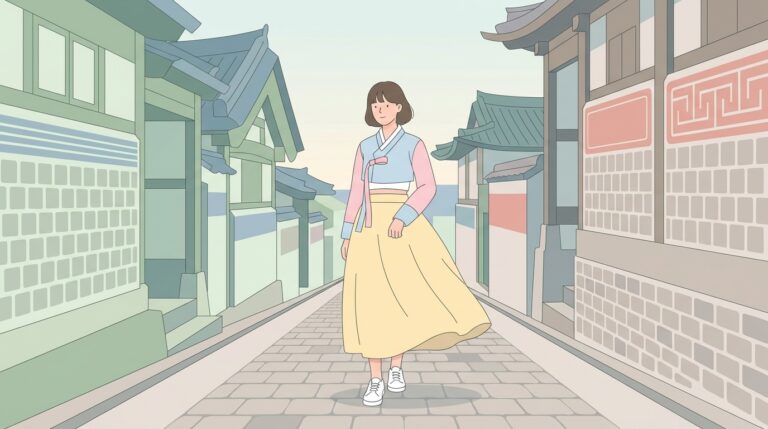
Picture this: You are watching a K-Pop music video—maybe BLACKPINK’s Coachella stage or BTS’s ‘Idol’—and suddenly, you see it. They are wearing Hanbok (한복), but it is not the traditional kind you see in historical K-Dramas. It is cropped, styled with combat boots, and looks incredibly cool. Or perhaps you are walking through Bukchon Hanok Village in Seoul, and you see young Koreans wearing sneakers with a modified, daily Hanbok (생활한복).
If you are an advanced learner (C1), simply saying ‘와, 예뻐요’ (Wow, it’s pretty) just won’t cut it anymore. You want to express the vibe, the aesthetics, and the cultural shift happening right in front of you. But how do you capture that in Korean?
Today, we are going beyond the textbook. We will explore how Koreans actually talk about the beauty of traditional clothing and its trendy modern reinterpretations. This guide is based on real conversations I have had with my advanced students in Seoul who wanted to sound like true local fashion insiders. Let’s dive in!
Phase 2: Core Expressions Deep Dive
1. 선이 곱다 (seoni gopda)
- Pronunciation: [seon-i gop-tta] (Sounds like: sun-ee gop-da)
- Meaning: Literal: ‘The line is beautiful.’ / Real Nuance: ‘The silhouette or curves are graceful and elegant.’
- K-Culture Moment: In historical K-Dramas (사극), when a character steps out in a new Hanbok, this is the ultimate compliment. It praises the unique, gentle curves of the Hanbok, especially the sleeves and the collar.
- Editor’s Insight: Hanbok is all about volume and curves, not tight fits. When you say ‘선이 곱다’, you show a deep understanding of Korean traditional aesthetics, which value flowing lines over straight rigidity.
- Situation Spectrum:
- Casual with friends: ✅
- Semi-formal (colleagues): ✅
- Formal (elders/bosses): ✅
- 🤔 Think About It: Why does traditional Korean art (architecture, clothing, pottery) emphasize soft curves rather than sharp angles? How does this reflect the traditional Korean philosophy of harmonizing with nature?
2. 현대적으로 재해석하다 (hyeondaejeogeuro jaehaeseokhada)
- Pronunciation: [hyeon-dae-jeog-eu-ro jae-hae-seok-ha-da]
- Meaning: Literal & Real: ‘To reinterpret in a modern way.’
- K-Culture Moment: This is the exact phrase used in fashion magazines or by K-Pop stylists when describing stage outfits that mix traditional motifs with streetwear.
- Editor’s Insight: This is a very high-level, sophisticated expression. Use this when you want to sound like a fashion critic or a cultural reviewer.
- Situation Spectrum:
- Casual with friends: ⚠️ (A bit too formal for casual chat, but great for deep discussions)
- Semi-formal (colleagues): ✅
- Formal (elders/bosses): ✅
- 🤔 Think About It: Reinterpreting tradition can sometimes cause controversy. In your culture, how do people react when traditional garments are heavily modified for modern fashion?
3. 힙하게 소화하다 (hiphage sohwahada)
- Pronunciation: [hip-ha-ge so-hwa-ha-da]
- Meaning: Literal: ‘To digest hip-ly.’ / Real Nuance: ‘To pull off a trendy/cool look perfectly.’
- K-Culture Moment: Seeing a teenager in Hongdae wearing a traditional ‘Jeogori’ (jacket) over a crop top with wide pants. You would say, ‘와, 저 사람 한복 진짜 힙하게 소화했네!’
- Editor’s Insight: ‘소화하다’ literally means to digest food, but in fashion, it means to ‘pull off’ a look. ‘힙하다’ (from the English word ‘hip’) is the go-to slang for anything trendy, unique, and cool in Korea right now.
- Situation Spectrum:
- Casual with friends: ✅
- Semi-formal (colleagues): ✅
- Formal (elders/bosses): 🚫 (Too slangy for elders)
- 🤔 Think About It: Why do you think Korean youth adopted the English word ‘hip’ instead of using a native Korean word for ‘trendy’?
Phase 3: Textbook vs. Real Korean
Let’s see how language shifts from the classroom to the streets of Seoul.
[Describing a Beautiful Hanbok]
* 📖 Textbook Korean: 이 한복은 매우 아름답습니다. (This Hanbok is very beautiful.)
* 🗣️ Real Korean: 와, 핏 장난 아니다. 선이 진짜 고와요! (Wow, the fit is no joke. The lines are so graceful!)
* 💡 Why the difference?: ‘장난 아니다’ (It’s no joke) is the ultimate everyday intensifier in Korea. Combining it with ‘선이 곱다’ mixes modern slang with traditional appreciation.
[Talking About Modern Hanbok]
* 📖 Textbook Korean: 이것은 현대적인 한복입니다. (This is a modern Hanbok.)
* 🗣️ Real Korean: 이거 완전 힙한 생활한복이네요. 평소에 입어도 되겠어요. (This is such a hip daily Hanbok. I could wear it normally.)
* 💡 Why the difference?: Koreans use specific terms like ‘생활한복’ (daily Hanbok) for modern variants, focusing on practicality (‘평소에 입어도 되다’).
Phase 4: Cultural Context — K-Culture Deep Dive
4-1. Non-Verbal Nuances
When wearing a traditional Hanbok, posture is everything. Traditionally, hands are folded neatly in front (a posture called 공수 – Gongsu). However, with modern Hanbok, the attitude shifts completely. The contrast is what makes it ‘hip.’ Walking confidently with hands in pockets while wearing a Hanbok jacket is a statement of modern rebellion and style.
4-2. K-Pop & K-Travel Connection
In K-Pop, the Hanbok has become a tool of global cultural diplomacy. When idols wear Hanbok, they aren’t just wearing clothes; they are making a statement about their identity. For travelers, wearing a Hanbok is a passport to the past. If you wear one in Seoul, entry to the grand palaces (like Gyeongbokgung) is absolutely free. But here is the critical view: Many rental Hanboks around palaces feature gold foil and hoop skirts—elements that are actually not historically accurate at all, but were modified to appeal to modern tourists’ tastes.
Phase 5: Real-Life Roleplay Scenario
Setting: A trendy ‘Modern Hanbok’ boutique in Ikseon-dong, Seoul. The shop mixes traditional elements with streetwear. You are looking for an outfit for a cultural event.
Characters:
– YOU: An advanced Korean learner looking for something unique.
– Sujin (30s): The stylish boutique owner.
Dialogue:
Sujin: 어서 오세요! 특별히 찾으시는 스타일 있으신가요?
(eoseo oseyo! teukbyeolhi chajeusineun seutail isseusingayo?)
[Welcome! Is there a particular style you are looking for?]
YOU: 네, 너무 전통적인 것보다는 좀 현대적으로 재해석한 생활한복을 찾고 있어요.
(ne, neomu jeontongjeogin geotbodaneun jom hyeondaejeogeuro jaehaeseokhan saenghwalhanbogeul chatgo isseoyo.)
[Yes, rather than something too traditional, I’m looking for a daily Hanbok that has been reinterpreted modernly.]
Sujin: 아, 그러시구나! 그럼 이 저고리 재킷은 어때요? 요즘 젊은 친구들이 청바지랑 매치해서 아주 힙하게 소화하더라고요.
(a, geureosiguna! geureom i jeogori jaekiseun eottaeyo? yojeum jeolmeun chingudeuri cheongbajirang maechihaeseo aju hiphage sohwahadeoragoyo.)
[Ah, I see! Then how about this Jeogori jacket? Lately, young people pull it off really hiply by matching it with jeans.]
YOU: 오, 예쁘네요. 그런데 제가 입으면 너무 어색하지 않을까요?
(o, yeppeuneyo. geureonde jega ibeumyeon neomu eosaekhaji aneulkkayo?)
[Oh, it’s pretty. But won’t it look too awkward if I wear it?]
Sujin: 전혀요! 오히려 외국인분들이 입으면 묘한 퓨전 느낌이 나서 더 멋있어요. 한번 입어보실래요?
(jeonhyeoyo! ohiryeo oeguginbundeuri ibeumyeon myohan pyujeon neukkimi naseo deo meosisseoyo. hambeon ibeobosillaeyo?)
[Not at all! Actually, when foreigners wear it, it gives off a unique fusion vibe and looks even cooler. Would you like to try it on?]
(🎭 Stage Direction: You try on the jacket over your t-shirt and look in the mirror.)
🔀 Your Turn! How should you respond looking at the mirror?
– A) 와, 예쁩니다. 감사합니다.
– B) 생각보다 핏이 장난 아니네요! 선이 고우면서도 엄청 트렌디해요.
– C) 이거 진짜 대박이네요. 당장 살게요!✅ Best Choice: B — Reason: It uses advanced vocabulary (‘핏이 장난 아니다’, ‘선이 곱다’) and perfectly captures the C1 level ability to balance traditional appreciation with modern fashion slang.
⚠️ Choice A & C Analysis: A is too basic (A1 level). C is natural but misses the opportunity to describe the aesthetic nuance of the Hanbok.
Phase 6: 10-Second Shadowing Drill
Practice this sentence to sound like a fashion-forward local!
😲 와, / 이 생활한복 / 선이 정말 고우면서도 / 엄청 힙하네요! (wa, / i saenghwalhanbok / seoni jeongmal goumyeonseodo / eomcheong hiphaneyo!)
Emotion Tag: Express pleasant surprise, as if you just discovered a hidden fashion gem.
Phase 7: K-Culture Mini Dictionary
1. 생활한복 (saenghwalhanbok)
* English: Daily / Modern Hanbok
* Context: Hanbok modified for everyday wear. They use modern fabrics (like cotton or linen), zippers, and shorter hemlines for comfort.
2. 퓨전 사극 (pyujeon sageuk)
* English: Fusion Historical Drama
* Context: K-Dramas set in the past but using modern music, speech styles, and highly stylized, often historically inaccurate (but beautiful) Hanbok.
3. 옷고름 (otgoreum)
* English: Hanbok ribbon/string
* Context: The ribbon used to tie the jacket (Jeogori). Tying it correctly (with only one loop) is notoriously difficult even for Koreans!
4. 국뽕 (gukbbong)
* English: Overwhelming national pride (Slang)
* Context: A mix of ‘Nation’ (국) and ‘Intoxication’ (뽕). Koreans often say they feel ‘gukbbong’ when they see global superstars rocking Hanbok on the world stage.
Phase 8: Traveler’s Survival Kit (Hanbok Rental Edition)
Are you planning to rent a Hanbok in Seoul? Save these C1-level survival phrases!
🆘 Survival Phrases
– 🇰🇷 1. “너무 화려한 것 말고, 좀 단아한 스타일로 추천해 주시겠어요?”
– Pronunciation: neomu hwaryeohan geot malgo, jom danahan seutaillo chucheonhae jusigesseoyo?
– Meaning: Instead of something too flashy, could you recommend a more elegant/simple style?
– 🇰🇷 2. “치마 길이는 어떻게 조절하나요?”
– Pronunciation: chima girineun eotteoke jojeolhanayo?
– Meaning: How do I adjust the skirt length?
– 🇰🇷 3. “머리 장식도 대여료에 포함되어 있나요?”
– Pronunciation: meori jangsikdo daeyeoryoe pohamdoeeo innayo?
– Meaning: Are hair accessories included in the rental fee?📌 Editor’s Travel Note
– Footwear: While traditional shoes (Boseon and Kkotshin) look great, they are uncomfortable for walking around palaces. It’s totally fine (and hip!) to wear clean white sneakers under your long Hanbok skirt.
– Free Entry: Wearing a Hanbok gets you free entry into the 5 Grand Palaces of Seoul. But remember, the Hanbok must meet certain criteria (e.g., you must wear both the top and bottom).
Phase 9: Critical Thinking — “One Step Deeper”
Global Era & Identity: The Hanbok Debate
As Hanbok gains global popularity through K-Pop, a debate has emerged in Korea. Traditionalists argue that the heavily modified, crop-top style Hanboks worn by idols destroy the original ‘graceful lines’ (선이 고운 매력) and dignity of the garment. On the other hand, the younger generation and global fans argue that ‘reinterpreting modernly’ (현대적으로 재해석하다) is the only way a traditional garment can survive and evolve in the 21st century. They believe that fashion must be living and breathing, not locked in a museum.
💬 Your Turn: Do you think modifying traditional clothing to make it ‘hip’ is a loss of culture or a brilliant evolution? How does your country handle its traditional attire today? Let us know in the comments!
Phase 10: FAQ & Avoiding Misunderstandings
Q: “Is it cultural appropriation if I, as a foreigner, wear Hanbok in Korea?”
A: Absolutely not! This is a huge misconception. Koreans love seeing foreigners wearing Hanbok. It is viewed as a deep sign of cultural appreciation and respect. You will likely get many smiles and compliments!
Q: “Can I wear a male Hanbok if I identify as female, or vice versa?”
A: Yes! In recent years, Hanbok rental shops have become very open to this, and the palaces have officially changed their rules to allow free entry regardless of cross-dressing, as long as the Hanbok itself is worn correctly.
❌ Common Mistake: Tying the Otgoreum (jacket ribbon) like a Western bow tie with two loops.
✅ Do This Instead: Hanbok ribbons only have one loop. If you don’t know how to tie it, always ask the rental shop staff. Tying it like a shoelace is considered a big fashion faux pas!
Phase 11: Summary & Action Items
One-Liner Summary: To talk about Hanbok like a true local, look beyond ‘pretty’ and praise its elegant curves (선이 곱다) or its hip, modern reinterpretation (현대적으로 재해석하다).
Action Mission 3 Steps:
– 🥉 Bronze (Solo): Look at a picture of a modern Hanbok and say out loud: “이 생활한복, 완전 힙하게 재해석했네!”
– 🥈 Silver (Online): Find a K-Pop music video featuring Hanbok (e.g., BLACKPINK, Stray Kids, BTS) and leave a comment in Korean praising the outfit’s ‘선’.
– 🥇 Gold (Real World): Visit a modern Hanbok store (or a rental shop in Seoul) and use today’s phrases to ask the staff for a recommendation.
K-Culture Mission: Search Instagram for the hashtag #생활한복 (Daily Hanbok). Scroll through the posts and notice how ordinary Koreans style traditional tops with jeans, skirts, and sneakers!
Phase 12: Quiz — Interactive Challenge
1. Situational Judgment:
You are at a Hanbok rental shop and want to compliment your friend’s elegant traditional Hanbok. Which expression is the most natural and sophisticated?
– A) 와, 옷이 참 큽니다.
– B) 핏이 장난 아니네, 선이 진짜 곱다!
– C) 너무 힙하게 재해석했어!
(Answer: B. A means ‘the clothes are big’. C is for modern/modified Hanbok, not traditional elegant ones.)
2. True or False – K-Culture Edition:
Foreigners paying to rent Hanbok is considered cultural appropriation by Korean locals.
(Answer: False. It is highly encouraged and celebrated as cultural appreciation!)
3. Fill in the Blank:
요즘 아이돌 무대 의상을 보면 한복을 아주 ( )으로 ( )한 것 같아요.
(Answer: 현대적, 재해석. – Modernly reinterpreted)
Frequently Asked Questions (FAQ)
Q: What does "선이 곱다 (seoni gopda)" mean in Korean and how do you pronounce it?
A: In Korean, "선이 곱다 (seoni gopda)" is pronounced [seon-i gop-tta] and means: Literal: 'The line is beautiful.' / Real Nuance: 'The silhouette or curves are graceful and elegant.'
Q: What does "현대적으로 재해석하다 (hyeondaejeogeuro jaehaeseokhada)" mean in Korean and how do you pronounce it?
A: In Korean, "현대적으로 재해석하다 (hyeondaejeogeuro jaehaeseokhada)" is pronounced [hyeon-dae-jeog-eu-ro jae-hae-seok-ha-da] and means: Literal & Real: 'To reinterpret in a modern way.'
Q: What does "힙하게 소화하다 (hiphage sohwahada)" mean in Korean and how do you pronounce it?
A: In Korean, "힙하게 소화하다 (hiphage sohwahada)" is pronounced [hip-ha-ge so-hwa-ha-da] and means: Literal: 'To digest hip-ly.' / Real Nuance: 'To pull off a trendy/cool look perfectly.'






