

Phase 1: Empathy & Immersion
Hello there! It’s your Daily Hangul Editor. 👋
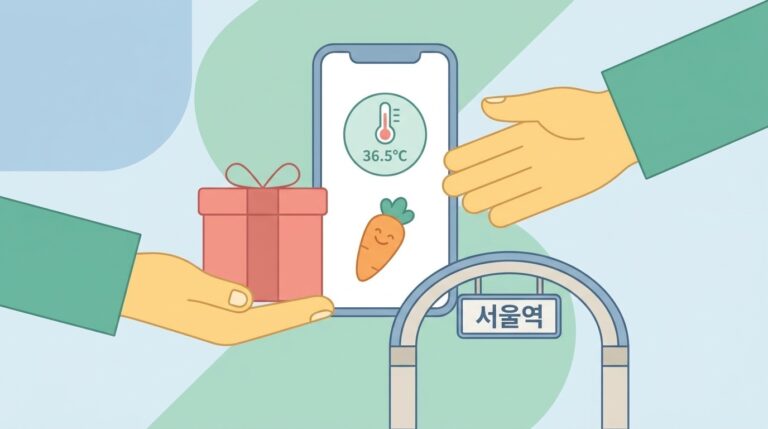
Picture this: You are standing at Exit 3 of a bustling Seoul subway station. You are holding a small shopping bag and awkwardly making eye contact with every person who walks by. Finally, a stranger approaches you, glances at your phone, and whispers: “Are you… Karrot?”
If you have ever lived in Korea, you know exactly what this scene is. Welcome to the world of Korean second-hand trading! But the real K-Culture test doesn’t end when you exchange the item and the cash. The true finale happens on your phone afterward: The Manner Temperature Evaluation (매너 온도 평가).
In Korea’s most popular neighborhood trading apps, your reputation is measured in Celsius. You start at 36.5°C (the average human body temperature), and your score goes up or down based on the reviews you receive after a trade. If you don’t know how to navigate this, you might unintentionally leave a bad impression or miss out on becoming a trusted ‘Insider’ (인싸) in your local community.
Don’t worry! This guide is built from the real experiences of my foreign students who once panicked over what to click after a successful trade. Let’s dive into the phrases that will push your Manner Temperature straight to 99°C! 🌡️
Phase 2: Deep Dive into Key Expressions
Here are the top 3 expressions you will see and use when evaluating a trade partner.
1. 시간 약속을 잘 지켜요
- Pronunciation: si-gan yak-so-geul jal ji-kyeo-yo [she-gan yahk-so-geul jahl jee-kyuh-yo]
- Meaning: (Literal) Keeps the time promise well / (Real Nuance) You are punctual and reliable.
- K-Culture Moment: Punctuality is a virtue globally, but in Korea’s “Ppal-li Ppal-li” (hurry up) culture, making someone wait at a subway station for a $10 item is a huge offense. Selecting this review badge is the ultimate sign of respect for the other person’s time.
- Editor’s Insight: This phrase isn’t just for trading apps! You can use it in daily life to compliment a friend or colleague who is always on time.
- Situation Spectrum:
- Casual (Friends): ✅ (You can say “너 진짜 시간 약속 잘 지킨다!”)
- Semi-formal (Trading App/Coworkers): ✅
- Formal (Boss): ⚠️ (A bit patronizing to evaluate a boss’s punctuality!)
- 🤔 Think About It: Why does Korean use the word ‘promise’ (약속) for simply agreeing on a time to meet? How does this reflect the cultural weight of making plans?
2. 응답이 빨라요
- Pronunciation: eung-da-bi ppal-la-yo [eung-dah-bee ppahl-la-yo]
- Meaning: (Literal) Response is fast / (Real Nuance) You reply to messages instantly.
- K-Culture Moment: Imagine messaging a seller to ask if a K-Pop photocard is still available. If they reply within 30 seconds, they get this badge. Fast communication is the backbone of Korean customer service and daily interactions.
- Editor’s Insight: The word ‘응답’ (eung-dap) feels slightly formal, like “response.” In casual speech, we just say “답장이 빨라요” (dap-jang-i ppal-la-yo – Your text replies are fast).
- Situation Spectrum:
- Casual: ✅
- Semi-formal: ✅
- Formal: ✅
- 🤔 Think About It: How long is an “acceptable” response time in your culture? In Korea, leaving a trade message on “read” for more than an hour might drop your Manner Temperature!
3. 친절하고 매너가 좋아요
- Pronunciation: chin-jeol-ha-go mae-neo-ga jo-a-yo [cheen-juhl-ha-go meh-nuh-gah jo-ah-yo]
- Meaning: (Literal) Kind and manners are good / (Real Nuance) You are friendly and polite.
- K-Culture Moment: The holy grail of trade reviews. You use this when the seller greets you warmly, brings the item in a neat little paper bag, and bows politely when saying goodbye.
- Editor’s Insight: Notice the Konglish word ‘매너’ (manner). In Korean, “having good manners” is usually expressed in the singular form (매너가 좋다) rather than plural.
- Situation Spectrum:
- Casual: ✅
- Semi-formal: ✅
- Formal: ⚠️ (Better to use “예의가 바르시다” for elders).
- 🤔 Think About It: In an anonymous, location-based app, why do Koreans care so much about friendliness (친절) rather than just the item’s quality?
Phase 3: Textbook vs. Real Korean
Let’s see how the textbook differs from the vibrant language used on the streets (and in the chatrooms) of Seoul!
[Reviewing a smooth, hassle-free trade]
* 📖 Textbook Korean: 거래가 성공적으로 끝났습니다. (The transaction ended successfully.)
* 🗣️ Real Korean: 쿨거래 감사합니다! (Thank you for the cool trade!)
* 💡 Why the difference?: A “cool trade” (쿨거래) is modern slang for a transaction with no unnecessary questions, no haggling, and immediate payment. It is highly valued in modern fast-paced Korean society.
[Reviewing the condition of the item]
* 📖 Textbook Korean: 물건 상태가 매우 좋습니다. (The item’s condition is very good.)
* 🗣️ Real Korean: 상태 완전 꿀이네요! or 새상품 같아요. (The condition is totally honey! / It’s like a brand new product.)
* 💡 Why the difference?: Adding “꿀” (honey) as a prefix is a popular slang way to say something is sweet, lucky, or excellent quality.
Bottom Note: At a
B2 (Intermediate)level, using “쿨거래” (Cool trade) will instantly make locals smile and think, “Wow, this person really knows Korean culture!”
Phase 4: Cultural Context — K-Culture Deep Dive
4-1. Non-Verbal Cues: The Art of “Nunchi”
When meeting for a second-hand trade, you don’t need a long conversation. The non-verbal Nunchi (눈치 – situational awareness) is key.
– The Stance: Hold your phone with the app open so the other person can identify you easily.
– The Exchange: Hand the item or cash over with two hands (or one hand supporting your other arm) to show respect.
– The Exit: A slight head bow and a quick “수고하세요” (Keep up the good work) is enough. Don’t linger!
4-2. The “Manner Temperature” & Community Trust
Why 36.5°C? It represents the temperature of a warm human heart. Second-hand apps in Korea aren’t just an eBay alternative; they are built on hyper-local community trust. By gamifying “manners” through temperature, the app encourages the traditional Korean concept of Jeong (정 – warm connection/affection) in a digital space. If your temperature drops below 36.5°C, people will actively avoid trading with you!
Phase 5: Interactive Roleplay Scenario
Let’s put you in the spotlight.
Setting: A chilly Friday evening outside Gangnam Station Exit 10. The street is crowded. You are meeting a local seller to buy a limited-edition K-Pop album you couldn’t find anywhere else.
Characters:
– YOU: An expat who really wants to secure this album and leave a good impression.
– Min-ji (25): The Korean seller. She looks a bit in a hurry but is polite.
Dialogue:
YOU: 저기… 혹시 당근이세요? 🥕
(jeo-gi… hok-si dang-geun-i-se-yo?)
[Excuse me… by any chance, are you Karrot?]
(🎭 Stage Direction: You show your phone screen tentatively.)
Min-ji: 아, 네! 안녕하세요. 앨범 보시겠어요?
(a, ne! an-nyeong-ha-se-yo. ael-beom bo-si-ge-sseo-yo?)
[Ah, yes! Hello. Would you like to check the album?]
(🎭 Stage Direction: Min-ji hands you a neat little paper bag with both hands.)
YOU: 우와, 포장도 예쁘게 해주셨네요. 상태 너무 좋아요!
(u-wa, po-jang-do ye-ppeu-ge hae-ju-syeon-ne-yo. sang-tae neo-mu jo-a-yo!)
[Wow, you even packaged it nicely. The condition is so good!]
Min-ji: 다행이네요. 계좌이체 확인했습니다.
(da-haeng-i-ne-yo. gye-jwa-i-che hwa-gin-haet-seum-ni-da.)
[I’m glad. I have confirmed the bank transfer.]
🔀 Your Turn! How should you say goodbye to secure a great review?
– A) “안녕히 가세요. 거래가 성공적으로 끝났습니다.”
– B) “감사합니다! 제가 매너 온도 팍팍 올려드릴게요! 조심히 가세요~”
– C) “수고하세요. 우리 친구 할래요?”✅ Best Choice: B — “Thank you! I’ll boost your Manner Temperature a lot! Get home safely~”. This shows high cultural fluency. Mentioning the “Manner Temperature” playfully ensures she will leave you a great review in return.
⚠️ Choice A Analysis: Too robotic and textbook.
⚠️ Choice C Analysis: Big mistake! Trading app etiquette dictates strictly transactional boundaries. Asking to be friends is a breach of Nunchi.
Phase 6: 10-Second Shadowing Drill
Let’s practice the ultimate phrase to end a perfect trade. Speak aloud, following the emotion tags and pauses!
😊 쿨거래 / 감사합니다! / 매너 온도 / 올려드릴게요!
(kul-geo-rae / gam-sa-ham-ni-da! / mae-neo on-do / ol-lyeo-deu-ril-gge-yo!)
[Thank you for the cool trade! I will raise your Manner Temperature!]
Phase 7: K-Culture Mini Dictionary
Here are some must-know vocab words for your Korean trading journey:
1. 당근하다
* Romanization: dang-geun-ha-da
* English: To Karrot / To do a second-hand trade
* Context: The app’s name “Danggeun” (Carrot) literally means “Of course” in slang, but has become a verb for second-hand trading, much like “to Google.”
2. 쿨거래
* Romanization: kul-geo-rae
* English: Cool trade
* Context: A fast, polite transaction without asking for discounts or asking too many questions. Highly praised!
3. 네고
* Romanization: ne-go
* English: Negotiation / Haggling
* Context: Derived from “negotiation.” “네고 가능” means price is negotiable; “네고 불가” means price is firm.
4. 잠수 타다
* Romanization: jam-su ta-da
* English: To ghost (literally: to ride a submarine)
* Context: When a buyer or seller suddenly disappears and stops responding. This is the fastest way to ruin your Manner Temperature!
Phase 8: Traveler’s Survival Kit
Even if you are just visiting Korea for a K-Pop concert, you might use X (Twitter) or local platforms to buy tickets or merchandise. Here is your survival kit!
🆘 Survival Phrases for Trading
– 🇰🇷 “여기 도착했어요!” (yeo-gi do-cha-kae-sseo-yo!) – “I have arrived here!”
– 🇰🇷 “계좌이체 할게요.” (gye-jwa-i-che hal-ge-yo.) – “I will do a bank transfer.”
– 🇰🇷 “현금도 괜찮으세요?” (hyeon-geum-do gwaen-cha-neu-se-yo?) – “Is cash okay too?”📌 Editor’s Travel Note
– Haggling Rule: In Korea, if you want a discount (네고), you must ask before agreeing to meet. Asking for a discount face-to-face at the meeting spot is considered very bad manners!
– Payment: While travelers might rely on cash, Koreans almost exclusively use bank transfers (계좌이체) via their banking apps during trades.
Phase 9: Critical Thinking — “One Step Deeper”
🧠 Think Deeper: Language, Tech, & Community Trust
Why did Korean society create a digital “Manner Temperature”? In the past, Korean communities were tightly knit; neighbors shared food and knew each other’s business. Today, with most people living in large, anonymous apartment complexes, that traditional trust has faded. By assigning a visible “Temperature” to an individual’s manners, technology has effectively gamified polite behavior, creating a modern, digital version of the traditional village community. Language like “시간 약속을 잘 지켜요” (keeps the time promise) acts as the new currency of trust.
💬 Your Turn: Does your country have a localized app for second-hand trading? How do people build trust with strangers in your culture? Let me know in the comments!
Phase 10: FAQ & Avoiding Misunderstandings
- Q: Can I use “수고하세요” (Keep up the good work) to an older seller?
- Maybe: Generally, saying “수고하세요” to an elder is considered slightly rude. However, in brief service interactions or fast trades, it is widely used as a generic goodbye. To be perfectly safe, just say “감사합니다. 안녕히 가세요” (Thank you. Goodbye).
- Q: Is it okay to message them again if I have questions about how to use the item?
- Yes, but briefly: You can send one polite message. Don’t treat the chat like a customer service hotline.
❌ Common Mistake #1: Trying to make small talk during the meetup.
✅ Do this instead: Keep it brief! Confirm the item, pay, bow, and leave. Koreans value efficiency in these trades.
Phase 11: Summary & Action Items
- One-Liner Summary: Mastering the phrases for the “Manner Temperature” review will not only boost your Korean trading score but also deepen your understanding of modern Korean trust culture.
-
Action Mission 3 Steps:
- 🥉 Bronze (Solo): Practice saying “쿨거래 감사합니다!” (kul-geo-rae gam-sa-ham-ni-da) 3 times out loud.
- 🥈 Silver (Online): Write a mock review in Korean in your language study group.
- 🥇 Gold (Real Life): If you are in Korea, buy a cheap item ($1-$2) on a local app just to experience the trade and leave a perfect review!
- K-Culture Mission: Go to YouTube and search “당근마켓 거래” (Karrot Market Trade). Watch a vlog of someone doing a trade and listen for the “쿨거래” or “수고하세요” at the end!
Phase 12: Quiz — Interactive Challenge
Test your new K-Culture knowledge!
1. Fill in the Blank:
The seller was very quick, didn’t ask silly questions, and the trade was smooth. You want to leave a review saying “Thank you for the cool trade!”
– “___거래 감사합니다!”
2. True or False – K-Culture Edition:
– “In Korea, it is completely acceptable to ask for a 10% discount when you meet the seller face-to-face, even if you didn’t discuss it in the app beforehand.”
3. Situational Judgment:
What is the base “Manner Temperature” everyone starts with on the app?
– A) 0°C
– B) 36.5°C
– C) 100°C
(Answers: 1. 쿨 (Cool), 2. False! Always negotiate before meeting, 3. B – 36.5°C, representing human body temperature!)
Frequently Asked Questions (FAQ)
Q: What does "시간 약속을 잘 지켜요" mean in Korean and how do you pronounce it?
A: In Korean, "시간 약속을 잘 지켜요" is pronounced [si-gan yak-so-geul jal ji-kyeo-yo [she-gan yahk-so-geul jahl jee-kyuh-yo] and means: (Literal) Keeps the time promise well / (Real Nuance) You are punctual and reliable.
Q: What does "응답이 빨라요" mean in Korean and how do you pronounce it?
A: In Korean, "응답이 빨라요" is pronounced [eung-da-bi ppal-la-yo [eung-dah-bee ppahl-la-yo] and means: (Literal) Response is fast / (Real Nuance) You reply to messages instantly.
Q: What does "친절하고 매너가 좋아요" mean in Korean and how do you pronounce it?
A: In Korean, "친절하고 매너가 좋아요" is pronounced [chin-jeol-ha-go mae-neo-ga jo-a-yo [cheen-juhl-ha-go meh-nuh-gah jo-ah-yo] and means: (Literal) Kind and manners are good / (Real Nuance) You are friendly and polite.







