

Phase 1: Empathy & K-Culture Cold Open
Hello! I’m the Senior Editor of Daily Hangul.
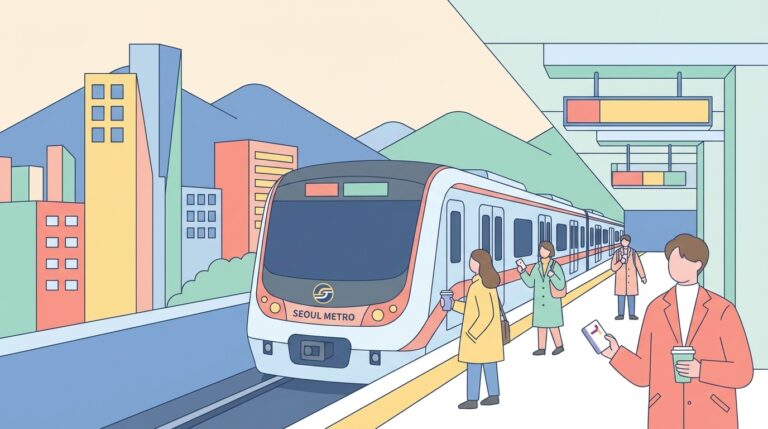
Imagine this: It’s 8:00 AM on a crisp morning in Seoul. In a classic K-Drama, you’d see the main character running out of their house with a piece of toast in their mouth, sprinting to catch the bus. In reality? You’re squeezed into Seoul Metro Line 2 (the infamous ‘Hell-cheol’), surrounded by people speed-walking with an Iced Americano in hand.
Whether you’re heading to your language school, an exchange program, or your new job in Korea, the morning routine is universally relatable. In English, you simply say “I’m going to work” or “I’m going to school.” But in Korean, we have specific verbs for these exact morning journeys!
If you use these expressions right, your Korean colleagues or friends won’t just see you as a beginner—they’ll see you as someone who truly understands the Korean daily rhythm. Let’s dive into the absolute essentials of starting your day in Korea!
(Note: This guide is tailored for absolute beginners [A1], crafted from the real-life struggles and lightbulb moments of my actual tutoring students.)
Phase 2: Core Expressions Deep Dive
1. 출근하다 (To go to work)
- Pronunciation: chul-geun-ha-da [Sounds like: chool-goon-hah-dah]
- Meaning: To go to work / To commute
- K-Culture Moment: Picture a tense K-Drama office scene. The strict boss looks at his watch and says, “Why isn’t Manager Kim here yet?” Someone whispers, “He hasn’t chul-geun-ha-da yet!” It’s the official act of arriving at your workplace.
- Editor’s Insight: This word feels very ‘professional.’ You don’t just say “I go to the company” (회사에 가요) when you are an employee. Saying “저 출근해요 (I am going to work)” makes you sound like a true working professional in Korea.
- Situation Spectrum:
- Casual (Friends): ✅ (출근해~)
- Semi-formal (Coworkers): ✅ (출근해요)
- Formal (Boss/Elders): ✅ (출근합니다)
- 🤔 Think About It: The syllable ‘geun’ (근) relates to diligence and duty. Why do you think the Korean language has such a formal, specific word just for “showing up to work”?
2. 학교에 가다 / 등교하다 (To go to school)
- Pronunciation: hak-gyo-e ga-da [Sounds like: hahk-gyoh-eh gah-dah] / deung-gyo-ha-da [Sounds like: doong-gyoh-hah-dah]
- Meaning: To go to school / To attend school
- K-Culture Moment: In coming-of-age K-Dramas, you always see students in uniforms getting checked by teachers at the school gate. That action of entering the school gates is deung-gyo-ha-da.
- Editor’s Insight: Here is a big secret—while textbooks teach deung-gyo-ha-da, real Koreans rarely use it in daily conversation unless they are watching the news! For everyday life, just say 학교에 가요 (hak-gyo-e ga-yo: I go to school).
- Situation Spectrum (For 학교에 가요):
- Casual (Friends): ✅
- Semi-formal (Coworkers): ✅
- Formal (Boss/Elders): ✅
- 🤔 Think About It: In many languages, “going to school” is a simple action. But deung-gyo-ha-da literally means “ascending to school.” How does this reflect traditional respect for education?
3. 퇴근하다 (To get off work)
- Pronunciation: toe-geun-ha-da [Sounds like: tweh-goon-hah-dah]
- Meaning: To finish work / To leave the office
- K-Culture Moment: The magic word! When an idol finishes a long day of filming, fans will cheer, “퇴근 축하해요!” (Congratulations on getting off work!). It is the happiest word in the Korean dictionary.
- Editor’s Insight: It carries a feeling of relief. When you say “저 퇴근해요!” (I’m getting off work!), you should say it with a bright smile.
- Situation Spectrum:
- Casual (Friends): ✅
- Semi-formal (Coworkers): ✅
- Formal (Boss/Elders): ✅
- 🤔 Think About It: Is there a specific verb in your language for “leaving the workplace,” or do you just say “I’m going home”?
Phase 3: Textbook vs Real Korean
[Saying “I am going to work”]
* 📖 Textbook Korean: 저는 회사에 출근합니다. (jeo-neun hoe-sa-e chul-geun-ham-ni-da.)
* 🗣️ Real Korean: 저 지금 출근해요. (jeo ji-geum chul-geun-hae-yo.)
* 💡 Why the difference?: Textbooks teach the highly formal ‘니다(ni-da)’ form first, but in daily life, the friendly ‘요(yo)’ form with the word ‘지금(ji-geum: now)’ is much more natural and efficient.
[Saying “I am going to school”]
* 📖 Textbook Korean: 저는 학교에 등교합니다. (jeo-neun hak-gyo-e deung-gyo-ham-ni-da.)
* 🗣️ Real Korean: 저 학교 가요. (jeo hak-gyo ga-yo.)
* 💡 Why the difference?: ‘등교하다’ is a formal written word (Hanja-based). Koreans prefer simpler, action-based verbs (‘가다’ – to go) for everyday casual chats.
Bottom Note: For A1 beginners, don’t worry about complex slang! Just dropping the ‘저는 (I am)’ and saying “출근해요” or “학교 가요” instantly makes you sound like a local.
Phase 4: Cultural Context — K-Culture Deep Dive
4-1. Non-verbal Elements of the Commute
When you chul-geun-ha-da, pace is everything. Korea’s 빨리빨리 (Ppalli-ppalli: Hurry up) culture peaks between 8:00 AM and 9:00 AM.
* Pro Tip: Never stand on the left side of an escalator in a subway station during commute hours! The right side is for standing, and the left side is for people running to work. Also, when saying “출근해요” to someone on the phone, sound a little breathless for maximum realism!
4-2. The Holy Grail of the Morning Routine: K-Food (Coffee Culture)
You cannot discuss commuting in Korea without mentioning the Iced Americano. Walk around Gangnam or Yeouido at 8:30 AM, and you will see a sea of people holding giant plastic cups with iced coffee, even in the middle of winter! This is famously known as 얼죽아 (Eol-juk-ah): “Even if I freeze to death, Iced Americano.”
Before Koreans sit at their desks, securing an ‘Ah-ah’ (아아) is an essential part of the chul-geun ritual. It’s the survival potion of the Korean workforce.
Phase 5: Real-Life Roleplay Scenario
Setting: Tuesday, 8:15 AM. Seoul Metro Line 2 (Gangnam-bound). The subway is incredibly packed. You are holding the handrail tightly. Suddenly, you make eye contact with your friendly Korean coworker, Minsu.
Characters:
– YOU: An expat working in Korea for 3 months. You know basic survival Korean.
– Minsu (30): Your enthusiastic Korean coworker who always helps you out.
Dialogue:
Minsu: 어? 안녕하세요! (eo? an-nyeong-ha-se-yo!)
[Translation] Oh? Hello!
(🎭 Stage Direction: Minsu waves awkwardly while being squished by the crowd)
YOU: 아, 민수 씨! 안녕하세요. (a, min-su ssi! an-nyeong-ha-se-yo.)
[Translation] Ah, Minsu! Hello.
Minsu: 지금 출근하세요? (ji-geum chul-geun-ha-se-yo?)
[Translation] Are you going to work now?
YOU: 네, 출근해요. (ne, chul-geun-hae-yo.)
[Translation] Yes, I’m going to work.
Minsu: 지하철에 사람 진짜 많죠? (ji-ha-cheol-e sa-ram jin-jja man-jyo?)
[Translation] There are so many people on the subway, right?
YOU: 네, 진짜 지옥철이에요! (ne, jin-jja ji-ok-cheol-i-e-yo!)
[Translation] Yes, it’s really a ‘hell-train’!
Minsu: 와, 그 단어 알아요? 대박! (wa, geu dan-eo ar-a-yo? dae-bak!)
[Translation] Wow, you know that word? Awesome!
YOU: 하하, 조금 알아요. 커피 샀어요? (ha-ha, jo-geum ar-a-yo. keo-pi sa-sseo-yo?)
[Translation] Haha, I know a little. Did you buy coffee?
Minsu: 당연하죠! 아이스 아메리카노! (dang-yeon-ha-jyo! a-i-seu a-me-ri-ka-no!)
[Translation] Of course! Iced Americano!
🔀 Your Turn! How should you respond to finish the chat before getting off?
– A) “저는 학교에 등교합니다.” (I attend school.)
– B) “오늘도 파이팅!” (Let’s cheer up today / Fighting!)
– C) “안녕!” (Bye! – casual)✅ Best Choice: B — Saying “파이팅” (Pa-i-ting) is the perfect, positive way to encourage a coworker before a long workday!
⚠️ Choice C Analysis: Minsu is your coworker. Unless you are very close friends of the same age, dropping the polite form (saying “안녕”) is a big cultural no-no!
Phase 6: 10-Second Shadowing Drill
Practice this sentence to sound incredibly natural when someone calls you in the morning!
😊 저 지금 / 출근해요! (jeo ji-geum / chul-geun-hae-yo!)
Translation: I am going to work right now!
* Intonation Tip: Raise your pitch slightly at the end of “해요(yo)” to sound energetic and polite. Pause briefly after “지금 (now)”.
Phase 7: K-Culture Mini Dictionary
Here are 4 words you will hear EVERY morning in Korea:
1. 지옥철 (Jiokcheol)
* Romanization: ji-ok-cheol
* English: Hell-train (Crowded subway)
* Context: A combination of ‘Jiok’ (Hell) and ‘Jihacheol’ (Subway). It perfectly describes the extreme crowding of Seoul’s morning commute.
2. 아아 (Ah-ah)
* Romanization: a-a
* English: Iced Americano
* Context: The shortened slang for ‘Aiseu-amerikano’. The absolute fuel for anyone who is chul-geun-ha-da.
3. 따릉이 (Ttareungi)
* Romanization: tta-reung-i
* English: Seoul’s Public Bicycles
* Context: The cute name for the green rental bikes you see everywhere. Many young professionals use them to complete the last mile of their chul-geun.
4. 눈치 (Nunchi)
* Romanization: nun-chi
* English: Social sense / Reading the room
* Context: Crucial during the morning commute! Using nunchi means knowing when to move out of the way on the train, or knowing not to talk loudly when everyone is tired.
Phase 8: Traveler Survival Kit
If you are traveling in Korea, you will definitely interact with the morning rush hour. Even if you aren’t going to work, you need these phrases!
🆘 Survival Phrases for the Morning Commute
– 🇰🇷 “내릴게요!” (nae-ril-gge-yo!)
– 🗣️ Pronunciation: neh-ril-ggeh-yo!
– 📍 Where to use: On a crowded bus or subway when people are blocking the door.
– 💡 Meaning: “I’m getting off!” (Say this loudly but politely, and the Red Sea of commuters will part for you).
- 🇰🇷 “카드 충전해 주세요.” (ka-deu chung-jeon-hae ju-se-yo.)
- 🗣️ Pronunciation: kah-deu choong-jeon-heh joo-seh-yo.
- 📍 Where to use: Convenience stores.
- 💡 Meaning: “Please recharge my card.” (Essential for your T-money transit card!).
📌 Editor’s Travel Note
– Best Apps: KakaoMetro & Naver Map are your best friends. Google Maps does not work well for walking/transit in Korea!
– Rush Hour Warning: If you are a tourist with huge luggage, DO NOT take the subway between 8:00 AM and 9:00 AM. The Jiokcheol is unforgiving to big suitcases!
Phase 9: Critical Thinking — “One Step Deeper”
Media vs Reality: The K-Drama Commute Illusion
🧠 Think Deeper:
If you watch romantic K-Dramas, the main characters often commute on completely empty buses, sitting by the window with the sun shining, listening to indie K-Pop. They arrive at work looking flawless. However, the reality of chul-geun in a mega-city like Seoul is quite the opposite! It’s a fast, crowded, and somewhat exhausting experience that requires a lot of public etiquette (nunchi). Media creates an aesthetic, romanticized version of Korea, but understanding the real, gritty, hardworking morning routine gives you a much deeper appreciation for the resilience of Korean people.💬 Your Turn: Does your country’s media romanticize daily routines like going to work or school? Share your thoughts below!
Phase 10: FAQ & Avoiding Misunderstandings
- Q: Can I just say “Good Morning” in Korean at work?
- A: Yes and No. You can say “좋은 아침입니다” (jo-eun a-chim-im-ni-da: Good morning), but the standard and safest greeting is simply “안녕하세요!” (an-nyeong-ha-se-yo).
- Q: Can I use ‘출근하다’ if I am going to my part-time job at a cafe?
- A: Yes! Even for part-time jobs (알바 – Alba), arriving at work is still called chul-geun-ha-da. It shows you take your job seriously.
❌ Common Mistake #1: Saying “저는 언어 학교에 등교해요” (I deung-gyo-ha-da to language school).
✅ Do This Instead: Use “어학당에 가요” (eo-hak-dang-e ga-yo: I go to language school). Deung-gyo-ha-da is strictly used for formal education like elementary, middle, and high schools!
Phase 11: Summary & Action Items
One-Liner Summary: Use 출근해요 (chul-geun-hae-yo) for going to work, and 학교 가요 (hak-gyo ga-yo) for going to school, to sound just like a local.
Action Mission 3 Steps:
– 🥉 Bronze (Solo): Tomorrow morning, look in the mirror and say “저 출근해요!” (or 학교 가요!) with a bright smile.
– 🥈 Silver (Online): Drop a comment on this blog post saying what time you usually chul-geun or go to school!
– 🥇 Gold (Real World): If you are in Korea, buy an Iced Americano tomorrow morning and mentally declare, “This is my chul-geun ritual!”
🎬 K-Culture Mission:
Watch one episode of a modern office K-Drama (like Misaeng or Business Proposal). Try to spot the exact moment a character taps their ID card to chul-geun-ha-da!
Phase 12: Quiz — Interactive Challenge
1. Situational Judgment:
You are running late for your office job. You call your manager. What is the most natural thing to say?
– A) 저 학교 가요.
– B) 저 지금 출근 중이에요! (I am in the middle of commuting!)
– C) 저 퇴근해요.
2. True or False — K-Culture Edition:
– In Korea, it is considered polite to stand on the left side of the escalator during morning rush hour so people can see you. (T/F)
3. Fill in the Blank:
You are leaving the office at 6 PM. You happily tell your coworkers:
“저 먼저 _______! 내일 봬요!” (I am doing [this] first! See you tomorrow!)
(Answers: 1. B / 2. False – Always leave the left side open for walkers! / 3. 퇴근해요)
How was your commute today? Let us know in the comments! 👇
Frequently Asked Questions (FAQ)
Q: What does "출근하다 (To go to work)" mean in Korean and how do you pronounce it?
A: In Korean, "출근하다 (To go to work)" is pronounced [chul-geun-ha-da [Sounds like: chool-goon-hah-dah] and means: To go to work / To commute
Q: What does "학교에 가다 / 등교하다 (To go to school)" mean in Korean and how do you pronounce it?
A: In Korean, "학교에 가다 / 등교하다 (To go to school)" is pronounced [hak-gyo-e ga-da [Sounds like: hahk-gyoh-eh gah-dah] and means: To go to school / To attend school
Q: What does "퇴근하다 (To get off work)" mean in Korean and how do you pronounce it?
A: In Korean, "퇴근하다 (To get off work)" is pronounced [toe-geun-ha-da [Sounds like: tweh-goon-hah-dah] and means: To finish work / To leave the office







