

안녕하세요! (Hello!) I’m the Lead Editor of Daily Hangul, your premium Korean tutoring brand. As someone who has spent years teaching Korean to expats and binge-watching way too many K-Dramas, I know exactly where the textbooks end and real life in Seoul begins.
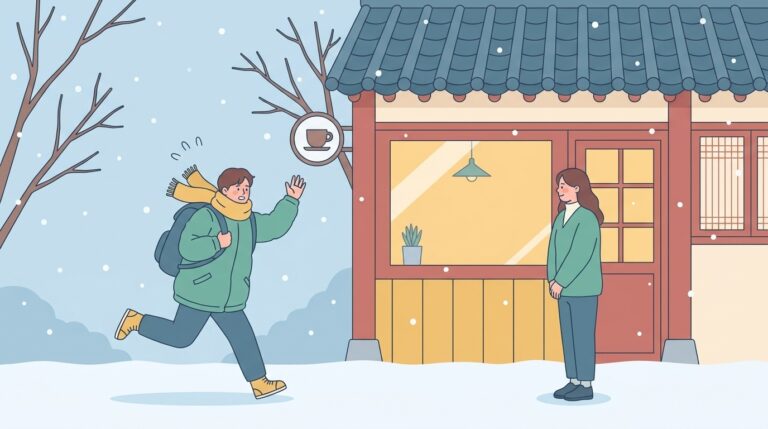
Imagine this classic K-Drama scene: It’s pouring rain, the male lead is stuck in traffic, and his date is waiting outside a cozy cafe. He calls her and says, “먼저 들어가.” (meonjeo deureoga).
If you translate this literally, it means “Enter first.” But enter where? And why didn’t he just say “Sorry I’m late”?
When plans change, or you’re running behind schedule, knowing how to gracefully tell someone to “go on ahead” or “wait inside” is an absolute lifesaver. It saves them from freezing outside in the Korean winter, and it saves you from feeling terribly guilty! Today, we’re going to master how to manage these tiny, yet crucial, appointment changes just like a true local.
Phase 2: Core Expressions Deep Dive
Let’s break down the most essential phrases you need when you’re running late or changing plans on the go.
1. 먼저 들어가 있어요
- Pronunciation: meonjeo deureoga isseoyo [sounds like: mun-juh dro-ga ee-sso-yo]
- Meaning: Literal: Exist having entered first. / Real Nuance: “Go inside first (and wait for me).”
- K-Culture Moment: You’re meeting a friend at a popular K-BBQ place in Hongdae. There’s a long line (웨이팅 – waiting). You’re still on the subway. You text this so they can grab the table first!
- Editor’s Insight: This phrase is incredibly caring. You’re acknowledging their discomfort (waiting outside) and giving them permission to get comfortable inside. The ‘있어요(wait/stay)’ part is key!
- Situation Spectrum:
- Casual (Friends): 먼저 들어가 있어 ✅
- Semi-formal (Colleagues): 먼저 들어가 있어요 ✅
- Formal (Boss/Elders): 먼저 들어가 계세요 ⚠️ (Use with caution, better to apologize first!)
- 🤔 Think About It: Why is it so important to tell them to go inside? Because in Korea, friends usually wait to enter a restaurant together. Going in alone without telling the other person can feel a bit awkward!
2. 먼저 들어가(요)
- Pronunciation: meonjeo deureogayo [sounds like: mun-juh dro-ga-yo]
- Meaning: Literal: Enter first. / Real Nuance: “Go home first (without me)” or “Leave early.”
- K-Culture Moment: The company dinner (회식 – hoesik) is on its third round. You’re exhausted. You whisper to your work bestie, “I’m going home first, you guys enjoy.” Or, you tell your date to go home safely after dropping them off.
- Editor’s Insight: Yes, 들어가다 means “to enter,” but in Korean daily life, it heavily implies “entering one’s house” (going home). It sounds much warmer than saying 집에 가요 (Go home).
- Situation Spectrum:
- Casual (Friends): 먼저 들어가 ✅
- Semi-formal (Colleagues): 먼저 들어가요 ⚠️
- Formal (Boss/Elders): 먼저 들어가세요 🚫 (Never tell a boss to go home! Say: 조심히 들어가세요 – Get home safely).
- 🤔 Think About It: Does your language use the word “enter” to mean “go home”? This shows how Korean views the home as a safe, enclosed sanctuary you “enter” into.
3. 천천히 오세요
- Pronunciation: cheoncheonhi oseyo [sounds like: chun-chun-hee oh-se-yo]
- Meaning: Literal: Come slowly. / Real Nuance: “Take your time, no rush.”
- K-Culture Moment: You just told your friend to go inside the cafe because you’re late. They text you back saying this. Suddenly, your stress melts away!
- Editor’s Insight: Koreans are famous for “빨리빨리” (Ppal-li ppal-li – Hurry hurry!). So, when a Korean tells you to “come slowly,” it is the ultimate expression of politeness and reassurance.
- Situation Spectrum:
- Casual (Friends): 천천히 와 ✅
- Semi-formal (Colleagues): 천천히 오세요 ✅
- Formal (Boss/Elders): 천천히 오세요 ✅
Phase 3: Textbook vs. Real Korean
Let’s see how native speakers actually text when they are running late.
[Situation 1: You’re late to the cafe]
* 📖 Textbook Korean: 식당에 먼저 들어가세요. (Please enter the restaurant first.)
* 🗣️ Real Korean: 나 늦어ㅠㅠ 먼저 들어가 있어! (I’m lateㅠㅠ Go inside first!)
* 💡 Why the difference?: Textbooks use formal commands, but close friends use the “~아/어 있어” structure to mean “stay in that state.” Plus, the ㅠㅠ (crying face) shows you are truly sorry.
[Situation 2: Canceling the rest of the hangout]
* 📖 Textbook Korean: 저는 집에 먼저 가겠습니다. (I will go home first.)
* 🗣️ Real Korean: 저 먼저 들어가 볼게요! (I’ll try going in first!)
* 💡 Why the difference?: Koreans soften their statements by adding “~볼게요” (I will try to). It sounds much less abrupt than announcing your departure like a robot.
Bottom Note: At the
A2 (Beginner)level, using “~요” is your safest bet. If you forget everything else, just remember: “먼저 들어가요” (You go in first) and “먼저 들어가 볼게요” (I’ll go home first).
Phase 4: Cultural Context — K-Culture Deep Dive
4-1. Non-verbal Nunchi (눈치)
When you tell someone “먼저 들어가 있어” (Go in first) because you are late, your tone should be slightly apologetic. You don’t say it like a commander giving an order! If you’re on a video call, do a little apologetic wave (🙏) with your hands.
4-2. The “Waiting” Culture in K-Food
In Korea, especially at famous K-Food restaurants or cafes, there is a strong “Table Sharing” culture. Often, restaurants will not let you sit down unless your entire party has arrived.
If you tell your friend “먼저 들어가 있어,” they might text back: “일행 다 와야 들어갈 수 있대!” (They say we can only go in when the whole party is here!). In this case, you really need to run! Also, waiting outside together in the cold or heat is seen as a sign of solidarity. Telling them to go inside first shows you prioritize their comfort over that tradition.
Phase 5: Real-Life Roleplay Scenario
Setting: A freezing Friday night at 7 PM, right outside Exit 11 of Gangnam Station. The streets are packed. You were supposed to meet your Korean friend Min-su for some spicy Tteokbokki, but you just missed your bus.
Characters:
– YOU (The Reader): An expat navigating Seoul’s winter. Cold, but eager for food.
– Min-su (32): Your friendly local buddy who is already at the meeting spot, freezing.
Dialogue:
YOU: 민수 씨! 진짜 미안해요. 제가 버스를 놓쳤어요. 😭
(Minsu ssi! jinjja mianhaeyo. jega beoseureul nochyeosseoyo.)
[Min-su! I’m so sorry. I missed the bus.]
Min-su: 헐! 얼마나 걸려요?
(Heol! eolmana geollyeoyo?)
[Omg! How long will it take?]
YOU: 한 15분 정도 걸릴 것 같아요.
(han sibobun jeongdo geollil geot gatayo.)
[I think it’ll take about 15 minutes.]
Min-su: 아하, 알겠어요. 밖이 너무 추워요 ㅠㅠ
(Aha, algesseoyo. bakki neomu chuwoyo ㅠㅠ)
[Ah, got it. It’s so cold outside ㅠㅠ]
🔀 Your Turn! How should you respond?
– A) “그럼 밖에서 기다리세요.” (Then wait outside.)
– B) “식당에 먼저 들어가 있어요!” (Go inside the restaurant first!)
– C) “집에 먼저 들어가요!” (Go home first!)✅ Best Choice: B — You are showing consideration for his comfort.
⚠️ Choice C Analysis: Telling him to go home means you are canceling the plan entirely! Only use this if you really can’t make it.
🚫 Choice A Analysis: This is incredibly rude. Never tell a freezing person to keep waiting outside!
(Assuming you chose B)
YOU: 밖이 너무 추우니까 식당에 먼저 들어가 있어요!
(bakki neomu chuunikka sikdange meonjeo deureoga isseoyo!)
[It’s too cold outside, so go inside the restaurant first!]
Min-su: 알겠어요! 천천히 조심히 와요~ 떡볶이 시켜 놓을게요! 🍲
(Algesseoyo! cheoncheonhi josimhi wayo~ tteokbokki sikyeo noeulgeyo!)
[Got it! Take your time and come safely~ I’ll order the Tteokbokki in advance!]
Phase 6: 10-Second Shadowing Drill
Let’s practice the intonation. Speak out loud with the right emotion!
- 🥺 Apologetic & Caring: 나 늦어. / 추우니까 / 먼저 / 들어가 있어!
(na neujeo. / chuunikka / meonjeo / deureoga isseo!) - 😊 Reassuring: 괜찮아요! / 천천히 / 오세요~
(gwaenchanayo! / cheoncheonhi / oseyo~) - 😤 Tired but Polite (Leaving early): 저 / 먼저 / 들어가 볼게요.
(jeo / meonjeo / deureoga bolgeyo.)
Phase 7: K-Culture Mini Dictionary
1. 눈치 (nunchi)
* Romanization: nunchi
* Meaning: Social tact / Reading the room.
* Context: The quintessential Korean social skill. Knowing when to tell someone to “go in first” because they look cold requires good nunchi.
2. 웨이팅 (weiting)
* Romanization: weiting
* Meaning: Waiting in line.
* Context: A Konglish word. Popular cafes have a “웨이팅 리스트” (waiting list). If you say “먼저 들어가 있어,” they might reply “웨이팅 있어” (There’s a line).
3. 일행 (ilhaeng)
* Romanization: ilhaeng
* Meaning: One’s party / company.
* Context: Restaurant staff will ask “일행 다 오셨나요?” (Has your whole party arrived?).
4. 회식 (hoesik)
* Romanization: hoesik
* Meaning: Company dining / After-work drinks.
* Context: The perfect place to use “먼저 들어가 볼게요” when you need to sneak out before the boss orders round 3 of Soju!
Phase 8: Traveler’s Survival Kit
If you are traveling in Korea with a friend, there will be times when you want to look at cosmetics for another hour, but your friend is tired. Use these survival phrases!
🆘 Survival Phrase #1: Go back to the hotel first.
– 🇰🇷 “숙소에 먼저 들어가 있어.” (suksang-e meonjeo deureoga isseo)
– 📍 Where to use: Myeongdong, crowded shopping malls.
– 💡 Pro Tip: ‘숙소’ (sukso) is a great catch-all word for hotel, Airbnb, or guesthouse.🆘 Survival Phrase #2: You order first.
– 🇰🇷 “먼저 주문하고 있어.” (meonjeo jumunhago isseo)
– 📍 Where to use: Cafes, when you need to use the restroom urgently.📌 Editor’s Travel Note
– Useful Apps: When meeting up separately, use “KakaoMap” and share your live location. Google Maps doesn’t work well for walking directions in Korea!
– Subway Delays: Subways in Seoul are rarely late. If you are late, it’s usually because you got lost in the massive underground stations (like COEX or Gangnam!).
Phase 9: Critical Thinking — “One Step Deeper”
🧠 Think Deeper: Food, Identity & Collectivism
Why is telling someone to “go inside first” even a dedicated expression? In many Western cultures, meeting inside the venue or at the table is the default. You just show up when you show up. But in Korea, the strong culture of Collectivism (공동체 의식) means people prefer to experience things together from step one. Waiting outside a restaurant so you can walk in together, sit together, and order together is a sign of unity. Breaking this unity (going in alone) requires explicit permission, which is exactly why “먼저 들어가 있어” is such a vital phrase!💬 Your Turn: Does your culture prefer meeting at the restaurant table, or gathering outside to walk in together? Share in the comments!
Phase 10: FAQ & Avoiding Mistakes
Q: Can I say “먼저 가세요” (meonjeo gaseyo) to tell them to go inside?
A: ⚠️ Be careful! “먼저 가세요” literally means “You go first,” but in many contexts, it sounds like “Go away” or “Leave without me.” If you want them to wait inside for you, you must use “먼저 들어가 있어요.”
Q: Can I use “먼저 들어가 볼게요” to my boss when leaving work?
A: Yes! This is the standard, polite way to leave the office or a company dinner before your superiors. Just make sure to bow slightly!
❌ Common Mistake: Translating “Wait inside” directly as “안에서 기다리세요” (Wait inside).
✅ Do This Instead: While “안에서 기다리세요” is grammatically perfect, it sounds a bit like an instruction from a security guard. “먼저 들어가 있어요” sounds like a caring friend.
Phase 11: Summary & Action Items
One-Liner Summary: When you’re late, save your friends from the cold by saying “먼저 들어가 있어(요)” (Go inside first)!
🎯 Action Missions:
– 🥉 Bronze (Solo): Stand in front of your mirror, pretend you missed the bus, and say “미안해요, 먼저 들어가 있어요!” 3 times.
– 🥈 Silver (Online): Comment below using today’s phrase: “나 늦어, 000에 먼저 들어가 있어!” (Fill in the blank with your favorite place!).
– 🥇 Gold (Real Life): Next time you meet a Korean friend and you are 2 minutes late, text them this phrase!
🇰🇷 K-Culture Mission:
Next time you watch a K-Drama, pay attention to the scene where the second lead is waiting. When the main character calls to cancel the date, listen closely—I guarantee you’ll hear “먼저 들어가”!
Phase 12: Quiz — Interactive Challenge
1. Situational Judgment:
You are at a cafe with your Korean language partner. You feel sick and want to go home early, but you want them to stay and enjoy their coffee. What do you say?
– A) 먼저 오세요.
– B) 저 먼저 들어가 볼게요.
– C) 천천히 오세요.
Check the answer!
Answer: B. You are the one leaving to go home (entering your house), so you say “I will try entering first.”
2. Fill in the Blank:
You text your friend: “나 지하철 놓쳤어. 밖이 추우니까 카페에 ( ________ ) 있어!”
Answer: 먼저 들어가 (meonjeo deureoga)
3. True or False – K-Culture Edition:
In Korea, it’s totally normal and polite to tell your company CEO: “사장님, 피곤하시죠? 먼저 들어가세요!” (Boss, you’re tired right? Go home first!).
Answer: False! Never tell a superior to “들어가세요”. Instead, say “조심히 들어가세요” (Please get home safely) when they decide to leave.
Frequently Asked Questions (FAQ)
Q: What does "먼저 들어가 있어요" mean in Korean and how do you pronounce it?
A: In Korean, "먼저 들어가 있어요" is pronounced [meonjeo deureoga isseoyo [sounds like: mun-juh dro-ga ee-sso-yo] and means: Literal: Exist having entered first. / Real Nuance: "Go inside first (and wait for me)."
Q: What does "먼저 들어가(요)" mean in Korean and how do you pronounce it?
A: In Korean, "먼저 들어가(요)" is pronounced [meonjeo deureogayo [sounds like: mun-juh dro-ga-yo] and means: Literal: Enter first. / Real Nuance: "Go home first (without me)" or "Leave early."
Q: What does "천천히 오세요" mean in Korean and how do you pronounce it?
A: In Korean, "천천히 오세요" is pronounced [cheoncheonhi oseyo [sounds like: chun-chun-hee oh-se-yo] and means: Literal: Come slowly. / Real Nuance: "Take your time, no rush."







