

Phase 1: Empathy (Immersive Open)
Hello! I’m the Lead Editor at Daily Hangul.
Have you ever noticed this in a K-Drama? The main character has been working all night, they look completely exhausted, and when their mom or best friend calls, what is the very first thing they ask?
“Did you eat?”
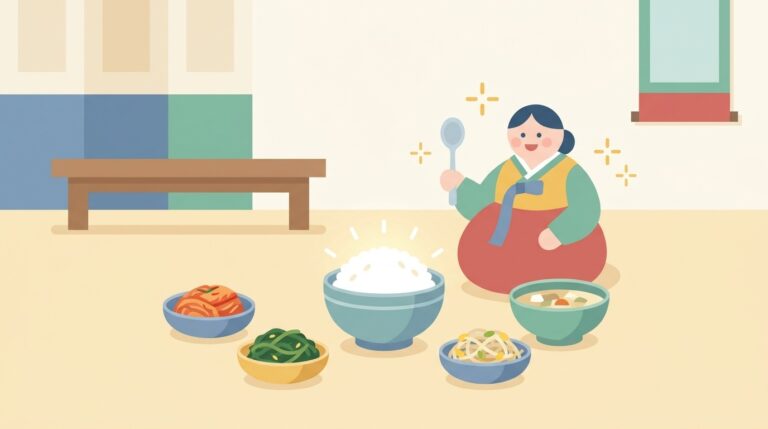
If the character is in the hospital, visitors don’t just bring flowers; they bring abalone porridge. In Korea, food isn’t just fuel for the body—it’s love, concern, and a social glue. There is a famous saying in Korea: “한국인은 밥심으로 산다” (Koreans live on the power of rice).
But what does Bapsim (rice power) really mean? If you don’t understand this concept, you might be very confused when a Korean coworker says, “Let’s eat sometime!” and then never actually sets a date. You might think they are rude, but they are actually showing affection!
This guide is built from the real struggles and “aha!” moments of my students. By the end of this post, you won’t just speak Korean; you’ll understand the “rice-powered” heart of Korean culture.
Phase 2: In-Depth Analysis of Core Expressions
1. 한국인은 밥심이지 (hangugineun bapsimiji)
- Pronunciation: [han-gu-gi-neun / bap-si-mi-ji] (‘eu’ sounds like the disgusted sound you make when stepping in gum)
- Meaning:
- Literal: Koreans live on the power of rice.
- Real nuance: Food gives us the energy to keep going. A proper meal (especially with rice) solves everything!
- K-Culture Moment: Imagine a K-Pop idol on a V-Live stream after a grueling 3-hour concert. They are eating a huge bowl of pork soup (gukbap). They look at the camera, smile, and say, “Wow, I survived today because of this. 한국인은 밥심이지!”
- Editor’s Insight: We use this when we feel suddenly energized after eating a good Korean meal, or to encourage someone who is tired to eat properly instead of just having a sandwich.
- Situation Spectrum:
- Casual (Friends): ✅
- Semi-formal (Coworkers): ✅
- Formal (Boss/Elders): ⚠️ (Use polite form: 밥심이죠 instead)
- 🤔 Think About It: Why specifically rice (밥) and not just ‘food’? Korea has an agricultural history. For centuries, a warm bowl of white rice was a symbol of wealth and health. Does your culture have a specific food that represents “strength” or “survival”?
2. 밥 먹었어? (bap meogeosseo?)
- Pronunciation: [bap / meo-geo-sseo?]
- Meaning:
- Literal: Did you eat rice?
- Real nuance: How are you? Are you doing okay?
- K-Culture Moment: You bump into a Korean friend on campus. They don’t say “How are you?” They immediately ask, “밥 먹었어?” If you say no, they might literally drag you to the cafeteria.
- Editor’s Insight: This is purely a greeting. Don’t overthink it! You don’t need to give them a detailed menu of what you ate. Just saying “Yes, I ate” is the equivalent of saying “I’m fine, thank you, and you?”
- Situation Spectrum:
- Casual (Friends): ✅
- Semi-formal (Coworkers): 🚫 (Too casual)
- Formal (Boss/Elders): 🚫 (You must use polite form: 식사하셨어요? – siksa hasyeosseoyo?)
- 🤔 Think About It: Greeting someone by asking about their meals dates back to times of war and poverty in Korea, when eating three meals a day was a luxury. Asking “Did you eat?” was literally checking if they were surviving.
3. 다음에 밥 한 번 먹자 (daeume bap han beon meokja)
- Pronunciation: [da-eu-me / bap / han-beon / meok-ja]
- Meaning:
- Literal: Let’s eat rice together next time.
- Real nuance: Let’s keep in touch. / See you later.
- K-Culture Moment: At the end of a K-Drama, two characters who used to be close but drifted apart run into each other. They smile awkwardly, and one says, “다음에 밥 한 번 먹자.”
- Editor’s Insight: This is the most misunderstood phrase by foreigners! It is often an empty promise, like saying “Let’s hang out sometime” in English. Don’t wait by the phone for them to invite you to dinner!
- Situation Spectrum:
- Casual (Friends): ✅
- Semi-formal (Coworkers): ✅
- Formal (Boss/Elders): 🚫 (Wait for the elder to suggest it)
- 🤔 Think About It: Koreans feel that sharing a meal is the ultimate way to bond. Why is eating together seen as a more intimate act than just having coffee?
Phase 3: Textbook vs. Real Korean
[Saying Hello / Greeting]
* 📖 Textbook Korean: 안녕하세요? 잘 지내셨어요? (How are you? Have you been well?)
* 🗣️ Real Korean: 어! 밥 먹었어? / 식사하셨어요? (Oh! Did you eat?)
* 💡 Why is it different?: While “안녕하세요” is standard, checking if someone has eaten is considered a much warmer, more intimate way to show you care about their well-being.
[Saying Goodbye / Ending a conversation]
* 📖 Textbook Korean: 안녕히 가세요. 다음에 또 만나요. (Goodbye. See you next time.)
* 🗣️ Real Korean: 다음에 밥 한 번 먹자! 밥 잘 챙겨 먹어! (Let’s grab a meal sometime! Make sure you eat well!)
* 💡 Why is it different?: Emphasizing “taking care of your meals” (밥 잘 챙겨 먹어) is the ultimate Korean expression of affection.
Bottom Note: For B1 learners, using “식사하셨어요?” (Did you have a meal?) with older colleagues or acquaintances is the perfect “sensible” phrase. It shows you truly understand the culture!
Phase 4: Cultural Context — K-Culture Deep Dive
4-1. Non-verbal Elements: Nunchi at the Table
Language is only half the battle. In Korea, mealtime comes with a heavy dose of 눈치 (Nunchi – the ability to read the room). When you go out to eat, especially in a group or with elders:
– Do not pick up your spoon or chopsticks before the oldest person at the table does.
– When pouring water or drinks (like Soju), always use two hands if you are pouring for someone older.
– These silent actions say “I respect you” louder than words!
4-2. K-Drama Connection: The Hospital & The Anger
If you watch K-Dramas, you’ll notice a classic trope. A character gets angry at someone they love. Do they say “I hate you”? No. They yell, “왜 밥을 굶어?!” (Why are you starving yourself?!).
In Korean culture, skipping meals is seen as self-harm and makes your loved ones incredibly upset. Conversely, making a feast for someone is the ultimate apology.
* Critical View: Dramas often show romantic leads feeding each other with chopsticks. In reality, while Koreans share communal dishes (like stews), feeding another adult directly is reserved for very intimate couples, or parents feeding children. Don’t try this on a first date!
Phase 5: Real-life Roleplay Scenario
Setting: Friday, 12:30 PM. A bustling Gomtang (beef bone soup) restaurant in Yeouido, Seoul. You’ve had a terrible morning full of stressful meetings. You are having lunch with your Korean coworker, Minsu.
Characters:
– YOU: A foreign professional working in Korea. Currently very tired.
– Minsu (32): Your friendly Korean coworker who always looks out for you.
Dialogue:
Minsu: 회의 때문에 많이 힘들었죠? 얼굴이 반쪽이 됐어요.
(hoe-ui ttaemune mani himdeureotjyo? eolguri banjjogi dwaesseoyo.)
[Translation] You had a hard time because of the meeting, right? Your face has gotten so thin.
(🎭 Stage Direction: Minsu looks concerned and pushes a bowl of hot soup toward you.)
YOU: 네, 오늘 진짜 피곤하네요. 입맛도 별로 없어요…
(ne, oneul jinjja pigonhaneyo. immatdo byeollo eopseoyo…)
[Translation] Yeah, I’m really tired today. I don’t even have much of an appetite…
Minsu: 에이, 그럴수록 잘 먹어야죠! 한국인은 뭐다? 밥심이다!
(ei, geureolsurok jal meogeoyajyo! hangugineun mwoda? bapsimida!)
[Translation] Hey, that’s exactly when you need to eat well! What are Koreans about? Rice power!
Minsu: 자, 얼른 국물부터 한 입 먹어봐요.
(ja, eolleun gungmulbuteo han ip meogeobwayo.)
[Translation] Here, hurry up and take a sip of the broth first.
(🎭 Stage Direction: Minsu hands you a spoon.)
🔀 Your Turn! How should you respond?
– A) “아, 저는 수프 안 좋아해요. 샌드위치 먹을게요.” (Ah, I don’t like soup. I’ll eat a sandwich.)
– B) “감사합니다. 잘 먹겠습니다! 국물이 진짜 끝내주네요.” (Thank you. I will eat well! The broth is really amazing.)
– C) “저 다이어트 중이에요. 밥심 필요 없어요.” (I’m on a diet. I don’t need rice power.)✅ Best Choice: B — Why? When a Korean person offers food to comfort you, accepting it enthusiastically (“잘 먹겠습니다!”) is the best way to show appreciation. Adding a compliment about the taste (“끝내주네요” – it’s amazing) will make Minsu very happy.
⚠️ Choice A & C Analysis: Rejecting food bluntly, especially when someone is trying to cheer you up with ‘bapsim’, can seem cold and reject their affection (Jeong). If you must decline, apologize softly first.
Phase 6: 10-Second Shadowing Drill
Let’s practice the intonation! Follow the slash marks for pauses.
😤 Resolutely (Like you are giving advice):
한국인은 / 밥심이죠! / 밥부터 / 먹으러 가요!
(hangugineun / bapsimijyo! / bapbuteo / meogeureo gayo!)
“Koreans live on rice power! Let’s go eat first!”
😊 Brightly (Greeting a friend):
어! / 오랜만이야! / 밥 먹었어?
(eo! / oraenmaniya! / bap meogeosseo?)
“Oh! It’s been a while! Did you eat?”
Phase 7: K-Culture Mini Dictionary
| Korean | Romanization | English | Context |
|---|---|---|---|
| 밥심 | bapsim | Rice power / Energy from food | The cultural belief that a proper meal (especially with rice) gives you the physical and mental strength to endure hardships. |
| 정 | jeong | Affection / Bonding | A deep emotional bond in Korea. Sharing food is the primary way to build Jeong. |
| 잘 먹겠습니다 | jal meokgetseumnida | I will eat well | A polite phrase said before a meal to thank the person who prepared or bought the food. |
| 회식 | hoesik | Company dinner | A mandatory/semi-mandatory drinking and dining event with coworkers to build team bonding. |
| 눈치 | nunchi | Social awareness | The ability to “read the room” and know how to behave at the dining table without being told. |
Phase 8: Traveler Survival Kit
Whether you are wandering the streets of Myeongdong or looking for a hidden gem in Busan, you need these phrases to survive Korean dining!
🆘 Survival Phrases for Restaurants
- 🇰🇷 “여기요! 주문할게요.” (yeogiyo! jumunhalgeyo.)
- 🗣️ Meaning: “Over here! I’d like to order.”
- 📍 Where to use: Any restaurant without a call button on the table.
- 🇰🇷 “반찬 좀 더 주시겠어요?” (banchan jom deo jusigesseoyo?)
- 🗣️ Meaning: “Could I have some more side dishes?”
- 📍 Where to use: Korea is famous for free side dish refills! Don’t be shy.
- 🇰🇷 “덜 맵게 해주세요.” (deol maepge haejuseyo.)
- 🗣️ Meaning: “Please make it less spicy.”
- 📍 Where to use: Crucial if you can’t handle high levels of spice.
📌 Editor’s Travel Note
– Call Bells: Look closely at your table. Many Korean restaurants have a small bell (콜벨) attached to the table. Just press it instead of shouting!
– Tipping: Do NOT leave a tip. There is no tipping culture in Korea. If you leave money on the table, the waiter might chase you down the street thinking you forgot your change!
– Paying: You usually take the bill to the counter near the exit to pay. The waiter won’t bring the card machine to your table.
Phase 9: Critical Thinking — “One Step Deeper”
🧠 Think Deeper: Food & Identity
Why is “eating together” so central to Korean identity? Historically, Korea went through devastating times, including the Korean War. Food was scarce, and asking “Have you eaten?” was a genuine inquiry about someone’s survival. Today, Korea is a modern, wealthy nation, but that communal trauma evolved into a beautiful cultural trait: 정 (Jeong). In Korea, eating from the same stew pot or sharing side dishes isn’t just about sharing food; it’s about sharing affection and building a collective identity. To eat together is to be family (식구 – literally ‘mouths that eat together’).💬 Your Turn: How does your culture view sharing food? Do you have a phrase similar to “Did you eat?” to check on someone? Share your thoughts in the comments!
Phase 10: FAQ & Avoiding Mistakes
Q1: If someone says “Let’s eat sometime (다음에 밥 한 번 먹자)”, should I ask them when?
Maybe, but usually no! If they don’t specify a day right then and there, it’s just a polite goodbye. If they really want to eat with you, they will text you later to set a date.
Q2: Can I ask my boss “밥 먹었어?”
NO! This is a huge mistake. “밥 먹었어?” is casual (반말). To a boss or someone older, you must use the polite honorific form: “식사하셨어요?” (siksa hasyeosseoyo?).
Q3: Can I write “밥 잘 챙겨 먹어” to my favorite K-Pop idol in a fan letter?
Yes! Idols love hearing this from fans. It shows you care about their health. (You can also add ‘요’ at the end to make it polite: 밥 잘 챙겨 먹어요).
❌ Common Mistake #1: Leaving a tip at a restaurant.
✅ Do this instead: Just say “잘 먹었습니다!” (I ate well!) with a smile to the staff as you walk out. That’s the best tip you can give!
Phase 11: Summary & Action Items
One-Liner Summary: In Korea, food is affection, greeting, and power—remember that “Koreans live on Bapsim!”
🎯 Action Missions:
– 🥉 Bronze (Solo): Stand in front of a mirror and ask yourself, “식사하셨어요?” (Did you eat?) 3 times.
– 🥈 Silver (Online): Go to YouTube, find a K-Pop idol’s vlog or live stream, and leave a comment saying: “밥 잘 챙겨 먹어요!” (Make sure to eat well!).
– 🥇 Gold (Real Life): The next time you meet your Korean friend or language partner, greet them first with “밥 먹었어?” instead of “Hello!”
🎬 K-Culture Mission:
Watch one episode of your favorite K-Drama today. Count how many times the characters mention eating, meals, or ask “Did you eat?” You’ll be shocked at the number!
Phase 12: Quiz — Interactive Challenge
Q1. (Situational Judgment) You bump into an old Korean friend at the mall. You are both busy and need to go your separate ways. What is the most natural Korean way to say “See you later”?
A) 당신을 다시 만나고 싶습니다. (I want to meet you again.)
B) 다음에 밥 한 번 먹자! (Let’s grab a meal sometime!)
C) 안녕히 계세요. (Stay in peace.)
Q2. (True/False – K-Culture Edition)
If a Korean coworker says “다음에 밥 한 번 먹자”, you should immediately open your calendar and force them to pick a date.
Q3. (Fill in the blank)
When you feel energized after eating a hearty Korean meal, you can say: “한국인은 역시 ( ______ )이지!”
(Check your answers!)
Click here for Answers
Q1: B (It’s the most natural, casual way to part ways affectionately.)
Q2: False (It’s often just a polite greeting. Don’t force a date unless they suggest it!)
Q3: 밥심 (Bapsim – Rice power!)
Frequently Asked Questions (FAQ)
Q: What does "한국인은 밥심이지 (hangugineun bapsimiji)" mean in Korean and how do you pronounce it?
A: In Korean, "한국인은 밥심이지 (hangugineun bapsimiji)" is pronounced [han-gu-gi-neun / bap-si-mi-ji] and means: Literal: Koreans live on the power of rice.
Q: What does "밥 먹었어? (bap meogeosseo?)" mean in Korean and how do you pronounce it?
A: In Korean, "밥 먹었어? (bap meogeosseo?)" is pronounced [bap / meo-geo-sseo?] and means: Literal: Did you eat rice?
Q: What does "다음에 밥 한 번 먹자 (daeume bap han beon meokja)" mean in Korean and how do you pronounce it?
A: In Korean, "다음에 밥 한 번 먹자 (daeume bap han beon meokja)" is pronounced [da-eu-me / bap / han-beon / meok-ja] and means: Literal: Let's eat rice together next time.







