Discovering the Sweet Suffering of Korean Backpacking: Essential K-Camping Phrases!
Phase 1: Welcome to the Wild Side of K-Culture
안녕하세요! I’m your Daily Hangul Editor, your personal cultural navigator and Korean tutor.
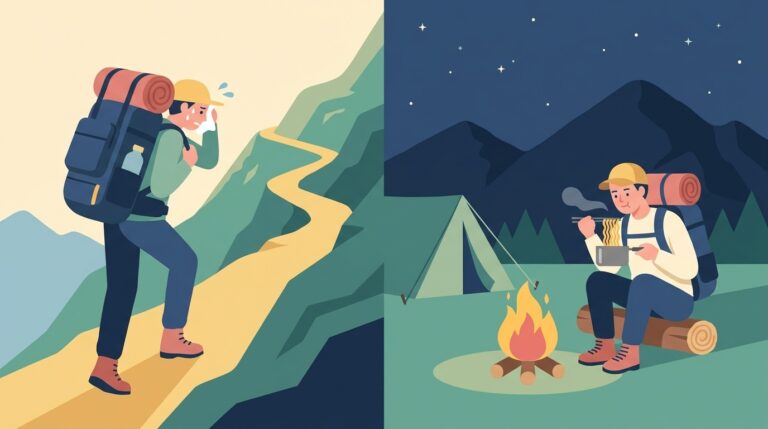
Picture this: You are watching a Korean variety show like “2 Days & 1 Night” (1박 2일) or “Tent Outside Europe.” The celebrities have just hiked up a ridiculously steep mountain carrying backpacks the size of refrigerators. They look absolutely exhausted, sweating buckets, and practically collapsing. But the moment they set up their tiny tent and take a bite of instant ramyeon cooked on a tiny portable stove, they look at the camera and sigh, “Ah, this is healing!”
Wait… carrying 20kg up a rocky mountain is healing?
If you’ve ever wondered why Koreans are so obsessed with backpacking (백패킹), camping, and eating outdoors despite the struggles, you are in the right place. Today, we are going to dive into the unique world of Korean camping culture. Knowing these phrases won’t just help you survive a trip to a Korean national park—it will make you sound like a true local who understands the beautiful contradiction of “suffering for fun.” Let’s pack our bags!
Phase 2: Core Expressions — Deep Dive
Here are the top phrases you need to understand the true mindset of a Korean backpacker.
1. 사서 고생하네요 (saseo gosaenghaneyo)
- Pronunciation: [sa-seo go-saeng-ha-ne-yo] (Sound analogy: Think of the ‘sa’ in safari and ‘go’ as in go.)
- Meaning:
- Literal: I am buying hardship.
- Real nuance: Willingly taking on a difficult task; suffering voluntarily for the experience.
- K-Culture Moment: You’ll hear this on almost every K-Variety travel show. When the cast is pitching a tent in the freezing rain instead of sleeping in a warm hotel, someone will inevitably laugh and say, “우리 진짜 사서 고생한다!” (We are really buying hardship!).
- Editor’s Insight: This phrase captures the very essence of backpacking. It’s not a complaint; it’s a badge of honor. It’s said with a wry smile, acknowledging that the physical pain makes the memory sweeter.
- Situation Spectrum:
- Casual with friends: ✅ (사서 고생하네!)
- Semi-formal with colleagues: ✅ (사서 고생하시네요~)
- Formal/Elders: ⚠️ (Use carefully; you shouldn’t tell an elder they are asking for trouble!)
- 🤔 Think About It: Why do humans “buy hardship”? Does your language have an expression that celebrates choosing the hard path just for the thrill of it?
2. 불멍하기 딱 좋은 날씨네요 (bulmeong-hagi ttak joeun nalssineyo)
- Pronunciation: [bul-meong-ha-gi ttak jo-eun nal-ssi-ne-yo] (‘딱’ sounds like a sharp ttak, like two wooden blocks hitting together.)
- Meaning:
- Literal: It’s the perfect weather to do fire-spacing-out.
- Real nuance: It’s the perfect weather to sit and zone out while staring at the campfire.
- K-Culture Moment: In K-Dramas like Hospital Playlist, when the doctors go camping, they often sit silently around the fire. That act of staring blankly at the flames is called 불멍 (bul-fire + 멍-blank/spacing out).
- Editor’s Insight: ‘멍 때리다’ (spacing out) is huge in Korea, a much-needed mental detox from the fast-paced “Ppalli-Ppalli” (hurry, hurry) society. Adding ‘불’ (fire) or ‘물’ (water – 물멍) specifies what you are staring at!
- Situation Spectrum:
- Casual with friends: ✅
- Semi-formal with colleagues: ✅
- Formal/Elders: ✅
- 🤔 Think About It: Is “spacing out” considered a waste of time in your culture, or is it seen as a healthy way to recharge, like in modern Korea?
3. 장비빨 무시 못 해요 (jangbi-ppal musi mot haeyo)
- Pronunciation: [jang-bi-ppal mu-si mot hae-yo]
- Meaning:
- Literal: You can’t ignore the power of gear.
- Real nuance: Good gear makes all the difference.
- K-Culture Moment: Walk into any Korean mountain or campsite, and you’ll see people decked out in top-tier, brightly colored outdoor brands from head to toe. Koreans take their hobbies seriously, and having the right ‘gear’ (장비) is half the fun.
- Editor’s Insight: The suffix ‘-빨’ (-ppal) implies the “power” or “effect” of something. ‘장비빨’ means the gear is doing the hard work. You can also use ‘화장빨’ (the power of makeup) or ‘조명빨’ (the power of good lighting).
- Situation Spectrum:
- Casual with friends: ✅
- Semi-formal with colleagues: ⚠️ (A bit colloquial)
- Formal/Elders: 🚫
- 🤔 Think About It: Koreans are known for their meticulous preparation and love for aesthetics, even in the wild. How does this compare to the “roughing it” camping style in your country?
Phase 3: Textbook vs. Real Korean
Let’s upgrade your textbook Korean to real, on-the-ground backpacker Korean!
[Situation 1: When the hike is brutally difficult]
* 📖 Textbook: 산에 올라가는 것이 너무 힘듭니다. (Climbing the mountain is very difficult.)
* 🗣️ Real Korean: 와, 오늘 코스 완전 빡세네요. (Wow, today’s course is totally intense/brutal.)
* 💡 Why the difference?: ‘빡세다’ is a universally loved slang word meaning physically or mentally exhausting. It expresses raw emotion much better than the polite ‘힘듭니다’.
[Situation 2: When the scenery at the peak is breathtaking]
* 📖 Textbook: 경치가 정말 아름답습니다. (The scenery is truly beautiful.)
* 🗣️ Real Korean: 미쳤다… 뷰가 다 했네요. (Crazy… the view did everything.)
* 💡 Why the difference?: Saying “[Noun]가 다 했다” implies that this one element was so perfect, it made the entire trip worth it. It’s a hyper-efficient way to express ultimate satisfaction.
Bottom Note: For B2 learners, using ‘빡세다’ with friends will instantly make you sound fluent, but remember to switch back to ‘힘들다’ when speaking to your boss!
Phase 4: Cultural Context — K-Culture Deep Dive
4-1. Non-Verbal Language of the Campsite
Language isn’t just words. In Korea, expressing the “refreshing” feeling of a hot soup on a cold mountain requires sound effects. When you eat outdoor ramyeon, you must take a sip of the broth, exhale deeply, and say, “크으~ (Keu-eu~)” or “아, 시원하다!” (Ah, that’s refreshing/cool!). Remember: In Korea, hot soup is often described as “cool/refreshing” because it relieves the tension in your stomach!
4-2. The “Jeong (정)” of Wild Dining
If you watch K-Dramas or K-Pop reality shows (like BTS’s In the Soop), you’ll notice that camping is 10% sleeping and 90% eating. Koreans will carry heavy cast-iron griddles (그리들) and kilos of pork belly (삼겹살) up a mountain just to eat together.
Why? Because in Korean culture, eating together is the ultimate form of bonding. The act of grilling meat for someone else, putting a piece of food on their plate, or sharing a single pot of ramyeon builds ‘Jeong’ (deep emotional connection). The hardship of the hike is simply the appetizer for the communal feast.
Phase 5: Interactive Roleplay Scenario
Setting: Saturday, 5:00 PM. A windy camping deck on Jeju Island. You and your Korean friend Min-su have just finished a grueling 3-hour hike carrying 15kg backpacks. The ocean view is stunning, but your shoulders are screaming.
Characters:
* YOU: An expat living in Korea who agreed to try backpacking for the first time.
* Min-su (30s): Your energetic Korean friend, an outdoor enthusiast who owns way too much camping gear.
Dialogue:
Min-su: 하아… 드디어 도착했다. 짐부터 내려놔!
(Haa… deudieo dochakaetda. Jimbuteo naeryeonwa!)
[Sigh… We finally arrived. Put your bags down first!]
(🎭 Stage Direction: Min-su drops his massive backpack with a loud thud and stretches his back.)
YOU: 와, 배낭 진짜 무거워요. 우리 완전 사서 고생하네요.
(Wa, baenang jinjja mugeowoyo. Uri wanjeon saseo gosaenghaneyo.)
[Wow, the backpack is so heavy. We are totally buying hardship.]
Min-su: ㅋㅋㅋ 원래 백패킹이 그런 맛이지. 그래도 뷰 보니까 어때?
(Kkk wonrae baekpaekingi geureon masiji. Geuraedo byu bonikka eottae?)
[Hahaha, that’s the flavor of backpacking. But how is it looking at the view?]
YOU: 인정! 뷰가 다 했네요. 근데 너무 배고파요.
(Injeong! Byuga da haenneyo. Geunde neomu baegopayo.)
[Agreed! The view did everything. But I’m so hungry.]
Min-su: 오케이, 텐트부터 빨리 치고 고기 굽자. 폴대 좀 잡아줄래?
(Okei, tenteubuteo ppalli chigo gogi gupja. Poldae jom jabajullae?)
[Okay, let’s pitch the tent quickly and grill meat. Can you hold the poles?]
(🎭 Stage Direction: 20 minutes later, the tent is up, and pork belly is sizzling on the burner.)
Min-su: 야, 냄새 장난 아니다. 산에서 먹는 고기가 진리인 거 알지?
(Ya, naemsae jangnan anida. Saneseo meongneun gogiga jinriin geo alji?)
[Hey, the smell is no joke. You know meat eaten on a mountain is the ultimate truth, right?]
YOU: 대박… 빨리 먹고 싶어요.
(Daebak… ppalli meokgo sipeoyo.)
[Awesome… I want to eat it quickly.]
Min-su: 앗! 큰일 났다. 쌈장을 안 가져왔어…
(At! Keunil natda. Ssamjang-eul an gajyeowasseo…)
[Ah! Big problem. I didn’t bring the ssamjang (dipping sauce)…]
🔀 Your Turn! How should you respond?
* A) 에이, 그냥 소금 찍어 먹어요. (Hey, let’s just dip it in salt.)
* B) 헐, 옆 텐트에서 조금 빌려올까요? (Oh no, should we borrow some from the next tent?)
* C) 쌈장 없이 고기를 어떻게 먹어요? 집에 가요! (How can we eat meat without ssamjang? Let’s go home!)✅ Best Choice: B — In Korean camping culture, “borrowing” small ingredients like salt or ssamjang from neighboring tents is surprisingly common and a great way to show community spirit. If you share something back (like a beer or snacks), you’ve made a new friend!
⚠️ Choice A Analysis: Perfectly fine and practical, but B is more culturally immersive!
🚫 Choice C Analysis: Too extreme! You just climbed a mountain!
Phase 6: 10-Second Shadowing Drill
Practice reading this aloud to nail the intonation. Listen to the emotions!
- 😤 Exhausted but proud:
우리 완전 / 사서 고생이지만 / (uri wanjeon / saseo gosaengijiman /) - 😊 Amazed:
진짜 / 뷰가 다 했어요! / (jinjja / byuga da haesseoyo! /) - 😌 Relaxed:
빨리 밥 먹고 / 불멍해요~ (ppalli bap meokgo / bulmeonghaeyo~)
Phase 7: K-Culture Mini Dictionary
Master these terms and impress any Korean outdoor enthusiast.
| 한국어 | Romanization | 영어 | 맥락 설명 |
|---|---|---|---|
| 불멍 | bulmeong | Fire-gazing / Zoning out by the fire | A core healing activity in Korean camping. Staring at the fire to clear one’s mind. |
| 박배낭 | bakbaenang | Heavy backpacking bag | A massive, sturdy backpack used for overnight wild camping (비박). |
| 노지캠핑 | noji camping | Wild / Free camping | Camping outside of designated commercial sites. Often free, but lacks amenities. |
| 꿀잼 | kkuljaem | Honey fun / Super fun | Slang for something incredibly entertaining. The opposite of ‘노잼’ (no fun). |
| 힐링 | hilling | Healing | Konglish word used to describe anything relaxing, soothing, or therapeutic. |
Phase 8: Traveler’s Survival Kit
Planning to camp in Korea? Here is your survival kit!
🆘 Survival Phrases TOP 3
1. 🇰🇷 “근처에 화장실이 어디 있어요?” (geuncheo-e hwajangsiri eodi isseoyo?)
* 🗣️ Meaning: Where is the restroom nearby?
* 📍 Use it: Free campsites (노지) often have hidden public restrooms.
2. 🇰🇷 “여기 텐트 쳐도 되나요?” (yeogi tenteu chyeodo doenayo?)
* 🗣️ Meaning: Can I pitch a tent here?
* 📍 Use it: To double-check if an area is legally open for camping.
3. 🇰🇷 “불 피워도 괜찮아요?” (bul piwodo gwaenchanayo?)
* 🗣️ Meaning: Is it okay to light a fire?
* 📍 Use it: Crucial! Many areas in Korea prohibit open fires due to wildfire risks.📌 Editor’s Travel Note
* Strict Rules: Cooking and camping are strictly prohibited in most Korean National Parks (like Seoraksan or Bukhansan) unless you are in a specifically designated shelter or campsite. Always check the Korea National Park Service website!
* Apps: Use Naver Map (카카오맵/네이버 지도) instead of Google Maps to find local campgrounds (캠핑장).
* Safety: Korea is incredibly safe. Leaving your expensive tent unattended while you hike is generally fine, but always secure your food to keep wild boars (멧돼지) away!
Phase 9: Critical Thinking Corner — “A Step Deeper”
🧠 Think Deeper: Food & Identity (음식과 정체성)
Why do Koreans go through the grueling physical labor of backpacking, only to recreate an entire kitchen at the peak of a mountain? In many Western cultures, backpacking food means lightweight, freeze-dried meals meant purely for survival. In Korea, however, a hike is incomplete without a proper, shared meal.
This reflects the Korean communal identity. Eating is not just fuel; it’s a social glue. By moving the dinner table from a busy Seoul restaurant to a quiet mountaintop, Koreans aren’t trying to escape society—they are trying to experience their social bonds (Jeong) in a purer, undistracted environment. The shared suffering of the hike makes the shared meal taste infinitely better.
💬 Your Turn: How does your culture view outdoor dining or camping? Is it about survival and minimalism, or do you also bring a feast to the forest? Share in the comments!
Phase 10: FAQ & Avoiding Mistakes
Q: “Can I use ‘사서 고생하다’ to my boss if they suggest a difficult project?”
No! Unless you have a very informal, joking relationship, telling your boss they are “buying hardship” sounds like you are criticizing their plan. Stick to using it about your own actions or with close friends.
Q: “Can I just camp on any beach in Korea?”
Many beaches allow it, but look for signs saying “취사 금지” (Cooking Prohibited) or “야영 금지” (Camping Prohibited). When in doubt, ask a local!
❌ Common Mistake #1: Starting a campfire directly on the ground.
✅ How to fix it: Always use a fire pit/stand (화로대). Leaving scorch marks on the ground is considered terrible manners in K-camping culture.
Phase 11: Summary & Action Items
- One-Liner Summary: Korean backpacking is all about embracing the beautiful struggle (사서 고생하다), enjoying the view (뷰가 다 했다), and spacing out by the fire (불멍).
🔥 Action Mission 3 Steps:
* 🥉 Bronze (Solo): Stand in front of your mirror, sigh deeply like a tired hiker, and say, “아휴, 사서 고생이네!” 3 times.
* 🥈 Silver (Online): Find a Korean camping vlog on YouTube (search: 백패킹 브이로그), leave a comment saying, “뷰가 다 했네요! 대박!”
* 🥇 Gold (Action): The next time you and a Korean friend do something physically exhausting but fun (like walking far for a good restaurant), use “우리 진짜 사서 고생하네요 ㅋㅋㅋ”.
K-Culture Mission: Watch an episode of the K-Variety show “Tent Outside Europe” or “1박 2일”. Notice how often they talk about food the moment they set up camp!
Phase 12: Interactive Challenge Quiz
1. Fill in the Blank:
Your friend bought an insanely expensive lightweight tent. You look at it and say, “역시, ________ 무시 못 하네요!” (As expected, you can’t ignore the…)
* A) 화장빨 (Makeup power)
* B) 장비빨 (Gear power)
* C) 텐트빨 (Tent power)
2. True or False — K-Culture Edition:
“It is legal and common to grill pork belly (Samgyeopsal) anywhere along the trails of Bukhansan National Park in Seoul.”
* (T / F)
3. Situational Judgment:
You just reached the top of Hallasan Mountain. It was exhausting but breathtaking. What is the most natural Korean exclamation?
* A) 산이 높습니다.
* B) 뷰가 다 했네요! 빡세지만 너무 좋아요.
* C) 불멍하기 좋은 날씨네요.
👀 Click here for Answers!
1. B (장비빨) – Gear power is everything in K-outdoor culture!
2. False – Cooking and camping are strictly banned on national park trails to prevent forest fires and protect nature. You can only cook in designated shelters!
3. B – “The view did everything! It was intense but so good.”
Did you enjoy today’s camping trip? Let us know in the comments what K-Culture topic you want to explore next!
Frequently Asked Questions (FAQ)
Q: What does "사서 고생하네요 (saseo gosaenghaneyo)" mean in Korean and how do you pronounce it?
A: In Korean, "사서 고생하네요 (saseo gosaenghaneyo)" is pronounced [sa-seo go-saeng-ha-ne-yo] and means: Literal: I am buying hardship.
Q: What does "불멍하기 딱 좋은 날씨네요 (bulmeong-hagi ttak joeun nalssineyo)" mean in Korean and how do you pronounce it?
A: In Korean, "불멍하기 딱 좋은 날씨네요 (bulmeong-hagi ttak joeun nalssineyo)" is pronounced [bul-meong-ha-gi ttak jo-eun nal-ssi-ne-yo] and means: Literal: It's the perfect weather to do fire-spacing-out.
Q: What does "장비빨 무시 못 해요 (jangbi-ppal musi mot haeyo)" mean in Korean and how do you pronounce it?
A: In Korean, "장비빨 무시 못 해요 (jangbi-ppal musi mot haeyo)" is pronounced [jang-bi-ppal mu-si mot hae-yo] and means: Literal: You can't ignore the power of gear.