Phase 1: Empathy (The Immersive Open)
Hello! I am the Senior Editor of Daily Hangul.
Picture this: It’s 7:00 PM on a Friday in Seoul. You’re at a bustling Korean BBQ restaurant in Gangnam with your coworkers. The sizzling sound of pork belly (삼겹살) fills the air, and soju glasses are clinking. Suddenly, a grease fire flares up on the grill—way higher than it should. The restaurant owner rushes over yelling, ‘불이야! (Buriya!)’ and grabs a red cylinder.
Your textbook might have taught you how to say ‘A fire has occurred’ in perfectly polite Korean, but in a real-life emergency, nobody has time for polite suffixes. As an advanced (C1) Korean learner, you already know how to order food and navigate the subway. But do you know the precise vocabulary and the cultural shift in language when disaster strikes? Knowing these expressions won’t just make you sound like a local; it might literally save your life. Let’s dive into the absolute essentials of fire safety, evacuation, and the K-Culture survival mindset.
Phase 2: Deep Dive into Core Expressions
Let’s break down the essential phrases you need. Notice how the vocabulary shifts from native Korean words to Sino-Korean (Hanja) words depending on the context.
1. 불이야! (Fire!)
- Pronunciation: [buriya!] (Sounds like: boo-ree-ya!)
- Meaning: Literal: ‘It is a fire!’ / Real nuance: ‘FIRE! EVERYONE GET OUT!’
- K-Culture Moment: You’ve definitely seen this in a K-Drama thriller. Someone spots smoke in a building, runs into the hallway, and screams this at the top of their lungs.
- Editor’s Insight: Why ‘이야’ (casual ending) and not ‘입니다’ (polite)? In extreme emergencies, Korean social hierarchies collapse. Using polite language wastes breath and time. ‘불이야!’ is the universally accepted, urgent alarm.
- Situation Spectrum:
- Casual: ✅
- Semi-formal: ✅
- Formal: ✅ (In a true emergency, this bypasses all rules!)
- ና2 Think About It: Why do you think societies drop their most complex politeness rules during a crisis? Does your native language have a similar ‘emergency bypass’ for social etiquette?
2. 소화기 안전핀을 뽑으세요. (Pull the safety pin of the fire extinguisher.)
- Pronunciation: [sohwagi anjeonpineul ppobeuseyo] (so-hwa-gi an-jeon-pin-eul ppob-eu-se-yo)
- Meaning: ‘Please pull the safety pin of the fire extinguisher.’
- K-Culture Moment: In every Korean subway station and hallway, you will see a bright red 소화기. South Korea takes fire safety very seriously due to its densely populated urban areas.
- Editor’s Insight: Let’s look at the Hanja: 소(消 – extinguish) + 화(火 – fire) + 기(機 – device). At the C1 level, breaking down Hanja helps you memorize rapidly. ‘안전핀’ (safety pin) is a Konglish blend!
- Situation Spectrum:
- Casual: ⚠️ (You’d just say ‘핀 뽑아!’)
- Semi-formal: ✅
- Formal: ✅
- ና2 Think About It: Notice how technical instructions often use ‘-(으)세요’ or ‘-(으)십시오’ regardless of who is reading it. It’s the voice of authority and safety.
3. 젖은 수건으로 코와 입을 막고 대피하세요. (Cover your nose and mouth with a wet towel and evacuate.)
- Pronunciation: [jeojeun sugeoneuro kowa ibeul makgo daepihaseyo]
- Meaning: ‘Cover your nose and mouth with a wet towel and evacuate.’
- K-Culture Moment: If you stay in a Korean hotel or ‘Jjimjilbang’ (Korean sauna), you will hear this specific instruction during mandatory safety broadcasts.
- Editor’s Insight: ‘대피’ (Daepi – Evacuation) is a crucial C1 vocabulary word. You wouldn’t use the simple word ‘가세요’ (go) here. ‘막고’ (block/cover) implies physical protection.
- Situation Spectrum:
- Casual: ⚠️ (To a friend: 젖은 수건으로 입 막고 빨리 나와!)
- Formal: ✅
Phase 3: Textbook vs. Real Korean
Here is how emergency Korean sounds on paper versus in a real-life panic.
[Situation 1: Spotting a fire]
* ኂ16 Textbook: 화재가 발생했습니다. (A fire has occurred.)
* ኁ63 Real Korean: 헐, 불났어! 빨리 나와! (Heol, bullasseo! Ppal-li nawa! – Omg, fire! Get out quick!)
* ኁ61 Why the difference?: ‘화재’ (Hwajae) is formal news terminology. ‘불’ (Bul) is the visceral, everyday word. In an emergency, Koreans default to ‘불이 나다’ (a fire broke out).
[Situation 2: Warning others to evacuate]
* ኂ16 Textbook: 신속히 비상구로 대피하십시오. (Please evacuate swiftly to the emergency exit.)
* ኁ63 Real Korean: 저쪽 비상구로 뛰어! (Jeojjok bisang-guro ttwieo! – Run to the emergency exit over there!)
* ኁ61 Why the difference?: Action verbs like ‘뛰다’ (run) or ‘나가다’ (get out) replace formal Sino-Korean nouns when seconds matter.
Bottom Note: At the C1 level, you must distinguish between ‘Written/Broadcast Emergency Language’ (화재, 대피, 신속히) and ‘Spoken Emergency Language’ (불, 도망쳐, 빨리).
Phase 4: Cultural Context — K-Culture Deep Dive
4-1. Non-Verbal Cues: The Nunchi of Survival
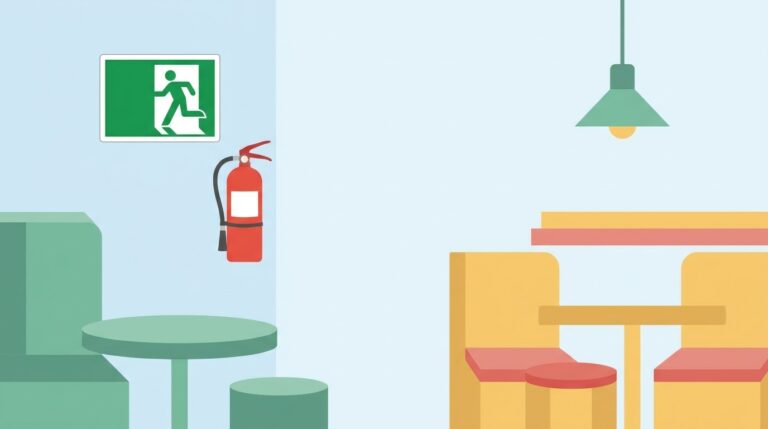
In an emergency, Korean ‘눈치’ (Nunchi – situational awareness) shifts into overdrive. It’s the famous ‘빨리빨리’ (Ppal-i ppal-i / Hurry hurry) culture applied to survival. If you see Koreans suddenly leaving their belongings on a cafe table and speed-walking toward the green ‘비상구’ (Emergency Exit) sign, do not wait for an English announcement. Read the room and follow.
4-2. K-Food Connection: The BBQ Flare-up
Let’s talk about the unique fire hazards of K-Food. Korean BBQ tables are equipped with live charcoal (숯불) or gas grills, and a heavy exhaust pipe overhead.
* The Reality: Grease dripping onto charcoal often causes a sudden pillar of flame.
* The Unwritten Rule: Do not panic and throw your water glass on a grease fire! The restaurant auntie (이모님) or uncle (사장님) will calmly walk over, turn down the heat, or put a piece of lettuce over the flame to starve it of oxygen.
* Critical View: This shared dining experience requires a communal sense of safety. Everyone at the table is responsible for watching the grill. It’s a micro-level example of Korean collective responsibility.
Phase 5: Real-Life Roleplay Scenario
Setting: Friday night. A crowded Gangnam BBQ restaurant. Smoke is thick, K-Pop is blasting, and you’re with your Korean coworkers.
Characters:
– YOU: The foreign expat, C1 Korean speaker, currently holding the grilling tongs.
– Minsu (32): Your friendly, somewhat easily-panicked Korean coworker.
Minsu: 야, 오늘 고기 진짜 맛있다. 더 시킬까? ና85
(Ya, oneul gogi jinjja masitda. Deo sikilkka?)
[Hey, the meat is so good today. Should we order more?]
YOU: 좋아요! 근데 판 좀 갈아야 할 것 같아요.
(Joayo! Geunde pan jom garaya hal geot gatayo.)
[Sounds good! But I think we need to change the grill pan.]
(🎭 Stage Direction: As Minsu puts more fatty pork belly on the un-changed grill, a massive flame shoots up, catching the edge of a napkin!)
Minsu: 헉! 어떡해! 불, 불붙었어!
(Heok! Eotteokhae! Bul, bulbuteosseo!)
[Gasp! What do we do! It caught fire!]
ኂ56 Your Turn! How do you respond to handle the situation?
– A) ‘사장님! 여기 화재가 발생했습니다! 119에 신고하세요!’ (Boss! A fire has occurred here! Call 119!)
– B) ‘사장님! 여기 불났어요! 소화기 어디 있어요?’ (Boss! There’s a fire here! Where’s the fire extinguisher?)
– C) ‘대박사건. 민수 씨 도망가요!’ (Epic fail. Run away Minsu!)✅ Best Choice: B — It’s urgent, uses the natural spoken phrase (불났어요), and immediately asks for the crucial item (소화기).
⚠️ Choice A Analysis: Too textbook. ‘화재가 발생했습니다’ sounds like a news anchor reporting the fire, not someone trying to put it out.
Restaurant Owner: (Running over with a fire extinguisher) 비키세요! 안전핀 뽑을게요!
(Bikiseyo! Anjeonpin ppobeulgeyo!)
[Step aside! I’ll pull the safety pin!]
Phase 6: 10-Second Shadowing Drill
Practice this sentence so it becomes muscle memory.
😤 비상구는 / 저쪽입니다! / 빨리 / 대피하세요!
(bisang-guneun / jeojjogimnida! / ppalli / daepihaseyo!)
- Intonation Guide: Keep your voice loud, firm, and authoritative.
- Pause: Take a micro-pause at the slashes (/) to ensure clarity, emphasizing ‘저쪽’ (that way) and ‘빨리’ (quickly).
Phase 7: K-Culture Mini Dictionary
| 한국어 | Romanization | English | Context |
|---|---|---|---|
| 소화기 | sohwagi | Fire extinguisher | Found in every building; red cylinder. |
| 비상구 | bisang-gu | Emergency exit | Always indicated by a green running-man sign. |
| 대피(하다) | daepi(hada) | Evacuation (to evacuate) | The formal term used in all safety broadcasts. |
| 화재 | hwajae | Fire disaster | Formal/News term. Bul (불) is the conversational term. |
| 119 | il-il-gu | Emergency Number | Korea’s 911. Used for both fire and medical emergencies. |
Phase 8: Traveler’s Survival Kit
Even as a C1 speaker, panic can make you forget your words. Memorize these survival phrases.
ሙ8 Survival Phrase #1: Calling for Help
– ቴ72ቴ77 ‘여기 불이 났어요! 119 불러주세요!’ (yeogi buri nasseoyo! il-il-gu bulleojuseyo!)
– ኁ63 English: A fire broke out here! Please call 119!
– ኂ05 Where to use: Anywhere a fire occurs.ሙ8 Survival Phrase #2: Finding the Exit
– ቴ72ቴ77 ‘비상구 어디예요?’ (bisang-gu eodiyeyo?)
– ኁ63 English: Where is the emergency exit?
– ኂ05 Where to use: Hotels, clubs, underground malls.ኂ04 Editor’s Travel Note
– Emergency Numbers: In Korea, 119 is for Fire & Ambulance. 112 is for Police.
– Location Tracking: If you call 119, try to find a telephone pole. In Korea, telephone poles have unique ID numbers that 119 dispatchers can use to pinpoint your exact location instantly!
Phase 9: Critical Thinking — ‘One Step Deeper’
Language and Power: The Collapse of Honorifics
As a C1 learner, you know that Korean honorifics (존댓말) dictate the social hierarchy. However, in a life-or-death situation like a fire, this linguistic hierarchy completely collapses. Yelling ‘불이야! 대피해!’ (Fire! Evacuate!) to a company CEO or an elder is not considered rude; it is considered survival. This phenomenon reveals a profound truth about Korean culture: while social respect is the foundation of daily life, the collective preservation of human life immediately overrides all cultural etiquette. It proves that at its core, language is a tool for survival.
ኁ72 Your Turn: In your culture, do people change their level of politeness during an extreme emergency, or do certain formalities remain? Share your thoughts in the comments!
Phase 10: FAQ & Avoiding Misunderstandings
Q: Can I really yell ‘불이야!’ to people older than me?
Yes! Absolutely. If there is a real fire, shouting ‘불입니다’ is unnatural and confusing. Panic requires clarity, and ‘불이야’ is the standard alarm cry for everyone, regardless of age.
Q: What if I accidentally set off a fire alarm at an Airbnb?
Do not just leave it! Call the host immediately and say: ‘오작동인 것 같아요’ (I think it’s a false alarm/malfunction).
❌ Common Mistake #1: Calling 911.
✅ Do This Instead: Dial 119. If you dial 911 on a Korean phone, it might redirect, but 119 is the official number.
Phase 11: Summary & Action Items
- One-Liner Summary: In a Korean fire emergency, drop the honorifics, shout ‘불이야!’, find the green ‘비상구’, and use the ‘소화기’.
Action Mission:
– ና53 Bronze: Say ‘소화기 안전핀을 뽑으세요’ out loud 3 times right now.
– ና52 Silver: Change your phone’s map app to Korean and search for the nearest ‘소방서’ (Fire station).
– ና51 Gold: Next time you go to a Korean restaurant or cafe, actively locate the red ‘소화기’ and the green ‘비상구’. Point to them and name them in Korean!
K-Culture Mission:
Next time you watch a K-Drama thriller or disaster movie (like Exit), listen closely for the words ‘대피’ and ‘비상구’. You’ll be amazed at how often they are used!
Phase 12: Quiz — Interactive Challenge
1. Situational Judgment: You are in an underground shopping mall in Myeongdong. Thick smoke appears. A security guard yells, ‘여러분, 이쪽 대피로를 따라 이동하십시오!’ What should you do?
– A) Look for a fire extinguisher (소화기) to fight the fire yourself.
– B) Follow the guard’s direction along the evacuation route (대피로).
– C) Wait for someone to say ‘불이야’.
(Answer: B. ‘대피로’ means evacuation route. Follow it immediately!)
2. True or False – K-Culture Edition: In Korea, the emergency number for an ambulance and a fire truck is the same.
(Answer: True! 119 dispatches both fire and medical services.)
3. Fill in the Blank:
사장님: 불이 났어요! 여기 ______ 좀 가져다주세요! (Boss: There’s a fire! Please bring me the ______!)
(Answer: 소화기 / Fire extinguisher)
Stay safe, and see you in the next lesson!
Frequently Asked Questions (FAQ)
Q: What does "불이야! (Fire!)" mean in Korean and how do you pronounce it?
A: In Korean, "불이야! (Fire!)" is pronounced [buriya!] and means: Literal: 'It is a fire!' / Real nuance: 'FIRE! EVERYONE GET OUT!'
Q: What does "소화기 안전핀을 뽑으세요. (Pull the safety pin of the fire extinguisher.)" mean in Korean and how do you pronounce it?
A: In Korean, "소화기 안전핀을 뽑으세요. (Pull the safety pin of the fire extinguisher.)" is pronounced [sohwagi anjeonpineul ppobeuseyo] and means: 'Please pull the safety pin of the fire extinguisher.'
Q: What does "젖은 수건으로 코와 입을 막고 대피하세요. (Cover your nose and mouth with a wet towel and evacuate.)" mean in Korean and how do you pronounce it?
A: In Korean, "젖은 수건으로 코와 입을 막고 대피하세요. (Cover your nose and mouth with a wet towel and evacuate.)" is pronounced [jeojeun sugeoneuro kowa ibeul makgo daepihaseyo] and means: 'Cover your nose and mouth with a wet towel and evacuate.'