

Hello! I’m your Lead Editor at Daily Hangul. 👋
Imagine this: You’ve just finished writing a highly analytical, 1,000-word post on a Korean forum defending your favorite K-Drama character’s controversial ending. Your vocabulary is flawless (C2 level, of course), your grammar is impeccable, and you hit ‘Submit’ with pride. A few minutes later, a native speaker comments: “글은 참 좋은데, 뭔가 안 읽혀요” (Your writing is good, but somehow it doesn’t read well).
Ouch. What went wrong?
The culprit is usually the flow of logic. In English, we are taught to be direct: state your thesis, provide evidence, and restate your thesis. But in Korean, logic often flows differently. It requires warming up the reader, building context, and carefully guiding them to an undeniable conclusion.
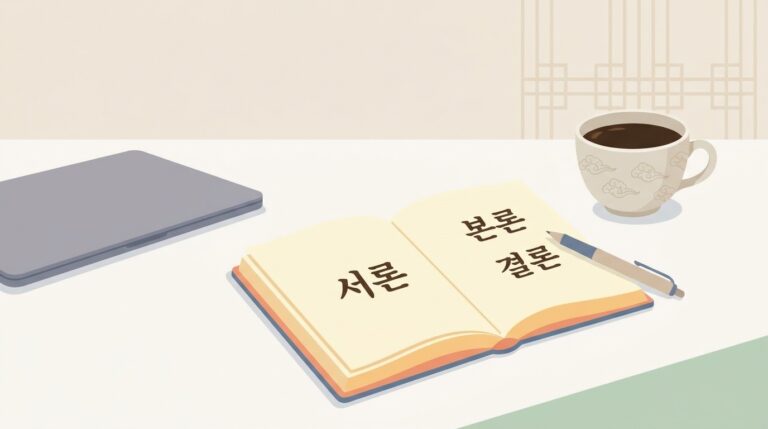
Today, we are diving deep into OBC (Opening, Body, Conclusion) — or 서론 (seoron), 본론 (bollon), 결론 (gyeollon) — in Korean writing. Whether you’re aiming for a perfect score on TOPIK II, writing a business proposal, or publishing a deep-dive K-Pop theory online, mastering this structure is what separates a “good foreign speaker” from an “absolute insider.”
Let’s map out the Korean mind, shall we?
Phase 2: Core Expressions Deep Dive
To build a flawless OBC outline, you need the right transition signposts. Here are the ultimate C2-level expressions to structure your thoughts.
1. 화두를 던지다 (Opening)
- Pronunciation: [hwadureul deonjida] -> Sounds like hwa-doo-reul don-jee-da
- Meaning: (Literal) To throw a topic / (Real nuance) To bring up a subject, to raise a question, to break the ice analytically.
- K-Culture Moment: Think of a suspenseful K-Drama where the genius detective starts a briefing not by stating the killer’s name, but by asking a profound, rhetorical question to the room. He is “throwing a hwadu” to capture everyone’s attention before laying out the facts.
- Editor’s Insight: This is the perfect way to describe the goal of your 서론 (Opening). You don’t just state a thesis; you toss a compelling thought into the readers’ minds to make them ponder.
- Situation Spectrum:
- Casual Friends: ⚠️ (A bit too academic)
- Professional / Online Forums: ✅
- Academic / Formal: ✅
- 🤔 Think About It: In Western writing, we “make a point.” In Korean, we “throw a topic.” What does the imagery of “throwing” something for others to catch and examine tell us about Korean conversational dynamics?
2. 본격적으로 논해 보자면 (Body)
- Pronunciation: [bongyeokjeogeuro nonhae bojamyeon] -> Sounds like bon-gyuk-juh-goo-ro non-hae bo-ja-myon
- Meaning: (Literal) If we try to discuss it in a full-scale manner / (Real nuance) Diving into the main point, let’s get down to the nitty-gritty.
- K-Culture Moment: You are watching a deep-dive K-Pop MV analysis on YouTube. The creator spends 2 minutes on the intro, then the music drops, the screen flashes, and they say, “Now, diving into the main theory…” This marks the transition from 서론 (Opening) to 본론 (Body).
- Editor’s Insight: This phrase signals a shift in gear. It tells the reader: “Okay, the warm-up is over. Put your thinking caps on.”
- Situation Spectrum:
- Casual Friends: 🚫 (Too rigid)
- Professional / Presentations: ✅
- Academic Writing: ✅
- 🤔 Think About It: Why do Koreans often need a clear verbal marker that the “real talk” is beginning? How does this relate to high-context cultures where “warming up” (building rapport) is a crucial preliminary step?
3. 요컨대 / 한마디로 정리하자면 (Conclusion)
- Pronunciation: [yokeonde / hanmadiro jeongrihajamyeon] -> Sounds like yo-kun-deh / han-ma-dee-ro jung-ree-ha-ja-myon
- Meaning: (Literal) In short / If I were to organize it into one word (phrase).
- K-Culture Moment: The final 5 minutes of a gripping K-Drama episode. The protagonist connects all the dots on their murder board and delivers one devastatingly clear concluding thought.
- Editor’s Insight: Use this at the start of your 결론 (Conclusion). 요컨대 is highly sophisticated and academic. 한마디로 정리하자면 is great for presentations, YouTube videos, or persuasive blog posts.
- Situation Spectrum:
- Casual Friends: ✅ (한마디로 정리하자면)
- Professional / Presentations: ✅
- Academic Writing: ✅ (요컨대)
- 🤔 Think About It: Notice the word 정리 (organize/clean up). In Korean, concluding isn’t just about “ending”; it’s about “cleaning up” the scattered thoughts for the reader’s convenience.
Phase 3: Textbook vs. Real Korean
Let’s look at how outline markers change from textbook rigidity to real-world fluency.
[Transitioning to the Body Paragraphs]
* 📖 Textbook Korean: 본론으로 들어가겠습니다. (I will enter the main body.)
* 🗣️ Real Korean: 일단 핵심부터 짚고 넘어가 볼까요? (First, shall we point out the core before moving on?)
* 💡 Why the difference?: The textbook version is perfectly fine but feels like a middle school speech. The “Real” version uses 짚고 넘어가다 (to point out and move over), showing a collaborative tone—inviting the audience/reader along the journey.
[Adding a Counter-Argument / Turn]
* 📖 Textbook Korean: 그러나 반대 의견도 있습니다. (However, there are opposing opinions.)
* 🗣️ Real Korean: 하지만 여기서 주목해야 할 변수가 있습니다. (However, there is a variable we must pay attention to here.)
* 💡 Why the difference?: Advanced writing in Korea (especially in reviews and business) loves terms like 변수 (variable) or 맹점 (blind spot). It sounds analytical and objective rather than simply argumentative.
Bottom Note: At the C2 level, your goal is to manipulate the flow effortlessly. Avoid sounding like a translated English essay; embrace Korean rhetorical devices!
Phase 4: Cultural Context — K-Culture Deep Dive
4-1. Non-verbal Elements of Logical Flow
When presenting an outline in Korea, pacing is everything. You don’t rush to the conclusion. Korean Nunchi (눈치) applies to writing too! You must “read” how much context the reader needs. A sudden, abrupt conclusion without sufficient buildup in the Body (본론) is considered aggressive or underdeveloped.
4-2. The K-Drama & Fandom Connection: “기승전결” (Gi-seung-jeon-gyeol)
While OBC is the standard western import for writing, the true soul of Korean storytelling and logical flow is 기승전결 (Introduction, Development, Turn, Conclusion).
If you read a highly rated K-Pop fandom analysis (분석글) on Namuwiki or Reddit, you’ll see this everywhere:
– 기 (Intro): A new MV drops. What are the basic visual motifs?
– 승 (Development): Connecting these motifs to previous albums. Building the lore.
– 전 (Turn/Climax): The twist! Wait, the lyrics actually mean the opposite of what we thought!
– 결 (Conclusion): The overarching philosophical message the idol group is conveying.
Critical View: While “기승전결” creates a beautiful, emotionally satisfying read, in modern fast-paced Korean business culture, there’s a strong push toward the “OBC” or even “Conclusion-First” (두괄식) method. Knowing when to use poetic buildup (fandoms, essays, reviews) versus blunt logic (business emails) is the true mark of fluency.
Phase 5: Real-World Roleplay Scenario
Setting: A trendy, minimalist cafe in Seongsu-dong. You and your Korean friend/collaborator, Ji-hoon (28, a sharp and witty content creator), are drafting a script for a video essay analyzing the cultural impact of a recent hit K-Drama.
Characters:
– YOU: A foreign content creator with a deep understanding of Korean media.
– Ji-hoon: Your Korean co-writer. He’s focused on making the logic flow perfectly for a Korean audience.
Dialogue:
Ji-hoon: 자, 개요부터 짜보자. 서론에서는 무슨 화두를 던질까? 💻
(Ja, gaeyobuteo jjaboja. Seoroneseo-neun museun hwadu-reul deonjilkka?)
[Alright, let’s build the outline first. What topic should we throw out in the intro?]
YOU: 저는 주인공의 첫 대사를 인용하는 게 좋을 것 같아요. 시청자들 시선을 확 끌게요.
(Jeoneun juingongui cheot daesareul inyonghaneun ge joeul geot gatayo. Sicheongjadeul siseoneul hwak kkeulgeyo.)
[I think quoting the protagonist’s first line would be good. I’ll grab the viewers’ attention right away.]
Ji-hoon: 오, 좋다. 그럼 본론은? 본격적으로 캐릭터 분석 들어갈까?
(O, jota. Geureom bolloneun? Bongyeokjeogeuro kaerikteo bunseok deureogalkka?)
[Oh, nice. Then the body? Shall we dive into the character analysis in earnest?]
YOU: 네. 본론 1에서는 캐릭터의 심리 변화를 다루고, 본론 2에서는 사회적 배경과 연결해 보죠.
(Ne. Bollon ireseoneun kaerikteoui simni byeonhwareul darugo, bollon ieseneun sahoejeok baegyeonggwa yeongyeolhae bojo.)
[Yes. In body 1, we cover the character’s psychological shift, and in body 2, let’s connect it to the social background.]
Ji-hoon: 완벽해. 그럼 결론은 어떻게 내릴까? 솔직히 드라마 후반부는 좀 아쉬웠잖아.
(Wanbyeokhae. Geureom gyeolloneun eotteoke naerilkka? Soljiki deurama hubanbuneun jom asiwotjana.)
[Perfect. Then how should we conclude? Honestly, the second half of the drama was a bit disappointing.]
🔀 Your Turn! How do you structure the conclusion?
– A) “결론적으로, 이 드라마는 후반부가 망해서 별로입니다.” (In conclusion, this drama sucks because the second half failed.)
– B) “요컨대, 시작은 창대했으나 끝은 미약했다… 한마디로 ‘용두사미’였다고 정리합시다.” (In short, the beginning was grand but the end was feeble… Let’s summarize it in one word: ‘Yongdusami’ (Dragon’s head, snake’s tail).)
– C) “마지막으로, 제 생각에는 작가가 대본을 대충 쓴 것 같아요.” (Lastly, I think the writer wrote the script lazily.)✅ Best Choice: B — Using four-character idioms (사자성어) like ‘용두사미’ in the conclusion is the ultimate C2 flex. It summarizes a complex critique into a culturally resonant, highly logical conclusion.
⚠️ Choice A & C Analysis: Too blunt and emotional for an analytical video essay. Korean conclusions usually aim for a thoughtful takeaway, even when criticizing.
Phase 6: 10-Second Shadowing Drill
Practice your flow! Pay attention to the pauses (/) and intonation to sound like a native presenting a brilliant idea.
- 🧐 (Thoughtfully) “서론에서 / 흥미로운 화두를 던지고, / 본론에서 / 본격적으로 파헤쳐 봅시다.”
(seo-ron-e-seo / heung-mi-ro-un hwa-du-reul deon-ji-go, / bol-lon-e-seo / bon-gyeok-jeok-eu-ro pa-he-chyeo bop-si-da.) - 😤 (Confidently) “요컨대, / 이 모든 현상은 / 하나의 결론으로 / 이어집니다.”
(yo-keon-dae, / i mo-deun hyeon-sang-eun / ha-na-ui gyeol-lon-eu-ro / i-eo-jip-ni-da.)
Phase 7: K-Culture Mini Dictionary
Master these terms to navigate any Korean intellectual or creative space.
| 한국어 | Romanization | English | Contextual Meaning |
|---|---|---|---|
| 개요 | gaeyo | Outline | The skeleton of your writing (OBC). Crucial in Korean university settings. |
| 두괄식 | dugwalsik | Deductive (Conclusion-first) | Stating the main point at the very beginning. Loved by Korean corporate bosses. |
| 미괄식 | migwalsik | Inductive (Conclusion-last) | Building up context and revealing the main point at the end. Common in essays. |
| 떡밥 | tteokbap | Bait / Foreshadowing | Slang used in reviews. “Throwing bait” in the opening to resolve in the conclusion. |
| 기승전결 | gi-seung-jeon-gyeol | 4-Act Structure | Intro, Development, Turn, Conclusion. The DNA of Korean storytelling. |
Phase 8: Traveler’s Survival Kit (Writing Edition)
You might think outlining is only for essays, but what if you need to write a formal complaint to a hotel, or leave a structured Naver review to help other travelers?
🆘 Survival Writing Expressions
– 🇰🇷 “먼저, ~ 점은 정말 좋았습니다. 하지만…” (meonjeo, ~ jeomeun jeongmal joatseumnida. hajiman…)
– 🗣️ Meaning: First, the [aspect] was really good. However…
– 📍 Where to use: Naver Map reviews, AirBnb feedback.
– 💡 Pro Tip: Koreans rarely leave completely negative reviews without a “sandwich method” (Good – Bad – Suggestion). Building this logical structure makes your review look credible, not just like an angry rant.📌 Editor’s Travel Note
– If you ever need to send a formal email in Korea (e.g., to a lost and found at an airport), always start with a weather/season greeting (서론), state your lost item details (본론), and end with gratitude for their hard work (결론). The OBC logic applies to daily etiquette!
Phase 9: Critical Thinking — “One Step Deeper”
Language & Power: High-Context vs. Low-Context Outlining
Why does English favor the deductive (Conclusion-first) approach, while Korean historically leans toward inductive (Conclusion-last, or 기승전결)? In a high-context culture like Korea, hierarchy and relationships are paramount. Thrusting your conclusion or demand immediately at the reader can feel aggressive, as if you are disregarding the social harmony. By building the Seoron (Opening) and Bollon (Body) carefully, you show respect for the reader’s intellect and feelings, gently guiding them to the Gyeollon (Conclusion) so they feel they arrived there with you, rather than being ordered to believe it. However, under the pressures of modern global business (빨리빨리 culture), this is shifting rapidly toward aggressive directness.
💬 Your Turn: Does your native language prefer to drop the main point immediately, or do you take time to “set the table” before serving the main idea? Share your thoughts below!
Phase 10: FAQ & Common Mistakes
Q: Can I use “결론적으로” (In conclusion) in everyday conversation?
Yes! But in speaking, it sounds a bit like you are cutting someone off or trying to sound overly smart. Use it when you are actively trying to summarize a long, rambling story. For a softer tone, use “그래서 내 말은~” (So what I’m saying is~).
Q: How long should the Opening (서론) be in a Korean essay?
Generally, 15-20% of your total text. Don’t drag it out, but don’t skip the context either.
❌ Common Mistake #1: Translating “In this essay, I will discuss…” directly into “이 에세이에서 저는 ~를 논의할 것입니다.”
✅ Do This Instead: Use a broader, more objective statement. “최근 ~에 대한 논의가 활발해지고 있다. 이에 본 글에서는 ~를 살펴보고자 한다.” (Recently, discussions about ~ are becoming active. Accordingly, this text aims to examine ~.) It removes the “I” (저는) and sounds infinitely more native.
Phase 11: Summary & Action Items
One-Liner Summary: A masterful Korean outline doesn’t just present facts; it uses 서론 to throw a hook, 본론 to dive deep, and 결론 to elegantly clean up the thoughts.
Action Mission 3 Steps:
– 🥉 Bronze (Solo): Look at a piece of writing you did in Korean. Identify your 서론, 본론, and 결론. Are the transitions clear?
– 🥈 Silver (Online): Find a Korean review of your favorite K-Drama on a blog or Naver. Can you spot where the writer transitions from the Body to the Conclusion?
– 🥇 Gold (Real World): Next time you write an email or a long message in Korean, consciously use “본격적으로” or “요컨대” to structure your thoughts.
🎬 K-Culture Mission:
Go to a Korean YouTube channel that does movie/drama reviews or K-Pop lore analysis. Turn on the Korean subtitles and listen for the moment they say “결론적으로” or “정리하자면”. Notice how the background music usually changes right at that moment!
Phase 12: Quiz — Interactive Challenge
1. Fill in the Blank:
You are transitioning from the introduction of your TOPIK II essay into the main arguments.
“___ ~에 대해 다루어보겠다.”
(A) 요컨대
(B) 본격적으로
(C) 기승전결
2. True or False — K-Culture Edition:
“In Korean business emails, you must always use the inductive (Conclusion-last) method to show respect to your boss.”
3. Situational Judgment:
You are writing a heated but logical post on a fan forum. You want to summarize your 3-page theory into one sentence for lazy readers. What is the most natural phrase to start your TL;DR?
(A) 제 생각은 다음과 같습니다. (My thoughts are as follows.)
(B) 서론을 마치겠습니다. (I will finish the introduction.)
(C) 한마디로 정리하자면, (To organize this in one phrase,)
👀 Click here for Answers!
- (B) 본격적으로. It means “in earnest/on a full scale,” perfect for starting the Body.
- False! While traditional culture favors inductive, modern Korean business actually prefers 두괄식 (Conclusion-first) for efficiency!
- (C) 한마디로 정리하자면, is the perfect, natural way to introduce a summary or a TL;DR online.
Did you enjoy today’s deep dive into the logic of Korean writing? Drop a comment below using “요컨대” to summarize your thoughts on this lesson! 📝✨
Frequently Asked Questions (FAQ)
Q: What does "화두를 던지다 (Opening)" mean in Korean and how do you pronounce it?
A: In Korean, "화두를 던지다 (Opening)" is pronounced [hwadureul deonjida] and means: (Literal) To throw a topic / (Real nuance) To bring up a subject, to raise a question, to break the ice analytically.
Q: What does "본격적으로 논해 보자면 (Body)" mean in Korean and how do you pronounce it?
A: In Korean, "본격적으로 논해 보자면 (Body)" is pronounced [bongyeokjeogeuro nonhae bojamyeon] and means: (Literal) If we try to discuss it in a full-scale manner / (Real nuance) Diving into the main point, let's get down to the nitty-gritty.
Q: What does "요컨대 / 한마디로 정리하자면 (Conclusion)" mean in Korean and how do you pronounce it?
A: In Korean, "요컨대 / 한마디로 정리하자면 (Conclusion)" is pronounced [yokeonde / hanmadiro jeongrihajamyeon] and means: (Literal) In short / If I were to organize it into one word (phrase).







