

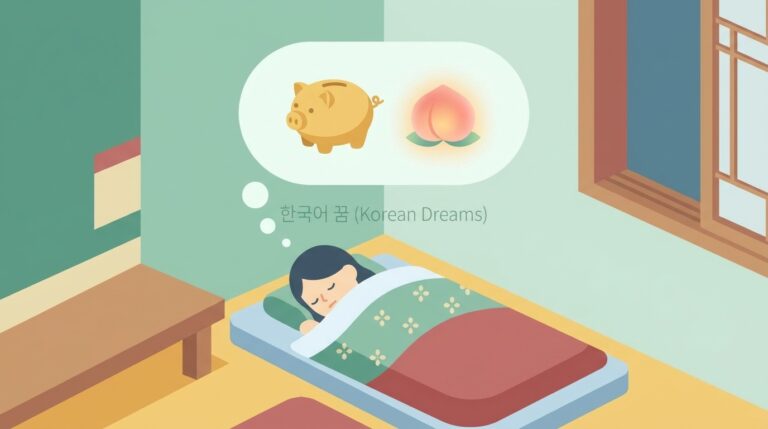
Phase 1: Empathy (The K-Culture Cold Open)
Hello! I’m the Lead Editor of Daily Hangul.
Imagine you’re watching a classic K-Drama. The heroine wakes up, gasps, and frantically searches her pockets for cash. She runs in her pajamas to the nearest convenience store and demands a lottery ticket. Why? Because a herd of little pigs just chased her in her sleep. Or picture this: you’re watching a K-Pop idol on a variety show, and the host asks, “What was your mother’s dream when she was pregnant with you?” The idol shyly replies, “A giant golden peach fell from the sky.”
If you’re from a Western culture, dreams are usually just random brain activity. Maybe you ate too much cheese before bed. But in Korea? Dreams are serious business. They can predict wealth, signal a new life, or serve as a spiritual warning. If you don’t know the cultural weight of dreams in Korea, you might just give away a million-dollar fortune by accident!
As a B2 learner, you already know how to talk about your daily life. Now, it’s time to dive into the mystical, deeply ingrained world of Korean fortune-telling and dream interpretation (해몽, haemong). Let’s decode the hidden messages of the Korean subconscious!
Phase 2: Core Expressions Deep Dive
1. 돼지꿈 꿨어 (I dreamt of pigs)
- Pronunciation: dwaejikkum kkwosseo [Sound-alike: “dweh-jee-kkoom kkwuh-sso” – ‘dwae’ sounds like the start of ‘dweller’, and make sure to tense the ‘kk’ in ‘kkum’ like you’re holding your breath for a split second.]
- Meaning: (Literal) I dreamt a pig dream. / (Real nuance) I had a dream that brings immense wealth or good luck.
- K-Culture Moment: In Korea, pigs symbolize wealth and fertility. If a Korean friend bursts into the group chat at 9 AM shouting “돼지꿈 꿨다!”, everyone will immediately tell them to buy a lotto ticket on the way home from work.
- Editor’s Insight: You don’t just “have” a dream in Korean; you “dream” a dream (꿈을 꾸다). This expression is always said with excitement, usually followed by a trip to the convenience store.
- Situation Spectrum:
- Casual friends: ✅ (야, 나 돼지꿈 꿨어!)
- Co-workers (Semi-formal): ✅ (대리님, 저 어제 돼지꿈 꿨어요.)
- Formal/Elders: ⚠️ (Use with polite form: 돼지꿈을 꾸었습니다, but usually keep it to peers).
- 🤔 Think About It: Why pigs? Historically in Korea, pigs were valuable livestock and a symbol of a rich household. Does your culture have an animal that strictly represents sudden financial luck?
2. 내 꿈 살래? (Do you want to buy my dream?)
- Pronunciation: nae kkum sallae? [Sound-alike: “neh kkoom sahl-leh?” – End with a playful rising intonation.]
- Meaning: (Literal) Will you buy my dream? / (Real nuance) I had a lucky dream, and I’ll transfer the luck to you for a small fee.
- K-Culture Moment: If you have an incredibly lucky dream but can’t be bothered to buy a lottery ticket, or if you want to wish someone well (like a friend taking an exam), you can “sell” your dream. They usually pay you a token amount, like 1,000 won or a cup of coffee, to officially transfer the spiritual copyright of the luck!
- Editor’s Insight: This is a fun, superstitious transaction. If you say this, expect your friend to toss you a coin and say, “Here, I bought it!”
- Situation Spectrum:
- Casual friends: ✅
- Co-workers (Semi-formal): ✅ (As a joke: 제 꿈 사실래요?)
- Formal/Elders: 🚫 (Do not try to sell things to your boss!)
- 🤔 Think About It: “Selling” a dream shows that Koreans view luck not just as a state of being, but as a transferable commodity. How does this reflect the highly transactional and communal nature of Korean society?
3. 혹시 태몽 아니야? (Could it be a conception dream?)
- Pronunciation: hoksi taemong aniya? [Sound-alike: “hok-shee teh-mong ah-nee-ya?” – ‘Tae’ sounds like ‘tech’ without the ‘ch’.]
- Meaning: (Literal) By any chance, is it a conception dream? / (Real nuance) Wait, did someone just get pregnant?
- K-Culture Moment: A female co-worker mentions she dreamt of a giant tiger picking a peach. Instantly, the office goes quiet. “Wait… are you pregnant? Or is your sister pregnant?” 태몽 (Taemong) is a dream foretelling the conception or birth of a child. It’s usually dreamt by the mother, but sometimes the father, grandmother, or even a close friend has it!
- Editor’s Insight: Taemong symbols are very specific: giant fruits (peaches, apples), majestic animals (tigers, dragons, giant carp), or shining jewels. Koreans love analyzing Taemong to predict the baby’s gender or future success.
- Situation Spectrum:
- Casual friends: ✅
- Co-workers (Semi-formal): ⚠️ (Be careful; asking if someone is pregnant can be sensitive in modern workplaces.)
- Formal/Elders: 🚫
- 🤔 Think About It: Why do Koreans place so much importance on the beginning of a life story before the baby is even born?
Phase 3: Textbook vs. Real Korean
[When you want to share a good dream]
* 📖 Textbook Korean: 저는 어젯밤에 아주 좋은 길몽을 꾸었습니다. (I had a very good, auspicious dream last night.)
* 🗣️ Real Korean: 아싸, 오늘 퇴근길에 로또 사야지! (Yes! I’m buying a lotto ticket on my way home!)
* 💡 Why the difference?: Modern Koreans skip the formal announcement of the dream type and jump straight to the action: buying a lottery ticket. It’s practical capitalism meeting ancient superstition.
[When a friend tells you a bad dream]
* 📖 Textbook Korean: 그것은 흉몽이니 조심하십시오. (That is a bad omen, so please be careful.)
* 🗣️ Real Korean: 헐, 꿈자리가 좀 사납네. 오늘 하루 조심해. (Whoa, the dream was a bit fierce/messy. Be careful today.)
* 💡 Why the difference?: “꿈자리가 사납다” (the place of the dream is fierce) is the most natural, idiomatic way to express that a dream left a lingering bad vibe.
Bottom Note: At the B2 level, start using idioms like “꿈자리가 사납다” instead of basic words like “나쁜 꿈” (bad dream). It instantly makes your Korean sound native and rich in cultural nuance.
Phase 4: Cultural Context — K-Culture Deep Dive
4-1. Non-verbal Cues: The Rule of Silence
If you have a 길몽 (Gilmong – lucky dream), do not talk about it in the morning! Korean superstition dictates that if you tell someone your good dream before noon, the luck will fly away (or the listener might steal it). Keep your mouth shut, buy your lottery ticket, and then brag about it. Conversely, if you have a 흉몽 (Hyungmong – bad dream), tell people immediately! Sharing a bad dream scatters the bad energy and breaks the curse.
4-2. The K-Pop Connection: Idol Taemong Lore
If you are deep into K-Pop fandoms, you’ve definitely heard of Taemong. It is a massive part of an idol’s lore. Fans compile lists of idols’ conception dreams because they often match the idol’s personality perfectly.
* Example: BTS Jungkook’s mother dreamt of rain turning into gold wherever it fell. Fans love this because he is the “Golden Maknae.”
* Fan Activity: In fan letters or on Weverse, fans sometimes playfully tell idols, “I had a dream about you! I think it’s a Taemong for your new album’s success!” (오빠, 저 어제 오빠 꿈 꿨어요! 이번 앨범 대박 날 태몽인가 봐요!)
Phase 5: Real-Life Roleplay Scenario
Setting: A Friday morning at the office pantry. You are getting coffee. Your close Korean colleague, Min-su (32, humorous and always looking for a get-rich-quick scheme), walks in looking tired but excited.
Characters:
– YOU: A foreign employee who has been working in Seoul for a year. You know a bit about Korean culture.
– Min-su: Your friendly Korean coworker.
Dialogue:
Min-su: 아, 어제 잠을 푹 못 잤더니 피곤하네요.
(a, eoje jameul puk mot jatdeoni pigonhaneyo.)
[Ah, I didn’t sleep well last night, so I’m tired.]
YOU: 왜요? 악몽이라도 꾸셨어요?
(waeyo? akmongirado kkusyeosseoyo?)
[Why? Did you have a nightmare or something?]
Min-su: (Looking around, whispering) 아니요… 사실 엄청난 돼지꿈을 꿨어요!
(aniyo… sasil eomcheongnan dwaejikkumeul kkwosseo-yo!)
[No… actually, I had an incredible pig dream!]
YOU: 헐! 진짜요? 황금 돼지였어요?
(heol! jinjjayo? hwanggeum dwaejiyeosseoyo?)
[Whoa! Really? Was it a golden pig?]
Min-su: 네! 제 품으로 막 달려오더라고요.
(ne! je pumeuro mak dallyeoodeoragoyo.)
[Yes! It came running right into my arms.]
🔀 Your Turn! How do you respond?
– A) “오, 축하해요. 좋은 하루 보내세요.” (Oh, congratulations. Have a good day.)
– B) “대박! 그 꿈 저한테 파세요! 제가 커피 쏠게요!” (Jackpot! Sell that dream to me! I’ll treat you to coffee!)
– C) “아, 혹시 부인께서 임신하신 거 아니에요? 태몽 같은데!” (Ah, isn’t your wife pregnant? Sounds like a conception dream!)✅ Best Choice: B — Reason: This shows you completely understand the cultural etiquette of “dream trading.” Min-su will be thrilled and might actually accept the coffee in exchange for the luck!
⚠️ Choice C Analysis: Pig dreams can be Taemong, but asking about pregnancy in the workplace can be overly personal unless you are incredibly close to his family. Choice A is too dry and ignores the cultural significance of the moment.
Min-su (If you chose B): 하하! 콜! 아이스 아메리카노 한 잔에 제 행운을 넘기죠!
(haha! kol! aiseu amerikano han jane je haenguneul neomgijo!)
[Haha! Deal! I’ll hand over my luck for an iced Americano!]
Phase 6: 10-Second Shadowing Drill
Read this out loud. Pay attention to the pauses (/) and the emotion tags!
😲 야! / 나 어젯밤에 / 돼~~~~지꿈 꿨어! / 오늘 당장 / 로또 사러 갈 거야!
(ya! / na eojetbame / dwae~~~~jikkum kkwosseo! / oneul dangjang / rotto sareo gal geoya!)
Translation: Hey! I had a piiiiig dream last night! I’m going to buy a lotto ticket right now today!
- Tip: Stretch out the ‘돼’ (dwae) to emphasize how big or amazing the pig was. Speak rapidly at the end with pure capitalistic excitement!
Phase 7: K-Culture Mini Dictionary
| 한국어 (Korean) | Romanization | English | Context & Usage |
|---|---|---|---|
| 해몽 | haemong | Dream interpretation | The act of analyzing a dream. There are professional haemong apps in Korea! |
| 길몽 | gilmong | Auspicious dream | A lucky dream (pigs, fire, excrement—yes, poop dreams mean money!). |
| 흉몽 | hyungmong | Bad omen dream | A dream warning of danger (losing teeth, dark water). |
| 로또 | rotto | Lottery / Lotto | The ultimate goal of a gilmong. In Korea, buying a lotto is a weekly ritual for many office workers. |
| 복권 | bokgwon | Lottery ticket | The formal word for lottery. “복권에 당첨되다” (to win the lottery). |
Phase 8: Traveler Survival Kit (Convenience Store Edition)
You bought someone’s dream, or you had a pig dream in your Seoul hotel. Now you need to buy a lottery ticket. Lotto tickets in Korea are sold at convenience stores (CU, GS25) that have a specific “Lotto 6/45” sign outside.
🆘 Survival Phrases for Buying a Lotto
– 🇰🇷 “로또 자동으로 오천 원어치 주세요.” (rotto jadongeuro ocheon woneochi juseyo.)
– 🗣️ English Guide: [Lotto ja-dong-eu-ro o-cheon won-uh-chi joo-se-yo.]
– 📍 Meaning: Please give me 5,000 won worth of auto-picked lotto tickets.
– 💡 Pro Tip: ‘자동’ (jadong) means automatic/quick-pick. If you want to pick your own numbers, say ‘수동’ (sudong) and fill out the paper slips provided at the counter.📌 Editor’s Travel Note
– Cash Only: You CANNOT buy a lottery ticket with a credit card in Korea. You must use physical cash.
– Age Limit: You must be 19 or older to purchase a ticket.
– Drawing Time: Drawings are held every Saturday night at 8:35 PM on MBC. The cutoff for buying tickets is 8:00 PM on Saturday!
Phase 9: Critical Thinking Corner — “한 발 더 깊이”
Modernity vs Tradition: Why do hyper-modern Koreans still check horoscopes and interpret dreams?
🧠 Think Deeper:
Korea is the land of 5G, AI, and cutting-edge technology. Yet, on New Year’s Day, servers for online fortune-telling (사주 – Saju) crash due to heavy traffic, and apps dedicated to dream interpretation have millions of downloads. Why? In a highly competitive, fast-paced society where success often feels like it depends on unpredictable variables (exams, housing markets, employment), traditional superstitions provide a sense of psychological comfort and control. Buying someone’s “pig dream” isn’t just about actually believing in magic; it’s a social bonding ritual. It’s a way of sharing hope and relieving stress with a laugh.💬 Your Turn: In your culture, do people turn to astrology, crystals, or superstitions when stressed? How do you view the blend of high-tech life and ancient superstitions? Share in the comments!
Phase 10: FAQ & Avoiding Mistakes
Q: “If I dream about poop, is that gross or good?”
A: It’s fantastic! In Korean dream interpretation, dreaming of stepping in poop or being covered in it (똥꿈) is on par with a pig dream. It guarantees financial luck. Do not wash it off in the dream!
Q: “Do all animals mean the same thing in a Taemong?”
A: Not exactly. Traditionally, people believed animals predicted the baby’s gender (e.g., Tigers/Dragons = boy, Peaches/Small fish = girl). However, nowadays, Koreans view these symbols as predicting the child’s personality or destiny rather than gender. A tiger means a strong leader, while a peach might mean someone loved by many (like a celebrity).
❌ Common Mistake #1: Telling your friends at breakfast, “I had an amazing dream about a pig!”
✅ How to fix it: Say nothing. Go to the convenience store. Buy a lotto ticket. Then at dinner, you can say, “Actually, I bought a lotto today because I had a pig dream!”
Phase 11: Summary & Action Items
- One-Liner Summary: In Korea, dreams aren’t just imagination—they are omens of wealth (돼지꿈) or new life (태몽) that can literally be bought and sold between friends!
-
Action Mission 3 Steps:
- 🥉 Bronze (Solo): Stand in front of the mirror and confidently declare, “내 꿈 살래?” (Do you want to buy my dream?)
- 🥈 Silver (Online): Look up your favorite K-Pop idol’s Taemong online and write it down in Korean in your study journal.
- 🥇 Gold (Real Life): The next time a Korean friend sighs about being tired from a weird dream, ask them: “혹시… 돼지꿈 꿨어요? 로또 사야 하는 거 아니에요?” (By any chance… did you dream of pigs? Shouldn’t you buy a lotto?)
Phase 12: Quiz — Interactive Challenge
1. Situational Judgment:
You just woke up from a dream where you fell into a giant vat of sparkling gold coins. What is the culturally correct first step in Korea?
A) Text your group chat immediately to brag.
B) Ignore it, dreams mean nothing.
C) Keep quiet, grab cash, and go buy a lottery ticket.
2. Fill in the Blank:
Friend: 나 어제 엄청 좋은 꿈 꿨어!
You: 대박! 그거 나한테 팔아. (____) 살래?
(Hint: “Do you want to sell your dream?”)
3. True or False — K-Culture Edition:
If your friend dreams of losing all their teeth, you should tell them to buy a lottery ticket immediately.
Click here for Answers!
1. C – Never share a lucky dream before you secure the luck (or buy the ticket)!
2. 내 꿈 (nae kkum sallae? Wait, the blank is for the friend asking. You should say: 내 꿈 말고, 네 꿈 살래? Actually, based on the lesson, the exact phrase is “네 꿈 나한테 팔래?” (Will you sell your dream to me?) or the friend would say “내 꿈 살래?” (Wanna buy my dream?).
3. False – Losing teeth is a classic 흉몽 (bad omen), usually associated with health issues or family problems. Tell them to be careful!
Frequently Asked Questions (FAQ)
Q: What does "돼지꿈 꿨어 (I dreamt of pigs)" mean in Korean and how do you pronounce it?
A: In Korean, "돼지꿈 꿨어 (I dreamt of pigs)" is pronounced [dwaejikkum kkwosseo [Sound-alike: "dweh-jee-kkoom kkwuh-sso" - 'dwae' sounds like the start of 'dweller', and make sure to tense the 'kk' in 'kkum' like you're holding your breath for a split second.] and means: (Literal) I dreamt a pig dream. / (Real nuance) I had a dream that brings immense wealth or good luck.
Q: What does "내 꿈 살래? (Do you want to buy my dream?)" mean in Korean and how do you pronounce it?
A: In Korean, "내 꿈 살래? (Do you want to buy my dream?)" is pronounced [nae kkum sallae? [Sound-alike: "neh kkoom sahl-leh?" - End with a playful rising intonation.] and means: (Literal) Will you buy my dream? / (Real nuance) I had a lucky dream, and I'll transfer the luck to you for a small fee.
Q: What does "혹시 태몽 아니야? (Could it be a conception dream?)" mean in Korean and how do you pronounce it?
A: In Korean, "혹시 태몽 아니야? (Could it be a conception dream?)" is pronounced [hoksi taemong aniya? [Sound-alike: "hok-shee teh-mong ah-nee-ya?" - 'Tae' sounds like 'tech' without the 'ch'.] and means: (Literal) By any chance, is it a conception dream? / (Real nuance) Wait, did someone just get pregnant?







