

Hello! I am the Lead Editor of Daily Hangul.
Phase 1: Empathy (Immersive Opening)
Picture a classic K-Drama scene. The female lead, wearing thick glasses, a messy bun, and an oversized tracksuit, sneaks out of her apartment late at night. She’s hauling a massive pile of crushed cardboard boxes, praying she won’t run into anyone. She thinks the coast is clear, but suddenly—whistle blows! 삐익! (Ppi-ik!)
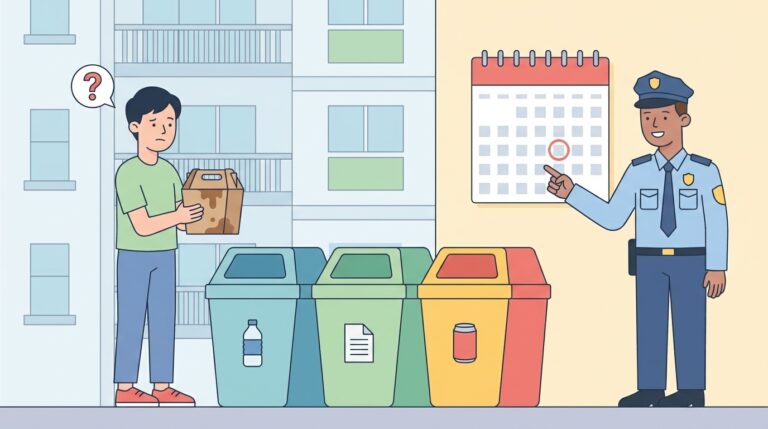
The strict apartment security guard appears out of nowhere, pointing sternly at the calendar on the wall. It’s Tuesday. And Tuesday, my friends, is not “Paper Day.”
If you’ve ever lived in Korea, stayed at an Airbnb in Seoul, or watched enough slice-of-life K-Dramas, you know that 분리수거 (bunrisugeo – recycling) in a Korean apartment is practically a competitive sport. Miss your designated recycling day, and you’ll be living with your smelly plastic bottles for another whole week. Worse? You might get a legendary scolding from the gyeongbi ajeossi (security guard).
Don’t worry! This guide is based on the real-life struggles (and tears) of our expat students. Today, we’ll teach you exactly how to navigate the strict Korean apartment recycling culture without sweating.
Phase 2: Core Expressions Deep Dive
1. 분리수거 하러 가요.
- Pronunciation: [Bun-ri-su-geo ha-reo ga-yo.]
(Tip: The ‘으 (eu)’ in ‘su-geo’ sounds like the disgusted grunt you make when you step in sticky gum: “Ugh!”)- Meaning: I’m going to take out the recycling.
- K-Culture Moment: You’ll hear this in K-Pop reality shows when idol group members are arguing over whose turn it is to do the dorm chores. “It’s the maknae’s turn to do bunrisugeo!”
- Editor’s Insight: Bunrisugeo literally means “separation and collection.” In Korea, you never just “take out the trash.” You separate it meticulously. This phrase is a great excuse when you need to quickly step out of a messy apartment!
- Situation Spectrum:
- Friends / Roommates (Casual): ✅ (분리수거 하러 갈게 – Bunrisugeo ha-reo galge)
- Acquaintances (Semi-formal): ✅
- Boss / Elders (Formal): ⚠️ (Not disrespectful, but you wouldn’t usually announce your chores to your boss!)
- 🤔 Think About It: Why does the Korean language have such a specific, clinical-sounding everyday word for recycling? How does it reflect the country’s rapid modernization and dense population?
2. 오늘 플라스틱 버리는 날이에요?
- Pronunciation: [O-neul peu-l-la-seu-tik beo-ri-neun na-ri-e-yo?]
- Meaning: Is today the day to throw away plastic?
- K-Culture Moment: Standing in the elevator with your neighbor, holding a bag of water bottles. You read the room (Nunchi), realize they aren’t holding plastic, and nervously ask this question to confirm before you embarrass yourself.
- Editor’s Insight: Because apartment complexes designate specific days for specific materials (e.g., Paper on Tuesdays, Plastics on Thursdays), this is a vital survival phrase. ‘버리는 날’ (throwing-away day) is much more natural than saying ‘recycling day’.
- Situation Spectrum:
- Friends (Casual): ✅ (오늘 플라스틱 버리는 날이야?)
- Security Guard / Neighbors (Semi-formal): ✅
- Formal/Public Announcements: 🚫 (They would use ‘배출일’ – discharge day)
- 🤔 Think About It: Notice how the subject “I” is completely dropped. Korean language relies heavily on context. Everyone knows who is throwing it away!
3. 종량제 봉투
- Pronunciation: [Jong-nyang-je bong-tu]
(Tip: ‘Jong’ rhymes with ‘song’, and ‘tu’ is like the English word ‘to’.)- Meaning: Volume-based garbage bag (General waste bag)
- K-Culture Moment: Convenience store scenes in K-Dramas! When characters buy a cheap bottle of Soju, they often ask the cashier to put it in a jongnyangje bongtu instead of a regular plastic bag, so they can use it for trash later.
- Editor’s Insight: You CANNOT throw general waste in a random grocery bag. It is illegal. You must buy these specific, color-coded municipal bags from the convenience store or supermarket.
- Situation Spectrum:
- Purchasing at a store: ✅ (종량제 봉투 20리터짜리 하나 주세요 – Please give me one 20-liter standard garbage bag.)
Phase 3: Textbook vs. Real Korean
[Situation 1: Asking the Security Guard about Trash Day]
* 📖 Textbook Korean: 플라스틱은 언제 배출합니까? (When do we discharge plastics?)
* 🗣️ Real Korean: 아저씨, 오늘 플라스틱 버려도 돼요? (Ajeossi, is it okay to throw away plastic today?)
* 💡 Why the difference?: Textbooks use administrative terms like ‘배출’ (discharge), but real people use the verb ‘버리다’ (to throw away) and soften the question with ‘~해도 돼요?’ (is it okay if I…).
[Situation 2: Scolding someone for mixing trash]
* 📖 Textbook Korean: 쓰레기를 혼합하여 버리면 안 됩니다. (You must not discard mixed garbage.)
* 🗣️ Real Korean: 에이, 이거 다 섞어서 버리면 어떡해요! 다 다시 하세요! (Hey, how can you throw this away all mixed up! Do it all over again!)
* 💡 Why the difference?: Koreans use emotional expressions like ‘어떡해요’ (What are we going to do!) when rules aren’t followed, emphasizing the collective frustration rather than just stating a cold rule.
Bottom Note: At the B1 (Lower-Intermediate) level, focus on mastering the verb “버리다” (to throw away) and “섞다” (to mix). These will save you in 90% of household conversations!
Phase 4: Cultural Context — K-Culture Deep Dive
4-1. Non-verbal cues: The Apologetic Bow
When (not if) you make a mistake and the security guard catches you putting an unwashed delivery container into the recycling bin, words aren’t enough. Do a quick 45-degree bow, look slightly embarrassed, and use both hands to take the container back. The famous Korean “Nunchi” (reading the room) is critical here—if the guard looks stressed, don’t argue. Just nod and fix it!
4-2. K-Food Connection: The Delivery App Aftermath
Korea is the undisputed king of food delivery (배달 – Baedal). Ordering late-night spicy Tteokbokki is amazing, but it creates a massive recycling challenge.
In Korea, you cannot simply toss a plastic container stained with red pepper sauce into the plastic bin. It will be rejected! You must wash away the red stains before recycling. This reflects a broader societal rule: your convenience (ordering food) shouldn’t become a burden for the community (the recycling plant workers). Next time you watch a K-Drama where characters eat delivery black bean noodles (Jajangmyeon), notice how they leave the bowls outside for the restaurant to pick up—a vintage form of recycling!
Phase 5: Practical Roleplay Scenario
Setting: Wednesday night, 9:00 PM. The dimly lit recycling area of your apartment complex. You’re exhausted from work and just want to throw away an Amazon cardboard box.
Characters:
* YOU: An expat who moved to Seoul 3 months ago. Still confused by the bins.
* Gyeongbi Ajeossi (경비 아저씨): The 60-year-old apartment security guard. Looks intimidating, but secretly feeds the neighborhood stray cats.
Dialogue:
YOU: (Tosses the box into a large cart) 후유, 끝났다. (Phew, done.)
Ajeossi: 🚨 잠깐만요! 학생! 거기 서봐요! (Wait a minute! Student! Stand right there!)
YOU: 네? 저요? 무슨 일이세요? (Yes? Me? What’s wrong?)
Ajeossi: 오늘 종이 버리는 날 아니잖아요. 화요일에 버려야지. (Today isn’t paper throwing day. You should throw it on Tuesday.)
YOU: 헉, 진짜요? 오늘 수요일인데요… (Gasp, really? Today is Wednesday though…)
Ajeossi: 수요일은 비닐이랑 페트병 버리는 날이에요. 그리고 박스에 테이프 다 뜯었어요? (Wednesday is the day for vinyl and PET bottles. And did you rip all the tape off the box?)
YOU: 아… 테이프도 뜯어야 해요? (Ah… Do I have to rip the tape off too?)
Ajeossi: 당연하죠! 테이프 붙어있으면 재활용 안 돼요. (Of course! If the tape is attached, it can’t be recycled.)
🔀 Your Turn! How do you respond?
– A) “아, 몰랐어요. 내일 버릴게요.” (Oh, I didn’t know. I’ll throw it away tomorrow.)
– B) “죄송합니다! 제가 외국인이라서 잘 몰랐어요. 지금 당장 테이프 뜯을게요!” (I’m sorry! I’m a foreigner so I didn’t know well. I’ll rip the tape off right now!)
– C) “아저씨, 그냥 한 번만 봐주세요~” (Ajeossi, please just let it slide this once~)✅ Best Choice: B — Honesty + immediate action! Admitting you didn’t know because you’re a foreigner while showing a willingness to fix it instantly melts the Ajeossi’s strict exterior.
⚠️ Choice C Analysis: Asking to “let it slide” (봐주세요) is common in K-Dramas, but doing it to an elder when you’ve broken a community rule might make you look disrespectful.
Ajeossi: (Sighs softly) 에휴, 다음부터는 테이프 꼭 뜯고 화요일에 버려요. 오늘은 그냥 놓고 가요. (Sigh, from next time make sure to rip off the tape and throw it on Tuesday. Just leave it today and go.)
YOU: 우와, 감사합니다! 안녕히 계세요! (Wow, thank you! Goodbye!)
Phase 6: 10-Second Shadowing Drill
Repeat this magical “get out of jail” card out loud. Follow the pauses (/) for natural pacing!
🥺 죄송해요, / 제가 / 한국 분리수거가 / 처음이라서요.
(Joe-song-hae-yo, / je-ga / han-guk bun-ri-su-geo-ga / cheo-eu-mi-ra-seo-yo.)
“I’m sorry, it’s my first time with Korean recycling.”
Phase 7: K-Culture Mini Dictionary
| Korean Word | Romanization | English | Cultural Context |
|---|---|---|---|
| 분리수거 | bunrisugeo | Recycling | The strict act of separating waste. A major part of Korean civic duty. |
| 경비 아저씨 | gyeongbi ajeossi | Security Guard | Often older men who manage apartment facilities. They are the absolute bosses of the recycling area. |
| 종량제 봉투 | jongnyangje bongtu | Standard Trash Bag | You must buy these at local stores for general waste. Different districts have different colors! |
| 음식물 쓰레기 | eumsikmul sseuregi | Food Waste | Handled separately from general waste. Often requires a specific bag or an RFID chipped bin. |
| 눈치 | nunchi | Social awareness | Reading the atmosphere. Essential when figuring out if the recycling bins are open. |
Phase 8: Traveler’s Survival Kit
Even if you’re just visiting Seoul and staying in an Airbnb, you must manage your trash. Hosts will definitely leave instructions about this!
🆘 Survival Phrases for Airbnb Guests
– 🇰🇷 “일반 쓰레기는 어디에 버려요?” (Il-ban sseu-re-gi-neun eo-di-e beo-ryeo-yo?)
– 🗣️ Meaning: Where do I throw away general waste?
– 📍 Useful for: Messaging your Airbnb host or asking the building manager.
– 💡 Pro Tip: Never mix food waste with regular trash in your Airbnb. It will smell, and your host might charge a penalty!📌 Editor’s Travel Note
– Where to buy bags? Any convenience store (CU, GS25, 7-Eleven). Just say “종량제 봉투 10리터 주세요” (Please give me a 10L general waste bag).
– Location matters: A trash bag bought in Gangnam-gu cannot be used in Mapo-gu! Buy bags in the specific district you are staying in.
Phase 9: Critical Thinking Corner — “One Step Deeper”
Language & Power: The “We” over “Me” Culture
Have you noticed how strict the recycling rules are in Korea? It’s not just about environmentalism; it deeply reflects Korean society’s communal mindset. In a small country with a dense population (especially in high-rise apartments), individual convenience must yield to collective harmony. When the security guard scolds you for not washing a plastic container, he’s enforcing the “We” mindset. The language reflects this too: Koreans rarely say “my apartment,” they say “우리 아파트” (our apartment).
💬 Your Turn:
How strict is recycling in your home country? Is it treated as a personal choice or a strict community law? Share in the comments!
Phase 10: FAQ & Preventing Misunderstandings
Q: Can I just put my trash in a random black plastic bag and leave it outside?
NO! This is called 무단투기 (illegal dumping). CCTV cameras are everywhere, and you will get fined heavily. Always use the jongnyangje bongtu.
Q: What do I do with pizza boxes?
Pizza boxes are cardboard, right? Yes, BUT if they have oil or cheese stains on them, they cannot be recycled as paper. Tear off the clean parts for recycling, and throw the greasy parts into the standard trash bag.
❌ Common Mistake #1: Leaving shipping tape on Amazon/Coupang boxes.
✅ How to fix it: You must remove all tape and shipping labels before flattening the box for recycling.❌ Common Mistake #2: Throwing chicken bones into Food Waste.
✅ How to fix it: Surprisingly, chicken bones, onion peels, and eggshells are considered GENERAL WASTE (일반 쓰레기), not food waste, because animals cannot easily digest them!
Phase 11: Summary & Action Items
One-Liner Summary: In Korea, recycling (분리수거) is a strict community duty tied to specific days, and knowing how to ask about it will save you from the wrath of the security guard!
Action Mission:
– 🥉 Bronze (Solo): Look at a plastic bottle in your room and say “플라스틱 버리는 날” out loud 3 times.
– 🥈 Silver (Online): Check a Seoul Airbnb listing online and look for the “Rules” section to see if they mention garbage separation.
– 🥇 Gold (Real Life): Go to a Korean convenience store and buy a “종량제 봉투” (jongnyangje bongtu) in Korean!
K-Culture Mission:
Next time you watch a modern K-Drama, pay attention to the background when characters are walking outside their apartments. Can you spot the colorful recycling bins?
Did you ever get confused by the Korean trash system? Drop your funny or frustrating stories in the comments below! 👇
Phase 12: Quiz — Interactive Challenge
1. Situational Judgment:
You just finished eating delivery Tteokbokki. The plastic container is stained bright red. What is the correct action?
* A) Throw it directly into the plastic recycling bin.
* B) Wash the red stains out completely with soap and water, then recycle it.
* C) Hide it under the sofa.
2. True or False – K-Culture Edition:
* Chicken bones go into the food waste (음식물 쓰레기) bin. (T / F)
3. Fill in the Blank:
* 아저씨, 오늘 플라스틱 ( _______ ) 날이에요?
* A) 사는 (buying)
* B) 버리는 (throwing away)
* C) 먹는 (eating)
(Answers: 1: B, 2: False – they go to general waste, 3: B)
Frequently Asked Questions (FAQ)
Q: What does "분리수거 하러 가요." mean in Korean and how do you pronounce it?
A: In Korean, "분리수거 하러 가요." is pronounced [Bun-ri-su-geo ha-reo ga-yo.] and means: I'm going to take out the recycling.
Q: What does "오늘 플라스틱 버리는 날이에요?" mean in Korean and how do you pronounce it?
A: In Korean, "오늘 플라스틱 버리는 날이에요?" is pronounced [O-neul peu-l-la-seu-tik beo-ri-neun na-ri-e-yo?] and means: Is today the day to throw away plastic?
Q: What does "종량제 봉투" mean in Korean and how do you pronounce it?
A: In Korean, "종량제 봉투" is pronounced [Jong-nyang-je bong-tu] and means: Volume-based garbage bag (General waste bag)







