

Phase 1: Empathy & The K-Culture Cold Open
Hello! I am the Lead Editor of Daily Hangul.
Imagine this: You are watching a K-Drama. A glamorous chaebol (conglomerate) mother is strolling through a sparkling, luxurious department store in Seoul, looking effortlessly chic. But as a parent visiting Korea, you might be wondering… “What happens when the baby starts crying? Where do they go?!”
If you are traveling in Korea with a baby, you might find yourself in the middle of a crowded mall like The Hyundai Seoul or Starfield, carrying a heavy diaper bag, and suddenly needing a quiet place for your little one. The panic sets in. You look around, but everything is in Korean. You need to ask someone, but your mind goes blank.
Don’t worry! This guide is created exactly for those “real-life survival” moments. By knowing just a few magical phrases, you won’t just find a nursing room—you will unlock access to Korea’s ultra-premium “Infant Lounges” (유아휴게실), which are so luxurious they feel like VIP hotel rooms!
Let’s learn how to ask for these essential facilities like a pro.
Phase 2: Core Expressions Deep Dive
At the A1 (Beginner) level, you don’t need complicated grammar. Just remember the magic formula: [Noun] + 어디에요? (eodieyo?) = Where is [Noun]?
1. 수유실 어디에요?
- Pronunciation: suyusil eodieyo? [Soo-yoo-shil uh-dee-eh-yo?]
- Meaning: Where is the nursing room?
- K-Culture Moment: You will often see the word “수유실” (suyusil) with a baby bottle icon on mall maps. However, in modern mega-malls, they often use the term “유아휴게실” (Infant Lounge). If you say “suyusil,” every staff member will immediately know what you mean and guide you there.
- Editor’s Insight: The word “어디에요?” (eodieyo?) is your best friend in Korea. Just point, look slightly urgent, and say this. It’s polite but direct enough for emergencies.
- Situation Spectrum:
- Casual (Friends): ☑️
- Semi-formal (Store Staff): ☑️ (Perfect!)
- Formal (Boss/Elders): ⚠️ (Add “실례하지만…” – Excuse me… before it)
- 🤔 Think About It: Why do Koreans use such a direct question structure (Noun + Where is it?) instead of a long, polite “Could you please tell me where…”? How does this reflect the “Pali-Pali” (Hurry-Hurry) culture of Korea?
2. 기저귀 갈 데 있어요?
- Pronunciation: gijeogwi gal de isseoyo? [Gee-juh-gwee gal deh iss-uh-yo?]
- Meaning: Is there a place to change diapers?
- K-Culture Moment: You are in a smaller cafe in Hongdae. There is no official “nursing room,” but you just need a safe spot to change a diaper. Asking this shows you are being considerate of the cafe space.
- Editor’s Insight: “기저귀” means diaper. “있어요?” means “Do you have / Is there?” It’s a lifesaver when you aren’t sure if a facility even exists.
- Situation Spectrum:
- Casual: ☑️
- Semi-formal: ☑️
- Formal: 🚫
- 🤔 Think About It: Koreans highly value keeping public eating areas clean. Asking this question before doing something in a public space shows great Nunchi (social awareness). Do you have a similar etiquette in your culture?
3. 엘리베이터 어디에요?
- Pronunciation: ellibeiteo eodieyo? [El-lee-bay-ee-tuh uh-dee-eh-yo?]
- Meaning: Where is the elevator?
- K-Culture Moment: Subway stations in Seoul are massive, often going 4 or 5 levels deep! If you have a “유모차” (yumocha – stroller), you cannot use the escalator. Finding the elevator is your top priority.
- Editor’s Insight: The pronunciation is basically the English word “elevator,” but spoken with a Korean accent. Break it down into flat syllables!
- Situation Spectrum:
- Casual: ☑️
- Semi-formal: ☑️
- Formal: ☑️
- 🤔 Think About It: Korea has adopted many English words (Konglish) for modern facilities. What other facility names do you think sound like English?
Phase 3: Textbook vs. Real Korean
Let’s see how the language transforms from the textbook to real life when you are in a rush!
[Situation 1: Asking for a location]
* 📖 Textbook Korean: 수유실이 어디에 있습니까? (suyusiri eodie itseumnikka?) – Very formal and robotic.
* 🗣️ Real Korean: 수유실 어디에요? (suyusil eodieyo?)
* 💡 Why is it different?: In spoken Korean, especially when people are busy, particles like “이” (subject marker) and “에” (location marker) are completely dropped for efficiency.
[Situation 2: Grabbing someone’s attention for help]
* 📖 Textbook Korean: 실례합니다. (sillyehamnida) – Excuse me (formal).
* 🗣️ Real Korean: 저기요! (jeogiyo!) – Over there! / Excuse me!
* 💡 Why is it different?: “저기요” is the universal “Excuse me” used to call staff in restaurants, stores, or on the street. It’s direct, practical, and gets immediate results.
Bottom Note: For A1 learners, don’t worry about complex markers! Just say the noun you need, followed by “어디에요?”
Phase 4: Cultural Context — K-Culture Deep Dive
4-1. Non-verbal Elements: The Art of Asking
When asking for a nursing room, body language matters. If you make a slightly apologetic face (because your baby might be crying) and hold one hand up slightly while making eye contact with a staff member, they will instantly recognize your urgency. Korean society is very sympathetic to mothers with babies.
4-2. K-Travel Connection: The Luxury of “Infant Lounges”
If you visit major Korean department stores (Lotte, Shinsegae, Hyundai) or large shopping malls, prepare to be amazed. They don’t just have “nursing rooms.” They have 유아휴게실 (Infant Lounges).
These lounges are practically spas for babies. They feature:
– Private nursing booths with cozy armchairs.
– Bottle sterilizers and premium water purifiers for formula.
– Microwaves for baby food.
– Diaper changing stations with special baby body wash and lotion.
– Sleeping rooms with cribs!
Knowing the phrase “수유실 어디에요?” is your golden ticket to finding these incredible, free-to-use oases in the middle of a chaotic shopping day.
Phase 5: Real-Life Roleplay Scenario
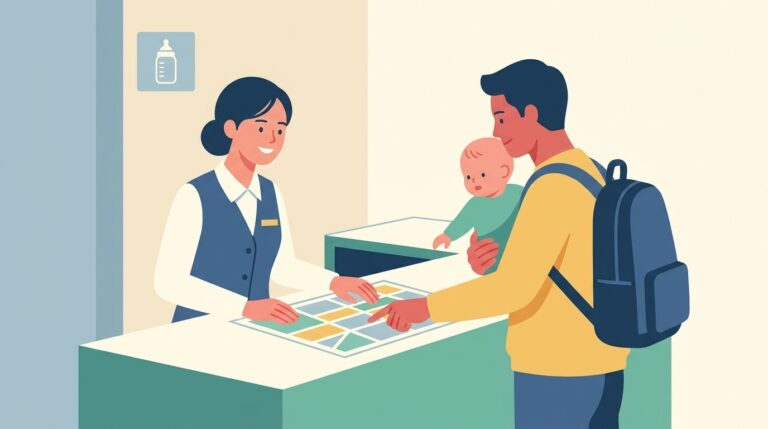
Setting: Saturday afternoon at The Hyundai Seoul in Yeouido. It is packed with people taking photos and shopping. Your baby just woke up and needs milk immediately. You spot an Information Desk.
Characters:
– YOU: A tourist parent who knows just a little bit of Korean.
– Jimin (25): The friendly Information Desk staff member wearing a neat uniform.
Dialogue:
YOU: 저기요!
(jeogiyo!)
[Excuse me!]
(Stage Direction: You approach the desk looking a bit flustered, pointing to your baby)
Jimin: 네, 고객님. 무엇을 도와드릴까요?
(ne, gogaengnim. mueoseul dowadeurilkkayo?)
[Yes, customer. How can I help you?]
YOU: 아… 수유실 어디에요?
(a… suyusil eodieyo?)
[Ah… where is the nursing room?]
Jimin: 아, 유아휴게실이요! 5층에 있습니다.
(a, yuahyugesiriyo! o-cheunge itseumnida.)
[Ah, the infant lounge! It is on the 5th floor.]
YOU: 5층이요?
(o-cheung-iyo?)
[The 5th floor?]
Jimin: 네, 저쪽 엘리베이터를 타세요.
(ne, jeojjok ellibeiteoreul taseyo.)
[Yes, please take the elevator over there.]
(Stage Direction: Jimin points towards a glass elevator)
YOU: 엘리베이터… 아, 네!
(ellibeiteo… a, ne!)
[Elevator… ah, yes!]
Jimin: 유모차 조심해서 가세요~
(yumocha josimhaeseo gaseyo~)
[Please be careful with the stroller~]
🔀 Your Turn! How should you respond to say thank you?
– A) “안녕히 계세요!” (Goodbye!)
– B) “감사합니다!” (Thank you!)
– C) “대박!” (Awesome!)✅ Best Choice: B — It’s the most natural and polite way to thank service staff.
⚠️ Choice C Analysis: “대박” is slang. It’s funny, but not appropriate to say to professional department store staff who just helped you!
Phase 6: 10-Second Shadowing Drill
Practice these sentences out loud. Pay attention to the pauses (/) and the emotions!
- 😢 (Urgently) 저기요! / 수유실 / 어디에요?
(jeogiyo! / suyusil / eodieyo?) - 🥺 (Politely) 기저귀 갈 데 / 있어요?
(gijeogwi gal de / isseoyo?) - 😊 (Relieved) 아! / 엘리베이터 / 저기 있네요!
(a! / ellibeiteo / jeogi inneyo! – Ah! The elevator is over there!)
Phase 7: K-Culture Mini Dictionary
| Korean | Romanization | English | Context |
|---|---|---|---|
| 수유실 | suyusil | Nursing Room | The standard word for a nursing room. |
| 유아휴게실 | yuahyugesil | Infant Lounge | The premium baby lounges found in big malls. |
| 기저귀 | gijeogwi | Diaper | Essential baby item! |
| 유모차 | yumocha | Stroller / Pram | You will need to look for elevators if you have this. |
| 몇 층 | myeot cheung | Which floor | Helpful when looking at a mall directory. |
Phase 8: Traveler Survival Kit
If you are traveling with a baby, these phrases are your lifesavers!
🆘 Survival Phrases for Parents
– 🇰🇷 “화장실 어디에요?” (hwajangsil eodieyo?) – Where is the restroom?
– 🇰🇷 “따뜻한 물 좀 주세요.” (ttatteutan mul jom juseyo) – Please give me some warm water. (Useful for mixing baby formula at a cafe!).
– 🇰🇷 “아기 의자 있어요?” (agi uija isseoyo?) – Do you have a high chair?📌 Editor’s Travel Note
– Useful Apps: Download Naver Map or Kakao Map. You can actually type “수유실” in English letters or Hangul to find nearby facilities!
– Mall Apps: Huge malls like Lotte or Shinsegae have apps. Usually, the infant lounge is located on the same floor as children’s clothing and toys.
– Men in the Lounge?: Dads are usually welcome in the main “Infant Lounge” area to feed babies or change diapers. However, the private nursing booths (수유실) inside the lounge are strictly for moms only.
Phase 9: Critical Thinking — “One Step Deeper”
Media vs Reality: The “No Kids Zone” vs. “Family Paradise”
🫠 Think Deeper:
If you look closely at modern Korea, you’ll notice an interesting contrast. On one hand, many trendy, aesthetic cafes in places like Seongsu-dong have a “No Kids Zone” (노키즈존) policy to maintain a quiet atmosphere for adults.
However, to counter this, massive shopping complexes and department stores are investing millions to create ultra-premium “Family Lounges” to attract families. It shows how Korean space is becoming highly categorized: spaces exclusively for quiet adults, and spaces aggressively catering to families with incredible convenience.💬 Your Turn: How are public spaces divided in your country? Do you have “No Kids Zones” or premium family lounges? Share your thoughts in the comments!
Phase 10: FAQ & Avoiding Misunderstandings
Q: Can I just ask anyone on the street “수유실 어디에요?”
A: Yes! But if you are asking an older person, it is polite to add “실례합니다” (Excuse me) first.
Q: Are nursing rooms common in subway stations?
A: Major transfer stations in Seoul have them! Look for the baby bottle icon on the station map. If you can’t find it, ask the station attendant.
❌ Common Mistake #1: Saying “수유실” (Nursing room) to a taxi driver.
✅ Do this instead: A taxi driver won’t know where a specific nursing room is. You need to ask to go to a department store (백화점 – baekhwajeom) or a big mart (마트 – mateu) first, and then find the facility inside.
Phase 11: Summary & Action Items
One-Liner Summary: Remember the golden rule: [수유실 / 유모차 / 엘리베이터] + 어디에요? (Where is…?)
Action Mission 3 Steps:
– 🥉 Bronze (Solo): Stand in front of a mirror and ask “수유실 어디에요?” 3 times with an urgent but polite face.
– 🥈 Silver (Online): Go to YouTube and search “더현대서울 유아휴게실” (The Hyundai Seoul Infant Lounge) to see how amazing Korean baby lounges are.
– 🥇 Gold (Real Life): Next time you are in a Korean mall or airport, ask the information desk for the elevator using “엘리베이터 어디에요?”
K-Culture Mission:
Watch an episode of the Korean reality show “The Return of Superman” (슈퍼맨이 돌아왔다). It’s a show about celebrity dads taking care of their kids. You will see exactly how Koreans navigate public spaces, cafes, and restaurants with babies!
Did you know Korean baby lounges had microwaves and bottle sterilizers? Let us know what surprised you the most in the comments below!
Phase 12: Quiz — Interactive Challenge
1. Situational Judgment: You are in a massive Korean mall. Your baby needs a diaper change. You see a staff member. What is the most natural thing to say?
– A) 엘리베이터 어디에요?
– B) 저기요! 수유실 어디에요?
– C) 실례합니다. 화장실이 어디에 있습니까?
2. Fill in the Blank:
You have a stroller (유모차) and need to go to the 5th floor. You cannot use the escalator. You ask:
“[________] 어디에요?”
3. True or False — K-Culture Edition:
Fathers are allowed inside the private nursing booths (수유실) to feed their babies.
4. Roleplay Outcome:
In a cafe, you politely ask the owner, “기저귀 갈 데 있어요?” (Is there a place to change diapers?). The owner says “아니요” (No). What should you do next?
– A) Change the diaper on the cafe table anyway.
– B) Ask “화장실 어디에요?” (Where is the restroom?) and change it there.
(Answers: 1. B, 2. 엘리베이터, 3. False – Dads can enter the main lounge but not the private nursing booths, 4. B)
Frequently Asked Questions (FAQ)
Q: What does "수유실 어디에요?" mean in Korean and how do you pronounce it?
A: In Korean, "수유실 어디에요?" is pronounced [suyusil eodieyo? [Soo-yoo-shil uh-dee-eh-yo?] and means: Where is the nursing room?
Q: What does "기저귀 갈 데 있어요?" mean in Korean and how do you pronounce it?
A: In Korean, "기저귀 갈 데 있어요?" is pronounced [gijeogwi gal de isseoyo? [Gee-juh-gwee gal deh iss-uh-yo?] and means: Is there a place to change diapers?
Q: What does "엘리베이터 어디에요?" mean in Korean and how do you pronounce it?
A: In Korean, "엘리베이터 어디에요?" is pronounced [ellibeiteo eodieyo? [El-lee-bay-ee-tuh uh-dee-eh-yo?] and means: Where is the elevator?







